Will AI replace animal control workers?

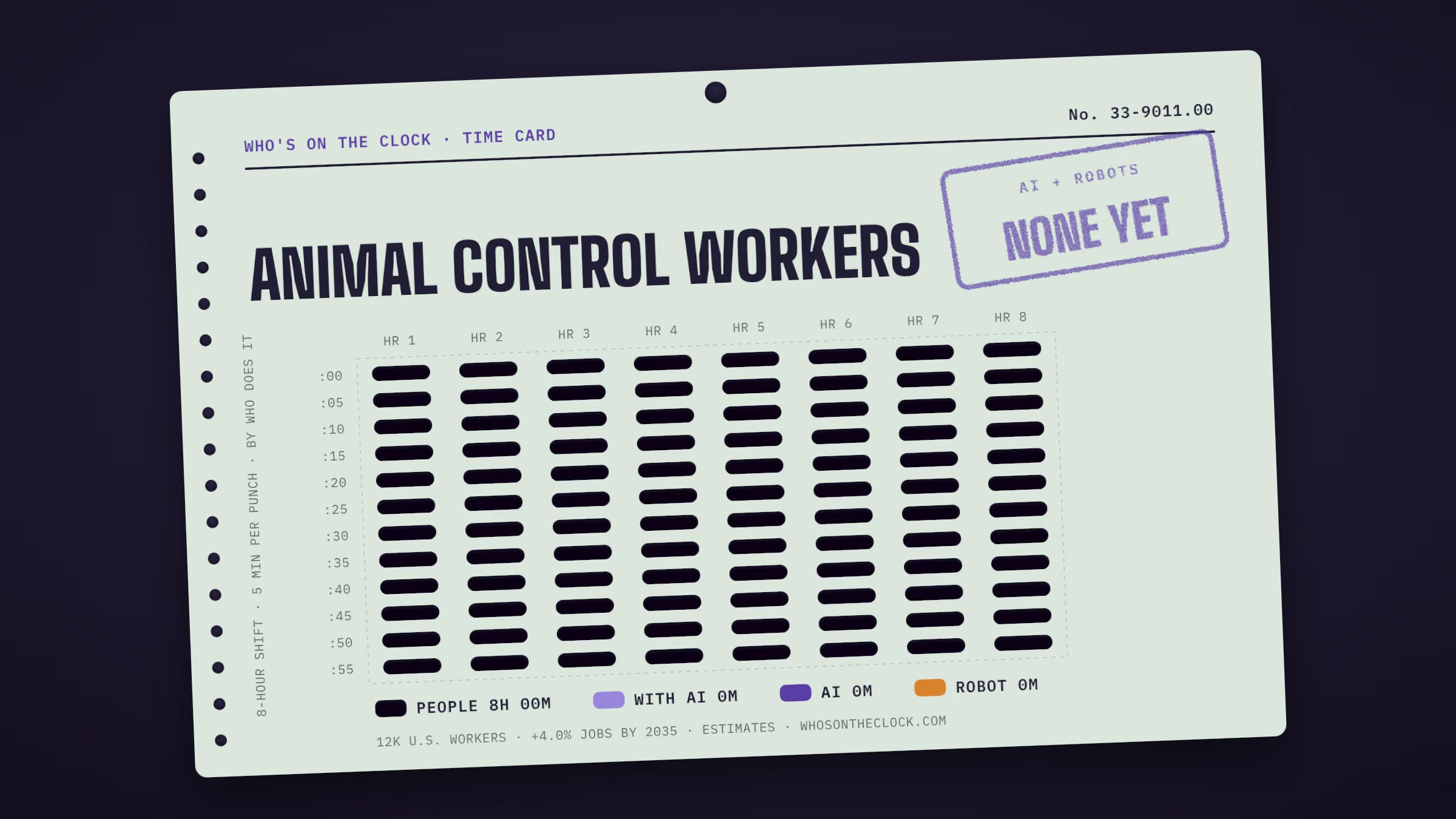
The biggest part of the day, “Capture and remove stray, uncontrolled”, is still entirely people's work, and so is every other task we checked: no AI use or robot deployment shows up for any of them yet. That reflects today's evidence and could change. BLS expects about 4% more of these jobs by 2035.

Time card for animal control workers showing a typical 8-hour shift: 8h done by people.
Each mark is 5 minutes of a typical shift for animal control workers, colored by who does that task today. Estimates from O*NET tasks and Anthropic Economic Index data. How it's made

Home / Protective services / Animal Control Workers

Handle animals for the purpose of investigations of mistreatment, or control of abandoned, dangerous, or unattended animals.

Time card

Untick tasks you don't do, or set your own times.
MineTask, by time spentHumanWith AIAIRobot
Capture and remove stray, uncontrolled, or abused animals from undesirable conditions, using nets, nooses, or tranquilizer darts as necessary.1h 18m a shift · No AI or robot evidence found
Why this label?This is physical work, and no robot has been shown doing it yet. How labels work
Investigate reports of animal attacks or animal cruelty, interviewing witnesses, collecting evidence, and writing reports.1h 6m a shift · No AI or robot evidence found
Why this label?This is physical work, and no robot has been shown doing it yet. How labels work
Write reports of activities, and maintain files of impoundments and dispositions of animals.54m a shift · No AI or robot evidence found
Why this label?No AI use or robot deployment showed up for this task in our data. That isn't proof it's safe; it may just be rare in the data. How labels work
Supply animals with food, water, and personal care.42m a shift · Robots only in factory cells
Why this label?Robots have done this only in factory setups built around the machine, so it stays Human for animal control workers. How labels work
Clean facilities and equipment such as dog pens and animal control trucks.42m a shift · Robots only in factory cells
Why this label?Robots have done this only in factory setups built around the machine, so it stays Human for animal control workers. How labels work
Answer inquiries from the public concerning animal control operations.30m a shift · No AI or robot evidence found
Why this label?No AI use or robot deployment showed up for this task in our data. That isn't proof it's safe; it may just be rare in the data. How labels work
Examine animals for injuries or malnutrition, and arrange for any necessary medical treatment.24m a shift · No AI or robot evidence found
Why this label?This is physical work, and no robot has been shown doing it yet. How labels work
Educate the public about animal welfare, and animal control laws and regulations.24m a shift · No AI or robot evidence found
Why this label?No AI use or robot deployment showed up for this task in our data. That isn't proof it's safe; it may just be rare in the data. How labels work
Contact animal owners to inform them that their pets are at animal holding facilities.18m a shift · No AI or robot evidence found
Why this label?No AI use or robot deployment showed up for this task in our data. That isn't proof it's safe; it may just be rare in the data. How labels work
Remove captured animals from animal-control service vehicles and place animals in shelter cages or other enclosures.18m a shift · No AI or robot evidence found
Why this label?This is physical work, and no robot has been shown doing it yet. How labels work
Prepare for prosecutions related to animal treatment, and give evidence in court.18m a shift · No AI or robot evidence found
Why this label?No AI use or robot deployment showed up for this task in our data. That isn't proof it's safe; it may just be rare in the data. How labels work
Issue warnings or citations in connection with animal-related offenses, or contact police to report violations and request arrests.18m a shift · No AI or robot evidence found
Why this label?No AI use or robot deployment showed up for this task in our data. That isn't proof it's safe; it may just be rare in the data. How labels work
Organize the adoption of unclaimed animals.18m a shift · No AI or robot evidence found
Why this label?This is physical work, and no robot has been shown doing it yet. How labels work
Examine animal licenses, and inspect establishments housing animals for compliance with laws.18m a shift · No AI or robot evidence found
Why this label?This is physical work, and no robot has been shown doing it yet. How labels work
Euthanize rabid, unclaimed, or severely injured animals.12m a shift · No AI or robot evidence found
Why this label?This is physical work, and no robot has been shown doing it yet. How labels work
Train police officers in dog handling and training techniques for tracking, crowd control, and narcotics and bomb detection.time not estimated · No AI or robot evidence found
Why this label?No AI use or robot deployment showed up for this task in our data. That isn't proof it's safe; it may just be rare in the data. How labels work

Clock history

  1. 0m touchedFirst published: O*NET 30.1, Anthropic Economic Index (2025 usage and September 2026 robot study), BLS May 2025

When new data changes this clock, the date, the new numbers and the reason are logged here. Company news alone never moves the clock.

On the floor

No company news tracked for this job yet. New stories are added as they happen.

Ask the clock

Will AI replace animal control workers?

Not on current evidence. Less than 30 minutes of a typical shift goes to tasks that AI or robots are doing today. The other 8h (100%) stays with people. Separately, BLS expects about 4% more of these jobs by 2035 (all jobs: +3.5%).

What can AI already do for animal control workers?

None of this job's tasks show regular AI use yet. That can mean the work is hands-on or in person, or simply that it rarely comes up in AI usage data.

Where do robots fit in?

Not in workplaces like this one, based on a 2026 review of robot deployments. 2 more tasks have only been done in factory setups built around the machine, so they stay with people here. For 7 physical tasks, no robot has shown it can do the work yet.

What still needs a person?

8h of a typical shift, or 100%, goes to tasks with no AI or robot evidence yet. No AI usage or robot deployment has shown up for these so far. The biggest:

  • Capture and remove stray, uncontrolled, or abused animals from undesirable conditions, using nets, nooses, or tranquilizer darts as necessary. (1h 18m a shift)
  • Investigate reports of animal attacks or animal cruelty, interviewing witnesses, collecting evidence, and writing reports. (1h 6m a shift)
  • Write reports of activities, and maintain files of impoundments and dispositions of animals. (54m a shift)
  • Supply animals with food, water, and personal care. (42m a shift)
  • Clean facilities and equipment such as dog pens and animal control trucks. (42m a shift)
Why is that work hard to automate?

Much of it comes down to where and how the work happens. In-person, hands-on and high-stakes work is where AI and robots have made the least headway so far. In the official O*NET survey of people in this job:

  • 96% say dealing with the public is very or extremely important
  • 92% work outdoors in all weather every day
  • 88% handle conflict at least once a week
Are employers still hiring animal control workers?

On Indeed, job postings in the Security & Public Safety sector are at 119% of their February 2020 level (all U.S. postings: 104%), up 4.4% from a year earlier, as of Oct 9, 2026. BLS separately expects about 1,500 openings a year in this job through 2035. Across all U.S. postings, 7.3% now mention AI skills. Sector postings cover more than this one job and move for many reasons besides AI.

How much do animal control workers make?

The median pay is about $45,660 a year ($21.95 an hour), 10% below the median for all U.S. jobs ($50,980). Most people in this job earn between $33,090 and $68,070 a year; that range covers the middle 80%. Pay figures are from BLS, May 2025, and vary a lot by state and employer. Pick a state to compare:

Is this job growing or shrinking?

BLS projects growth of 4% from 2025 to 2035, compared with 3.5% growth for all jobs. That's about 14,000 jobs in 2035. It expects about 1,500 openings a year, mostly from people retiring or changing careers. These projections don't single out AI as a cause.

How many animal control workers are there in the U.S.?

About 12,000 people in the U.S., roughly 0.01% of all workers (BLS, May 2025). That makes it the 642nd largest of the 796 jobs on this site. BLS expects about 14,000 in 2035.

What training do animal control workers need?

The most common requirement is a high school diploma: about 65% of people in the job said so in the official O*NET survey. O*NET rates the job at level 2 of 5 for preparation, which usually means: high school diploma, some training. Requirements vary by state and employer, especially for licensed work.

What should I learn to stay ahead of AI?

These come from the job's official skill ratings and from the tasks that AI and robots touch least today. Building them keeps you strong in the parts of the work that still need a person:

  • Skills that matter more here than in most jobs: Active Listening, Speaking, Service Orientation, Critical Thinking
  • Get strong at the parts of the job that stay with people (listed above), which take 8h of a typical shift
  • Tools employers list: Microsoft Office software, Microsoft Excel, Microsoft Access, Microsoft Outlook, Microsoft PowerPoint
What new tasks are animal control workers taking on?

Yes. Occupational experts recently added these to the official task list, a sign of how the work itself is shifting. New tasks aren't rated for AI or robots yet:

  • Deliver educational presentations on wildlife topics, such as animal safety, at schools and community events.
  • Pick up deceased animals from roadways and dispose of the animal carcasses.
  • Testify at court hearings when citations are contested.
  • Transport injured or ill wildlife to rescues.
What other jobs could animal control workers move into?

These use similar skills. Matches come from 109 official ratings of skills, knowledge and work activities, and each needs the same or less preparation unless the official list relates the jobs directly:

  • Police and Sheriff's Patrol Officers (1h 47m touched, $76k median pay)
  • Security Guards (3h 42m touched, $38k median pay)
  • Fish and Game Wardens (22m touched, $74k median pay)
How solid are these numbers?

Each task carries its own evidence label. For this job: 16 with no AI or robot evidence found. The minutes per task are estimates, not measured hours, and "no evidence" doesn't prove a task is safe.

Tools in demand

  • Microsoft Access
  • Microsoft SharePoint
  • Microsoft Visio

Plus everyday office tools: Microsoft Office software, Microsoft Excel, Microsoft Outlook, Microsoft PowerPoint, Microsoft Windows.

Also called

ACO (Animal Control Officer), Animal Attendant, Animal Control Specialist, Animal Cop, Animal Cruelty Investigator, Animal Enforcement Officer, Animal Instructor Officer, Animal Officer, Animal Ordinance Enforcement Officer, Animal Park Code Enforcement Officer, Animal Rescuer, Animal Safety Officer, Animal Services Officer, Animal Treatment Investigator