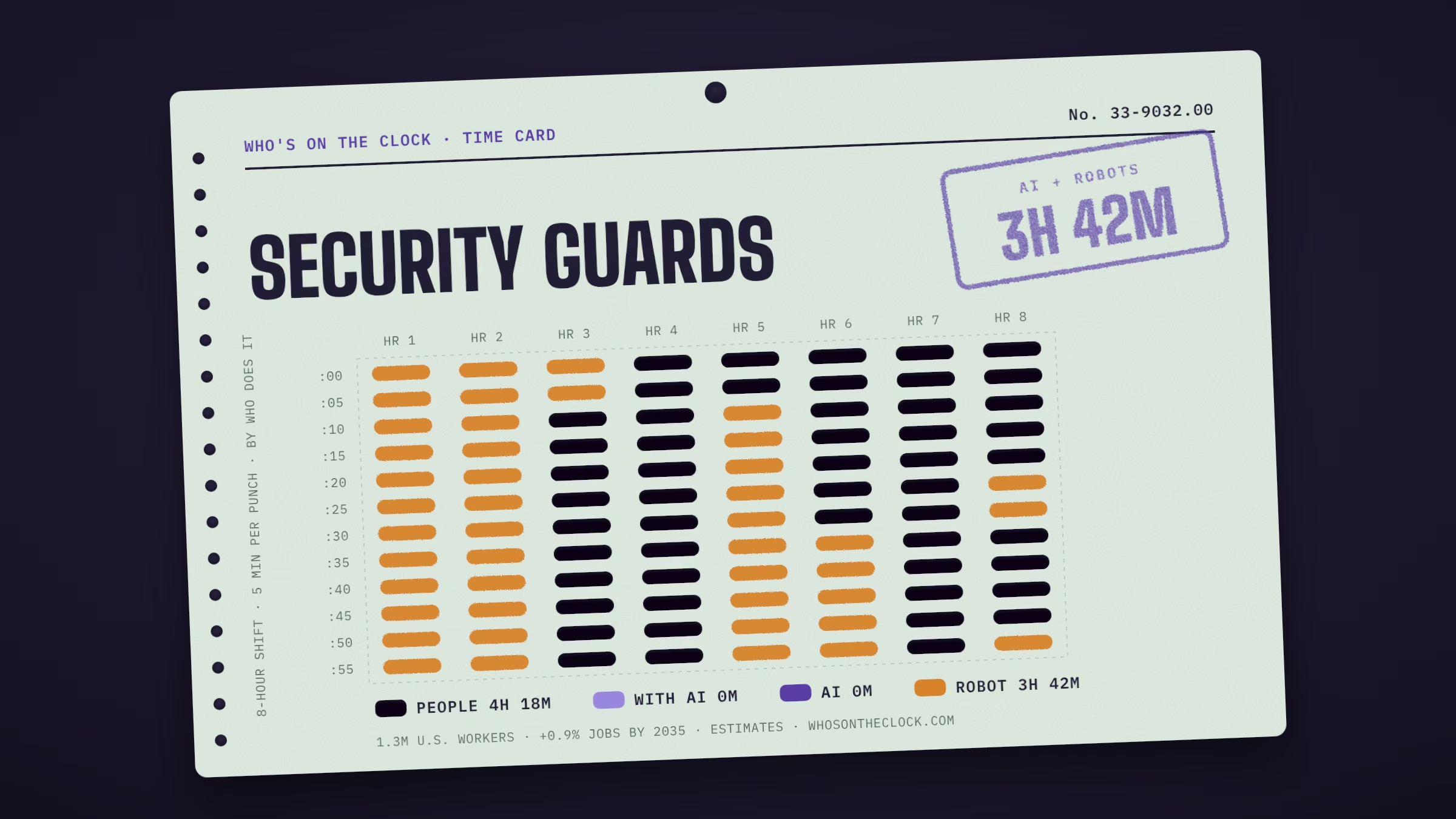
Some tasks are already handled by AI or machines; the rest still needs a person. About 3h 42m of an 8-hour shift goes to tasks that AI or robots largely take over. The other 4h 18m (54%) stays with people. Separately, BLS expects about 0.9% more of these jobs by 2035 (all jobs: +3.5%).
⤢ Full sizeEach mark is 5 minutes of a typical shift for security guards, colored by who does that task today. Estimates from O*NET tasks and Anthropic Economic Index data. How it's made
Guard, patrol, or monitor premises to prevent theft, violence, or infractions of rules. May operate x-ray and metal detector equipment.
Time card
Untick tasks you don't do, or set your own times.
Mine
Task, by time spent
Human
With AI
AI
Robot
Patrol industrial or commercial premises to prevent and detect signs of intrusion and ensure security of doors, windows, and gates.2h 12m a shift · Robots deployed · e.g. Cobalt Security Robot
Monitor and authorize entrance and departure of employees, visitors, and other persons to guard against theft and maintain security of premises.2h a shift · No AI or robot evidence found
Circulate among visitors, patrons, or employees to preserve order and protect property.48m a shift · Robots deployed · e.g. Knightscope K5 (Autonomous Data Machine)
Write reports of daily activities and irregularities, such as equipment or property damage, theft, presence of unauthorized persons, or unusual occurrences.36m a shift · No AI or robot evidence found
Answer telephone calls to take messages, answer questions, and provide information during non-business hours or when switchboard is closed.24m a shift · No AI or robot evidence found
Lock doors and gates of entrances and exits to secure buildings.18m a shift · Robots only in factory cells
Warn persons of rule infractions or violations, and apprehend or evict violators from premises, using force when necessary.18m a shift · No AI or robot evidence found
Operate detecting devices to screen individuals and prevent passage of prohibited articles into restricted areas.18m a shift · Robots only in factory cells
Escort or drive motor vehicle to transport individuals to specified locations or to provide personal protection.12m a shift · Robots only in factory cells
Respond to medical emergencies by administering basic first aid or by obtaining assistance from paramedics.6m a shift · No AI or robot evidence found
Call police or fire departments in cases of emergency, such as fire or presence of unauthorized persons.6m a shift · No AI or robot evidence found
Monitor and adjust controls that regulate building systems, such as air conditioning, furnace, or boiler.6m a shift · Robots deployed · e.g. Boston Dynamics Spot at AB InBev Leuven brewery
Knightscope signs 10 new security robot clients in early January 2025
Knightscope reported 10 new client agreements in the first 10 days of 2025. They include a 2-year K5 autonomous security robot deal with a Dallas automotive group with three dealerships.
Some tasks are already handled by AI or machines; the rest still needs a person. About 3h 42m of an 8-hour shift goes to tasks that AI or robots largely take over. The other 4h 18m (54%) stays with people. Separately, BLS expects about 0.9% more of these jobs by 2035 (all jobs: +3.5%).
What can AI already do for security guards?
None of this job's tasks show regular AI use yet. That can mean the work is hands-on or in person, or simply that it rarely comes up in AI usage data.
Where do robots fit in?
For some tasks, yes. Robots have done 5 of this job's tasks in workplaces like this one, about 3h 42m of a typical shift. 3 more tasks have only been done in factory setups built around the machine, so they stay with people here. For 2 physical tasks, no robot has shown it can do the work yet.
Patrol industrial or commercial premises to prevent and detect signs of intrusion and ensure security of doors, windows, and gates. (2h 12m a shift; e.g. Cobalt Security Robot, in use)
Circulate among visitors, patrons, or employees to preserve order and protect property. (48m a shift; e.g. Knightscope K5 (Autonomous Data Machine), in use)
Answer alarms and investigate disturbances. (24m a shift; e.g. Cobalt Robot / Cobalt Monitoring Intelligence, in use)
Inspect and adjust security systems, equipment, or machinery to ensure operational use and to detect evidence of tampering. (12m a shift; e.g. Cobalt Robot fleet at a 1.2M sq ft multi-building site, in use)
What still needs a person?
4h 18m of a typical shift, or 54%, goes to tasks with no AI or robot evidence yet. No AI usage or robot deployment has shown up for these so far. The biggest:
Monitor and authorize entrance and departure of employees, visitors, and other persons to guard against theft and maintain security of premises. (2h a shift)
Write reports of daily activities and irregularities, such as equipment or property damage, theft, presence of unauthorized persons, or unusual occurrences. (36m a shift)
Answer telephone calls to take messages, answer questions, and provide information during non-business hours or when switchboard is closed. (24m a shift)
Lock doors and gates of entrances and exits to secure buildings. (18m a shift)
Warn persons of rule infractions or violations, and apprehend or evict violators from premises, using force when necessary. (18m a shift)
Why is that work hard to automate?
Much of it comes down to where and how the work happens. In-person, hands-on and high-stakes work is where AI and robots have made the least headway so far. In the official O*NET survey of people in this job:
100% carry high or very high responsibility for other workers' safety
97% say dealing with the public is very or extremely important
90% are in constant contact with other people
What are companies actually doing?
We track 1 sourced company move that affects this job. Most recent:
Jan 14, 2025: Knightscope signs 10 new security robot clients in early January 2025 (Rolling out)
Are employers still hiring security guards?
On Indeed, job postings in the Security & Public Safety sector are at 119% of their February 2020 level (all U.S. postings: 104%), up 4.4% from a year earlier, as of Oct 9, 2026. BLS separately expects about 156,000 openings a year in this job through 2035. Across all U.S. postings, 7.3% now mention AI skills. Sector postings cover more than this one job and move for many reasons besides AI.
How much do security guards make?
The median pay is about $38,020 a year ($18.28 an hour), 25% below the median for all U.S. jobs ($50,980). Most people in this job earn between $30,210 and $58,840 a year; that range covers the middle 80%. Pay figures are from BLS, May 2025, and vary a lot by state and employer. Pick a state to compare:
Is this job growing or shrinking?
BLS projects growth of 0.9% from 2025 to 2035, compared with 3.5% growth for all jobs. That's about 1.3 million jobs in 2035. It expects about 156,000 openings a year, mostly from people retiring or changing careers. These projections don't single out AI as a cause.
How many security guards are there in the U.S.?
About 1.3 million people in the U.S., roughly 0.83% of all workers (BLS, May 2025). That makes it the 27th largest of the 796 jobs on this site. BLS expects about 1.3 million in 2035.
What training do security guards need?
The most common requirement is a high school diploma: about 79% of people in the job said so in the official O*NET survey. O*NET rates the job at level 2 of 5 for preparation, which usually means: high school diploma, some training. Requirements vary by state and employer, especially for licensed work.
What should I learn to stay ahead of AI?
These come from the job's official skill ratings and from the tasks that AI and robots touch least today. Building them keeps you strong in the parts of the work that still need a person:
Skills that matter more here than in most jobs: Active Listening, Monitoring, Coordination, Social Perceptiveness
Get strong at the parts of the job that stay with people (listed above), which take 4h 18m of a typical shift
Tools employers list: Microsoft Excel, Microsoft Office software, Microsoft Outlook, Microsoft SharePoint, Microsoft Word
What other jobs could security guards move into?
These use similar skills, with less of a typical shift touched by AI or robots. Matches come from 109 official ratings of skills, knowledge and work activities, and each needs the same or less preparation unless the official list relates the jobs directly:
Animal Control Workers (0m touched, $46k median pay)
Police and Sheriff's Patrol Officers (1h 47m touched, $76k median pay)
Public Safety Telecommunicators (22m touched, $53k median pay)
First-Line Supervisors of Security Workers (1h 35m touched, $56k median pay)
How solid are these numbers?
Each task carries its own evidence label. For this job: 5 with robots in real deployments, 9 with no AI or robot evidence found. The minutes per task are estimates, not measured hours, and "no evidence" doesn't prove a task is safe.
Tools in demand
Microsoft Excel
Microsoft Office software
Microsoft Outlook
Microsoft SharePoint
Microsoft Word
Also called
Alarm Investigator, Armed Guard, Armed Security Guard, Armed Security Officer, Armored Car Driver, Armored Car Guard, Bag Checker, Baggage Inspector, Baggage Screener, Baggage Security Checker, Bank Guard, Bodyguard, Bouncer, Camp Guard