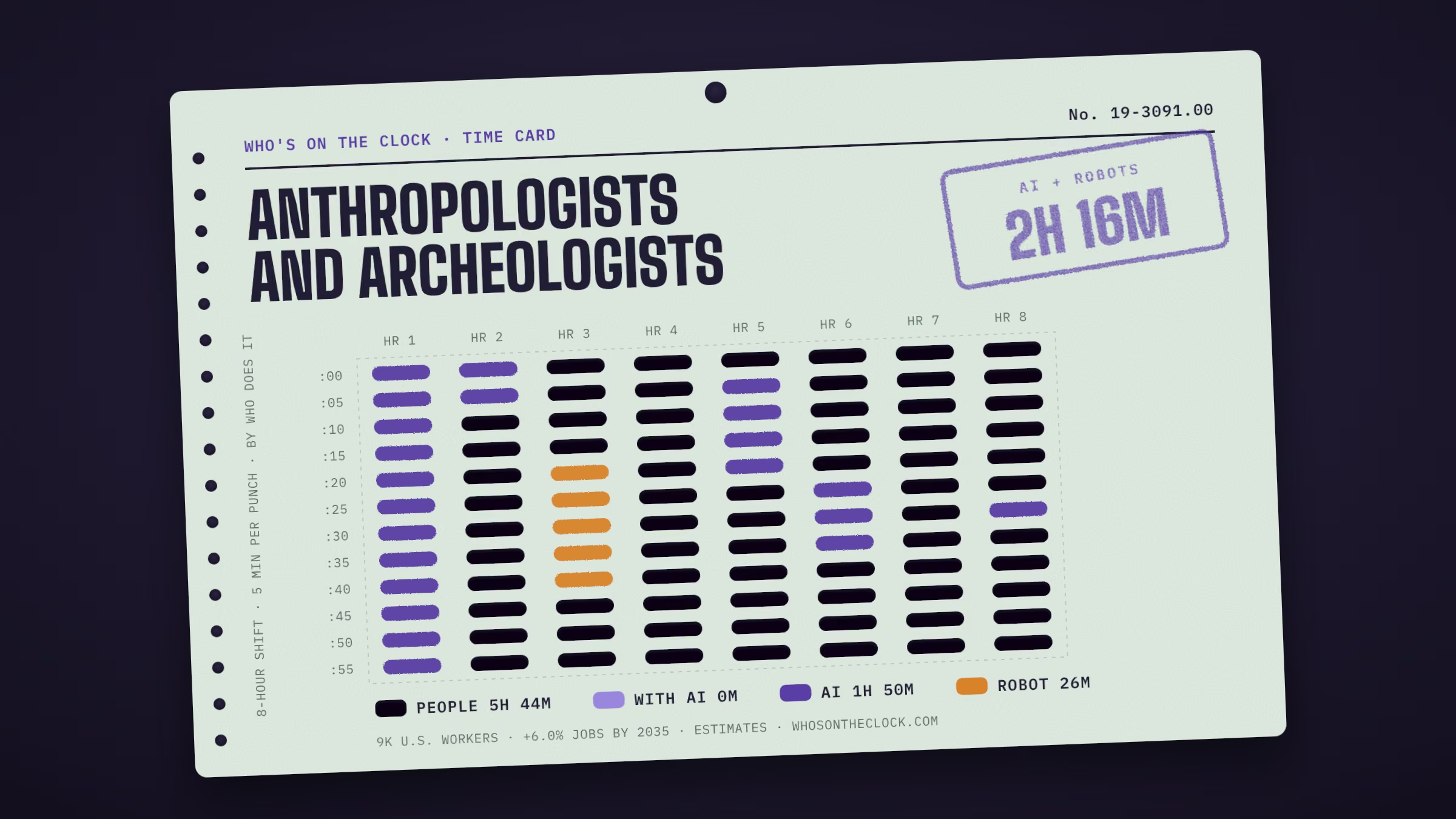
Study the origin, development, and behavior of human beings. May study the way of life, language, or physical characteristics of people in various parts of the world. May engage in systematic recovery and examination of material evidence, such as tools or pottery remaining from past human cultures, in order to determine the history, customs, and living habits of earlier civilizations.
Time card
Untick tasks you don't do, or set your own times.
| Mine | Task, by time spent | Human | With AI | AI | Robot |
|---|---|---|---|---|---|
Write about and present research findings for a variety of specialized and general audiences.1h 11m a shift · Observed in AI useTypical AI request: about 7h 32m alone, 41m with AIWhy this label?Marked AI because this task shows up regularly in real AI conversations (Anthropic Economic Index, 2025 usage), and in most of them AI does the task on its own rather than helping a person. Many workplaces may not use AI for it at all. How labels work | |||||
Research, survey, or assess sites of past societies and cultures in search of answers to specific research questions.45m a shift · No AI or robot evidence foundWhy this label?This is physical work, and no robot has been shown doing it yet. How labels work | |||||
Collect information and make judgments through observation, interviews, and review of documents.26m a shift · No AI or robot evidence foundWhy this label?No AI use or robot deployment showed up for this task in our data. That isn't proof it's safe; it may just be rare in the data. How labels work | |||||
Assess archeological sites for resource management, development, or conservation purposes and recommend methods for site protection.26m a shift · Robots deployed · e.g. Spot (Boston Dynamics) + autonomous laser-scanning drone, Smart@POMPEI projectWhy this label?Marked Robot because Spot (Boston Dynamics) + autonomous laser-scanning drone, Smart@POMPEI project (in real use) has done this task in a real workplace. It shows a robot can do it somewhere, not that most anthropologists and archeologists work alongside one. How labels work | |||||
Teach or mentor undergraduate and graduate students in anthropology or archeology.19m a shift · No AI or robot evidence foundWhy this label?No AI use or robot deployment showed up for this task in our data. That isn't proof it's safe; it may just be rare in the data. How labels work | |||||
Plan and direct research to characterize and compare the economic, demographic, health care, social, political, linguistic, and religious institutions of distinct cultural groups, communities, and organizations.19m a shift · No AI or robot evidence foundWhy this label?No AI use or robot deployment showed up for this task in our data. That isn't proof it's safe; it may just be rare in the data. How labels work | |||||
Write grant proposals to obtain funding for research.19m a shift · No AI or robot evidence foundWhy this label?No AI use or robot deployment showed up for this task in our data. That isn't proof it's safe; it may just be rare in the data. How labels work | |||||
Advise government agencies, private organizations, and communities regarding proposed programs, plans, and policies and their potential impacts on cultural institutions, organizations, and communities.19m a shift · No AI or robot evidence foundWhy this label?No AI use or robot deployment showed up for this task in our data. That isn't proof it's safe; it may just be rare in the data. How labels work | |||||
Record the exact locations and conditions of artifacts uncovered in diggings or surveys, using drawings and photographs as necessary.19m a shift · Observed in AI useWhy this label?Marked AI because this task shows up regularly in real AI conversations (Anthropic Economic Index, 2025 usage), and in most of them AI does the task on its own rather than helping a person. Many workplaces may not use AI for it at all. How labels work | |||||
Gather and analyze artifacts and skeletal remains to increase knowledge of ancient cultures.19m a shift · No AI or robot evidence foundWhy this label?This is physical work, and no robot has been shown doing it yet. How labels work | |||||
Compare findings from one site with archeological data from other sites to find similarities or differences.19m a shift · No AI or robot evidence foundWhy this label?No AI use or robot deployment showed up for this task in our data. That isn't proof it's safe; it may just be rare in the data. How labels work | |||||
Study objects and structures recovered by excavation to identify, date, and authenticate them and to interpret their significance.19m a shift · No AI or robot evidence foundWhy this label?This is physical work, and no robot has been shown doing it yet. How labels work | |||||
Create data records for use in describing and analyzing social patterns and processes, using photography, videography, and audio recordings.13m a shift · Observed in AI useWhy this label?Marked AI because this task shows up regularly in real AI conversations (Anthropic Economic Index, 2025 usage), and in most of them AI does the task on its own rather than helping a person. Many workplaces may not use AI for it at all. How labels work | |||||
Lead field training sites and train field staff, students, and volunteers in excavation methods.13m a shift · No AI or robot evidence foundWhy this label?No AI use or robot deployment showed up for this task in our data. That isn't proof it's safe; it may just be rare in the data. How labels work | |||||
Develop and test theories concerning the origin and development of past cultures.13m a shift · No AI or robot evidence foundWhy this label?No AI use or robot deployment showed up for this task in our data. That isn't proof it's safe; it may just be rare in the data. How labels work | |||||
Study archival collections of primary historical sources to help explain the origins and development of cultural patterns.13m a shift · No AI or robot evidence foundWhy this label?No AI use or robot deployment showed up for this task in our data. That isn't proof it's safe; it may just be rare in the data. How labels work | |||||
Describe artifacts' physical properties or attributes, such as the materials from which artifacts are made and their size, shape, function, and decoration.13m a shift · Robots only in factory cellsWhy this label?Robots have done this only in factory setups built around the machine, so it stays Human for anthropologists and archeologists. How labels work | |||||
Collect artifacts made of stone, bone, metal, and other materials, placing them in bags and marking them to show where they were found.13m a shift · No AI or robot evidence foundWhy this label?This is physical work, and no robot has been shown doing it yet. How labels work | |||||
Consult site reports, existing artifacts, and topographic maps to identify archeological sites.13m a shift · No AI or robot evidence foundWhy this label?No AI use or robot deployment showed up for this task in our data. That isn't proof it's safe; it may just be rare in the data. How labels work | |||||
Train others in the application of ethnographic research methods to solve problems in organizational effectiveness, communications, technology development, policy making, and program planning.6m a shift · No AI or robot evidence foundWhy this label?No AI use or robot deployment showed up for this task in our data. That isn't proof it's safe; it may just be rare in the data. How labels work | |||||
Identify culturally specific beliefs and practices affecting health status and access to services for distinct populations and communities, in collaboration with medical and public health officials.6m a shift · No AI or robot evidence foundWhy this label?No AI use or robot deployment showed up for this task in our data. That isn't proof it's safe; it may just be rare in the data. How labels work | |||||
Apply traditional ecological knowledge and assessments of culturally distinctive land and resource management institutions to assist in the resolution of conflicts over habitat protection and resource enhancement.6m a shift · No AI or robot evidence foundWhy this label?No AI use or robot deployment showed up for this task in our data. That isn't proof it's safe; it may just be rare in the data. How labels work | |||||
Conduct participatory action research in communities and organizations to assess how work is done and to design work systems, technologies, and environments.6m a shift · No AI or robot evidence foundWhy this label?No AI use or robot deployment showed up for this task in our data. That isn't proof it's safe; it may just be rare in the data. How labels work | |||||
Organize public exhibits and displays to promote public awareness of diverse and distinctive cultural traditions.6m a shift · Observed in AI useWhy this label?Marked AI because this task shows up regularly in real AI conversations (Anthropic Economic Index, 2025 usage), and in most of them AI does the task on its own rather than helping a person. Many workplaces may not use AI for it at all. How labels work | |||||
Collaborate with economic development planners to decide on the implementation of proposed development policies, plans, and programs based on culturally institutionalized barriers and facilitating circumstances.6m a shift · No AI or robot evidence foundWhy this label?No AI use or robot deployment showed up for this task in our data. That isn't proof it's safe; it may just be rare in the data. How labels work | |||||
Develop intervention procedures, using techniques such as individual and focus group interviews, consultations, and participant observation of social interaction.6m a shift · No AI or robot evidence foundWhy this label?No AI use or robot deployment showed up for this task in our data. That isn't proof it's safe; it may just be rare in the data. How labels work | |||||
Formulate general rules that describe and predict the development and behavior of cultures and social institutions.6m a shift · No AI or robot evidence foundWhy this label?No AI use or robot deployment showed up for this task in our data. That isn't proof it's safe; it may just be rare in the data. How labels work | |||||
Clean, restore, and preserve artifacts.6m a shift · No AI or robot evidence foundWhy this label?This is physical work, and no robot has been shown doing it yet. How labels work | |||||
Participate in forensic activities, such as tooth and bone structure identification, in conjunction with police departments and pathologists.6m a shift · No AI or robot evidence foundWhy this label?This is physical work, and no robot has been shown doing it yet. How labels work | |||||
Enhance the cultural sensitivity of elementary and secondary curricula and classroom interactions in collaboration with educators and teachers.time not estimated · No AI or robot evidence foundWhy this label?No AI use or robot deployment showed up for this task in our data. That isn't proof it's safe; it may just be rare in the data. How labels work |