Will AI replace geographers?

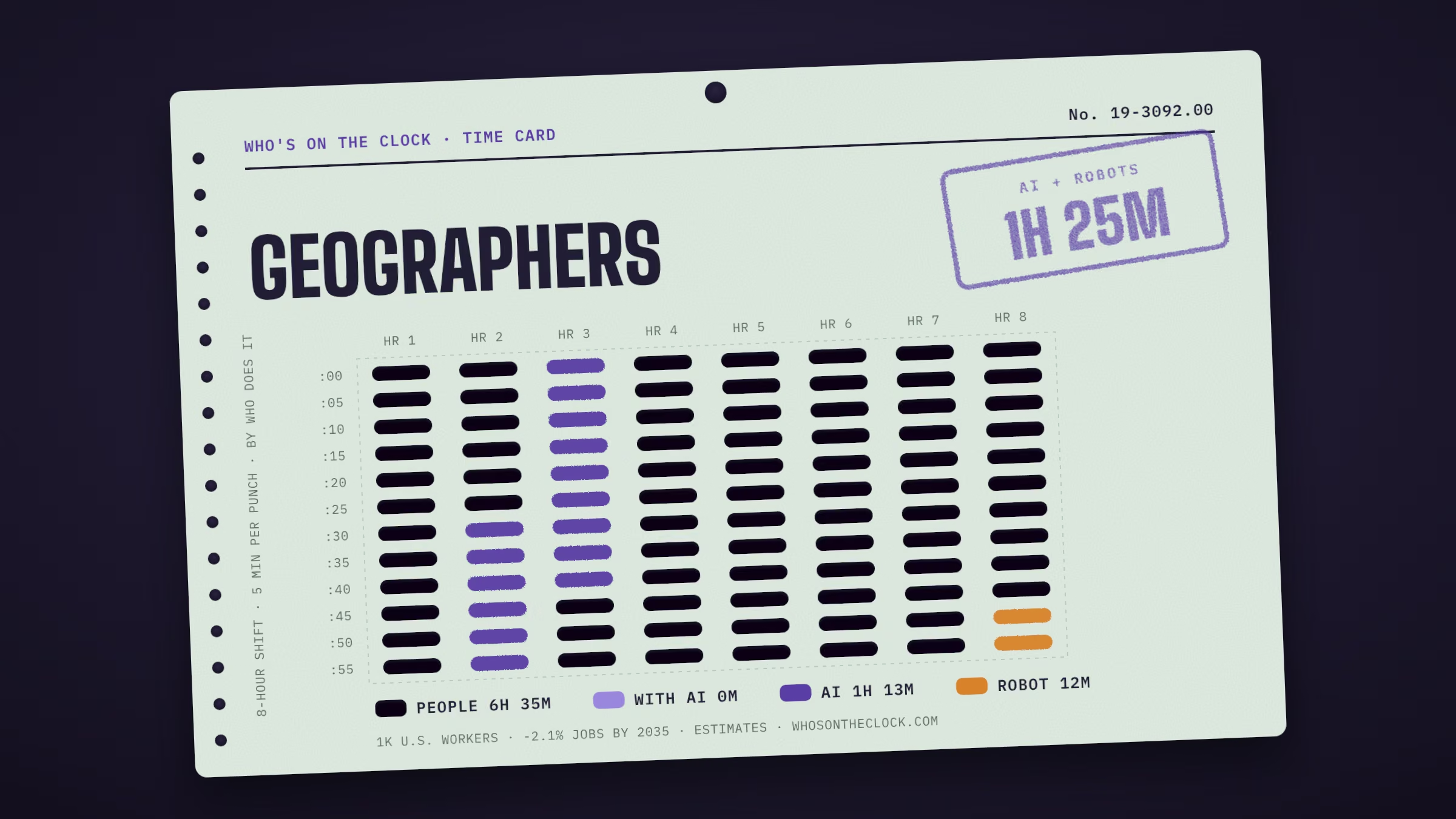
Not replace, but it is changing the job. About 1h 25m of an 8-hour shift goes to tasks touched by AI working on its own. The breakdown: 1h 13m that AI mostly does alone, 12m that robots have done in real workplaces. The other 6h 35m (82%) stays with people. Separately, BLS expects about 2.1% fewer of these jobs by 2035 (all jobs: +3.5%).

Time card for geographers showing a typical 8-hour shift: 6h 35m done by people, 1h 13m by AI, 12m by robots.
Each mark is 5 minutes of a typical shift for geographers, colored by who does that task today. Estimates from O*NET tasks and Anthropic Economic Index data. How it's made

Home / Science / Geographers

Study the nature and use of areas of the Earth's surface, relating and interpreting interactions of physical and cultural phenomena. Conduct research on physical aspects of a region, including land forms, climates, soils, plants, and animals, and conduct research on the spatial implications of human activities within a given area, including social characteristics, economic activities, and political organization, as well as researching interdependence between regions at scales ranging from local to global.

Time card

Untick tasks you don't do, or set your own times.
MineTask, by time spentHumanWith AIAIRobot
Create and modify maps, graphs, or diagrams, using geographical information software and related equipment, and principles of cartography, such as coordinate systems, longitude, latitude, elevation, topography, and map scales.1h 31m a shift · No AI or robot evidence found
Write and present reports of research findings.1h 13m a shift · Observed in AI use
Gather and compile geographic data from sources such as censuses, field observations, satellite imagery, aerial photographs, and existing maps.1h 7m a shift · No AI or robot evidence found
Analyze geographic distributions of physical and cultural phenomena on local, regional, continental, or global scales.1h 1m a shift · No AI or robot evidence found
Provide geographical information systems support to the private and public sectors.36m a shift · No AI or robot evidence found
Study the economic, political, and cultural characteristics of a specific region's population.30m a shift · No AI or robot evidence found
Develop, operate, and maintain geographical information computer systems, including hardware, software, plotters, digitizers, printers, and video cameras.24m a shift · No AI or robot evidence found
Locate and obtain existing geographic information databases.24m a shift · No AI or robot evidence found
Provide consulting services in fields such as resource development and management, business location and market area analysis, environmental hazards, regional cultural history, and urban social planning.24m a shift · No AI or robot evidence found
Teach geography.18m a shift · No AI or robot evidence found
Conduct field work at outdoor sites.18m a shift · No AI or robot evidence found
Collect data on physical characteristics of specified areas, such as geological formations, climates, and vegetation, using surveying or meteorological equipment.12m a shift · Robots deployed · e.g. Percepto AIM / Percepto Air drone-in-a-box

On the floor

No company news tracked for this job yet. New stories are added as they happen.

Ask the clock

Will AI replace geographers?

Not replace, but it is changing the job. About 1h 25m of an 8-hour shift goes to tasks touched by AI working on its own. The breakdown: 1h 13m that AI mostly does alone, 12m that robots have done in real workplaces. The other 6h 35m (82%) stays with people. Separately, BLS expects about 2.1% fewer of these jobs by 2035 (all jobs: +3.5%).

What parts of the job can AI already do?

AI shows up regularly in 1 of 12 tasks, about 1h 13m of a typical shift. The biggest ones:

  • Write and present reports of research findings. (1h 13m a shift, AI mostly does it alone)
Can a robot do this job?

For some tasks, yes. Robots have done 1 of this job's tasks in workplaces like this one, about 12m of a typical shift. For 1 physical task, no robot has shown it can do the work yet.

  • Collect data on physical characteristics of specified areas, such as geological formations, climates, and vegetation, using surveying or meteorological equipment. (12m a shift; e.g. Percepto AIM / Percepto Air drone-in-a-box, in use)
What parts of the job are still done by people?

6h 35m of a typical shift, or 82%, goes to tasks with no AI or robot evidence yet. No AI usage or robot deployment has shown up for these so far. The biggest:

  • Create and modify maps, graphs, or diagrams, using geographical information software and related equipment, and principles of cartography, such as coordinate systems, longitude, latitude, elevation, topography, and map scales. (1h 31m a shift)
  • Gather and compile geographic data from sources such as censuses, field observations, satellite imagery, aerial photographs, and existing maps. (1h 7m a shift)
  • Analyze geographic distributions of physical and cultural phenomena on local, regional, continental, or global scales. (1h 1m a shift)
  • Provide geographical information systems support to the private and public sectors. (36m a shift)
  • Study the economic, political, and cultural characteristics of a specific region's population. (30m a shift)
Are employers still hiring for this job?

On Indeed, job postings in the Social Science sector are at 126% of their February 2020 level (all U.S. postings: 104%), down 6.7% from a year earlier, as of Oct 9, 2026. BLS separately expects about 100 openings a year in this job through 2035. Across all U.S. postings, 7.3% now mention AI skills. Sector postings cover more than this one job and move for many reasons besides AI.

How much do geographers make?

The median pay is about $102,040 a year ($49.06 an hour), 100% above the median for all U.S. jobs ($50,980). Most people in this job earn between $66,770 and $136,660 a year; that range covers the middle 80%. Pay figures are from BLS, May 2025, and vary a lot by state and employer. Pick a state to compare:

Is this job growing or shrinking?

BLS projects a decline of 2.1% from 2025 to 2035, compared with 3.5% growth for all jobs. That's about 1,500 jobs in 2035. Even so, it expects about 100 openings a year, mostly from people retiring or changing careers. These projections don't single out AI as a cause.

How many people do this job?

About 1,400 people in the U.S., roughly 0.00% of all workers (BLS, May 2025). That makes it the 783rd largest of the 796 jobs on this site. BLS expects about 1,500 in 2035.

What do you need to become one?

The most common requirement is a bachelor's degree: about 45% of people in the job said so in the official O*NET survey. O*NET rates the job at level 4 of 5 for preparation, which usually means: bachelor's degree. Requirements vary by state and employer, especially for licensed work.

What should I learn to stay ahead?

These come from the job's official skill ratings and from the tasks that AI and robots touch least today. Building them keeps you strong in the parts of the work that still need a person:

  • Skills that matter more here than in most jobs: Science, Writing, Systems Analysis, Reading Comprehension
  • Get strong at the parts of the job that stay with people (listed above), which take 6h 35m of a typical shift
  • Tools employers list: Structured query language SQL, R, Python, Microsoft Excel, ESRI ArcGIS software
  • Learn to use AI well on the tasks where it already shows up in this job (listed above)
What similar jobs could I move into?

These use similar skills, with less of a typical shift touched by AI or robots. Matches come from 109 official ratings of skills, knowledge and work activities, and each needs the same or less preparation unless the official list relates the jobs directly:

  • Atmospheric and Space Scientists (48m touched, $99k median pay)
  • Geoscientists (19m touched, $102k median pay)
How solid are these numbers?

Each task carries its own evidence label. For this job: 1 observed in real AI use, 1 with robots in real deployments, 10 with no AI or robot evidence found. The minutes per task are estimates, not measured hours, and "no evidence" doesn't prove a task is safe.

Tools in demand

  • Structured query language SQL
  • R
  • Python
  • Microsoft Excel
  • ESRI ArcGIS software
  • Adobe Photoshop
  • Autodesk AutoCAD
  • IBM SPSS Statistics

Also called

Biogeographer, Cultural Resources Specialist, Earth Observations Scientist, Economic Geographer, GIS Coordinator (Geographic Information Systems Coordinator), GIS Geographer (Geographic Information Systems Geographer), GIS Physical Scientist (Geographic Information Systems Physical Scientist), Geographer, Geomorphologist, Glaciologist, Imagery Analyst, Natural Resources Specialist, Physical Geographer, Political Geographer