Will AI replace automotive and watercraft service attendants?

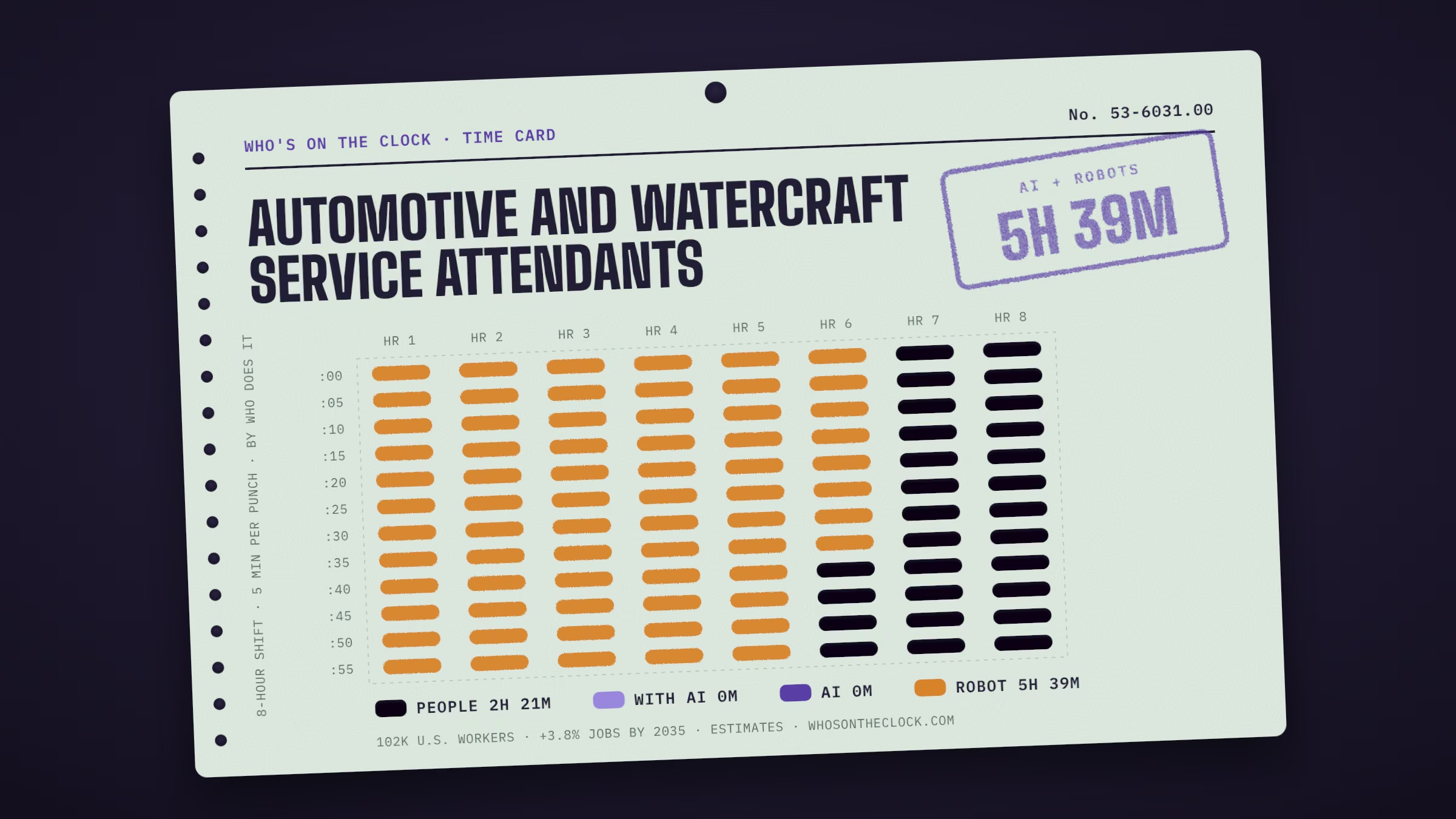
The biggest change here is physical: systems like Autofuel Gen 3 robotic refuelling arm have done tasks such as “Activate fuel pumps and fill fuel tanks of vehicles with gasoline or diesel fuel to specified levels” in real workplaces, about 5h 39m of a typical shift. Only 2h 21m of the shift has no AI or robot evidence. BLS expects about 3.8% more of these jobs by 2035.

Time card for automotive and watercraft service attendants showing a typical 8-hour shift: 2h 21m done by people, 5h 39m by robots.
Each mark is 5 minutes of a typical shift for automotive and watercraft service attendants, colored by who does that task today. Estimates from O*NET tasks and Anthropic Economic Index data. How it's made

Home / Transportation & warehouse / Automotive and Watercraft Service Attendants

Service automobiles, buses, trucks, boats, and other automotive or marine vehicles with fuel, lubricants, and accessories. Collect payment for services and supplies. May lubricate vehicle, change motor oil, refill antifreeze, or replace lights or other accessories, such as windshield wiper blades or fan belts. May repair or replace tires.

Time card

Untick tasks you don't do, or set your own times.
MineTask, by time spentHumanWith AIAIRobot
Activate fuel pumps and fill fuel tanks of vehicles with gasoline or diesel fuel to specified levels.3h 11m a shift · Robots deployed · e.g. Autofuel Gen 3 robotic refuelling arm (at Neste Express Vantaa Siltamäki)
Why this label?Marked Robot because Autofuel Gen 3 robotic refuelling arm (at Neste Express Vantaa Siltamäki) (in real use) has done this task in a real workplace. It shows a robot can do it somewhere, not that most automotive and watercraft service attendants work alongside one. How labels work
Collect cash payments from customers, and make change or charge purchases to customers' credit cards, providing customers with receipts.1h 46m a shift · Robots deployed · e.g. Mashgin self-checkout kiosk
Why this label?Marked Robot because Mashgin self-checkout kiosk (in real use) has done this task in a real workplace. It shows a robot can do it somewhere, not that most automotive and watercraft service attendants work alongside one. How labels work
Clean parking areas, offices, restrooms, or equipment, and remove trash.42m a shift · Robots deployed · e.g. Ice Cobotics Cobi 18
Why this label?Marked Robot because Ice Cobotics Cobi 18 (in real use) has done this task in a real workplace. It shows a robot can do it somewhere, not that most automotive and watercraft service attendants work alongside one. How labels work
Check tire pressure and levels of fuel, motor oil, transmission, radiator, battery, or other fluids, adding air or fluids as required.28m a shift · Robots only in factory cells
Why this label?Robots have done this only in factory setups built around the machine, so it stays Human for automotive and watercraft service attendants. How labels work
Perform minor repairs, such as adjusting brakes, replacing spark plugs, or changing engine oil or filters.21m a shift · No AI or robot evidence found
Why this label?This is physical work, and no robot has been shown doing it yet. How labels work
Order stock, and price and shelve incoming goods.14m a shift · Robots only in factory cells
Why this label?Robots have done this only in factory setups built around the machine, so it stays Human for automotive and watercraft service attendants. How labels work
Sell and install accessories, such as batteries, windshield wiper blades, fan belts, bulbs, or headlamps.14m a shift · No AI or robot evidence found
Why this label?This is physical work, and no robot has been shown doing it yet. How labels work
Prepare daily reports of fuel, oil, and accessory sales.14m a shift · No AI or robot evidence found
Why this label?No AI use or robot deployment showed up for this task in our data. That isn't proof it's safe; it may just be rare in the data. How labels work
Clean windshields.14m a shift · Robots only in factory cells
Why this label?Robots have done this only in factory setups built around the machine, so it stays Human for automotive and watercraft service attendants. How labels work
Grease and lubricate vehicles or specified units, such as springs, universal joints, or steering knuckles, using grease guns or spray lubricants.7m a shift · Robots only in factory cells
Why this label?Robots have done this only in factory setups built around the machine, so it stays Human for automotive and watercraft service attendants. How labels work
Rotate, test, and repair or replace tires.7m a shift · Robots only in factory cells
Why this label?Robots have done this only in factory setups built around the machine, so it stays Human for automotive and watercraft service attendants. How labels work
Test and charge batteries.7m a shift · Robots only in factory cells
Why this label?Robots have done this only in factory setups built around the machine, so it stays Human for automotive and watercraft service attendants. How labels work
Maintain customer records and follow up periodically with telephone, mail, or personal reminders of services due.7m a shift · No AI or robot evidence found
Why this label?No AI use or robot deployment showed up for this task in our data. That isn't proof it's safe; it may just be rare in the data. How labels work
Provide customers with information about local roads or highways.7m a shift · No AI or robot evidence found
Why this label?No AI use or robot deployment showed up for this task in our data. That isn't proof it's safe; it may just be rare in the data. How labels work

Clock history

  1. 5h 39m touchedFirst published: O*NET 30.1, Anthropic Economic Index (2025 usage and September 2026 robot study), BLS May 2025

When new data changes this clock, the date, the new numbers and the reason are logged here. Company news alone never moves the clock.

On the floor

No company news tracked for this job yet. New stories are added as they happen.

Ask the clock

Will AI replace automotive and watercraft service attendants?

Some tasks are already being done by AI or machines; the rest still needs a person. About 5h 39m of a typical shift is made up of tasks that AI or robots have done on their own in real use somewhere. That doesn't mean those hours are automated in a typical workplace. The other 2h 21m (29%) stays with people. Separately, BLS expects about 3.8% more of these jobs by 2035 (all jobs: +3.5%).

What can AI already do for automotive and watercraft service attendants?

None of this job's tasks show regular AI use yet. That can mean the work is hands-on or in person, or simply that it rarely comes up in AI usage data.

Where do robots fit in?

For some tasks, yes. Robots have done 3 of this job's tasks in workplaces like this one, about 5h 39m of a typical shift. 6 more tasks have only been done in factory setups built around the machine, so they stay with people here. For 2 physical tasks, no robot has shown it can do the work yet.

  • Activate fuel pumps and fill fuel tanks of vehicles with gasoline or diesel fuel to specified levels. (3h 11m a shift; e.g. Autofuel Gen 3 robotic refuelling arm (at Neste Express Vantaa Siltamäki), in use)
  • Collect cash payments from customers, and make change or charge purchases to customers' credit cards, providing customers with receipts. (1h 46m a shift; e.g. Mashgin self-checkout kiosk, in use)
  • Clean parking areas, offices, restrooms, or equipment, and remove trash. (42m a shift; e.g. Ice Cobotics Cobi 18, in use)
What still needs a person?

2h 21m of a typical shift, or 29%, goes to tasks with no AI or robot evidence yet. No AI usage or robot deployment has shown up for these so far. The biggest:

  • Check tire pressure and levels of fuel, motor oil, transmission, radiator, battery, or other fluids, adding air or fluids as required. (28m a shift)
  • Perform minor repairs, such as adjusting brakes, replacing spark plugs, or changing engine oil or filters. (21m a shift)
  • Order stock, and price and shelve incoming goods. (14m a shift)
  • Sell and install accessories, such as batteries, windshield wiper blades, fan belts, bulbs, or headlamps. (14m a shift)
  • Prepare daily reports of fuel, oil, and accessory sales. (14m a shift)
Why is that work hard to automate?

Much of it comes down to where and how the work happens. In-person, hands-on and high-stakes work is where AI and robots have made the least headway so far. In the official O*NET survey of people in this job:

  • 97% use their hands on tools, objects or controls more than half the time
  • 95% spend more than half the day on their feet
  • 83% say dealing with the public is very or extremely important
How much do automotive and watercraft service attendants make?

The median pay is about $35,670 a year ($17.15 an hour), 30% below the median for all U.S. jobs ($50,980). Most people in this job earn between $28,630 and $46,060 a year; that range covers the middle 80%. Pay figures are from BLS, May 2025, and vary a lot by state and employer. Pick a state to compare:

Is this job growing or shrinking?

BLS projects growth of 3.8% from 2025 to 2035, compared with 3.5% growth for all jobs. That's about 106,000 jobs in 2035. It expects about 13,000 openings a year, mostly from people retiring or changing careers. These projections don't single out AI as a cause.

How many automotive and watercraft service attendants are there in the U.S.?

About 102,000 people in the U.S., roughly 0.07% of all workers (BLS, May 2025). That makes it the 273rd largest of the 796 jobs on this site. BLS expects about 106,000 in 2035.

What training do automotive and watercraft service attendants need?

The most common requirement is a high school diploma: about 59% of people in the job said so in the official O*NET survey. O*NET rates the job at level 2 of 5 for preparation, which usually means: high school diploma, some training. Requirements vary by state and employer, especially for licensed work.

What should I learn to stay ahead of AI?

These come from the job's official skill ratings and from the tasks that AI and robots touch least today. Building them keeps you strong in the parts of the work that still need a person:

  • Skills that matter more here than in most jobs: Repairing, Equipment Maintenance, Operation and Control, Service Orientation
  • Get strong at the parts of the job that stay with people (listed above), which take 2h 21m of a typical shift
  • Tools employers list: Mozilla Firefox, Microsoft Edge, Apple Safari, Microsoft Excel, Microsoft Outlook
What other jobs could automotive and watercraft service attendants move into?

These use similar skills, with less of a typical shift touched by AI or robots. Matches come from 109 official ratings of skills, knowledge and work activities, and each needs the same or less preparation unless the official list relates the jobs directly:

  • Home Appliance Repairers (0m touched, $51k median pay)
  • Automotive Service Technicians and Mechanics (0m touched, $51k median pay)
How solid are these numbers?

Each task carries its own evidence label. For this job: 3 with robots in real deployments, 11 with no AI or robot evidence found. The minutes per task are estimates, not measured hours, and "no evidence" doesn't prove a task is safe.

Tools in demand

Mostly everyday office tools: Mozilla Firefox, Microsoft Edge, Apple Safari, Microsoft Excel, Microsoft Outlook, Microsoft Windows. The job's skills matter more than any specific software.

Also called

Attendant, Auto Garage Attendant, Auto Self Service Station Attendant, Auto Service Station Attendant, Auto Servicer, Automobile Self-Serve Service Station Attendant, Automobile Service Station Attendant, Automobile Technician, Automotive Service Advisor, Battery Charger, Boat Fueler, Bus Greaser, Buster, Car Greaser