Will AI replace home appliance repairers?

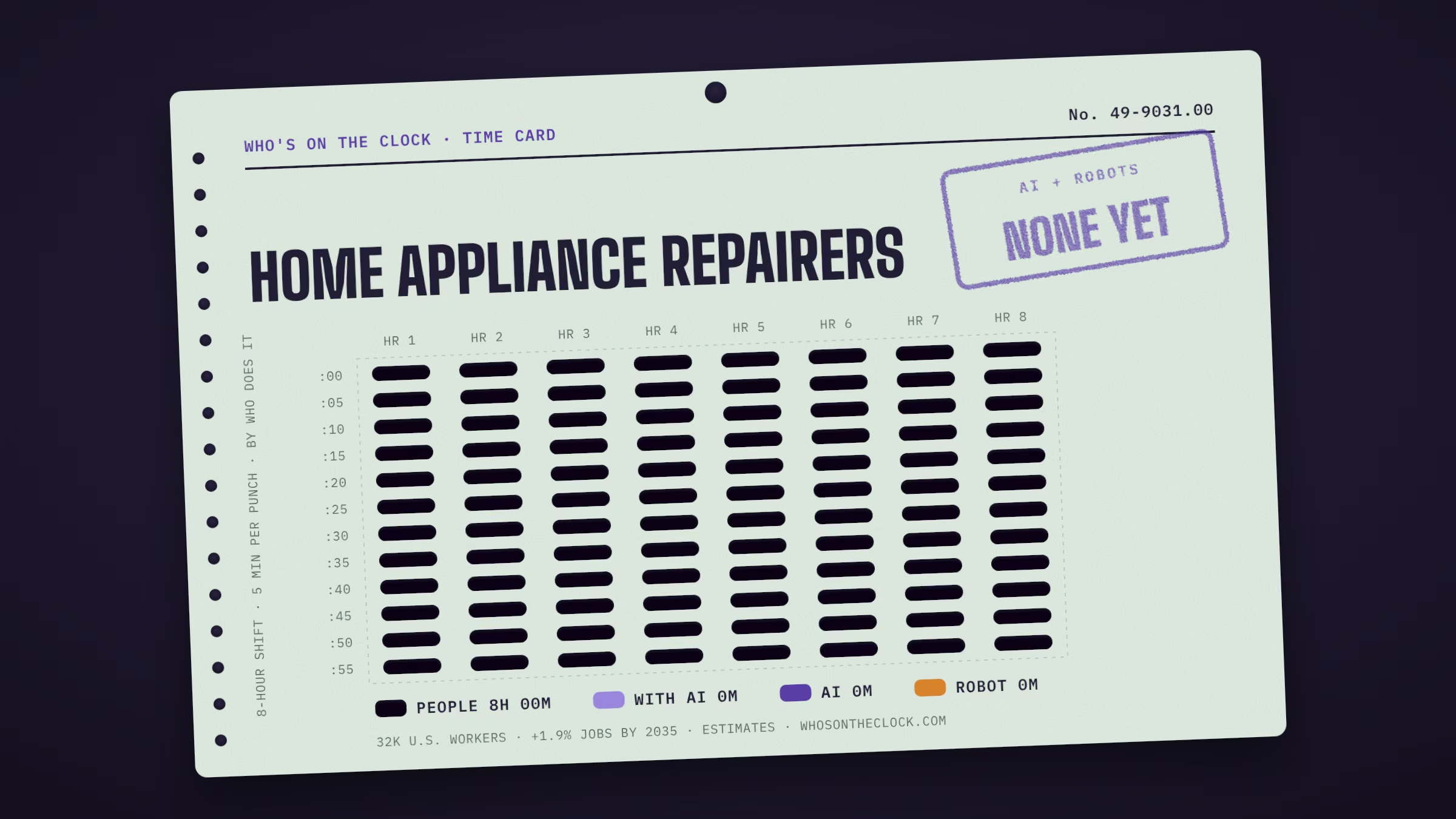
Not on current evidence. Less than 30 minutes of a typical shift goes to tasks that AI or robots are doing today. The other 8h (100%) stays with people. Separately, BLS expects about 1.9% more of these jobs by 2035 (all jobs: +3.5%).

Time card for home appliance repairers showing a typical 8-hour shift: 8h done by people.
Each mark is 5 minutes of a typical shift for home appliance repairers, colored by who does that task today. Estimates from O*NET tasks and Anthropic Economic Index data. How it's made

Home / Repair & maintenance / Home Appliance Repairers

Repair, adjust, or install all types of electric or gas household appliances, such as refrigerators, washers, dryers, and ovens.

Time card

Untick tasks you don't do, or set your own times.
MineTask, by time spentHumanWith AIAIRobot
Replace worn and defective parts such as switches, bearings, transmissions, belts, gears, circuit boards, or defective wiring.1h 6m a shift · No AI or robot evidence found
Observe and examine appliances during operation to detect specific malfunctions such as loose parts or leaking fluid.33m a shift · Robots only in factory cells
Disassemble appliances so that problems can be diagnosed and repairs can be made.33m a shift · Robots only in factory cells
Reassemble units after repairs are made, making adjustments and cleaning and lubricating parts as needed.33m a shift · Robots only in factory cells
Talk to customers or refer to work orders to establish the nature of appliance malfunctions.26m a shift · No AI or robot evidence found
Service and repair domestic electrical or gas appliances, such as clothes washers, refrigerators, stoves, and dryers.26m a shift · No AI or robot evidence found
Bill customers for repair work, and collect payment.20m a shift · No AI or robot evidence found
Refer to schematic drawings, product manuals, and troubleshooting guides to diagnose and repair problems.20m a shift · No AI or robot evidence found
Trace electrical circuits, following diagrams, and conduct tests with circuit testers and other equipment to locate shorts and grounds.20m a shift · Robots only in factory cells
Provide repair cost estimates, and recommend whether appliance repair or replacement is a better choice.20m a shift · No AI or robot evidence found
Record maintenance and repair work performed on appliances.20m a shift · No AI or robot evidence found
Maintain stocks of parts used in on-site installation, maintenance, and repair of appliances.20m a shift · Robots only in factory cells
Instruct customers regarding operation and care of appliances, and provide information such as emergency service numbers.13m a shift · No AI or robot evidence found
Contact supervisors or offices to receive repair assignments.13m a shift · No AI or robot evidence found
Observe and test operation of appliances following installation, and make any initial installation adjustments that are necessary.13m a shift · No AI or robot evidence found
Install appliances such as refrigerators, washing machines, and stoves.13m a shift · Robots only in factory cells
Clean and reinstall parts.13m a shift · No AI or robot evidence found
Respond to emergency calls for problems such as gas leaks.7m a shift · No AI or robot evidence found
Test and examine gas pipelines and equipment to locate leaks and faulty connections, and to determine the pressure and flow of gas.7m a shift · Robots only in factory cells
Light and adjust pilot lights on gas stoves, and examine valves and burners for gas leakage and specified flame.7m a shift · Robots only in factory cells
Level refrigerators, adjust doors, and connect water lines to water pipes for ice makers and water dispensers, using hand tools.7m a shift · Robots only in factory cells
Set appliance thermostats, and check to ensure that they are functioning properly.7m a shift · Robots only in factory cells
Level washing machines and connect hoses to water pipes, using hand tools.7m a shift · Robots only in factory cells
Clean, lubricate, and touch up minor defects on newly installed or repaired appliances.7m a shift · Robots only in factory cells
Conserve, recover, and recycle refrigerants used in cooling systems.7m a shift · No AI or robot evidence found
Install gas pipes and water lines to connect appliances to existing gas lines or plumbing.7m a shift · Robots only in factory cells
Take measurements to determine if appliances will fit in installation locations, performing minor carpentry work when necessary to ensure proper installation.7m a shift · Robots only in factory cells
Measure, cut, and thread pipe, and connect it to feeder lines and equipment or appliances, using rules and hand tools.7m a shift · Robots only in factory cells
Assemble new or reconditioned appliances.7m a shift · No AI or robot evidence found

On the floor

No company news tracked for this job yet. New stories are added as they happen.

Ask the clock

Will AI replace home appliance repairers?

Not on current evidence. Less than 30 minutes of a typical shift goes to tasks that AI or robots are doing today. The other 8h (100%) stays with people. Separately, BLS expects about 1.9% more of these jobs by 2035 (all jobs: +3.5%).

What can AI already do for home appliance repairers?

None of this job's tasks show regular AI use yet. That can mean the work is hands-on or in person, or simply that it rarely comes up in AI usage data.

Where do robots fit in?

Not in workplaces like this one, based on a 2026 review of robot deployments. 15 more tasks have only been done in factory setups built around the machine, so they stay with people here. For 8 physical tasks, no robot has shown it can do the work yet.

What still needs a person?

8h of a typical shift, or 100%, goes to tasks with no AI or robot evidence yet. No AI usage or robot deployment has shown up for these so far. The biggest:

  • Replace worn and defective parts such as switches, bearings, transmissions, belts, gears, circuit boards, or defective wiring. (1h 6m a shift)
  • Observe and examine appliances during operation to detect specific malfunctions such as loose parts or leaking fluid. (33m a shift)
  • Disassemble appliances so that problems can be diagnosed and repairs can be made. (33m a shift)
  • Reassemble units after repairs are made, making adjustments and cleaning and lubricating parts as needed. (33m a shift)
  • Talk to customers or refer to work orders to establish the nature of appliance malfunctions. (26m a shift)
Why is that work hard to automate?

Much of it comes down to where and how the work happens. In-person, hands-on and high-stakes work is where AI and robots have made the least headway so far. In the official O*NET survey of people in this job:

  • 96% say dealing with the public is very or extremely important
  • 87% are in constant contact with other people
  • 81% use their hands on tools, objects or controls more than half the time
Are employers still hiring home appliance repairers?

On Indeed, job postings in the Installation & Maintenance sector are at 118% of their February 2020 level (all U.S. postings: 104%), up 4.1% from a year earlier, as of Oct 9, 2026. BLS separately expects about 2,800 openings a year in this job through 2035. Across all U.S. postings, 7.3% now mention AI skills. Sector postings cover more than this one job and move for many reasons besides AI.

How much do home appliance repairers make?

The median pay is about $50,990 a year ($24.51 an hour), about the same as the median for all U.S. jobs ($50,980). Most people in this job earn between $36,190 and $80,660 a year; that range covers the middle 80%. Pay figures are from BLS, May 2025, and vary a lot by state and employer. Pick a state to compare:

Is this job growing or shrinking?

BLS projects growth of 1.9% from 2025 to 2035, compared with 3.5% growth for all jobs. That's about 41,000 jobs in 2035. It expects about 2,800 openings a year, mostly from people retiring or changing careers. These projections don't single out AI as a cause.

How many home appliance repairers are there in the U.S.?

About 32,000 people in the U.S., roughly 0.02% of all workers (BLS, May 2025). That makes it the 466th largest of the 796 jobs on this site. BLS expects about 41,000 in 2035.

What training do home appliance repairers need?

The most common requirement is a high school diploma: about 69% of people in the job said so in the official O*NET survey. O*NET rates the job at level 2 of 5 for preparation, which usually means: high school diploma, some training. Requirements vary by state and employer, especially for licensed work.

What should I learn to stay ahead of AI?

These come from the job's official skill ratings and from the tasks that AI and robots touch least today. Building them keeps you strong in the parts of the work that still need a person:

  • Skills that matter more here than in most jobs: Installation, Repairing, Equipment Maintenance, Troubleshooting
  • Get strong at the parts of the job that stay with people (listed above), which take 8h of a typical shift
  • Tools employers list: Microsoft Excel, Microsoft Office software, Microsoft Outlook, Microsoft Windows, Microsoft Word
What other jobs could home appliance repairers move into?

These use similar skills. Matches come from 109 official ratings of skills, knowledge and work activities, and each needs the same or less preparation unless the official list relates the jobs directly:

  • Outdoor Power Equipment and Other Small Engine Mechanics (0m touched, $48k median pay)
  • Heating, Air Conditioning, and Refrigeration Mechanics and Installers (12m touched, $61k median pay)
  • Electric Motor, Power Tool, and Related Repairers (0m touched, $56k median pay)
How solid are these numbers?

Each task carries its own evidence label. For this job: 29 with no AI or robot evidence found. The minutes per task are estimates, not measured hours, and "no evidence" doesn't prove a task is safe.

Tools in demand

  • Microsoft Excel
  • Microsoft Office software
  • Microsoft Outlook
  • Microsoft Windows
  • Microsoft Word

Also called

Air-Conditioner Window Unit Installer (AC Window Unit Installer), Air-Conditioner Window Unit Servicer (AC Window Unit Servicer), Appliance Adjuster, Appliance Advisor, Appliance Installer, Appliance Mechanic, Appliance Repair Mechanic, Appliance Repair Service Consultant, Appliance Repair Technician (Appliance Repair Tech), Appliance Repairer, Appliance Service Technician, Appliance Technician (Appliance Tech), Appliance Worker, Automatic Washer Mechanic