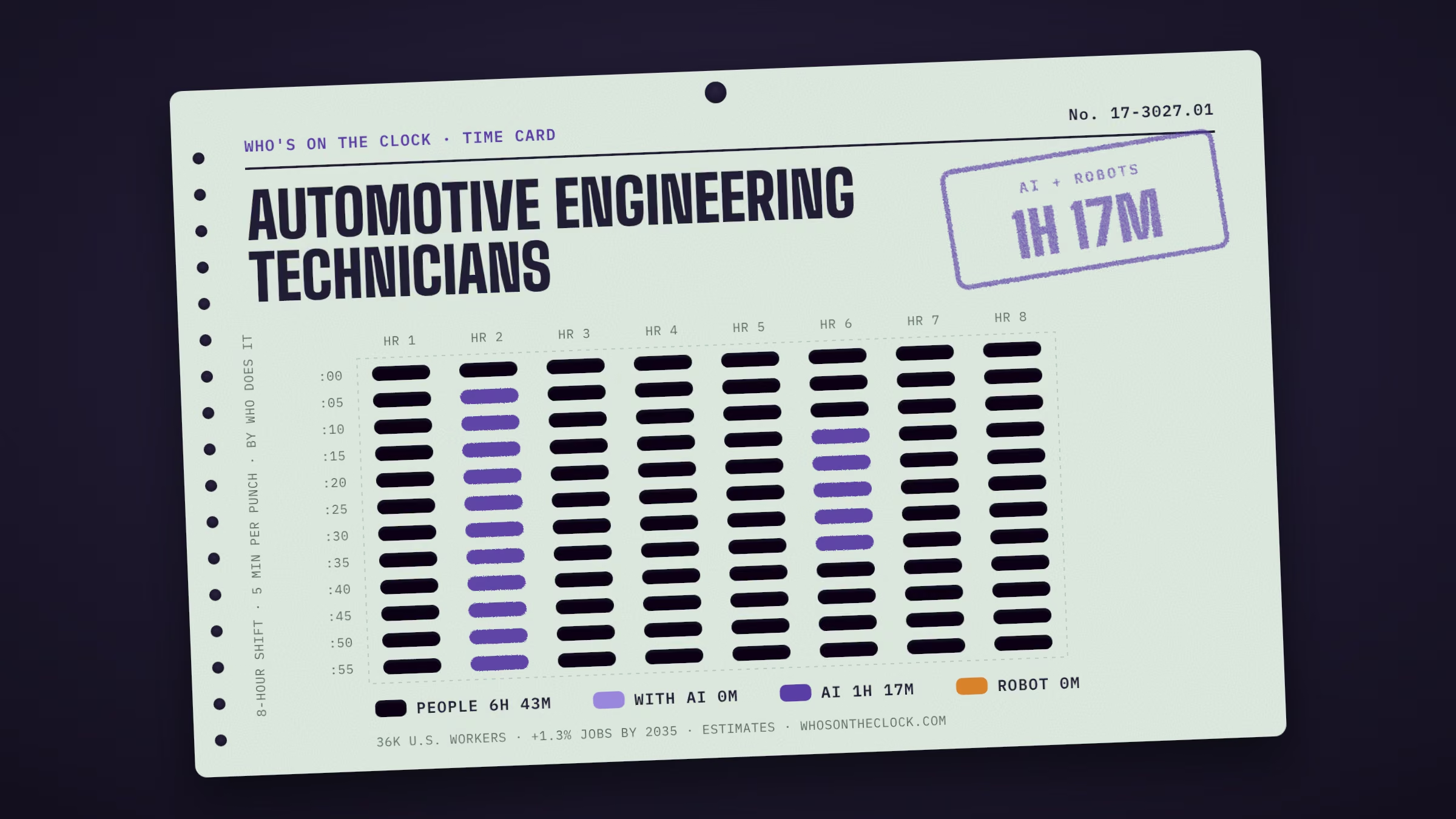
Assist engineers in determining the practicality of proposed product design changes and plan and carry out tests on experimental test devices or equipment for performance, durability, or efficiency.
Time card
Untick tasks you don't do, or set your own times.
| Mine | Task, by time spent | Human | With AI | AI | Robot |
|---|---|---|---|---|---|
Perform or execute manual or automated tests of automotive system or component performance, efficiency, or durability.1h 5m a shift · Robots only in factory cellsWhy this label?Robots have done this only in factory setups built around the machine, so it stays Human for automotive engineering technicians. How labels work | |||||
Document test results, using cameras, spreadsheets, documents, or other tools.53m a shift · Observed in AI useWhy this label?Marked AI because this task shows up regularly in real AI conversations (Anthropic Economic Index, 2025 usage), and in most of them AI does the task on its own rather than helping a person. Many workplaces may not use AI for it at all. How labels work | |||||
Set up mechanical, hydraulic, or electric test equipment in accordance with engineering specifications, standards, or test procedures.53m a shift · No AI or robot evidence foundWhy this label?This is physical work, and no robot has been shown doing it yet. How labels work | |||||
Analyze test data for automotive systems, subsystems, or component parts.41m a shift · No AI or robot evidence foundWhy this label?No AI use or robot deployment showed up for this task in our data. That isn't proof it's safe; it may just be rare in the data. How labels work | |||||
Monitor computer-controlled test equipment, according to written or verbal instructions.36m a shift · No AI or robot evidence foundWhy this label?No AI use or robot deployment showed up for this task in our data. That isn't proof it's safe; it may just be rare in the data. How labels work | |||||
Install equipment, such as instrumentation, test equipment, engines, or aftermarket products, to ensure proper interfaces.36m a shift · No AI or robot evidence foundWhy this label?This is physical work, and no robot has been shown doing it yet. How labels work | |||||
Inspect or test parts to determine nature or cause of defects or malfunctions.30m a shift · Robots only in factory cellsWhy this label?Robots have done this only in factory setups built around the machine, so it stays Human for automotive engineering technicians. How labels work | |||||
Read and interpret blueprints, schematics, work specifications, drawings, or charts.24m a shift · Observed in AI useTypical AI request: about 4h 49m alone, 27m with AIWhy this label?Marked AI because this task shows up regularly in real AI conversations (Anthropic Economic Index, 2025 usage), and in most of them AI does the task on its own rather than helping a person. Many workplaces may not use AI for it at all. How labels work | |||||
Maintain test equipment in operational condition by performing routine maintenance or making minor repairs or adjustments as needed.24m a shift · No AI or robot evidence foundWhy this label?This is physical work, and no robot has been shown doing it yet. How labels work | |||||
Fabricate new or modify existing prototype components or fixtures.24m a shift · Robots only in factory cellsWhy this label?Robots have done this only in factory setups built around the machine, so it stays Human for automotive engineering technicians. How labels work | |||||
Participate in research or testing of computerized automotive applications, such as telemetrics, intelligent transportation systems, artificial intelligence, or automatic control.18m a shift · Robots only in factory cellsWhy this label?Robots have done this only in factory setups built around the machine, so it stays Human for automotive engineering technicians. How labels work | |||||
Analyze performance of vehicles or components that have been redesigned to increase fuel efficiency, such as camless or dual-clutch engines or alternative types of air-conditioning systems.12m a shift · No AI or robot evidence foundWhy this label?No AI use or robot deployment showed up for this task in our data. That isn't proof it's safe; it may just be rare in the data. How labels work | |||||
Order new test equipment, supplies, or replacement parts.12m a shift · No AI or robot evidence foundWhy this label?No AI use or robot deployment showed up for this task in our data. That isn't proof it's safe; it may just be rare in the data. How labels work | |||||
Recommend product or component design improvements, based on test data or observations.12m a shift · No AI or robot evidence foundWhy this label?No AI use or robot deployment showed up for this task in our data. That isn't proof it's safe; it may just be rare in the data. How labels work | |||||
Recommend tests or testing conditions in accordance with designs, customer requirements, or industry standards to ensure test validity.12m a shift · No AI or robot evidence foundWhy this label?No AI use or robot deployment showed up for this task in our data. That isn't proof it's safe; it may just be rare in the data. How labels work | |||||
Test performance of vehicles that use alternative fuels, such as alcohol blends, natural gas, liquefied petroleum gas, biodiesel, nano diesel, or alternative power methods, such as solar energy or hydrogen fuel cells.12m a shift · Robots only in factory cellsWhy this label?Robots have done this only in factory setups built around the machine, so it stays Human for automotive engineering technicians. How labels work | |||||
Build instrumentation or laboratory test equipment for special purposes.12m a shift · No AI or robot evidence foundWhy this label?This is physical work, and no robot has been shown doing it yet. How labels work | |||||
Improve fuel efficiency by testing vehicles or components that use lighter materials, such as aluminum, magnesium alloy, or plastic.6m a shift · Robots only in factory cellsWhy this label?Robots have done this only in factory setups built around the machine, so it stays Human for automotive engineering technicians. How labels work |