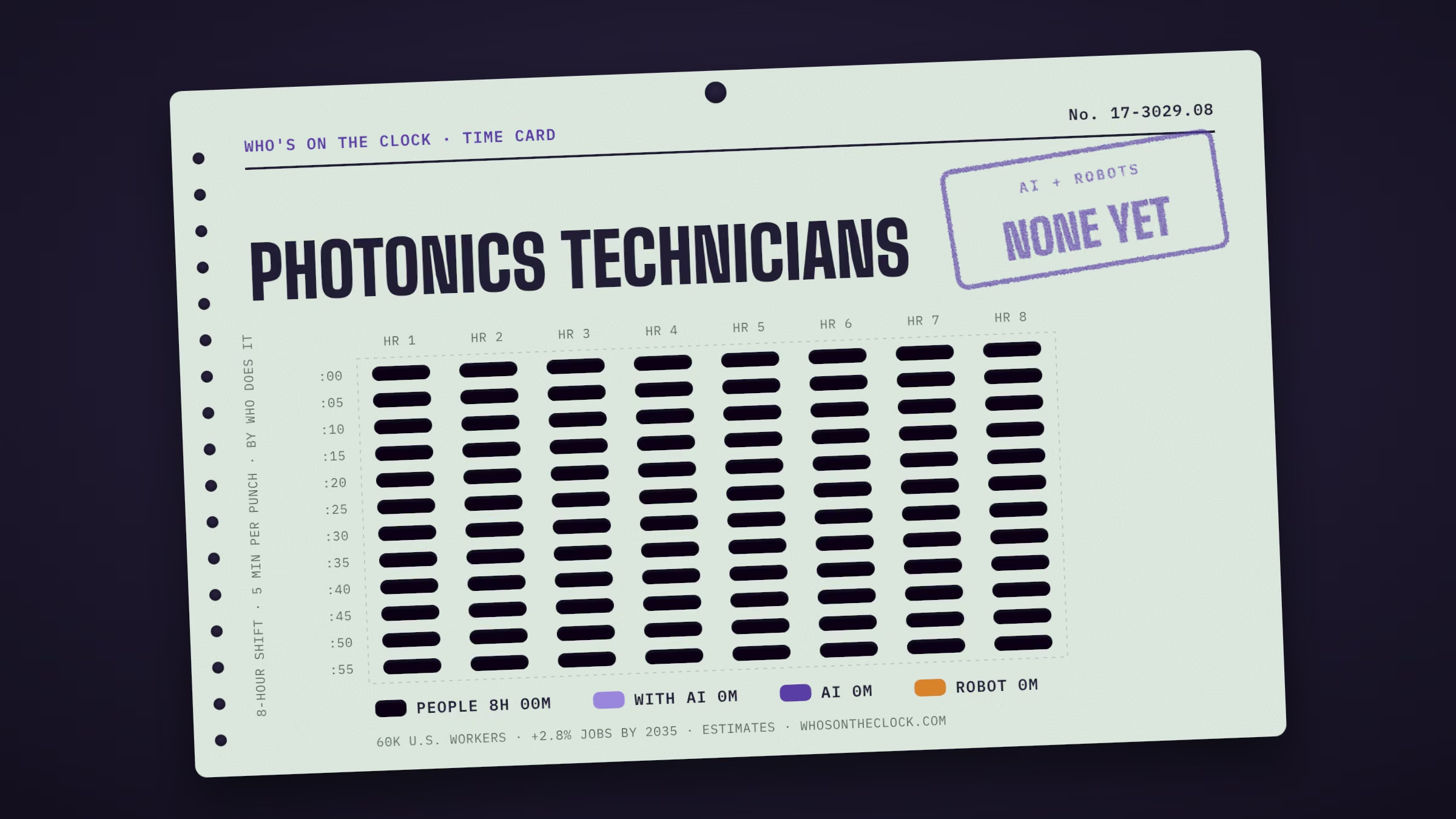
Build, install, test, or maintain optical or fiber optic equipment, such as lasers, lenses, or mirrors, using spectrometers, interferometers, or related equipment.
Time card
Untick tasks you don't do, or set your own times.
| Mine | Task, by time spent | Human | With AI | AI | Robot |
|---|---|---|---|---|---|
Assemble fiber optical, optoelectronic, or free-space optics components, subcomponents, assemblies, or subassemblies.45m a shift · Robots only in factory cellsWhy this label?Robots have done this only in factory setups built around the machine, so it stays Human for photonics technicians. How labels work | |||||
Adjust or maintain equipment, such as lasers, laser systems, microscopes, oscilloscopes, pulse generators, power meters, beam analyzers, or energy measurement devices.38m a shift · Robots only in factory cellsWhy this label?Robots have done this only in factory setups built around the machine, so it stays Human for photonics technicians. How labels work | |||||
Set up or operate assembly or processing equipment, such as lasers, cameras, die bonders, wire bonders, dispensers, reflow ovens, soldering irons, die shears, wire pull testers, temperature or humidity chambers, or optical spectrum analyzers.38m a shift · Robots only in factory cellsWhy this label?Robots have done this only in factory setups built around the machine, so it stays Human for photonics technicians. How labels work | |||||
Test or perform failure analysis for optomechanical or optoelectrical products, according to test plans.38m a shift · Robots only in factory cellsWhy this label?Robots have done this only in factory setups built around the machine, so it stays Human for photonics technicians. How labels work | |||||
Compute or record photonic test data.32m a shift · No AI or robot evidence foundWhy this label?No AI use or robot deployment showed up for this task in our data. That isn't proof it's safe; it may just be rare in the data. How labels work | |||||
Maintain clean working environments, according to clean room standards.26m a shift · Robots only in factory cellsWhy this label?Robots have done this only in factory setups built around the machine, so it stays Human for photonics technicians. How labels work | |||||
Assist scientists or engineers in the conduct of photonic experiments.26m a shift · Robots only in factory cellsWhy this label?Robots have done this only in factory setups built around the machine, so it stays Human for photonics technicians. How labels work | |||||
Assist engineers in the development of new products, fixtures, tools, or processes.26m a shift · Robots only in factory cellsWhy this label?Robots have done this only in factory setups built around the machine, so it stays Human for photonics technicians. How labels work | |||||
Document procedures, such as calibration of optical or fiber optic equipment.19m a shift · No AI or robot evidence foundWhy this label?No AI use or robot deployment showed up for this task in our data. That isn't proof it's safe; it may just be rare in the data. How labels work | |||||
Set up or operate prototype or test apparatus, such as control consoles, collimators, recording equipment, or cables.19m a shift · Robots only in factory cellsWhy this label?Robots have done this only in factory setups built around the machine, so it stays Human for photonics technicians. How labels work | |||||
Terminate, cure, polish, or test fiber cables with mechanical connectors.19m a shift · Robots only in factory cellsWhy this label?Robots have done this only in factory setups built around the machine, so it stays Human for photonics technicians. How labels work | |||||
Assemble or adjust parts or related electrical units of prototypes to prepare for testing.19m a shift · Robots only in factory cellsWhy this label?Robots have done this only in factory setups built around the machine, so it stays Human for photonics technicians. How labels work | |||||
Monitor inventory levels and order supplies as necessary.13m a shift · No AI or robot evidence foundWhy this label?No AI use or robot deployment showed up for this task in our data. That isn't proof it's safe; it may just be rare in the data. How labels work | |||||
Optimize photonic process parameters by making prototype or production devices.13m a shift · Robots only in factory cellsWhy this label?Robots have done this only in factory setups built around the machine, so it stays Human for photonics technicians. How labels work | |||||
Splice fibers, using fusion splicing or other techniques.13m a shift · Robots only in factory cellsWhy this label?Robots have done this only in factory setups built around the machine, so it stays Human for photonics technicians. How labels work | |||||
Build prototype optomechanical devices for use in equipment such as aerial cameras, gun sights, or telescopes.13m a shift · Robots only in factory cellsWhy this label?Robots have done this only in factory setups built around the machine, so it stays Human for photonics technicians. How labels work | |||||
Perform diagnostic analyses of processing steps, using analytical or metrological tools, such as microscopy, profilometry, or ellipsometry devices.13m a shift · Robots only in factory cellsWhy this label?Robots have done this only in factory setups built around the machine, so it stays Human for photonics technicians. How labels work | |||||
Repair or calibrate products, such as surgical lasers.13m a shift · No AI or robot evidence foundWhy this label?This is physical work, and no robot has been shown doing it yet. How labels work | |||||
Design, build, or modify fixtures used to assemble parts.13m a shift · No AI or robot evidence foundWhy this label?This is physical work, and no robot has been shown doing it yet. How labels work | |||||
Assemble components of energy-efficient optical communications systems involving photonic switches, optical backplanes, or optoelectronic interfaces.13m a shift · Robots only in factory cellsWhy this label?Robots have done this only in factory setups built around the machine, so it stays Human for photonics technicians. How labels work | |||||
Fabricate devices, such as optoelectronic or semiconductor devices.13m a shift · Robots only in factory cellsWhy this label?Robots have done this only in factory setups built around the machine, so it stays Human for photonics technicians. How labels work | |||||
Recommend optical or optic equipment design or material changes to reduce costs or processing times.6m a shift · No AI or robot evidence foundWhy this label?No AI use or robot deployment showed up for this task in our data. That isn't proof it's safe; it may just be rare in the data. How labels work | |||||
Lay out cutting lines for machining, using drafting tools.6m a shift · Robots only in factory cellsWhy this label?Robots have done this only in factory setups built around the machine, so it stays Human for photonics technicians. How labels work | |||||
Mix, pour, or use processing chemicals or gases according to safety standards or established operating procedures.6m a shift · Robots only in factory cellsWhy this label?Robots have done this only in factory setups built around the machine, so it stays Human for photonics technicians. How labels work |