Will AI replace cost estimators?

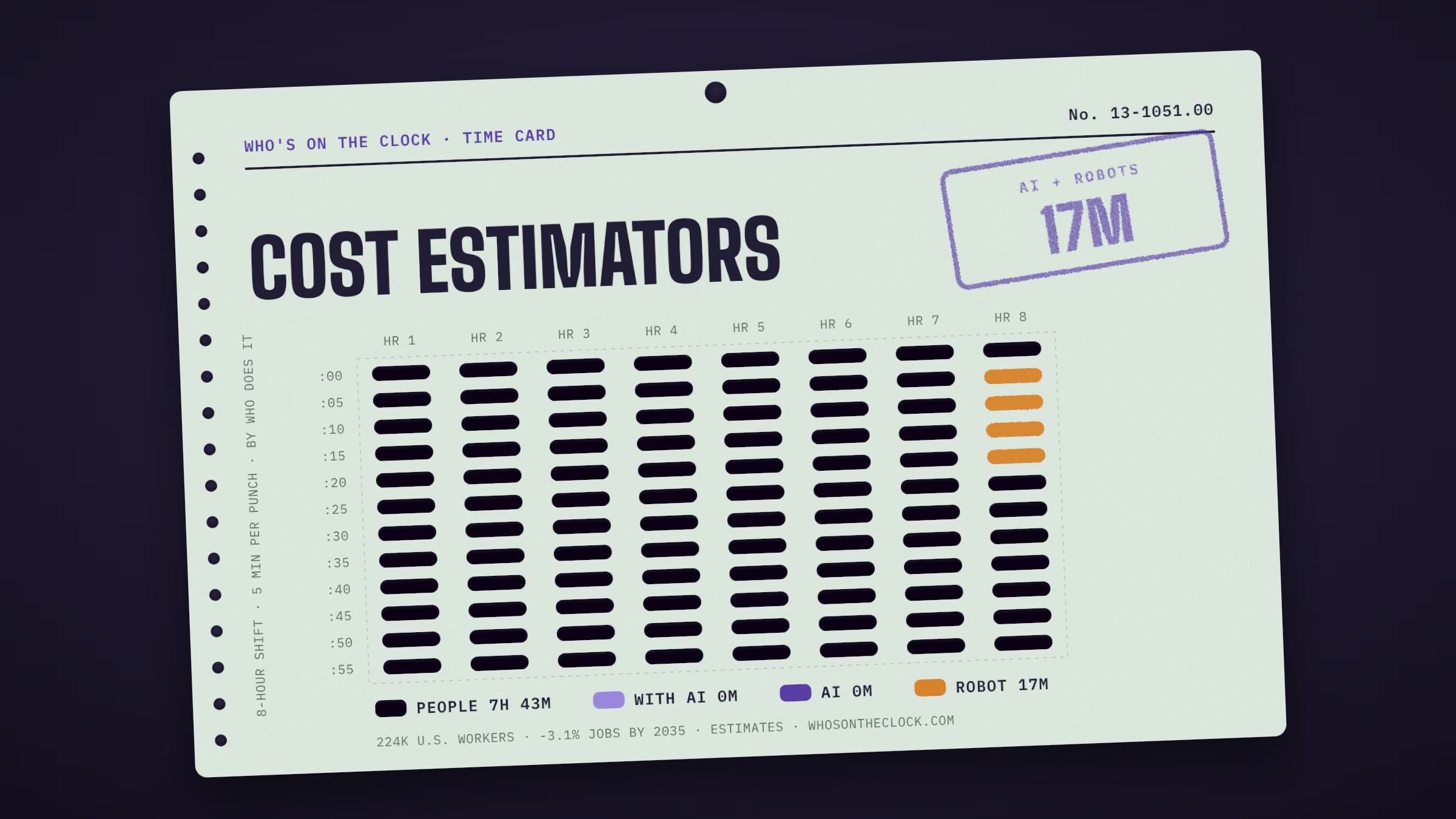
The biggest change here is physical: systems like Spot + FieldAI Field Foundation Models have done tasks such as “Visit site and record information about access” in real workplaces, about 17m of a typical shift. Most of the rest, 7h 43m, has no AI or robot evidence. BLS expects about 3.1% fewer of these jobs by 2035.

Time card for cost estimators showing a typical 8-hour shift: 7h 43m done by people, 17m by robots.
Each mark is 5 minutes of a typical shift for cost estimators, colored by who does that task today. Estimates from O*NET tasks and Anthropic Economic Index data. How it's made

Home / Business & finance / Cost Estimators

Prepare cost estimates for product manufacturing, construction projects, or services to aid management in bidding on or determining price of product or service. May specialize according to particular service performed or type of product manufactured.

Time card

Untick tasks you don't do, or set your own times.
MineTask, by time spentHumanWith AIAIRobot
Analyze blueprints and other documentation to prepare time, cost, materials, and labor estimates.1h 56m a shift · No AI or robot evidence found
Why this label?No AI use or robot deployment showed up for this task in our data. That isn't proof it's safe; it may just be rare in the data. How labels work
Consult with clients, vendors, personnel in other departments, or construction foremen to discuss and formulate estimates and resolve issues.52m a shift · No AI or robot evidence found
Why this label?No AI use or robot deployment showed up for this task in our data. That isn't proof it's safe; it may just be rare in the data. How labels work
Confer with engineers, architects, owners, contractors, and subcontractors on changes and adjustments to cost estimates.46m a shift · No AI or robot evidence found
Why this label?No AI use or robot deployment showed up for this task in our data. That isn't proof it's safe; it may just be rare in the data. How labels work
Assess cost effectiveness of products, projects or services, tracking actual costs relative to bids as the project develops.40m a shift · No AI or robot evidence found
Why this label?No AI use or robot deployment showed up for this task in our data. That isn't proof it's safe; it may just be rare in the data. How labels work
Prepare estimates used by management for purposes such as planning, organizing, and scheduling work.40m a shift · No AI or robot evidence found
Why this label?No AI use or robot deployment showed up for this task in our data. That isn't proof it's safe; it may just be rare in the data. How labels work
Collect historical cost data to estimate costs for current or future products.35m a shift · No AI or robot evidence found
Why this label?No AI use or robot deployment showed up for this task in our data. That isn't proof it's safe; it may just be rare in the data. How labels work
Prepare estimates for use in selecting vendors or subcontractors.35m a shift · No AI or robot evidence found
Why this label?No AI use or robot deployment showed up for this task in our data. That isn't proof it's safe; it may just be rare in the data. How labels work
Establish and maintain tendering process, and conduct negotiations.29m a shift · No AI or robot evidence found
Why this label?No AI use or robot deployment showed up for this task in our data. That isn't proof it's safe; it may just be rare in the data. How labels work
Prepare cost and expenditure statements and other necessary documentation at regular intervals for the duration of the project.29m a shift · No AI or robot evidence found
Why this label?No AI use or robot deployment showed up for this task in our data. That isn't proof it's safe; it may just be rare in the data. How labels work
Visit site and record information about access, drainage and topography, and availability of utility services.17m a shift · Robots deployed · e.g. Spot + FieldAI Field Foundation Models
Why this label?Marked Robot because Spot + FieldAI Field Foundation Models (in real use) has done this task in a real workplace. It shows a robot can do it somewhere, not that most cost estimators work alongside one. How labels work
Set up cost monitoring and reporting systems and procedures.12m a shift · No AI or robot evidence found
Why this label?No AI use or robot deployment showed up for this task in our data. That isn't proof it's safe; it may just be rare in the data. How labels work
Review material and labor requirements to decide whether it is more cost-effective to produce or purchase components.12m a shift · No AI or robot evidence found
Why this label?No AI use or robot deployment showed up for this task in our data. That isn't proof it's safe; it may just be rare in the data. How labels work
Conduct special studies to develop and establish standard hour and related cost data or to reduce cost.12m a shift · No AI or robot evidence found
Why this label?No AI use or robot deployment showed up for this task in our data. That isn't proof it's safe; it may just be rare in the data. How labels work
Prepare and maintain a directory of suppliers, contractors and subcontractors.6m a shift · No AI or robot evidence found
Why this label?No AI use or robot deployment showed up for this task in our data. That isn't proof it's safe; it may just be rare in the data. How labels work

Clock history

  1. 17m touchedFirst published: O*NET 30.1, Anthropic Economic Index (2025 usage and September 2026 robot study), BLS May 2025

When new data changes this clock, the date, the new numbers and the reason are logged here. Company news alone never moves the clock.

On the floor

  1. Rolling outSeamless Flooring Systems
    Philadelphia-area contractors use AI to measure plans for bids

    Seamless Flooring Systems and Hispanic Ventures use AI takeoff tools that calculate quantities from plans. A ServiceTitan survey found 38% of contractors see measurable impact from AI, up from 17% in 2025.

    The Philadelphia Inquirer

Ask the clock

Will AI replace cost estimators?

Not on current evidence. Less than 30 minutes of a typical shift goes to tasks that AI or robots are doing today. The other 7h 43m (96%) stays with people. Separately, BLS expects about 3.1% fewer of these jobs by 2035 (all jobs: +3.5%).

What can AI already do for cost estimators?

None of this job's tasks show regular AI use yet. That can mean the work is hands-on or in person, or simply that it rarely comes up in AI usage data.

Where do robots fit in?

For some tasks, yes. Robots have done 1 of this job's tasks in workplaces like this one, about 17m of a typical shift.

  • Visit site and record information about access, drainage and topography, and availability of utility services. (17m a shift; e.g. Spot + FieldAI Field Foundation Models, in use)
What still needs a person?

7h 43m of a typical shift, or 96%, goes to tasks with no AI or robot evidence yet. No AI usage or robot deployment has shown up for these so far. The biggest:

  • Analyze blueprints and other documentation to prepare time, cost, materials, and labor estimates. (1h 56m a shift)
  • Consult with clients, vendors, personnel in other departments, or construction foremen to discuss and formulate estimates and resolve issues. (52m a shift)
  • Confer with engineers, architects, owners, contractors, and subcontractors on changes and adjustments to cost estimates. (46m a shift)
  • Assess cost effectiveness of products, projects or services, tracking actual costs relative to bids as the project develops. (40m a shift)
  • Prepare estimates used by management for purposes such as planning, organizing, and scheduling work. (40m a shift)
Why is that work hard to automate?

Much of it comes down to where and how the work happens. In-person, hands-on and high-stakes work is where AI and robots have made the least headway so far. In the official O*NET survey of people in this job:

  • 50% talk face to face with others every day
What are companies actually doing?

We track 1 sourced company move that affects this job. Most recent:

  • Aug 11, 2026: Philadelphia-area contractors use AI to measure plans for bids (Rolling out)
Are employers still hiring cost estimators?

On Indeed, job postings in the Management sector are at 104% of their February 2020 level (all U.S. postings: 104%), up 8.3% from a year earlier, as of Oct 9, 2026. BLS separately expects about 18,000 openings a year in this job through 2035. Across all U.S. postings, 7.3% now mention AI skills. Sector postings cover more than this one job and move for many reasons besides AI.

How much do cost estimators make?

The median pay is about $78,740 a year ($37.86 an hour), 54% above the median for all U.S. jobs ($50,980). Most people in this job earn between $48,530 and $130,820 a year; that range covers the middle 80%. Pay figures are from BLS, May 2025, and vary a lot by state and employer. Pick a state to compare:

Is this job growing or shrinking?

BLS projects a decline of 3.1% from 2025 to 2035, compared with 3.5% growth for all jobs. That's about 220,000 jobs in 2035. Even so, it expects about 18,000 openings a year, mostly from people retiring or changing careers. These projections don't single out AI as a cause.

How many cost estimators are there in the U.S.?

About 224,000 people in the U.S., roughly 0.14% of all workers (BLS, May 2025). That makes it the 159th largest of the 796 jobs on this site. BLS expects about 220,000 in 2035.

What training do cost estimators need?

The most common requirement is a bachelor's degree: about 82% of people in the job said so in the official O*NET survey. O*NET rates the job at level 4 of 5 for preparation, which usually means: bachelor's degree. Requirements vary by state and employer, especially for licensed work.

What should I learn to stay ahead of AI?

These come from the job's official skill ratings and from the tasks that AI and robots touch least today. Building them keeps you strong in the parts of the work that still need a person:

  • Skills that matter more here than in most jobs: Management of Financial Resources, Mathematics, Reading Comprehension, Judgment and Decision Making
  • Get strong at the parts of the job that stay with people (listed above), which take 7h 43m of a typical shift
  • Tools employers list: Microsoft Outlook, Microsoft Office software, Microsoft Excel, Adobe Acrobat, Autodesk AutoCAD
What new tasks are cost estimators taking on?

Yes. Occupational experts recently added these to the official task list, a sign of how the work itself is shifting. New tasks aren't rated for AI or robots yet:

  • Use remote sensing technologies or drones to evaluate site conditions when in-person visits are not feasible.
What other jobs could cost estimators move into?

These use similar skills. Matches come from 109 official ratings of skills, knowledge and work activities, and each needs the same or less preparation unless the official list relates the jobs directly:

  • Logistics Engineers (2h 8m touched, $82k median pay)
  • Architectural and Engineering Managers (27m touched, $171k median pay)
How solid are these numbers?

Each task carries its own evidence label. For this job: 1 with robots in real deployments, 13 with no AI or robot evidence found. The minutes per task are estimates, not measured hours, and "no evidence" doesn't prove a task is safe.

Tools in demand

  • Adobe Acrobat
  • Autodesk AutoCAD
  • Autodesk Revit
  • Intuit QuickBooks
  • Microsoft Access

Plus everyday office tools: Microsoft Outlook, Microsoft Office software, Microsoft Excel.

Also called

Acquisition Cost Estimator, Analyst, Building Construction Estimator, Building Estimator, Civil Estimator, Commercial Construction Estimator, Commercial Estimator, Commercial Roofing Estimator, Concrete Estimator, Construction Estimator, Construction Job Cost Estimator, Cost Analyst, Cost Consultant, Cost Engineer