Will AI replace logistics engineers?

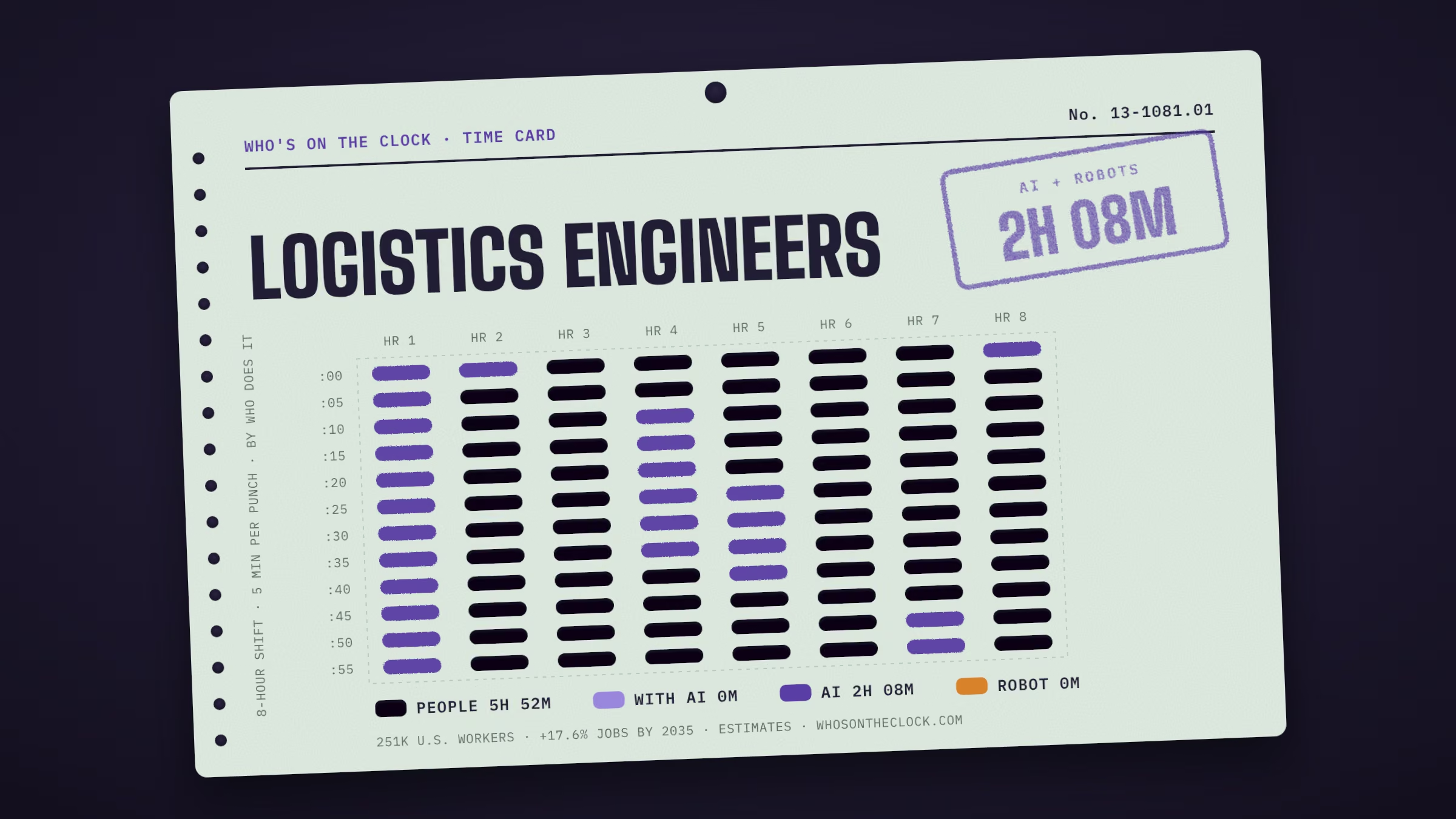
Some tasks are already handled by AI or machines; the rest still needs a person. About 2h 8m of an 8-hour shift goes to tasks that AI or robots largely take over. The other 5h 52m (73%) stays with people. Separately, BLS expects about 17.6% more of these jobs by 2035 (all jobs: +3.5%).

Time card for logistics engineers showing a typical 8-hour shift: 5h 52m done by people, 2h 8m by AI.
Each mark is 5 minutes of a typical shift for logistics engineers, colored by who does that task today. Estimates from O*NET tasks and Anthropic Economic Index data. How it's made

Home / Business & finance / Logistics Engineers

Design or analyze operational solutions for projects such as transportation optimization, network modeling, process and methods analysis, cost containment, capacity enhancement, routing and shipment optimization, or information management.

Time card

Untick tasks you don't do, or set your own times.
MineTask, by time spentHumanWith AIAIRobot
Analyze or interpret logistics data involving customer service, forecasting, procurement, manufacturing, inventory, transportation, or warehousing.1h 4m a shift · Observed in AI useTypical AI request: about 4h 28m alone, 27m with AI
Conduct logistics studies or analyses, such as time studies, zero-base analyses, rate analyses, network analyses, flow-path analyses, or supply chain analyses.58m a shift · No AI or robot evidence found
Identify cost-reduction or process-improvement logistic opportunities.38m a shift · No AI or robot evidence found
Develop logistic metrics, internal analysis tools, or key performance indicators for business units.32m a shift · No AI or robot evidence found
Propose logistics solutions for customers.32m a shift · Observed in AI useTypical AI request: about 4h 41m alone, 52m with AI
Evaluate effectiveness of current or future logistical processes.26m a shift · No AI or robot evidence found
Apply logistics modeling techniques to address issues, such as operational process improvement or facility design or layout.19m a shift · No AI or robot evidence found
Develop or maintain cost estimates, forecasts, or cost models.19m a shift · Observed in AI useTypical AI request: about 3h 24m alone, 30m with AI
Direct the work of logistics analysts.19m a shift · No AI or robot evidence found
Identify or develop business rules or standard operating procedures to streamline operating processes.13m a shift · No AI or robot evidence found
Interview key staff or tour facilities to identify efficiency-improvement, cost-reduction, or service-delivery opportunities.13m a shift · No AI or robot evidence found
Review contractual commitments, customer specifications, or related information to determine logistics or support requirements.13m a shift · No AI or robot evidence found
Prepare or validate documentation on automated logistics or maintenance-data reporting or management information systems.13m a shift · No AI or robot evidence found
Provide logistical facility or capacity planning analyses for distribution or transportation functions.13m a shift · No AI or robot evidence found
Determine logistics support requirements, such as facility details, staffing needs, or safety or maintenance plans.13m a shift · No AI or robot evidence found
Develop specifications for equipment, tools, facility layouts, or material-handling systems.13m a shift · No AI or robot evidence found
Provide logistics technology or information for effective and efficient support of product, equipment, or system manufacturing or service.13m a shift · Observed in AI useTypical AI request: about 1h 38m alone, 16m with AI
Prepare logistic strategies or conceptual designs for production facilities.6m a shift · No AI or robot evidence found
Design plant distribution centers.6m a shift · No AI or robot evidence found
Evaluate the use of inventory tracking technology, Web-based warehousing software, or intelligent conveyor systems to maximize plant or distribution center efficiency.6m a shift · No AI or robot evidence found
Determine feasibility of designing new facilities or modifying existing facilities, based on factors such as cost, available space, schedule, technical requirements, or ergonomics.6m a shift · No AI or robot evidence found
Design comprehensive supply chains that minimize environmental impacts or costs.6m a shift · No AI or robot evidence found
Create models or scenarios to predict the impact of changing circumstances, such as fuel costs, road pricing, energy taxes, or carbon emissions legislation.6m a shift · No AI or robot evidence found
Evaluate the use of technologies, such as global positioning systems (GPS), radio-frequency identification (RFID), route navigation software, or satellite linkup systems, to improve transportation efficiency.6m a shift · No AI or robot evidence found
Determine requirements for compliance with environmental certification standards.6m a shift · No AI or robot evidence found
Develop or document procedures to minimize or mitigate carbon output resulting from the movement of materials or products.6m a shift · No AI or robot evidence found
Develop or document reverse logistics management processes to ensure maximal efficiency of product recycling, reuse, or final disposal.6m a shift · No AI or robot evidence found
Review global, national, or regional transportation or logistics reports for ways to improve efficiency or minimize the environmental impact of logistics activities.6m a shift · No AI or robot evidence found
Conduct environmental audits for logistics activities, such as storage, distribution, or transportation.time not estimated · No AI or robot evidence found
Assess the environmental impact or energy efficiency of logistics activities, using carbon mitigation software.time not estimated · No AI or robot evidence found

On the floor

No company news tracked for this job yet. New stories are added as they happen.

Ask the clock

Will AI replace logistics engineers?

Some tasks are already handled by AI or machines; the rest still needs a person. About 2h 8m of an 8-hour shift goes to tasks that AI or robots largely take over. The other 5h 52m (73%) stays with people. Separately, BLS expects about 17.6% more of these jobs by 2035 (all jobs: +3.5%).

What can AI already do for logistics engineers?

AI shows up regularly in 4 of 30 tasks, about 2h 8m of a typical shift. The biggest ones:

  • Analyze or interpret logistics data involving customer service, forecasting, procurement, manufacturing, inventory, transportation, or warehousing. (1h 4m a shift, AI mostly does it alone)
  • Propose logistics solutions for customers. (32m a shift, AI mostly does it alone)
  • Develop or maintain cost estimates, forecasts, or cost models. (19m a shift, AI mostly does it alone)
  • Provide logistics technology or information for effective and efficient support of product, equipment, or system manufacturing or service. (13m a shift, AI mostly does it alone)
What still needs a person?

5h 52m of a typical shift, or 73%, goes to tasks with no AI or robot evidence yet. No AI usage or robot deployment has shown up for these so far. The biggest:

  • Conduct logistics studies or analyses, such as time studies, zero-base analyses, rate analyses, network analyses, flow-path analyses, or supply chain analyses. (58m a shift)
  • Identify cost-reduction or process-improvement logistic opportunities. (38m a shift)
  • Develop logistic metrics, internal analysis tools, or key performance indicators for business units. (32m a shift)
  • Evaluate effectiveness of current or future logistical processes. (26m a shift)
  • Apply logistics modeling techniques to address issues, such as operational process improvement or facility design or layout. (19m a shift)
Why is that work hard to automate?

Much of it comes down to where and how the work happens. In-person, hands-on and high-stakes work is where AI and robots have made the least headway so far. In the official O*NET survey of people in this job:

  • 57% say dealing with the public is very or extremely important
  • 57% talk face to face with others every day
How much time does AI save on these tasks?

For the 4 tasks in this job where AI shows up and timing data exists, a typical request takes about 3h 56m for a person alone and about 29m with AI. These are Claude's own estimates from real conversations in April and May 2026 (Anthropic Economic Index). They describe single requests, not whole workdays, and time saved on a task doesn't mean jobs are cut. The biggest gaps:

  • Analyze or interpret logistics data involving customer service, forecasting, procurement, manufacturing, inventory, transportation, or warehousing (about 4h 28m alone, 27m with AI)
  • Propose logistics solutions for customers (about 4h 41m alone, 52m with AI)
  • Develop or maintain cost estimates, forecasts, or cost models (about 3h 24m alone, 30m with AI)
Are employers still hiring logistics engineers?

On Indeed, job postings in the Logistic Support sector are at 119% of their February 2020 level (all U.S. postings: 104%), up 5.1% from a year earlier, as of Oct 9, 2026. BLS separately expects about 27,000 openings a year in this job through 2035. Across all U.S. postings, 7.3% now mention AI skills. Sector postings cover more than this one job and move for many reasons besides AI.

How much do logistics engineers make?

The median pay is about $82,320 a year ($39.58 an hour), 61% above the median for all U.S. jobs ($50,980). Most people in this job earn between $50,890 and $133,160 a year; that range covers the middle 80%. Pay figures are from BLS, May 2025, and vary a lot by state and employer. Pick a state to compare:

Is this job growing or shrinking?

BLS projects growth of 17.6% from 2025 to 2035, compared with 3.5% growth for all jobs. That's about 300,000 jobs in 2035. It expects about 27,000 openings a year, mostly from people retiring or changing careers. These projections don't single out AI as a cause.

How many logistics engineers are there in the U.S.?

About 251,000 people in the U.S., roughly 0.16% of all workers (BLS, May 2025). That makes it the 150th largest of the 796 jobs on this site. BLS expects about 300,000 in 2035.

What training do logistics engineers need?

The most common requirement is a bachelor's degree: about 74% of people in the job said so in the official O*NET survey. O*NET rates the job at level 4 of 5 for preparation, which usually means: bachelor's degree. Requirements vary by state and employer, especially for licensed work.

What should I learn to stay ahead of AI?

These come from the job's official skill ratings and from the tasks that AI and robots touch least today. Building them keeps you strong in the parts of the work that still need a person:

  • Skills that matter more here than in most jobs: Systems Analysis, Operations Analysis, Systems Evaluation, Mathematics
  • Get strong at the parts of the job that stay with people (listed above), which take 5h 52m of a typical shift
  • Tools employers list: SAP software, Microsoft PowerPoint, Microsoft Outlook, Microsoft Office software, Microsoft Excel
  • Learn to use AI well on the tasks where it already shows up in this job (listed above)
What other jobs could logistics engineers move into?

These use similar skills, with less of a typical shift touched by AI or robots. Matches come from 109 official ratings of skills, knowledge and work activities, and each needs the same or less preparation unless the official list relates the jobs directly:

  • Supply Chain Managers (0m touched, $107k median pay)
  • Logistics Analysts (1h 3m touched, $82k median pay)
  • Manufacturing Engineers (33m touched, $102k median pay)
  • Logisticians (46m touched, $82k median pay)
How solid are these numbers?

Each task carries its own evidence label. For this job: 4 observed in real AI use, 26 with no AI or robot evidence found. The minutes per task are estimates, not measured hours, and "no evidence" doesn't prove a task is safe.

Tools in demand

  • SAP software
  • Microsoft PowerPoint
  • Microsoft Outlook
  • Microsoft Office software
  • Microsoft Excel
  • Autodesk AutoCAD
  • C++
  • Microsoft Access

Also called

Acquisition Logistics Engineer, Aero Logistics Engineer (Aeronautical Logistics Engineer), Auto Logistics Engineer (Automotive Logistics Engineer), Continuous Improvement Specialist, Cost Engineer, Cost Estimating Engineer, Cost Reduction Engineer, Logistics Engineer, Logistics Planning Engineer, Logistics Research Engineer, Logistics Specialist, Logistics System Engineer, Procurement Engineer, Reliability Engineer