Will AI replace dental laboratory technicians?

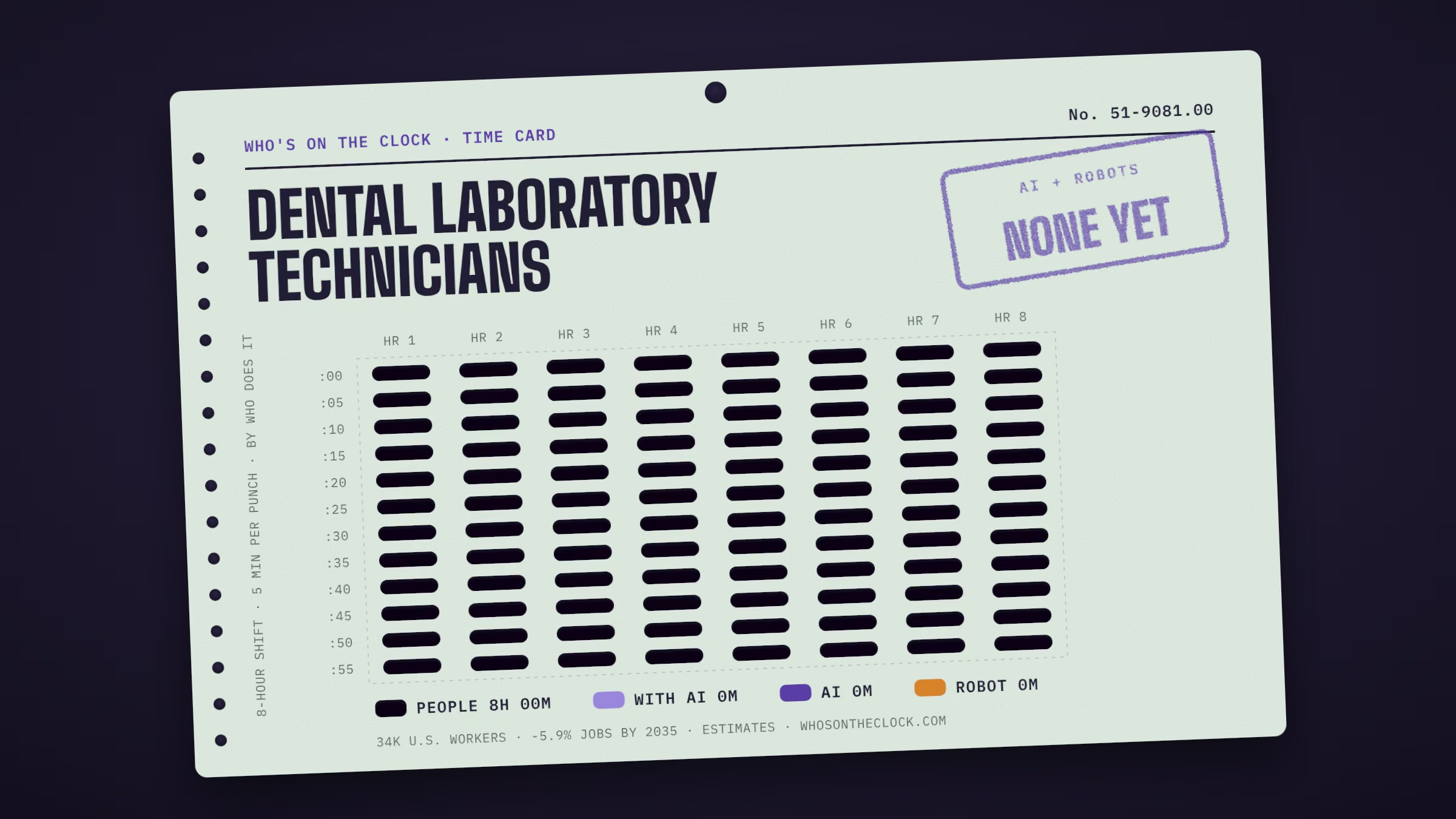
“Fabricate, alter, or repair dental devices, such as dentures, crowns” is the largest task here, and like every other task on this time card it is still done by people. We found no AI use or robot deployment for any of them. That reflects today's evidence and could change. BLS expects about 5.9% fewer of these jobs by 2035.

Time card for dental laboratory technicians showing a typical 8-hour shift: 8h done by people.
Each mark is 5 minutes of a typical shift for dental laboratory technicians, colored by who does that task today. Estimates from O*NET tasks and Anthropic Economic Index data. How it's made

Home / Production & factory / Dental Laboratory Technicians

Construct and repair full or partial dentures or dental appliances.

Time card

Untick tasks you don't do, or set your own times.
MineTask, by time spentHumanWith AIAIRobot
Fabricate, alter, or repair dental devices, such as dentures, crowns, bridges, inlays, or appliances for straightening teeth.1h 25m a shift · Robots only in factory cells
Why this label?Robots have done this only in factory setups built around the machine, so it stays Human for dental laboratory technicians. How labels work
Remove excess metal or porcelain and polish surfaces of prostheses or frameworks, using polishing machines.53m a shift · Robots only in factory cells
Why this label?Robots have done this only in factory setups built around the machine, so it stays Human for dental laboratory technicians. How labels work
Apply porcelain paste or wax over prosthesis frameworks or setups, using brushes and spatulas.46m a shift · Robots only in factory cells
Why this label?Robots have done this only in factory setups built around the machine, so it stays Human for dental laboratory technicians. How labels work
Read prescriptions or specifications and examine models or impressions to determine the design of dental products to be constructed.39m a shift · No AI or robot evidence found
Why this label?No AI use or robot deployment showed up for this task in our data. That isn't proof it's safe; it may just be rare in the data. How labels work
Melt metals or mix plaster, porcelain, or acrylic pastes and pour materials into molds or over frameworks to form dental prostheses or apparatuses.33m a shift · Robots only in factory cells
Why this label?Robots have done this only in factory setups built around the machine, so it stays Human for dental laboratory technicians. How labels work
Build and shape wax teeth, using small hand instruments and information from observations or dentists' specifications.33m a shift · Robots only in factory cells
Why this label?Robots have done this only in factory setups built around the machine, so it stays Human for dental laboratory technicians. How labels work
Test appliances for conformance to specifications and accuracy of occlusion, using articulators and micrometers.26m a shift · Robots only in factory cells
Why this label?Robots have done this only in factory setups built around the machine, so it stays Human for dental laboratory technicians. How labels work
Rebuild or replace linings, wire sections, or missing teeth to repair dentures.26m a shift · No AI or robot evidence found
Why this label?This is physical work, and no robot has been shown doing it yet. How labels work
Create a model of patient's mouth by pouring plaster into a dental impression and allowing plaster to set.26m a shift · Robots only in factory cells
Why this label?Robots have done this only in factory setups built around the machine, so it stays Human for dental laboratory technicians. How labels work
Place tooth models on an apparatus that mimics bite and movement of patient's jaw to evaluate functionality of model.20m a shift · No AI or robot evidence found
Why this label?This is physical work, and no robot has been shown doing it yet. How labels work
Prepare metal surfaces for bonding with porcelain to create artificial teeth, using small hand tools.20m a shift · Robots only in factory cells
Why this label?Robots have done this only in factory setups built around the machine, so it stays Human for dental laboratory technicians. How labels work
Load newly constructed teeth into porcelain furnaces to bake the porcelain onto the metal framework.20m a shift · Robots only in factory cells
Why this label?Robots have done this only in factory setups built around the machine, so it stays Human for dental laboratory technicians. How labels work
Train or supervise other dental technicians or dental laboratory bench workers.13m a shift · No AI or robot evidence found
Why this label?No AI use or robot deployment showed up for this task in our data. That isn't proof it's safe; it may just be rare in the data. How labels work
Mold wax over denture setups to form the full contours of artificial gums.13m a shift · Robots only in factory cells
Why this label?Robots have done this only in factory setups built around the machine, so it stays Human for dental laboratory technicians. How labels work
Shape and solder wire and metal frames or bands for dental products, using soldering irons and hand tools.13m a shift · Robots only in factory cells
Why this label?Robots have done this only in factory setups built around the machine, so it stays Human for dental laboratory technicians. How labels work
Prepare wax bite blocks and impression trays for use.7m a shift · Robots only in factory cells
Why this label?Robots have done this only in factory setups built around the machine, so it stays Human for dental laboratory technicians. How labels work
Fill chipped or low spots in surfaces of devices, using acrylic resins.7m a shift · No AI or robot evidence found
Why this label?This is physical work, and no robot has been shown doing it yet. How labels work

Clock history

  1. 0m touchedFirst published: O*NET 30.1, Anthropic Economic Index (2025 usage and September 2026 robot study), BLS May 2025

When new data changes this clock, the date, the new numbers and the reason are logged here. Company news alone never moves the clock.

On the floor

No company news tracked for this job yet. New stories are added as they happen.

Ask the clock

Will AI replace dental laboratory technicians?

Not on current evidence. Less than 30 minutes of a typical shift goes to tasks that AI or robots are doing today. The other 8h (100%) stays with people. Separately, BLS expects about 5.9% fewer of these jobs by 2035 (all jobs: +3.5%).

What can AI already do for dental laboratory technicians?

None of this job's tasks show regular AI use yet. That can mean the work is hands-on or in person, or simply that it rarely comes up in AI usage data.

Where do robots fit in?

Not in workplaces like this one, based on a 2026 review of robot deployments. 12 more tasks have only been done in factory setups built around the machine, so they stay with people here. For 3 physical tasks, no robot has shown it can do the work yet.

What still needs a person?

8h of a typical shift, or 100%, goes to tasks with no AI or robot evidence yet. No AI usage or robot deployment has shown up for these so far. The biggest:

  • Fabricate, alter, or repair dental devices, such as dentures, crowns, bridges, inlays, or appliances for straightening teeth. (1h 25m a shift)
  • Remove excess metal or porcelain and polish surfaces of prostheses or frameworks, using polishing machines. (53m a shift)
  • Apply porcelain paste or wax over prosthesis frameworks or setups, using brushes and spatulas. (46m a shift)
  • Read prescriptions or specifications and examine models or impressions to determine the design of dental products to be constructed. (39m a shift)
  • Melt metals or mix plaster, porcelain, or acrylic pastes and pour materials into molds or over frameworks to form dental prostheses or apparatuses. (33m a shift)
Why is that work hard to automate?

Much of it comes down to where and how the work happens. In-person, hands-on and high-stakes work is where AI and robots have made the least headway so far. In the official O*NET survey of people in this job:

  • 95% use their hands on tools, objects or controls more than half the time
  • 71% talk face to face with others every day
  • 51% are exposed to disease or infection every day
Are employers still hiring dental laboratory technicians?

On Indeed, job postings in the Production & Manufacturing sector are at 124% of their February 2020 level (all U.S. postings: 104%), up 12.6% from a year earlier, as of Oct 9, 2026. BLS separately expects about 3,600 openings a year in this job through 2035. Across all U.S. postings, 7.3% now mention AI skills. Sector postings cover more than this one job and move for many reasons besides AI.

How much do dental laboratory technicians make?

The median pay is about $49,610 a year ($23.85 an hour), 3% below the median for all U.S. jobs ($50,980). Most people in this job earn between $36,660 and $76,940 a year; that range covers the middle 80%. Pay figures are from BLS, May 2025, and vary a lot by state and employer. Pick a state to compare:

Is this job growing or shrinking?

BLS projects a decline of 5.9% from 2025 to 2035, compared with 3.5% growth for all jobs. That's about 32,000 jobs in 2035. Even so, it expects about 3,600 openings a year, mostly from people retiring or changing careers. These projections don't single out AI as a cause.

How many dental laboratory technicians are there in the U.S.?

About 34,000 people in the U.S., roughly 0.02% of all workers (BLS, May 2025). That makes it the 451st largest of the 796 jobs on this site. BLS expects about 32,000 in 2035.

What training do dental laboratory technicians need?

The most common requirement is a high school diploma: about 52% of people in the job said so in the official O*NET survey. O*NET rates the job at level 2 of 5 for preparation, which usually means: high school diploma, some training. Requirements vary by state and employer, especially for licensed work.

What should I learn to stay ahead of AI?

These come from the job's official skill ratings and from the tasks that AI and robots touch least today. Building them keeps you strong in the parts of the work that still need a person:

  • Skills that matter more here than in most jobs: Operations Monitoring, Time Management, Reading Comprehension, Active Learning
  • Get strong at the parts of the job that stay with people (listed above), which take 8h of a typical shift
  • Tools employers list: Intuit QuickBooks, Microsoft Excel, Microsoft Office software, Microsoft Outlook, Microsoft PowerPoint
What new tasks are dental laboratory technicians taking on?

Yes. Occupational experts recently added these to the official task list, a sign of how the work itself is shifting. New tasks aren't rated for AI or robots yet:

  • Meet with dentists or patients to discuss dental appliances.
  • Order parts or materials needed to make dental appliances.
  • Scan dental models to create digital files.
  • Stain porcelain on dental appliances to match the color of patients' teeth.
What other jobs could dental laboratory technicians move into?

These use similar skills. Matches come from 109 official ratings of skills, knowledge and work activities, and each needs the same or less preparation unless the official list relates the jobs directly:

  • Medical Appliance Technicians (0m touched, $48k median pay)
  • Dental Assistants (0m touched, $48k median pay)
  • Ophthalmic Laboratory Technicians (40m touched, $39k median pay)
  • Medical Equipment Repairers (0m touched, $62k median pay)
  • Molders, Shapers, and Casters (6m touched, $46k median pay)
How solid are these numbers?

Each task carries its own evidence label. For this job: 17 with no AI or robot evidence found. The minutes per task are estimates, not measured hours, and "no evidence" doesn't prove a task is safe.

Tools in demand

  • Intuit QuickBooks

Plus everyday office tools: Microsoft Excel, Microsoft Office software, Microsoft Outlook, Microsoft PowerPoint, Microsoft Windows, Microsoft Word.

Also called

Bridge Technician, CAD Tech (Computer-Aided Design Technician), CAM Tech (Computer-Aided Manufacturing Technician), Ceramist, Certified Dental Technologist (CDT), Crown Ceramist, Crown and Bridge Dental Laboratory Technician (Crown and Bridge Dental Lab Tech), Crown and Bridge Technician (Crown and Bridge Tech), Dental Appliance Fixer, Dental Appliance Mechanic, Dental Appliance Repairer, Dental Ceramist, Dental Ceramist Assistant, Dental Equipment Installer and Servicer