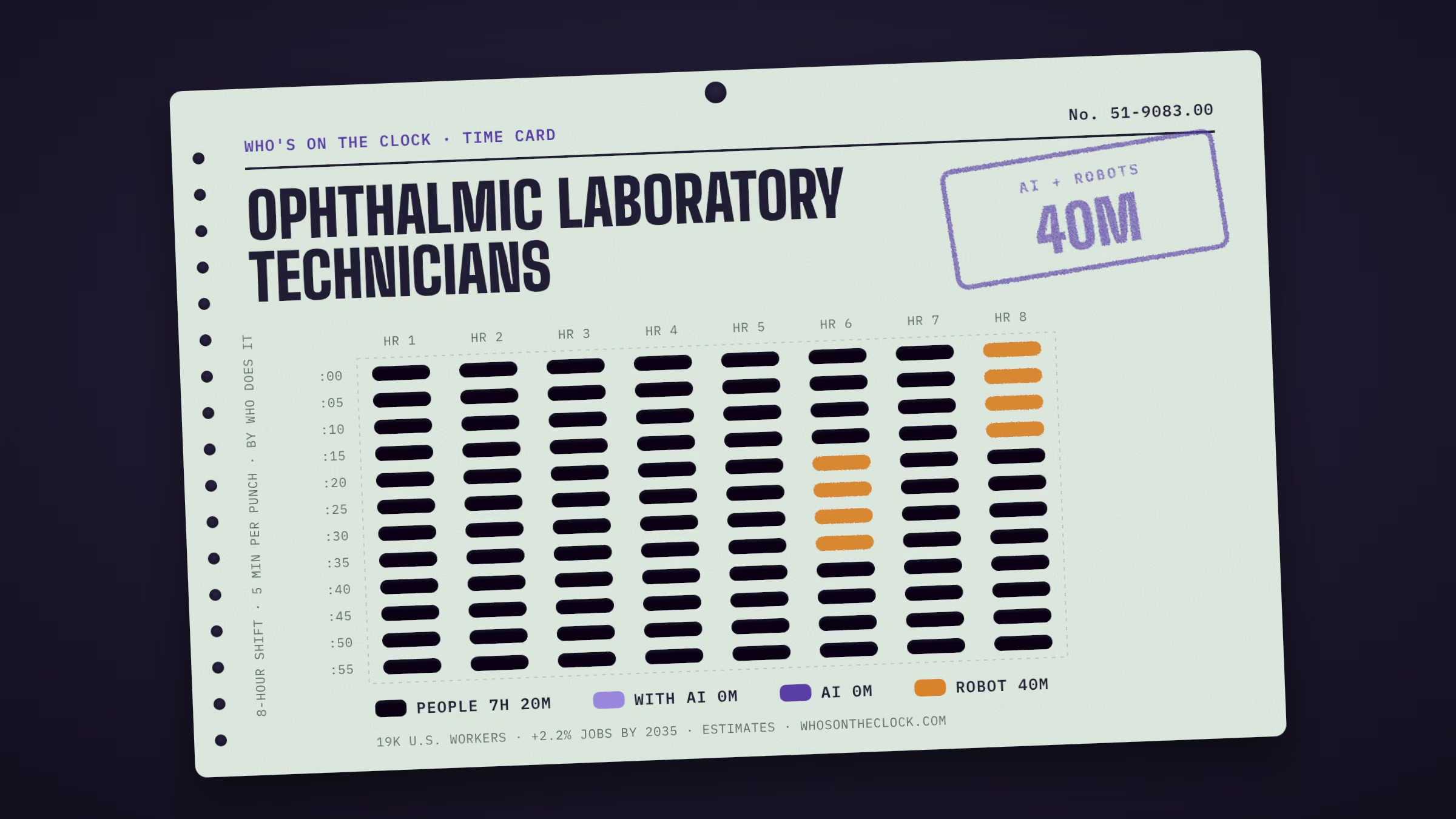
Cut, grind, and polish eyeglasses, contact lenses, or other precision optical elements. Assemble and mount lenses into frames or process other optical elements. Includes precision lens polishers or grinders, centerer-edgers, and lens mounters.
Time card
Untick tasks you don't do, or set your own times.
| Mine | Task, by time spent | Human | With AI | AI | Robot |
|---|---|---|---|---|---|
Inspect, weigh, and measure mounted or unmounted lenses after completion to verify alignment and conformance to specifications, using precision instruments.53m a shift · Robots only in factory cellsWhy this label?Robots have done this only in factory setups built around the machine, so it stays Human for ophthalmic laboratory technicians. How labels work | |||||
Shape lenses appropriately so that they can be inserted into frames.53m a shift · Robots only in factory cellsWhy this label?Robots have done this only in factory setups built around the machine, so it stays Human for ophthalmic laboratory technicians. How labels work | |||||
Mount and secure lens blanks or optical lenses in holding tools or chucks of cutting, polishing, grinding, or coating machines.47m a shift · Robots only in factory cellsWhy this label?Robots have done this only in factory setups built around the machine, so it stays Human for ophthalmic laboratory technicians. How labels work | |||||
Mount, secure, and align finished lenses in frames or optical assemblies, using precision hand tools.47m a shift · No AI or robot evidence foundWhy this label?This is physical work, and no robot has been shown doing it yet. How labels work | |||||
Set up machines to polish, bevel, edge, or grind lenses, flats, blanks, or other precision optical elements.33m a shift · Robots only in factory cellsWhy this label?Robots have done this only in factory setups built around the machine, so it stays Human for ophthalmic laboratory technicians. How labels work | |||||
Examine prescriptions, work orders, or broken or used eyeglasses to determine specifications for lenses, contact lenses, or other optical elements.33m a shift · No AI or robot evidence foundWhy this label?No AI use or robot deployment showed up for this task in our data. That isn't proof it's safe; it may just be rare in the data. How labels work | |||||
Clean finished lenses and eyeglasses, using cloths and solvents.27m a shift · Robots only in factory cellsWhy this label?Robots have done this only in factory setups built around the machine, so it stays Human for ophthalmic laboratory technicians. How labels work | |||||
Adjust lenses and frames to correct alignment.27m a shift · No AI or robot evidence foundWhy this label?This is physical work, and no robot has been shown doing it yet. How labels work | |||||
Inspect lens blanks to detect flaws, verify smoothness of surface, and ensure thickness of coating on lenses.20m a shift · Robots deployed · e.g. CSI Modulo ONE (Schneider cosmetic inspection system)Why this label?Marked Robot because CSI Modulo ONE (Schneider cosmetic inspection system) (in real use) has done this task in a real workplace. It shows a robot can do it somewhere, not that most ophthalmic laboratory technicians work alongside one. How labels work | |||||
Select lens blanks, molds, tools, and polishing or grinding wheels, according to production specifications.20m a shift · Robots only in factory cellsWhy this label?Robots have done this only in factory setups built around the machine, so it stays Human for ophthalmic laboratory technicians. How labels work | |||||
Position and adjust cutting tools to specified curvature, dimensions, and depth of cut.20m a shift · Robots only in factory cellsWhy this label?Robots have done this only in factory setups built around the machine, so it stays Human for ophthalmic laboratory technicians. How labels work | |||||
Assemble eyeglass frames and attach shields, nose pads, and temple pieces, using pliers, screwdrivers, and drills.20m a shift · No AI or robot evidence foundWhy this label?This is physical work, and no robot has been shown doing it yet. How labels work | |||||
Set dials and start machines to polish lenses or hold lenses against rotating wheels to polish them manually.20m a shift · Robots only in factory cellsWhy this label?Robots have done this only in factory setups built around the machine, so it stays Human for ophthalmic laboratory technicians. How labels work | |||||
Control equipment that coats lenses to alter their reflective qualities.20m a shift · Robots deployed · e.g. Automation & Robotics automated cosmetic inspection machine (hybrid-AI)Why this label?Marked Robot because Automation & Robotics automated cosmetic inspection machine (hybrid-AI) (in real use) has done this task in a real workplace. It shows a robot can do it somewhere, not that most ophthalmic laboratory technicians work alongside one. How labels work | |||||
Repair broken parts, using precision hand tools and soldering irons.13m a shift · No AI or robot evidence foundWhy this label?This is physical work, and no robot has been shown doing it yet. How labels work | |||||
Immerse eyeglass frames in solutions to harden, soften, or dye frames.13m a shift · Robots only in factory cellsWhy this label?Robots have done this only in factory setups built around the machine, so it stays Human for ophthalmic laboratory technicians. How labels work | |||||
Lay out lenses and trace lens outlines on glass, using templates.7m a shift · Robots only in factory cellsWhy this label?Robots have done this only in factory setups built around the machine, so it stays Human for ophthalmic laboratory technicians. How labels work | |||||
Remove lenses from molds and separate lenses in containers for further processing or storage.7m a shift · Robots only in factory cellsWhy this label?Robots have done this only in factory setups built around the machine, so it stays Human for ophthalmic laboratory technicians. How labels work |