Will AI replace driver/sales workers?

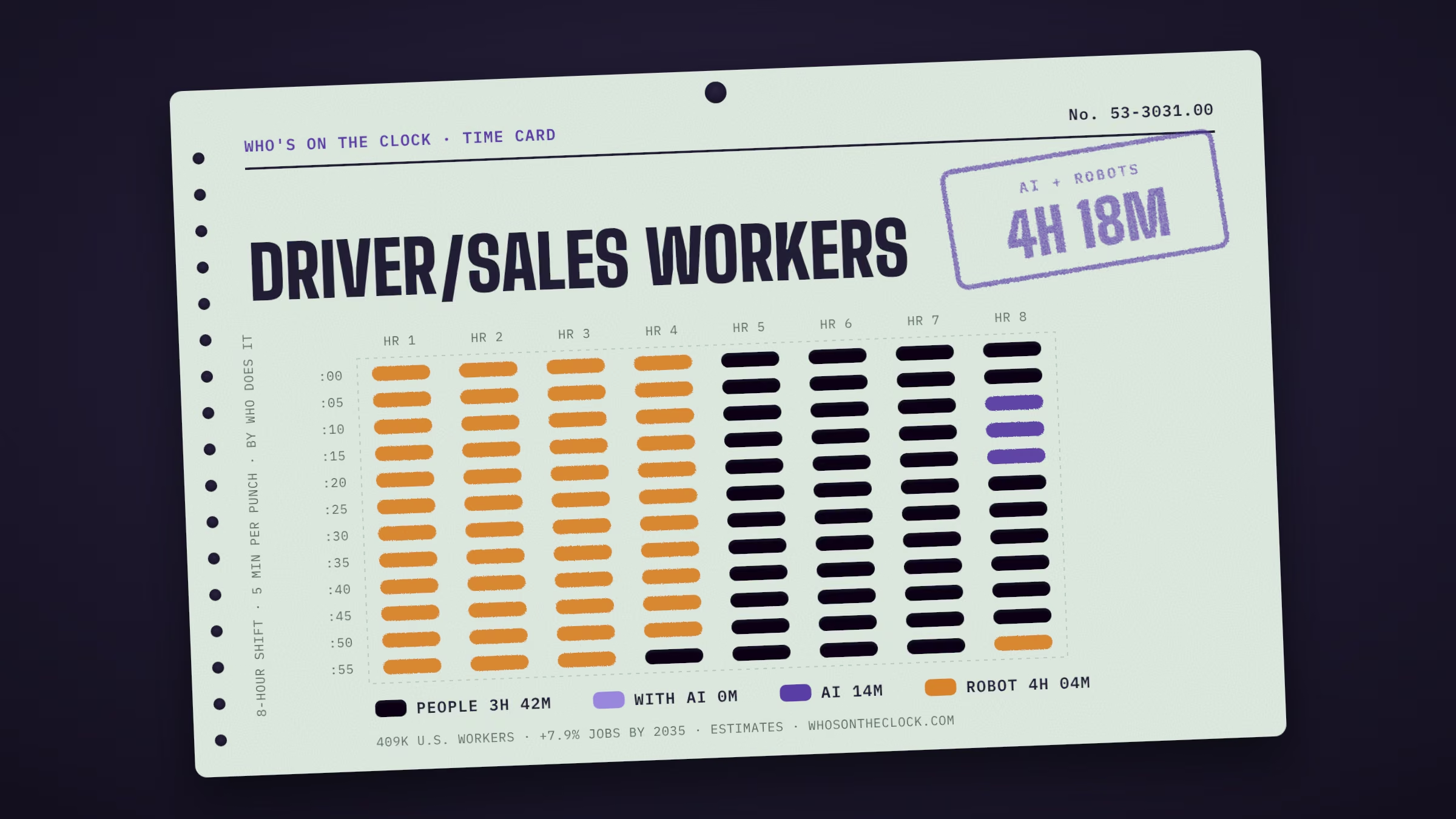
The biggest change here is physical: systems like Gatik Driver have done tasks such as “Drive trucks to deliver such items as food, medical supplies” in real workplaces, about 4h 4m of a typical shift. Only 3h 42m of the shift has no AI or robot evidence. BLS expects about 7.9% more of these jobs by 2035.

Time card for driver/sales workers showing a typical 8-hour shift: 3h 42m done by people, 14m by AI, 4h 4m by robots.
Each mark is 5 minutes of a typical shift for driver/sales workers, colored by who does that task today. Estimates from O*NET tasks and Anthropic Economic Index data. How it's made

Home / Transportation & warehouse / Driver/Sales Workers

Drive truck or other vehicle over established routes or within an established territory and sell or deliver goods, such as food products, including restaurant take-out items, or pick up or deliver items such as commercial laundry. May also take orders, collect payment, or stock merchandise at point of delivery.

Time card

Untick tasks you don't do, or set your own times.
MineTask, by time spentHumanWith AIAIRobot
Drive trucks to deliver such items as food, medical supplies, or newspapers.3h 56m a shift · Robots deployed · e.g. Gatik Driver (26- and 30-ft autonomous box trucks)
Why this label?Marked Robot because Gatik Driver (26- and 30-ft autonomous box trucks) (in real use) has done this task in a real workplace. It shows a robot can do it somewhere, not that most driver/sales workers work alongside one. How labels work
Collect money from customers, make change, and record transactions on customer receipts.50m a shift · Robots only in factory cells
Why this label?Robots have done this only in factory setups built around the machine, so it stays Human for driver/sales workers. How labels work
Review lists of dealers, customers, or station drops and load trucks.43m a shift · Robots only in factory cells
Why this label?Robots have done this only in factory setups built around the machine, so it stays Human for driver/sales workers. How labels work
Record sales or delivery information on daily sales or delivery record.36m a shift · No AI or robot evidence found
Why this label?No AI use or robot deployment showed up for this task in our data. That isn't proof it's safe; it may just be rare in the data. How labels work
Maintain trucks and food-dispensing equipment and clean inside of machines that dispense food or beverages.29m a shift · No AI or robot evidence found
Why this label?This is physical work, and no robot has been shown doing it yet. How labels work
Arrange merchandise and sales promotion displays or issue sales promotion materials to customers.22m a shift · Robots only in factory cells
Why this label?Robots have done this only in factory setups built around the machine, so it stays Human for driver/sales workers. How labels work
Inform regular customers of new products or services and price changes.14m a shift · No AI or robot evidence found
Why this label?No AI use or robot deployment showed up for this task in our data. That isn't proof it's safe; it may just be rare in the data. How labels work
Listen to and resolve customers' complaints regarding products or services.14m a shift · Observed in AI use
Why this label?Marked AI because this task shows up regularly in real AI conversations (Anthropic Economic Index, 2025 usage), and in most of them AI does the task on its own rather than helping a person. Many workplaces may not use AI for it at all. How labels work
Collect coins from vending machines, refill machines, and remove aged merchandise.14m a shift · No AI or robot evidence found
Why this label?This is physical work, and no robot has been shown doing it yet. How labels work
Write customer orders and sales contracts according to company guidelines.14m a shift · No AI or robot evidence found
Why this label?No AI use or robot deployment showed up for this task in our data. That isn't proof it's safe; it may just be rare in the data. How labels work
Sell food specialties, such as sandwiches and beverages, to office workers and patrons of sports events.7m a shift · Robots deployed · e.g. Neolix autonomous delivery/vending vehicle
Why this label?Marked Robot because Neolix autonomous delivery/vending vehicle (in real use) has done this task in a real workplace. It shows a robot can do it somewhere, not that most driver/sales workers work alongside one. How labels work

Clock history

  1. 4h 18m touchedFirst published: O*NET 30.1, Anthropic Economic Index (2025 usage and September 2026 robot study), BLS May 2025

When new data changes this clock, the date, the new numbers and the reason are logged here. Company news alone never moves the clock.

On the floor

  1. Rolling outLittle Caesars
    Little Caesars starts Coco robot deliveries in Los Angeles, Chicago and Miami

    Little Caesars partnered with Coco Robotics so DoorDash and Uber Eats orders at participating locations in Los Angeles, Chicago and Miami can be delivered by robot, with downtown San Jose coming soon. The companies call it the start of a broader rollout.

    Chain Store Age

  2. Rolling outServe Robotics
    Serve Robotics adds Grubhub robot delivery in three U.S. cities

    Serve Robotics' sidewalk delivery robots became available on Grubhub in Chicago, Los Angeles and Alexandria, Va., with more than 100 participating merchants in Chicago and nearly 200 in Los Angeles. Serve also launched DoorDash deliveries in Washington, D.C. and San Jose.

    The Robot Report

  3. Rolling outServe Robotics
    Serve Robotics has deployed more than 2,000 sidewalk delivery robots

    Serve said it has deployed more than 2,000 sidewalk delivery robots in U.S. cities including Los Angeles, Atlanta, Miami and Chicago. It works with Uber Eats, DoorDash and 7-Eleven and has completed more than 100,000 deliveries.

    The Robot Report

Ask the clock

Will AI replace driver/sales workers?

Some tasks are already being done by AI or machines; the rest still needs a person. About 4h 18m of a typical shift is made up of tasks that AI or robots have done on their own in real use somewhere. That doesn't mean those hours are automated in a typical workplace. The breakdown: 14m that AI mostly does alone, 4h 4m that robots have done in real workplaces. The other 3h 42m (46%) stays with people. Separately, BLS expects about 7.9% more of these jobs by 2035 (all jobs: +3.5%).

What can AI already do for driver/sales workers?

AI shows up regularly in 1 of 11 tasks, about 14m of a typical shift. The biggest ones:

  • Listen to and resolve customers' complaints regarding products or services. (14m a shift, AI mostly does it alone)
Where do robots fit in?

For some tasks, yes. Robots have done 2 of this job's tasks in workplaces like this one, about 4h 4m of a typical shift. 3 more tasks have only been done in factory setups built around the machine, so they stay with people here. For 2 physical tasks, no robot has shown it can do the work yet.

  • Drive trucks to deliver such items as food, medical supplies, or newspapers. (3h 56m a shift; e.g. Gatik Driver (26- and 30-ft autonomous box trucks), in use)
  • Sell food specialties, such as sandwiches and beverages, to office workers and patrons of sports events. (7m a shift; e.g. Neolix autonomous delivery/vending vehicle, in use)
What still needs a person?

3h 42m of a typical shift, or 46%, goes to tasks with no AI or robot evidence yet. No AI usage or robot deployment has shown up for these so far. The biggest:

  • Collect money from customers, make change, and record transactions on customer receipts. (50m a shift)
  • Review lists of dealers, customers, or station drops and load trucks. (43m a shift)
  • Record sales or delivery information on daily sales or delivery record. (36m a shift)
  • Maintain trucks and food-dispensing equipment and clean inside of machines that dispense food or beverages. (29m a shift)
  • Arrange merchandise and sales promotion displays or issue sales promotion materials to customers. (22m a shift)
Why is that work hard to automate?

Much of it comes down to where and how the work happens. In-person, hands-on and high-stakes work is where AI and robots have made the least headway so far. In the official O*NET survey of people in this job:

  • 100% work outdoors in all weather every day
  • 100% work in very hot or cold conditions at least weekly
  • 86% use their hands on tools, objects or controls more than half the time
What are companies actually doing?

We track 3 sourced company moves that affect this job. Most recent:

  • Aug 19, 2026: Little Caesars starts Coco robot deliveries in Los Angeles, Chicago and Miami (Rolling out)
  • Aug 19, 2026: Serve Robotics adds Grubhub robot delivery in three U.S. cities (Rolling out)
  • Dec 16, 2025: Serve Robotics has deployed more than 2,000 sidewalk delivery robots (Rolling out)
Are employers still hiring driver/sales workers?

On Indeed, job postings in the Driving sector are at 81% of their February 2020 level (all U.S. postings: 104%), down 8.5% from a year earlier, as of Oct 9, 2026. BLS separately expects about 46,000 openings a year in this job through 2035. Across all U.S. postings, 7.3% now mention AI skills. Sector postings cover more than this one job and move for many reasons besides AI.

How much do driver/sales workers make?

The median pay is about $38,770 a year ($18.64 an hour), 24% below the median for all U.S. jobs ($50,980). Most people in this job earn between $22,590 and $59,980 a year; that range covers the middle 80%. Pay figures are from BLS, May 2025, and vary a lot by state and employer. Pick a state to compare:

Is this job growing or shrinking?

BLS projects growth of 7.9% from 2025 to 2035, compared with 3.5% growth for all jobs. That's about 478,000 jobs in 2035. It expects about 46,000 openings a year, mostly from people retiring or changing careers. These projections don't single out AI as a cause.

How many driver/sales workers are there in the U.S.?

About 409,000 people in the U.S., roughly 0.26% of all workers (BLS, May 2025). That makes it the 99th largest of the 796 jobs on this site. BLS expects about 478,000 in 2035.

What training do driver/sales workers need?

The most common requirement is a high school diploma: about 64% of people in the job said so in the official O*NET survey. O*NET rates the job at level 2 of 5 for preparation, which usually means: high school diploma, some training. Requirements vary by state and employer, especially for licensed work.

What should I learn to stay ahead of AI?

These come from the job's official skill ratings and from the tasks that AI and robots touch least today. Building them keeps you strong in the parts of the work that still need a person:

  • Skills that matter more here than in most jobs: Active Listening, Service Orientation, Speaking, Time Management
  • Get strong at the parts of the job that stay with people (listed above), which take 3h 42m of a typical shift
  • Tools employers list: Microsoft Excel, Microsoft Office software
  • Learn to use AI well on the tasks where it already shows up in this job (listed above)
What other jobs could driver/sales workers move into?

These use similar skills, with less of a typical shift touched by AI or robots. Matches come from 109 official ratings of skills, knowledge and work activities, and each needs the same or less preparation unless the official list relates the jobs directly:

  • Parking Attendants (2h 26m touched, $35k median pay)
  • Stockers and Order Fillers (1h 17m touched, $37k median pay)
How solid are these numbers?

Each task carries its own evidence label. For this job: 1 observed in real AI use, 2 with robots in real deployments, 8 with no AI or robot evidence found. The minutes per task are estimates, not measured hours, and "no evidence" doesn't prove a task is safe.

Tools in demand

Mostly everyday office tools: Microsoft Excel, Microsoft Office software. The job's skills matter more than any specific software.

Also called

Automotive Parts Delivery Driver (Auto Parts Delivery Driver), Bakery Deliverer, Bobtailer, Bread Distributor, Bread Jockey, Breadman, Catering Driver, City Route Driver, City Routeman, Coal Deliverer, DSP Driver (Delivery Service Partner Driver), Delivery Man, Delivery Partner, Delivery Person