Will AI replace stockers and order fillers?

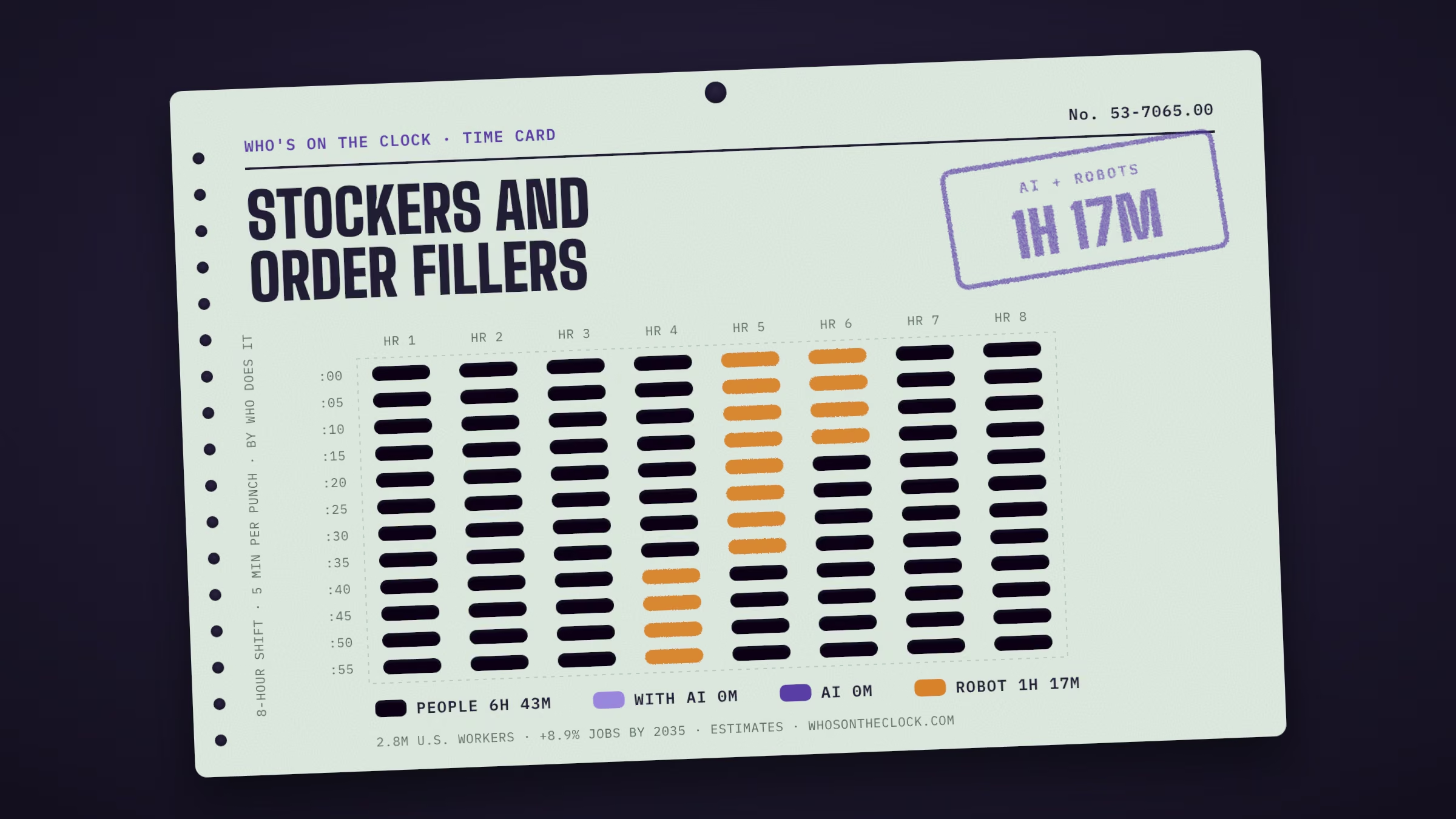
The biggest change here is physical: systems like Fox Robotics FoxBot ATL have done tasks such as “Operate equipment such as forklifts” in real workplaces, about 1h 17m of a typical shift. Most of the rest, 6h 43m, has no AI or robot evidence. BLS expects about 8.9% more of these jobs by 2035.

Time card for stockers and order fillers showing a typical 8-hour shift: 6h 43m done by people, 1h 17m by robots.
Each mark is 5 minutes of a typical shift for stockers and order fillers, colored by who does that task today. Estimates from O*NET tasks and Anthropic Economic Index data. How it's made

Home / Transportation & warehouse / Stockers and Order Fillers

Receive, store, and issue merchandise, materials, equipment, and other items from stockroom, warehouse, or storage yard to fill shelves, racks, tables, or customers' orders. May operate power equipment to fill orders. May mark prices on merchandise and set up sales displays.

Time card

Untick tasks you don't do, or set your own times.
MineTask, by time spentHumanWith AIAIRobot
Stock shelves, racks, cases, bins, and tables with new or transferred merchandise.1h 44m a shift · Robots only in factory cells
Why this label?Robots have done this only in factory setups built around the machine, so it stays Human for stockers and order fillers. How labels work
Obtain merchandise from bins or shelves.1h 3m a shift · Robots only in factory cells
Why this label?Robots have done this only in factory setups built around the machine, so it stays Human for stockers and order fillers. How labels work
Receive, unload, open, unpack, or issue sales floor merchandise.49m a shift · Robots only in factory cells
Why this label?Robots have done this only in factory setups built around the machine, so it stays Human for stockers and order fillers. How labels work
Operate equipment such as forklifts.28m a shift · Robots deployed · e.g. Fox Robotics FoxBot ATL (autonomous trailer loader/unloader)
Why this label?Marked Robot because Fox Robotics FoxBot ATL (autonomous trailer loader/unloader) (in real use) has done this task in a real workplace. It shows a robot can do it somewhere, not that most stockers and order fillers work alongside one. How labels work
Receive and count stock items, and record data manually or on computer.28m a shift · Robots deployed · e.g. Simbe Tally
Why this label?Marked Robot because Simbe Tally (in real use) has done this task in a real workplace. It shows a robot can do it somewhere, not that most stockers and order fillers work alongside one. How labels work
Store items in an orderly and accessible manner in warehouses, tool rooms, supply rooms, or other areas.21m a shift · Robots only in factory cells
Why this label?Robots have done this only in factory setups built around the machine, so it stays Human for stockers and order fillers. How labels work
Take inventory or examine merchandise to identify items to be reordered or replenished.21m a shift · Robots deployed · e.g. Tally (Simbe Robotics)
Why this label?Marked Robot because Tally (Simbe Robotics) (in real use) has done this task in a real workplace. It shows a robot can do it somewhere, not that most stockers and order fillers work alongside one. How labels work
Answer customers' questions about merchandise and advise customers on merchandise selection.14m a shift · No AI or robot evidence found
Why this label?No AI use or robot deployment showed up for this task in our data. That isn't proof it's safe; it may just be rare in the data. How labels work
Stamp, attach, or change price tags on merchandise, referring to price list.14m a shift · Robots only in factory cells
Why this label?Robots have done this only in factory setups built around the machine, so it stays Human for stockers and order fillers. How labels work
Read orders to ascertain catalog numbers, sizes, colors, and quantities of merchandise.14m a shift · No AI or robot evidence found
Why this label?No AI use or robot deployment showed up for this task in our data. That isn't proof it's safe; it may just be rare in the data. How labels work
Complete order receipts.7m a shift · No AI or robot evidence found
Why this label?No AI use or robot deployment showed up for this task in our data. That isn't proof it's safe; it may just be rare in the data. How labels work
Issue or distribute materials, products, parts, and supplies to customers or coworkers, based on information from incoming requisitions.7m a shift · Robots only in factory cells
Why this label?Robots have done this only in factory setups built around the machine, so it stays Human for stockers and order fillers. How labels work
Keep records of out-going orders.7m a shift · No AI or robot evidence found
Why this label?No AI use or robot deployment showed up for this task in our data. That isn't proof it's safe; it may just be rare in the data. How labels work
Pack customer purchases in bags or cartons.7m a shift · Robots only in factory cells
Why this label?Robots have done this only in factory setups built around the machine, so it stays Human for stockers and order fillers. How labels work
Mark stock items, using identification tags, stamps, electric marking tools, or other labeling equipment.7m a shift · Robots only in factory cells
Why this label?Robots have done this only in factory setups built around the machine, so it stays Human for stockers and order fillers. How labels work
Pack and unpack items to be stocked on shelves in stockrooms, warehouses, or storage yards.7m a shift · Robots only in factory cells
Why this label?Robots have done this only in factory setups built around the machine, so it stays Human for stockers and order fillers. How labels work
Clean display cases, shelves, and aisles.7m a shift · Robots only in factory cells
Why this label?Robots have done this only in factory setups built around the machine, so it stays Human for stockers and order fillers. How labels work
Keep records on the use or damage of stock or stock-handling equipment.7m a shift · No AI or robot evidence found
Why this label?No AI use or robot deployment showed up for this task in our data. That isn't proof it's safe; it may just be rare in the data. How labels work
Clean and maintain supplies, tools, equipment, and storage areas to ensure compliance with safety regulations.7m a shift · Robots only in factory cells
Why this label?Robots have done this only in factory setups built around the machine, so it stays Human for stockers and order fillers. How labels work
Determine proper storage methods, identification, and stock location, based on turnover, environmental factors, and physical capabilities of facilities.7m a shift · No AI or robot evidence found
Why this label?No AI use or robot deployment showed up for this task in our data. That isn't proof it's safe; it may just be rare in the data. How labels work
Dispose of damaged or defective items, or return them to vendors.7m a shift · Robots only in factory cells
Why this label?Robots have done this only in factory setups built around the machine, so it stays Human for stockers and order fillers. How labels work
Design and set up advertising signs and displays of merchandise on shelves, counters, or tables to attract customers and promote sales.7m a shift · Robots only in factory cells
Why this label?Robots have done this only in factory setups built around the machine, so it stays Human for stockers and order fillers. How labels work
Provide assistance or direction to other stockroom, warehouse, or storage yard workers.7m a shift · No AI or robot evidence found
Why this label?No AI use or robot deployment showed up for this task in our data. That isn't proof it's safe; it may just be rare in the data. How labels work
Examine and inspect stock items for wear or defects, reporting any damage to supervisors.7m a shift · Robots only in factory cells
Why this label?Robots have done this only in factory setups built around the machine, so it stays Human for stockers and order fillers. How labels work
Itemize and total customer merchandise selection at checkout counter, using cash register, and accept cash or charge card for purchases.7m a shift · Robots only in factory cells
Why this label?Robots have done this only in factory setups built around the machine, so it stays Human for stockers and order fillers. How labels work
Requisition merchandise from supplier, based on available space, merchandise on hand, customer demand, or advertised specials.7m a shift · No AI or robot evidence found
Why this label?No AI use or robot deployment showed up for this task in our data. That isn't proof it's safe; it may just be rare in the data. How labels work
Compare merchandise invoices to items actually received to ensure that shipments are correct.7m a shift · Robots only in factory cells
Why this label?Robots have done this only in factory setups built around the machine, so it stays Human for stockers and order fillers. How labels work
Transport packages to customers' vehicles.7m a shift · Robots only in factory cells
Why this label?Robots have done this only in factory setups built around the machine, so it stays Human for stockers and order fillers. How labels work
Recommend disposal of excess, defective, or obsolete stock.time not estimated · No AI or robot evidence found
Why this label?No AI use or robot deployment showed up for this task in our data. That isn't proof it's safe; it may just be rare in the data. How labels work
Compute prices of items or groups of items.time not estimated · No AI or robot evidence found
Why this label?No AI use or robot deployment showed up for this task in our data. That isn't proof it's safe; it may just be rare in the data. How labels work

Clock history

  1. 1h 17m touchedFirst published: O*NET 30.1, Anthropic Economic Index (2025 usage and September 2026 robot study), BLS May 2025

When new data changes this clock, the date, the new numbers and the reason are logged here. Company news alone never moves the clock.

On the floor

  1. PilotRalphs
    Shelf-scanning robots roll through some Los Angeles Ralphs stores

    Simbe Robotics' Tally robot scans aisles in some LA Ralphs stores, flagging out-of-stock items, pricing errors and misplaced products for associates. Simbe says it can shift up to 50 labor hours per store per week away from shelf checks.

    Gadget Review

  2. Rolling outCorvus Robotics
    Corvus has deployed over 300 inventory drones, raises $20 million

    Corvus has deployed 300+ warehouse inventory drones across 26 U.S. states, Canada and Mexico. Southern Glazer's Wine & Spirits runs 40+ drones across nine distribution centers, and Corvus says 35% of inventory labor was redirected.

    DroneLife

  3. Rolling outHomeBase USA
    HomeBase USA puts Simbe shelf scanning robots in all nine stores

    After a two-store pilot, HomeBase USA is deploying Simbe Robotics' Tally shelf scanning robots in its nine stores in Texas, Wyoming, Kansas and Missouri. The pilot reported 92% fewer pricing errors and cut annual physical inventories from three days to under one.

    Chain Store Age

  4. Rolling outB&R Stores
    B&R Stores deploys Simbe's Tally shelf-scanning robot in Nebraska

    B&R Stores deployed Simbe's Tally autonomous shelf-scanning robot at select Lincoln, Nebraska locations to track product availability, pricing and placement. Simbe says associates can spend up to 30 hours a week on manual inventory tasks.

    Robotics 24/7

  5. Rolling outSenseTime
    SenseTime opens robot run stores in Shanghai and plans 100 by end of 2026

    SenseTime subsidiary SenseTime Shanhui has opened several SenseMartGo robot stores in Shanghai, where robots take orders, pick items and handle inventory. It plans 100 outlets by the end of 2026.

    Gasgoo

  6. PlanAmazon
    Internal Amazon documents plan robots for 75% of operations

    According to documents reported by The New York Times, Amazon expects to avoid hiring more than 160,000 U.S. workers by 2027 and 600,000 by 2033. Amazon says the documents are incomplete and don't represent its hiring strategy.

    Business Standard, citing The New York Times

  7. Rolling outWalmart
    Walmart gives 1.5 million associates AI task and translation tools

    Walmart launched an AI task management tool for overnight stocking that cut shift planning from 90 minutes to 30, plus AI translation in 44 languages. The tools are for its 1.5 million associates.

    Intelligent CIO

  8. WidespreadAmazon
    Amazon reaches 1 million warehouse robots

    Amazon said it now has 1 million robots in its warehouses and that 75% of its global deliveries are assisted by robots in some way. It also released DeepFleet, an AI model it says will make the robot fleet 10% faster.

    TechCrunch

  9. Rolling outAmazon
    Amazon puts touch-sensing Vulcan robot to work stowing items

    Vulcan is in full operation stowing items in Spokane, Washington, and can handle about 75% of the roughly 1 million unique items there. A picking version is being tested in Hamburg, and Amazon plans more U.S. and German sites in 2026.

    CNBC via NBC New York

  10. AnnouncedWalmart
    Walmart targets automation for 65% of stores by early 2026

    Walmart expected about 65% of stores to be served by automation and 55% of fulfillment volume to run through automated facilities by the end of fiscal 2026. It said headcount would hold steady or grow as roles change.

    TipRanks / The Fly

Ask the clock

Will AI replace stockers and order fillers?

Unlikely, though parts of the work are changing. About 1h 17m of an 8-hour shift goes to tasks touched by robots. The other 6h 43m (84%) stays with people. Separately, BLS expects about 8.9% more of these jobs by 2035 (all jobs: +3.5%).

What can AI already do for stockers and order fillers?

None of this job's tasks show regular AI use yet. That can mean the work is hands-on or in person, or simply that it rarely comes up in AI usage data.

Where do robots fit in?

For some tasks, yes. Robots have done 3 of this job's tasks in workplaces like this one, about 1h 17m of a typical shift. 17 more tasks have only been done in factory setups built around the machine, so they stay with people here.

  • Operate equipment such as forklifts. (28m a shift; e.g. Fox Robotics FoxBot ATL (autonomous trailer loader/unloader), in use)
  • Receive and count stock items, and record data manually or on computer. (28m a shift; e.g. Simbe Tally, in use)
  • Take inventory or examine merchandise to identify items to be reordered or replenished. (21m a shift; e.g. Tally (Simbe Robotics), in use)
What still needs a person?

6h 43m of a typical shift, or 84%, goes to tasks with no AI or robot evidence yet. No AI usage or robot deployment has shown up for these so far. The biggest:

  • Stock shelves, racks, cases, bins, and tables with new or transferred merchandise. (1h 44m a shift)
  • Obtain merchandise from bins or shelves. (1h 3m a shift)
  • Receive, unload, open, unpack, or issue sales floor merchandise. (49m a shift)
  • Store items in an orderly and accessible manner in warehouses, tool rooms, supply rooms, or other areas. (21m a shift)
  • Answer customers' questions about merchandise and advise customers on merchandise selection. (14m a shift)
Why is that work hard to automate?

Much of it comes down to where and how the work happens. In-person, hands-on and high-stakes work is where AI and robots have made the least headway so far. In the official O*NET survey of people in this job:

  • 90% talk face to face with others every day
  • 74% say dealing with the public is very or extremely important
  • 69% spend more than half the day on their feet
What are companies actually doing?

We track 10 sourced company moves that affect this job. Most recent:

  • Oct 16, 2026: Shelf-scanning robots roll through some Los Angeles Ralphs stores (Pilot)
  • Aug 27, 2026: Corvus has deployed over 300 inventory drones, raises $20 million (Rolling out)
  • Jul 30, 2026: HomeBase USA puts Simbe shelf scanning robots in all nine stores (Rolling out)
Are employers still hiring stockers and order fillers?

On Indeed, job postings in the Loading & Stocking sector are at 109% of their February 2020 level (all U.S. postings: 104%), up 12.4% from a year earlier, as of Oct 9, 2026. BLS separately expects about 431,000 openings a year in this job through 2035. Across all U.S. postings, 7.3% now mention AI skills. Sector postings cover more than this one job and move for many reasons besides AI.

How much do stockers and order fillers make?

The median pay is about $37,330 a year ($17.95 an hour), 27% below the median for all U.S. jobs ($50,980). Most people in this job earn between $30,110 and $49,260 a year; that range covers the middle 80%. Pay figures are from BLS, May 2025, and vary a lot by state and employer. Pick a state to compare:

Is this job growing or shrinking?

BLS projects growth of 8.9% from 2025 to 2035, compared with 3.5% growth for all jobs. That's about 3.1 million jobs in 2035. It expects about 431,000 openings a year, mostly from people retiring or changing careers. These projections don't single out AI as a cause.

How many stockers and order fillers are there in the U.S.?

About 2.8 million people in the U.S., roughly 1.8% of all workers (BLS, May 2025). That makes it the 9th largest of the 796 jobs on this site. BLS expects about 3.1 million in 2035.

What training do stockers and order fillers need?

The most common requirement is a high school diploma: about 57% of people in the job said so in the official O*NET survey. O*NET rates the job at level 2 of 5 for preparation, which usually means: high school diploma, some training. Requirements vary by state and employer, especially for licensed work.

What should I learn to stay ahead of AI?

These come from the job's official skill ratings and from the tasks that AI and robots touch least today. Building them keeps you strong in the parts of the work that still need a person:

  • Skills that matter more here than in most jobs: Active Listening, Reading Comprehension
  • Get strong at the parts of the job that stay with people (listed above), which take 6h 43m of a typical shift
  • Tools employers list: Google Docs, Microsoft Access, Microsoft Excel, Microsoft Office software, Microsoft Outlook
What other jobs could stockers and order fillers move into?

These use similar skills. Matches come from 109 official ratings of skills, knowledge and work activities, and each needs the same or less preparation unless the official list relates the jobs directly:

  • Parking Attendants (2h 26m touched, $35k median pay)
  • Postal Service Mail Sorters, Processors, and Processing Machine Operators (1h 50m touched, $58k median pay)
  • Refuse and Recyclable Material Collectors (5h 14m touched, $50k median pay)
  • Machine Feeders and Offbearers (3h 26m touched, $41k median pay)
How solid are these numbers?

Each task carries its own evidence label. For this job: 3 with robots in real deployments, 27 with no AI or robot evidence found. The minutes per task are estimates, not measured hours, and "no evidence" doesn't prove a task is safe.

Tools in demand

  • Google Docs
  • Microsoft Access
  • SAP software

Plus everyday office tools: Microsoft Excel, Microsoft Office software, Microsoft Outlook, Microsoft Windows, Microsoft Word.

Also called

Agent Contract Clerk, Backroom Associate, Bakery Products Checker, Bay Stocker, Camera Storage Clerk, Central Service Supply Distributor, Central Supply Aide, Central Supply Technician, Central Supply Worker, Checker Stocker, Clerical Stock Inspector, Clerical Warehouse Worker, Clerical Warehouseman, Cloth Burler