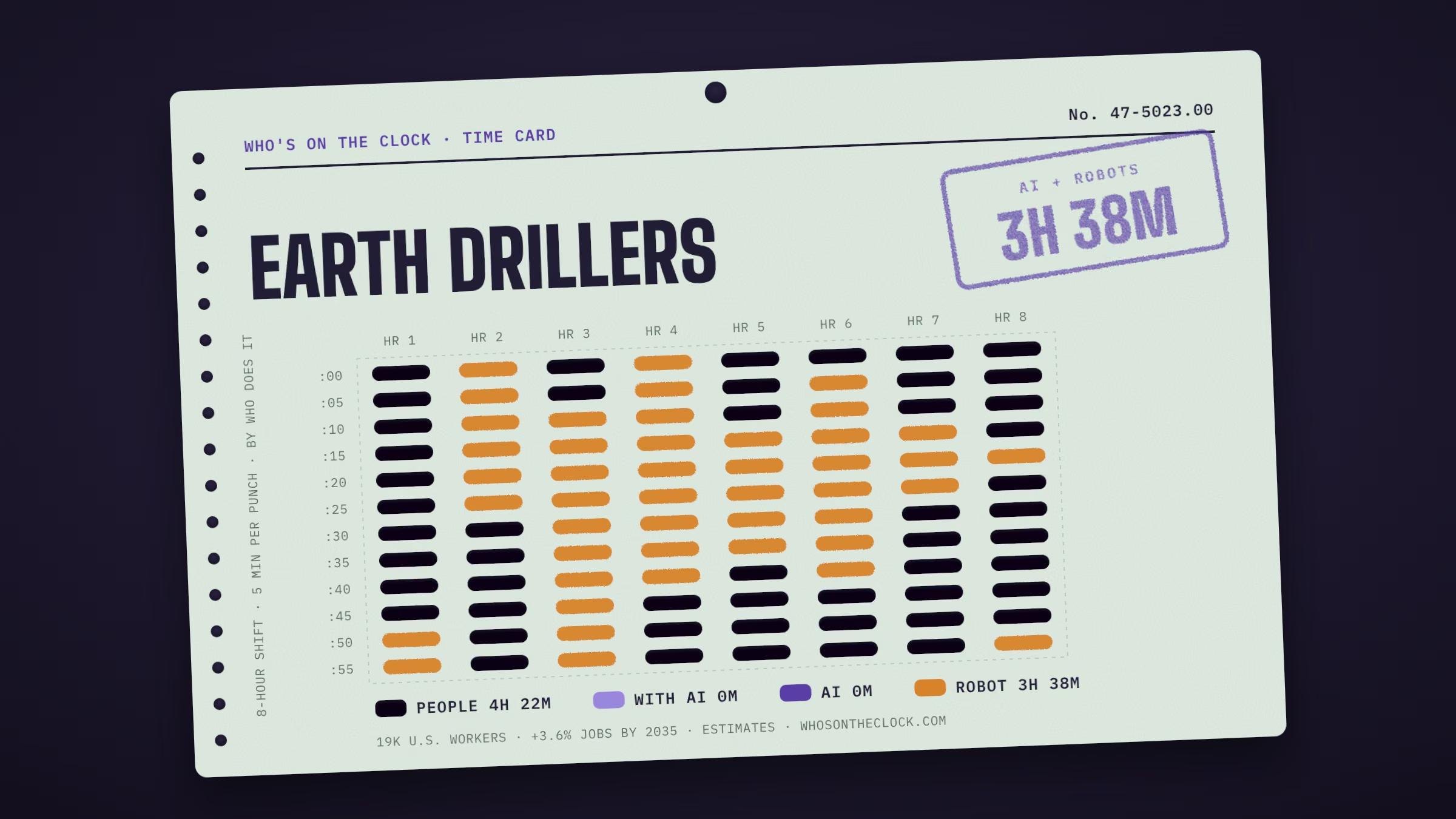
Operate a variety of drills such as rotary, churn, and pneumatic to tap subsurface water and salt deposits, to remove core samples during mineral exploration or soil testing, and to facilitate the use of explosives in mining or construction. Includes horizontal and earth boring machine operators.
Time card
Untick tasks you don't do, or set your own times.
| Mine | Task, by time spent | Human | With AI | AI | Robot |
|---|---|---|---|---|---|
Start, stop, and control drilling speed of machines and insertion of casings into holes.50m a shift · Robots only in factory cellsWhy this label?Robots have done this only in factory setups built around the machine, so it stays Human for earth drillers. How labels work | |||||
Select and attach drill bits and drill rods, adding more rods as hole depths increase, and changing drill bits as needed.39m a shift · Robots deployed · e.g. Sandvik Leopard DI650i with AutoMine (LKAB Leveaniemi open pit)Why this label?Marked Robot because Sandvik Leopard DI650i with AutoMine (LKAB Leveaniemi open pit) (in real use) has done this task in a real workplace. It shows a robot can do it somewhere, not that most earth drillers work alongside one. How labels work | |||||
Perform routine maintenance and upgrade work on machines and equipment, such as replacing parts, building up drill bits, and lubricating machinery.39m a shift · No AI or robot evidence foundWhy this label?This is physical work, and no robot has been shown doing it yet. How labels work | |||||
Regulate air pressure, rotary speed, and downward pressure, according to the type of rock or concrete being drilled.34m a shift · Robots deployed · e.g. Cat MineStar Command for drilling (MD6250, MD6310 surface drills)Why this label?Marked Robot because Cat MineStar Command for drilling (MD6250, MD6310 surface drills) (in real use) has done this task in a real workplace. It shows a robot can do it somewhere, not that most earth drillers work alongside one. How labels work | |||||
Operate controls to stabilize machines and to position and align drills.28m a shift · Robots deployed · e.g. Epiroc SmartROC D65 MKII (autonomous surface drill rig)Why this label?Marked Robot because Epiroc SmartROC D65 MKII (autonomous surface drill rig) (in real use) has done this task in a real workplace. It shows a robot can do it somewhere, not that most earth drillers work alongside one. How labels work | |||||
Drive trucks, tractors, or truck-mounted drills to and from work sites.28m a shift · Robots deployed · e.g. Kodiak Driver RoboTrucks operated by Atlas Energy SolutionsWhy this label?Marked Robot because Kodiak Driver RoboTrucks operated by Atlas Energy Solutions (in real use) has done this task in a real workplace. It shows a robot can do it somewhere, not that most earth drillers work alongside one. How labels work | |||||
Monitor drilling operations, by checking gauges and listening to equipment to assess drilling conditions and to determine the need to adjust drilling or alter equipment.28m a shift · No AI or robot evidence foundWhy this label?No AI use or robot deployment showed up for this task in our data. That isn't proof it's safe; it may just be rare in the data. How labels work | |||||
Drive or guide truck-mounted equipment into position, level and stabilize rigs, and extend telescoping derricks.22m a shift · Robots deployed · e.g. Cat MD6250 + two MD6310 drills with MineStar Command for drilling (Thiess, Mt Arthur South)Why this label?Marked Robot because Cat MD6250 + two MD6310 drills with MineStar Command for drilling (Thiess, Mt Arthur South) (in real use) has done this task in a real workplace. It shows a robot can do it somewhere, not that most earth drillers work alongside one. How labels work | |||||
Assemble and position machines, augers, casing pipes, and other equipment, using hand and power tools.22m a shift · Robots only in factory cellsWhy this label?Robots have done this only in factory setups built around the machine, so it stays Human for earth drillers. How labels work | |||||
Drill or bore holes in rock for blasting, grouting, anchoring, or building foundations.22m a shift · Robots deployed · e.g. Epiroc SmartROC D65 MKII AutonomousWhy this label?Marked Robot because Epiroc SmartROC D65 MKII Autonomous (in real use) has done this task in a real workplace. It shows a robot can do it somewhere, not that most earth drillers work alongside one. How labels work | |||||
Operate machines to flush earth cuttings or to blow dust from holes.17m a shift · Robots deployed · e.g. Epiroc SmartROC D65 MKII (autonomous surface DTH drill)Why this label?Marked Robot because Epiroc SmartROC D65 MKII (autonomous surface DTH drill) (in real use) has done this task in a real workplace. It shows a robot can do it somewhere, not that most earth drillers work alongside one. How labels work | |||||
Place and install screens, casings, pumps, and other well fixtures to develop wells.17m a shift · No AI or robot evidence foundWhy this label?This is physical work, and no robot has been shown doing it yet. How labels work | |||||
Operate water-well drilling rigs and other equipment to drill, bore, and dig for water wells or for environmental assessment purposes.17m a shift · Robots only in factory cellsWhy this label?Robots have done this only in factory setups built around the machine, so it stays Human for earth drillers. How labels work | |||||
Withdraw drill rods from holes, and extract core samples.17m a shift · Robots deployed · e.g. SmartROC D65 MKII (autonomous)Why this label?Marked Robot because SmartROC D65 MKII (autonomous) (in real use) has done this task in a real workplace. It shows a robot can do it somewhere, not that most earth drillers work alongside one. How labels work | |||||
Verify depths and alignments of boring positions.11m a shift · Robots only in factory cellsWhy this label?Robots have done this only in factory setups built around the machine, so it stays Human for earth drillers. How labels work | |||||
Record drilling progress and geological data.11m a shift · No AI or robot evidence foundWhy this label?No AI use or robot deployment showed up for this task in our data. That isn't proof it's safe; it may just be rare in the data. How labels work | |||||
Pour water into wells, or pump water or slush into wells to cool drill bits and to remove drillings.11m a shift · Robots only in factory cellsWhy this label?Robots have done this only in factory setups built around the machine, so it stays Human for earth drillers. How labels work | |||||
Select the appropriate drill for the job, using knowledge of rock or soil conditions.6m a shift · No AI or robot evidence foundWhy this label?No AI use or robot deployment showed up for this task in our data. That isn't proof it's safe; it may just be rare in the data. How labels work | |||||
Document geological formations encountered during work.6m a shift · No AI or robot evidence foundWhy this label?No AI use or robot deployment showed up for this task in our data. That isn't proof it's safe; it may just be rare in the data. How labels work | |||||
Retrieve lost equipment from bore holes, using retrieval tools and equipment.6m a shift · No AI or robot evidence foundWhy this label?This is physical work, and no robot has been shown doing it yet. How labels work | |||||
Fabricate well casings.6m a shift · Robots only in factory cellsWhy this label?Robots have done this only in factory setups built around the machine, so it stays Human for earth drillers. How labels work | |||||
Create and lay out designs for drill and blast patterns.6m a shift · Robots deployed · e.g. Epiroc SmartROC D65 MKII Autonomous at Luck Stone quarryWhy this label?Marked Robot because Epiroc SmartROC D65 MKII Autonomous at Luck Stone quarry (in real use) has done this task in a real workplace. It shows a robot can do it somewhere, not that most earth drillers work alongside one. How labels work | |||||
Review client requirements and proposed locations for drilling operations to determine feasibility, and to determine cost estimates.6m a shift · No AI or robot evidence foundWhy this label?No AI use or robot deployment showed up for this task in our data. That isn't proof it's safe; it may just be rare in the data. How labels work | |||||
Perform pumping tests to assess well performance.6m a shift · Robots only in factory cellsWhy this label?Robots have done this only in factory setups built around the machine, so it stays Human for earth drillers. How labels work | |||||
Disinfect, reconstruct, and redevelop contaminated wells and water pumping systems, and clean and disinfect new wells in preparation for use.6m a shift · No AI or robot evidence foundWhy this label?This is physical work, and no robot has been shown doing it yet. How labels work | |||||
Design well pumping systems.6m a shift · No AI or robot evidence foundWhy this label?No AI use or robot deployment showed up for this task in our data. That isn't proof it's safe; it may just be rare in the data. How labels work | |||||
Signal crane operators to move equipment.6m a shift · No AI or robot evidence foundWhy this label?No AI use or robot deployment showed up for this task in our data. That isn't proof it's safe; it may just be rare in the data. How labels work | |||||
Inspect core samples to determine nature of strata, or take samples to laboratories for analysis.6m a shift · Robots only in factory cellsWhy this label?Robots have done this only in factory setups built around the machine, so it stays Human for earth drillers. How labels work | |||||
Retract augers to force discharge dirt from holes.6m a shift · Robots deployed · e.g. Epiroc SmartROC D65 MKII (autonomous)Why this label?Marked Robot because Epiroc SmartROC D65 MKII (autonomous) (in real use) has done this task in a real workplace. It shows a robot can do it somewhere, not that most earth drillers work alongside one. How labels work |