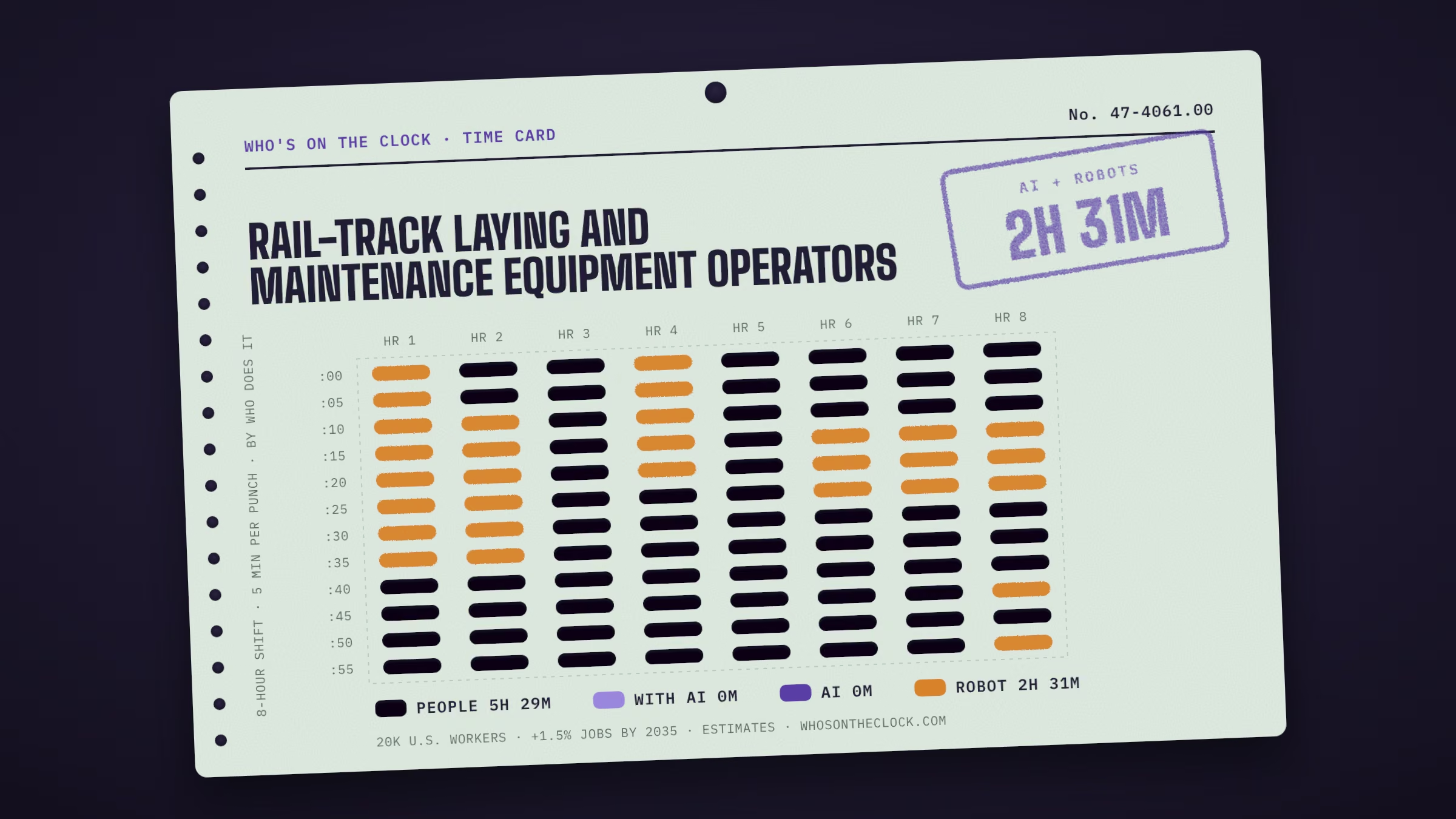
Lay, repair, and maintain track for standard or narrow-gauge railroad equipment used in regular railroad service or in plant yards, quarries, sand and gravel pits, and mines. Includes ballast cleaning machine operators and railroad bed tamping machine operators.
Time card
Untick tasks you don't do, or set your own times.
| Mine | Task, by time spent | Human | With AI | AI | Robot |
|---|---|---|---|---|---|
Patrol assigned track sections so that damaged or broken track can be located and reported.39m a shift · Robots deployed · e.g. Automated Track Inspection / Track Geometry Measurement Systems (industry ATI programs under AAR waiver)Why this label?Marked Robot because Automated Track Inspection / Track Geometry Measurement Systems (industry ATI programs under AAR waiver) (in real use) has done this task in a real workplace. It shows a robot can do it somewhere, not that most rail-track laying and maintenance equipment operators work alongside one. How labels work | |||||
Repair or adjust track switches, using wrenches and replacement parts.33m a shift · Robots only in factory cellsWhy this label?Robots have done this only in factory setups built around the machine, so it stays Human for rail-track laying and maintenance equipment operators. How labels work | |||||
Adjust controls of machines that spread, shape, raise, level, or align track, according to specifications.33m a shift · Robots deployed · e.g. System7 705 ballast regulatorWhy this label?Marked Robot because System7 705 ballast regulator (in real use) has done this task in a real workplace. It shows a robot can do it somewhere, not that most rail-track laying and maintenance equipment operators work alongside one. How labels work | |||||
Drive graders, tamping machines, brooms, or ballast spreading machines to redistribute gravel or ballast between rails.33m a shift · Robots only in factory cellsWhy this label?Robots have done this only in factory setups built around the machine, so it stays Human for rail-track laying and maintenance equipment operators. How labels work | |||||
Operate track wrenches to tighten or loosen bolts at joints that hold ends of rails together.26m a shift · Robots only in factory cellsWhy this label?Robots have done this only in factory setups built around the machine, so it stays Human for rail-track laying and maintenance equipment operators. How labels work | |||||
Clean tracks or clear ice or snow from tracks or switch boxes.26m a shift · No AI or robot evidence foundWhy this label?This is physical work, and no robot has been shown doing it yet. How labels work | |||||
Clean, grade, or level ballast on railroad tracks.26m a shift · Robots sold commercially · e.g. System7 705 fully automatic ballast regulatorWhy this label?Marked Robot because System7 705 fully automatic ballast regulator (sold commercially) has done this task in a real workplace. It shows a robot can do it somewhere, not that most rail-track laying and maintenance equipment operators work alongside one. How labels work | |||||
Raise rails, using hydraulic jacks, to allow for tie removal and replacement.26m a shift · Robots only in factory cellsWhy this label?Robots have done this only in factory setups built around the machine, so it stays Human for rail-track laying and maintenance equipment operators. How labels work | |||||
Clean or make minor repairs to machines or equipment.26m a shift · No AI or robot evidence foundWhy this label?This is physical work, and no robot has been shown doing it yet. How labels work | |||||
Weld sections of track together, such as switch points and frogs.20m a shift · Robots only in factory cellsWhy this label?Robots have done this only in factory setups built around the machine, so it stays Human for rail-track laying and maintenance equipment operators. How labels work | |||||
Operate single- or multiple-head spike driving machines to drive spikes into ties and secure rails.20m a shift · Robots only in factory cellsWhy this label?Robots have done this only in factory setups built around the machine, so it stays Human for rail-track laying and maintenance equipment operators. How labels work | |||||
Lubricate machines, change oil, or fill hydraulic reservoirs to specified levels.20m a shift · Robots only in factory cellsWhy this label?Robots have done this only in factory setups built around the machine, so it stays Human for rail-track laying and maintenance equipment operators. How labels work | |||||
Observe leveling indicator arms to verify levelness and alignment of tracks.13m a shift · Robots deployed · e.g. Plasser & Theurer ALC automatic guiding computer / tamping machine measuring systemWhy this label?Marked Robot because Plasser & Theurer ALC automatic guiding computer / tamping machine measuring system (in real use) has done this task in a real workplace. It shows a robot can do it somewhere, not that most rail-track laying and maintenance equipment operators work alongside one. How labels work | |||||
Cut rails to specified lengths, using rail saws.13m a shift · Robots only in factory cellsWhy this label?Robots have done this only in factory setups built around the machine, so it stays Human for rail-track laying and maintenance equipment operators. How labels work | |||||
Drill holes through rails, tie plates, or fishplates for insertion of bolts or spikes, using power drills.13m a shift · Robots only in factory cellsWhy this label?Robots have done this only in factory setups built around the machine, so it stays Human for rail-track laying and maintenance equipment operators. How labels work | |||||
Dress and reshape worn or damaged railroad switch points or frogs, using portable power grinders.13m a shift · Robots only in factory cellsWhy this label?Robots have done this only in factory setups built around the machine, so it stays Human for rail-track laying and maintenance equipment operators. How labels work | |||||
Grind ends of new or worn rails to attain smooth joints, using portable grinders.13m a shift · Robots deployed · e.g. ONE Rail Group fixed-plant electric flash-butt welding lineWhy this label?Marked Robot because ONE Rail Group fixed-plant electric flash-butt welding line (in real use) has done this task in a real workplace. It shows a robot can do it somewhere, not that most rail-track laying and maintenance equipment operators work alongside one. How labels work | |||||
Operate single- or multiple-head spike pullers to pull old spikes from ties.13m a shift · No AI or robot evidence foundWhy this label?This is physical work, and no robot has been shown doing it yet. How labels work | |||||
Engage mechanisms that lay tracks or rails to specified gauges.13m a shift · Robots only in factory cellsWhy this label?Robots have done this only in factory setups built around the machine, so it stays Human for rail-track laying and maintenance equipment operators. How labels work | |||||
Drive vehicles that automatically move and lay tracks or rails over sections of track to be constructed, repaired, or maintained.13m a shift · Robots only in factory cellsWhy this label?Robots have done this only in factory setups built around the machine, so it stays Human for rail-track laying and maintenance equipment operators. How labels work | |||||
Turn wheels of machines, using lever controls, to adjust guidelines for track alignments or grades, following specifications.13m a shift · Robots sold commercially · e.g. ALC automatic guiding computer on Plasser & Theurer tamping machinesWhy this label?Marked Robot because ALC automatic guiding computer on Plasser & Theurer tamping machines (sold commercially) has done this task in a real workplace. It shows a robot can do it somewhere, not that most rail-track laying and maintenance equipment operators work alongside one. How labels work | |||||
Push controls to close grasping devices on track or rail sections so that they can be raised or moved.13m a shift · Robots only in factory cellsWhy this label?Robots have done this only in factory setups built around the machine, so it stays Human for rail-track laying and maintenance equipment operators. How labels work | |||||
String and attach wire-guidelines machine to rails so that tracks or rails can be aligned or leveled.7m a shift · Robots deployed · e.g. Autonomous Track Geometry Measurement System (ATGMS)Why this label?Marked Robot because Autonomous Track Geometry Measurement System (ATGMS) (in real use) has done this task in a real workplace. It shows a robot can do it somewhere, not that most rail-track laying and maintenance equipment operators work alongside one. How labels work | |||||
Operate tie-adzing machines to cut ties and permit insertion of fishplates that hold rails.7m a shift · Robots only in factory cellsWhy this label?Robots have done this only in factory setups built around the machine, so it stays Human for rail-track laying and maintenance equipment operators. How labels work | |||||
Spray ties, fishplates, or joints with oil to protect them from weathering.7m a shift · Robots deployed · e.g. Robolube Switch Plate Lubricator (SWPL) / R2K wayside lubricatorWhy this label?Marked Robot because Robolube Switch Plate Lubricator (SWPL) / R2K wayside lubricator (in real use) has done this task in a real workplace. It shows a robot can do it somewhere, not that most rail-track laying and maintenance equipment operators work alongside one. How labels work | |||||
Paint railroad signs, such as speed limits or gate-crossing warnings.time not estimated · Robots only in factory cellsWhy this label?Robots have done this only in factory setups built around the machine, so it stays Human for rail-track laying and maintenance equipment operators. How labels work |