Will AI replace editors?

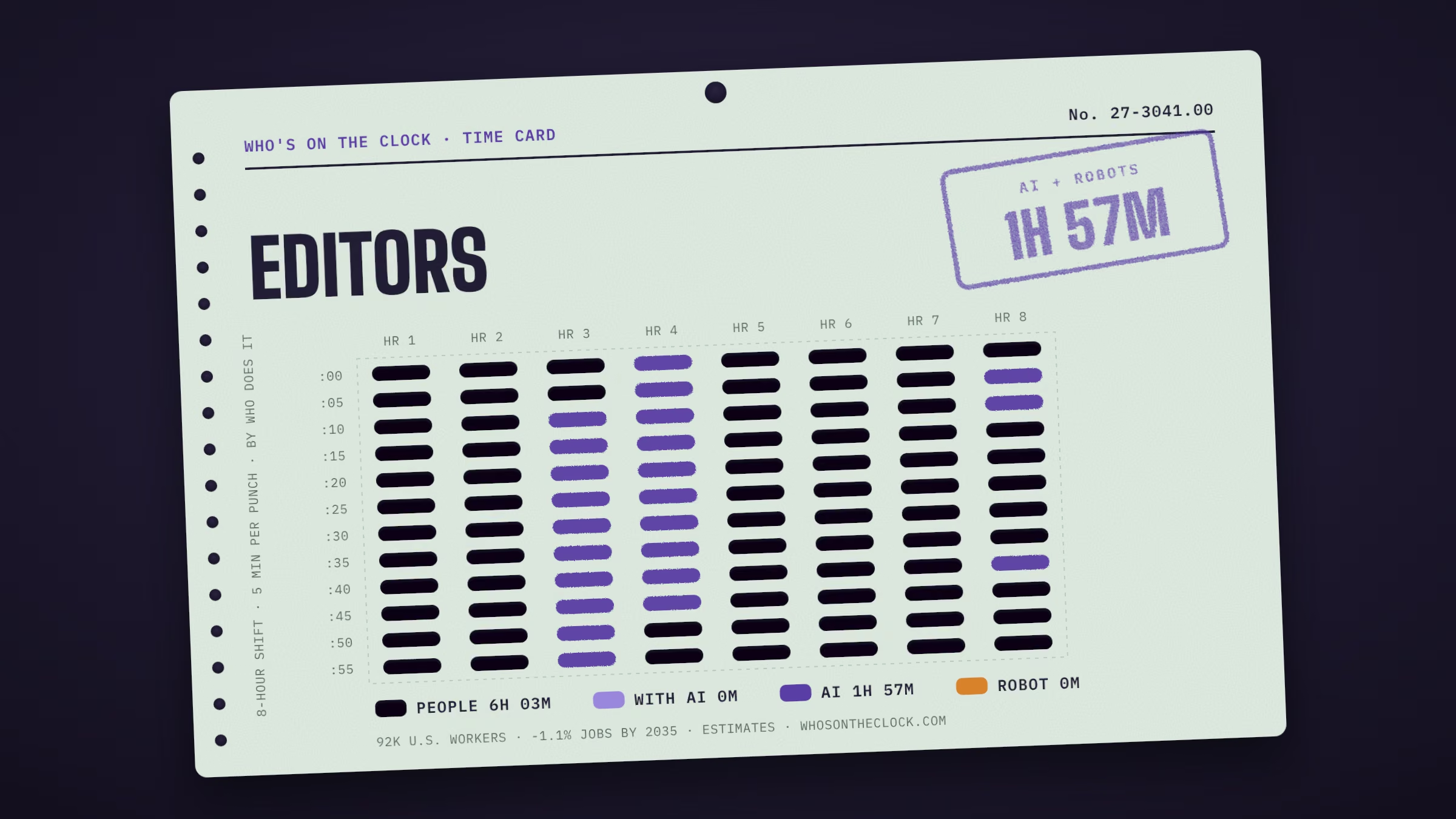
AI already handles some of this work on its own in real use, for tasks like “Prepare, rewrite and edit copy to improve readability”. That's 1h 57m of a typical shift; 6h 3m still has no AI or robot evidence. BLS expects about 1.1% fewer of these jobs by 2035.

Time card for editors showing a typical 8-hour shift: 6h 3m done by people, 1h 57m by AI.
Each mark is 5 minutes of a typical shift for editors, colored by who does that task today. Estimates from O*NET tasks and Anthropic Economic Index data. How it's made

Home / Arts, media & sports / Editors

Plan, coordinate, revise, or edit written material. May review proposals and drafts for possible publication.

Time card

Untick tasks you don't do, or set your own times.
MineTask, by time spentHumanWith AIAIRobot
Read copy or proof to detect and correct errors in spelling, punctuation, and syntax.1h 4m a shift · No AI or robot evidence found
Why this label?No AI use or robot deployment showed up for this task in our data. That isn't proof it's safe; it may just be rare in the data. How labels work
Read, evaluate and edit manuscripts or other materials submitted for publication, and confer with authors regarding changes in content, style or organization, or publication.1h 4m a shift · No AI or robot evidence found
Why this label?No AI use or robot deployment showed up for this task in our data. That isn't proof it's safe; it may just be rare in the data. How labels work
Prepare, rewrite and edit copy to improve readability, or supervise others who do this work.59m a shift · Observed in AI useTypical AI request: about 3h 4m alone, 35m with AI
Why this label?Marked AI because this task shows up regularly in real AI conversations (Anthropic Economic Index, 2025 usage), and in most of them AI does the task on its own rather than helping a person. Many workplaces may not use AI for it at all. How labels work
Develop story or content ideas, considering reader or audience appeal.41m a shift · Observed in AI useTypical AI request: about 6h 6m alone, 59m with AI
Why this label?Marked AI because this task shows up regularly in real AI conversations (Anthropic Economic Index, 2025 usage), and in most of them AI does the task on its own rather than helping a person. Many workplaces may not use AI for it at all. How labels work
Write text, such as stories, articles, editorials, or newsletters.35m a shift · No AI or robot evidence found
Why this label?No AI use or robot deployment showed up for this task in our data. That isn't proof it's safe; it may just be rare in the data. How labels work
Supervise and coordinate work of reporters and other editors.35m a shift · No AI or robot evidence found
Why this label?No AI use or robot deployment showed up for this task in our data. That isn't proof it's safe; it may just be rare in the data. How labels work
Verify facts, dates, and statistics, using standard reference sources.29m a shift · No AI or robot evidence found
Why this label?No AI use or robot deployment showed up for this task in our data. That isn't proof it's safe; it may just be rare in the data. How labels work
Oversee publication production, including artwork, layout, computer typesetting, and printing, ensuring adherence to deadlines and budget requirements.29m a shift · No AI or robot evidence found
Why this label?No AI use or robot deployment showed up for this task in our data. That isn't proof it's safe; it may just be rare in the data. How labels work
Plan the contents of publications according to the publication's style, editorial policy, and publishing requirements.23m a shift · No AI or robot evidence found
Why this label?No AI use or robot deployment showed up for this task in our data. That isn't proof it's safe; it may just be rare in the data. How labels work
Confer with management and editorial staff members regarding placement and emphasis of developing news stories.18m a shift · No AI or robot evidence found
Why this label?No AI use or robot deployment showed up for this task in our data. That isn't proof it's safe; it may just be rare in the data. How labels work
Meet frequently with artists, typesetters, layout personnel, marketing directors, and production managers to discuss projects and resolve problems.18m a shift · No AI or robot evidence found
Why this label?No AI use or robot deployment showed up for this task in our data. That isn't proof it's safe; it may just be rare in the data. How labels work
Review and approve proofs submitted by composing room prior to publication production.12m a shift · Observed in AI use
Why this label?Marked AI because this task shows up regularly in real AI conversations (Anthropic Economic Index, 2025 usage), and in most of them AI does the task on its own rather than helping a person. Many workplaces may not use AI for it at all. How labels work
Assign topics, events and stories to individual writers or reporters for coverage.12m a shift · No AI or robot evidence found
Why this label?No AI use or robot deployment showed up for this task in our data. That isn't proof it's safe; it may just be rare in the data. How labels work
Monitor news-gathering operations to ensure utilization of all news sources, such as press releases, telephone contacts, radio, television, wire services, and other reporters.6m a shift · No AI or robot evidence found
Why this label?No AI use or robot deployment showed up for this task in our data. That isn't proof it's safe; it may just be rare in the data. How labels work
Select local, state, national, and international news items received from wire services, based on assessment of items' significance and interest value.6m a shift · No AI or robot evidence found
Why this label?No AI use or robot deployment showed up for this task in our data. That isn't proof it's safe; it may just be rare in the data. How labels work
Allocate print space for story text, photos, and illustrations according to space parameters and copy significance, using knowledge of layout principles.6m a shift · No AI or robot evidence found
Why this label?No AI use or robot deployment showed up for this task in our data. That isn't proof it's safe; it may just be rare in the data. How labels work
Make manuscript acceptance or revision recommendations to the publisher.6m a shift · Observed in AI useTypical AI request: about 8h 7m alone, 45m with AI
Why this label?Marked AI because this task shows up regularly in real AI conversations (Anthropic Economic Index, 2025 usage), and in most of them AI does the task on its own rather than helping a person. Many workplaces may not use AI for it at all. How labels work
Direct the policies and departments of newspapers, magazines and other publishing establishments.6m a shift · No AI or robot evidence found
Why this label?No AI use or robot deployment showed up for this task in our data. That isn't proof it's safe; it may just be rare in the data. How labels work
Arrange for copyright permissions.6m a shift · No AI or robot evidence found
Why this label?No AI use or robot deployment showed up for this task in our data. That isn't proof it's safe; it may just be rare in the data. How labels work
Interview and hire writers and reporters or negotiate contracts, royalties, and payments for authors or freelancers.6m a shift · No AI or robot evidence found
Why this label?No AI use or robot deployment showed up for this task in our data. That isn't proof it's safe; it may just be rare in the data. How labels work
Read material to determine index items and arrange them alphabetically or topically, indicating page or chapter location.time not estimated · Observed in AI use
Why this label?Marked AI because this task shows up regularly in real AI conversations (Anthropic Economic Index, 2025 usage), and in most of them AI does the task on its own rather than helping a person. Many workplaces may not use AI for it at all. How labels work

Clock history

  1. 1h 57m touchedFirst published: O*NET 30.1, Anthropic Economic Index (2025 usage and September 2026 robot study), BLS May 2025

When new data changes this clock, the date, the new numbers and the reason are logged here. Company news alone never moves the clock.

On the floor

  1. Rolling outBusiness Insider
    Business Insider cuts 21% of staff while fully embracing AI

    Business Insider cut about 21% of staff across every department. CEO Barbara Peng said the company is fully embracing AI and that roughly seven in ten employees already use Enterprise ChatGPT.

    Fox Business

  2. Pulled backChicago Sun-Times
    Chicago Sun-Times apologizes for AI reading list with fake books

    A licensed summer reading list in the May 18 Sun-Times included 10 books out of 15 that do not exist, written by a freelancer using an AI agent. The paper apologized, said it is updating its policies, and will not charge subscribers for the edition.

    CBS News Chicago

Ask the clock

Will AI replace editors?

Unlikely, though parts of the work are changing. About 1h 57m of an 8-hour shift goes to tasks touched by AI working on its own. The other 6h 3m (76%) stays with people. Separately, BLS expects about 1.1% fewer of these jobs by 2035 (all jobs: +3.5%).

What can AI already do for editors?

AI shows up regularly in 4 of 21 tasks, about 1h 57m of a typical shift. The biggest ones:

  • Prepare, rewrite and edit copy to improve readability, or supervise others who do this work. (59m a shift, AI mostly does it alone)
  • Develop story or content ideas, considering reader or audience appeal. (41m a shift, AI mostly does it alone)
  • Review and approve proofs submitted by composing room prior to publication production. (12m a shift, AI mostly does it alone)
  • Make manuscript acceptance or revision recommendations to the publisher. (6m a shift, AI mostly does it alone)
What still needs a person?

6h 3m of a typical shift, or 76%, goes to tasks with no AI or robot evidence yet. No AI usage or robot deployment has shown up for these so far. The biggest:

  • Read copy or proof to detect and correct errors in spelling, punctuation, and syntax. (1h 4m a shift)
  • Read, evaluate and edit manuscripts or other materials submitted for publication, and confer with authors regarding changes in content, style or organization, or publication. (1h 4m a shift)
  • Write text, such as stories, articles, editorials, or newsletters. (35m a shift)
  • Supervise and coordinate work of reporters and other editors. (35m a shift)
  • Verify facts, dates, and statistics, using standard reference sources. (29m a shift)
Why is that work hard to automate?

Much of it comes down to where and how the work happens. In-person, hands-on and high-stakes work is where AI and robots have made the least headway so far. In the official O*NET survey of people in this job:

  • 83% talk face to face with others every day
  • 60% are in constant contact with other people
  • 59% say dealing with the public is very or extremely important
What are companies actually doing?

We track 2 sourced company moves that affect this job, including at least one pullback. Most recent:

  • May 29, 2025: Business Insider cuts 21% of staff while fully embracing AI (Rolling out)
  • May 20, 2025: Chicago Sun-Times apologizes for AI reading list with fake books (Pulled back)
How much time does AI save on these tasks?

For the 3 tasks in this job where AI shows up and timing data exists, a typical request takes about 6h 6m for a person alone and about 45m with AI. These are Claude's own estimates from real conversations in April and May 2026 (Anthropic Economic Index). They describe single requests, not whole workdays, and time saved on a task doesn't mean jobs are cut. The biggest gaps:

  • Make manuscript acceptance or revision recommendations to the publisher (about 8h 7m alone, 45m with AI)
  • Develop story or content ideas, considering reader or audience appeal (about 6h 6m alone, 59m with AI)
  • Prepare, rewrite and edit copy to improve readability, or supervise others who do this work (about 3h 4m alone, 35m with AI)
Are employers still hiring editors?

On Indeed, job postings in the Media & Communications sector are at 69% of their February 2020 level (all U.S. postings: 104%), up 6.8% from a year earlier, as of Oct 9, 2026. BLS separately expects about 7,900 openings a year in this job through 2035. Across all U.S. postings, 7.3% now mention AI skills. Sector postings cover more than this one job and move for many reasons besides AI.

How much do editors make?

The median pay is about $77,920 a year ($37.46 an hour), 53% above the median for all U.S. jobs ($50,980). Most people in this job earn between $41,250 and $153,700 a year; that range covers the middle 80%. Pay figures are from BLS, May 2025, and vary a lot by state and employer. Pick a state to compare:

Is this job growing or shrinking?

BLS projects a decline of 1.1% from 2025 to 2035, compared with 3.5% growth for all jobs. That's about 104,000 jobs in 2035. Even so, it expects about 7,900 openings a year, mostly from people retiring or changing careers. These projections don't single out AI as a cause.

How many editors are there in the U.S.?

About 92,000 people in the U.S., roughly 0.06% of all workers (BLS, May 2025). That makes it the 290th largest of the 796 jobs on this site. BLS expects about 104,000 in 2035.

What training do editors need?

The most common requirement is a bachelor's degree: about 80% of people in the job said so in the official O*NET survey. O*NET rates the job at level 4 of 5 for preparation, which usually means: bachelor's degree. Requirements vary by state and employer, especially for licensed work.

What should I learn to stay ahead of AI?

These come from the job's official skill ratings and from the tasks that AI and robots touch least today. Building them keeps you strong in the parts of the work that still need a person:

  • Skills that matter more here than in most jobs: Reading Comprehension, Writing, Quality Control Analysis, Time Management
  • Get strong at the parts of the job that stay with people (listed above), which take 6h 3m of a typical shift
  • Tools employers list: Microsoft Word, Microsoft PowerPoint, Microsoft Outlook, Microsoft Office software, Microsoft Excel
  • Learn to use AI well on the tasks where it already shows up in this job (listed above)
What new tasks are editors taking on?

Yes. Occupational experts recently added these to the official task list, a sign of how the work itself is shifting. New tasks aren't rated for AI or robots yet:

  • Respond to questions from the public.
What other jobs could editors move into?

These use similar skills. Matches come from 109 official ratings of skills, knowledge and work activities, and each needs the same or less preparation unless the official list relates the jobs directly:

  • News Analysts, Reporters, and Journalists (1h 15m touched, $62k median pay)
  • Writers and Authors (2h 36m touched, $77k median pay)
  • Poets, Lyricists and Creative Writers (2h 5m touched, $77k median pay)
  • Film and Video Editors (2h 18m touched, $75k median pay)
How solid are these numbers?

Each task carries its own evidence label. For this job: 5 observed in real AI use, 16 with no AI or robot evidence found. The minutes per task are estimates, not measured hours, and "no evidence" doesn't prove a task is safe.

Tools in demand

  • Hypertext markup language HTML
  • Adobe Photoshop
  • Adobe Acrobat

Plus everyday office tools: Microsoft Word, Microsoft PowerPoint, Microsoft Outlook, Microsoft Office software, Microsoft Excel.

Also called

Acquisitions Editor, Acute Editor, Advertising Editor, Art Editor, Assignment Editor, Book Editor, Business Editor, Censor, Communications Editor, Content Editor, Continuity Editor, Continuity Reader, Copy Reader, Dictionary Editor