Will AI replace electrical and electronics drafters?

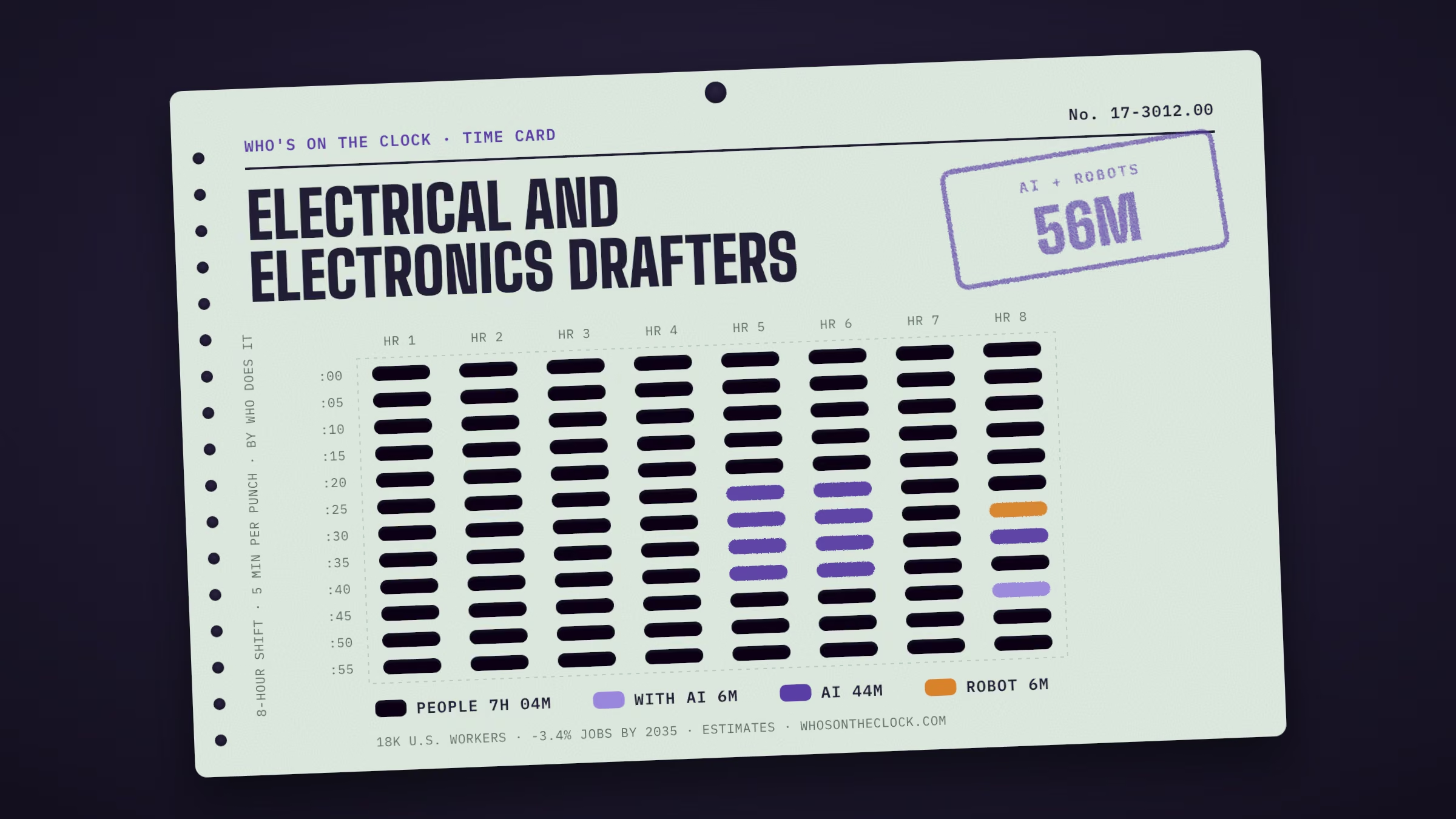
Unlikely, though parts of the work are changing. About 56m of an 8-hour shift goes to tasks touched by AI working on its own. The breakdown: 6m done by people with AI help, 44m that AI mostly does alone, 6m that robots have done in real workplaces. The other 7h 4m (88%) stays with people. Separately, BLS expects about 3.4% fewer of these jobs by 2035 (all jobs: +3.5%).

Time card for electrical and electronics drafters showing a typical 8-hour shift: 7h 4m done by people, 6m done by people with AI, 44m by AI, 6m by robots.
Each mark is 5 minutes of a typical shift for electrical and electronics drafters, colored by who does that task today. Estimates from O*NET tasks and Anthropic Economic Index data. How it's made

Home / Engineering & architecture / Electrical and Electronics Drafters

Prepare wiring diagrams, circuit board assembly diagrams, and layout drawings used for the manufacture, installation, or repair of electrical equipment.

Time card

Untick tasks you don't do, or set your own times.
MineTask, by time spentHumanWith AIAIRobot
Draft detail and assembly drawings of design components, circuitry or printed circuit boards, using computer-assisted equipment or standard drafting techniques and devices.1h 27m a shift · No AI or robot evidence found
Draft working drawings, wiring diagrams, wiring connection specifications, or cross-sections of underground cables, as required for instructions to installation crew.1h 9m a shift · No AI or robot evidence found
Assemble documentation packages and produce drawing sets to be checked by an engineer or an architect.31m a shift · No AI or robot evidence found
Consult with engineers to discuss or interpret design concepts, or determine requirements of detailed working drawings.31m a shift · No AI or robot evidence found
Design electrical systems, such as lighting systems.25m a shift · No AI or robot evidence found
Examine electronic schematics and supporting documents to develop, compute, and verify specifications for drafting data, such as configuration of parts, dimensions, or tolerances.25m a shift · No AI or robot evidence found
Review completed construction drawings and cost estimates for accuracy and conformity to standards and regulations.19m a shift · Observed in AI useTypical AI request: about 10h 20m alone, 29m with AI
Confer with engineering staff and other personnel to resolve problems.19m a shift · No AI or robot evidence found
Draw master sketches to scale showing relation of proposed installations to existing facilities and exact specifications and dimensions.19m a shift · No AI or robot evidence found
Locate files relating to specified design project in database library, load program into computer, and record completed job data.19m a shift · Observed in AI useTypical AI request: about 43m alone, 4m with AI
Review work orders or procedural manuals and confer with vendors or design staff to resolve problems or modify design.12m a shift · No AI or robot evidence found
Review blueprints to determine customer requirements and consult with assembler regarding schematics, wiring procedures, or conductor paths.12m a shift · No AI or robot evidence found
Explain drawings to production or construction teams and provide adjustments, as necessary.12m a shift · No AI or robot evidence found
Prepare and interpret specifications, calculating weights, volumes, or stress factors.12m a shift · No AI or robot evidence found
Use computer-aided drafting equipment or conventional drafting stations, technical handbooks, tables, calculators, or traditional drafting tools, such as boards, pencils, protractors, or T-squares.12m a shift · No AI or robot evidence found
Measure factors that affect installation and arrangement of equipment, such as distances to be spanned by wire and cable.6m a shift · No AI or robot evidence found
Compare logic element configuration on display screen with engineering schematics and calculate figures to convert, redesign, or modify element.6m a shift · No AI or robot evidence found
Study work order requests to determine type of service, such as lighting or power, demanded by installation.6m a shift · No AI or robot evidence found
Reproduce working drawings on copy machines or trace drawings in ink.6m a shift · Robots only in factory cells
Generate computer tapes of final layout design to produce layered photo masks or photo plotting design onto film.6m a shift · No AI or robot evidence found
Determine the order of work and the method of presentation, such as orthographic or isometric drawing.6m a shift · No AI or robot evidence found
Visit proposed installation sites and draw rough sketches of location.6m a shift · Robots deployed · e.g. Boston Dynamics Spot + Trimble X7
Key and program specified commands and engineering specifications into computer system to change functions and test final layout.6m a shift · Observed in AI useTypical AI request: about 4h 55m alone, 22m with AI
Plot electrical test points on layout sheets and draw schematics for wiring test fixture heads to frames.6m a shift · No AI or robot evidence found
Write technical reports and draw charts that display statistics and data.6m a shift · Observed in AI use
Supervise and coordinate work activities of workers engaged in drafting, designing layouts, assembling, or testing printed circuit boards.6m a shift · No AI or robot evidence found
Supervise or train other technologists, technicians, or drafters.6m a shift · No AI or robot evidence found
Copy drawings of printed circuit board fabrication using print machine or blueprinting procedure.time not estimated · Robots deployed · e.g. Ripcord robotic digitization robots (Hayward / Union City, CA facilities)
Select drill size to drill test head, according to test design and specifications, and submit guide layout to designated department.time not estimated · No AI or robot evidence found
Train students to use drafting machines and to prepare schematic diagrams, block diagrams, control drawings, logic diagrams, integrated circuit drawings, or interconnection diagrams.time not estimated · No AI or robot evidence found

On the floor

No company news tracked for this job yet. New stories are added as they happen.

Ask the clock

Will AI replace electrical and electronics drafters?

Unlikely, though parts of the work are changing. About 56m of an 8-hour shift goes to tasks touched by AI working on its own. The breakdown: 6m done by people with AI help, 44m that AI mostly does alone, 6m that robots have done in real workplaces. The other 7h 4m (88%) stays with people. Separately, BLS expects about 3.4% fewer of these jobs by 2035 (all jobs: +3.5%).

What can AI already do for electrical and electronics drafters?

AI shows up regularly in 4 of 30 tasks, about 50m of a typical shift. The biggest ones:

  • Review completed construction drawings and cost estimates for accuracy and conformity to standards and regulations. (19m a shift, AI mostly does it alone)
  • Locate files relating to specified design project in database library, load program into computer, and record completed job data. (19m a shift, AI mostly does it alone)
  • Key and program specified commands and engineering specifications into computer system to change functions and test final layout. (6m a shift, AI mostly does it alone)
  • Write technical reports and draw charts that display statistics and data. (6m a shift, people use AI to help)
Where do robots fit in?

For some tasks, yes. Robots have done 1 of this job's tasks in workplaces like this one, about 6m of a typical shift. 1 more task has only been done in factory setups built around the machine, so it stays with people here.

  • Visit proposed installation sites and draw rough sketches of location. (6m a shift; e.g. Boston Dynamics Spot + Trimble X7, in use)
What still needs a person?

7h 4m of a typical shift, or 88%, goes to tasks with no AI or robot evidence yet. No AI usage or robot deployment has shown up for these so far. The biggest:

  • Draft detail and assembly drawings of design components, circuitry or printed circuit boards, using computer-assisted equipment or standard drafting techniques and devices. (1h 27m a shift)
  • Draft working drawings, wiring diagrams, wiring connection specifications, or cross-sections of underground cables, as required for instructions to installation crew. (1h 9m a shift)
  • Assemble documentation packages and produce drawing sets to be checked by an engineer or an architect. (31m a shift)
  • Consult with engineers to discuss or interpret design concepts, or determine requirements of detailed working drawings. (31m a shift)
  • Design electrical systems, such as lighting systems. (25m a shift)
Why is that work hard to automate?

Much of it comes down to where and how the work happens. In-person, hands-on and high-stakes work is where AI and robots have made the least headway so far. In the official O*NET survey of people in this job:

  • 72% talk face to face with others every day
How much time does AI save on these tasks?

For the 3 tasks in this job where AI shows up and timing data exists, a typical request takes about 4h 55m for a person alone and about 22m with AI. These are Claude's own estimates from real conversations in April and May 2026 (Anthropic Economic Index). They describe single requests, not whole workdays, and time saved on a task doesn't mean jobs are cut. The biggest gaps:

  • Review completed construction drawings and cost estimates for accuracy and conformity to standards and regulations (about 10h 20m alone, 29m with AI)
  • Key and program specified commands and engineering specifications into computer system to change functions and test final layout (about 4h 55m alone, 22m with AI)
  • Locate files relating to specified design project in database library, load program into computer, and record completed job data (about 43m alone, 4m with AI)
Are employers still hiring electrical and electronics drafters?

On Indeed, job postings in the Industrial Engineering sector are at 124% of their February 2020 level (all U.S. postings: 104%), up 38% from a year earlier, as of Oct 9, 2026. BLS separately expects about 1,400 openings a year in this job through 2035. Across all U.S. postings, 7.3% now mention AI skills. Sector postings cover more than this one job and move for many reasons besides AI.

How much do electrical and electronics drafters make?

The median pay is about $76,870 a year ($36.96 an hour), 51% above the median for all U.S. jobs ($50,980). Most people in this job earn between $50,040 and $120,290 a year; that range covers the middle 80%. Pay figures are from BLS, May 2025, and vary a lot by state and employer. Pick a state to compare:

Is this job growing or shrinking?

BLS projects a decline of 3.4% from 2025 to 2035, compared with 3.5% growth for all jobs. That's about 18,000 jobs in 2035. Even so, it expects about 1,400 openings a year, mostly from people retiring or changing careers. These projections don't single out AI as a cause.

How many electrical and electronics drafters are there in the U.S.?

About 18,000 people in the U.S., roughly 0.01% of all workers (BLS, May 2025). That makes it the 570th largest of the 796 jobs on this site. BLS expects about 18,000 in 2035.

What training do electrical and electronics drafters need?

The most common requirement is a bachelor's degree: about 40% of people in the job said so in the official O*NET survey. O*NET rates the job at level 3 of 5 for preparation, which usually means: vocational school or associate's degree. Requirements vary by state and employer, especially for licensed work.

What should I learn to stay ahead of AI?

These come from the job's official skill ratings and from the tasks that AI and robots touch least today. Building them keeps you strong in the parts of the work that still need a person:

  • Skills that matter more here than in most jobs: Judgment and Decision Making, Writing, Complex Problem Solving, Active Learning
  • Get strong at the parts of the job that stay with people (listed above), which take 7h 4m of a typical shift
  • Tools employers list: Microsoft Word, Microsoft Outlook, Microsoft Office software, Microsoft Excel, Bentley MicroStation
  • Learn to use AI well on the tasks where it already shows up in this job (listed above)
What other jobs could electrical and electronics drafters move into?

These use similar skills, with less of a typical shift touched by AI or robots. Matches come from 109 official ratings of skills, knowledge and work activities, and each needs the same or less preparation unless the official list relates the jobs directly:

  • Architectural and Civil Drafters (19m touched, $66k median pay)
  • Mechanical Drafters (0m touched, $72k median pay)
  • Electrical and Electronic Engineering Technologists and Technicians (19m touched, $78k median pay)
How solid are these numbers?

Each task carries its own evidence label. For this job: 4 observed in real AI use, 2 with robots in real deployments, 24 with no AI or robot evidence found. The minutes per task are estimates, not measured hours, and "no evidence" doesn't prove a task is safe.

Tools in demand

  • Microsoft Word
  • Microsoft Outlook
  • Microsoft Office software
  • Microsoft Excel
  • Bentley MicroStation
  • Autodesk Revit
  • Autodesk AutoCAD
  • Adobe Illustrator

Also called

Analog Design Engineer, Analog Integrated Circuits Design Engineer (Analog IC Design Engineer), AutoCAD Drafter, AutoCAD Technician, CAD Drafter (Computer-Aided Design Drafter), CAD Draftsman (Computer-Aided Design Draftsman), CADD Drafter (Computer-Aided Design and Drafting Drafter), Circuit Board Drafter, Circuit Designer, Computer-Aided Design Designer (CAD Designer), Computer-Aided Design Operator, Computer-Aided Design Technician (CAD Tech), Computer-Aided Drafting and Design Designer, Computer-Aided Drafting and Design Operator