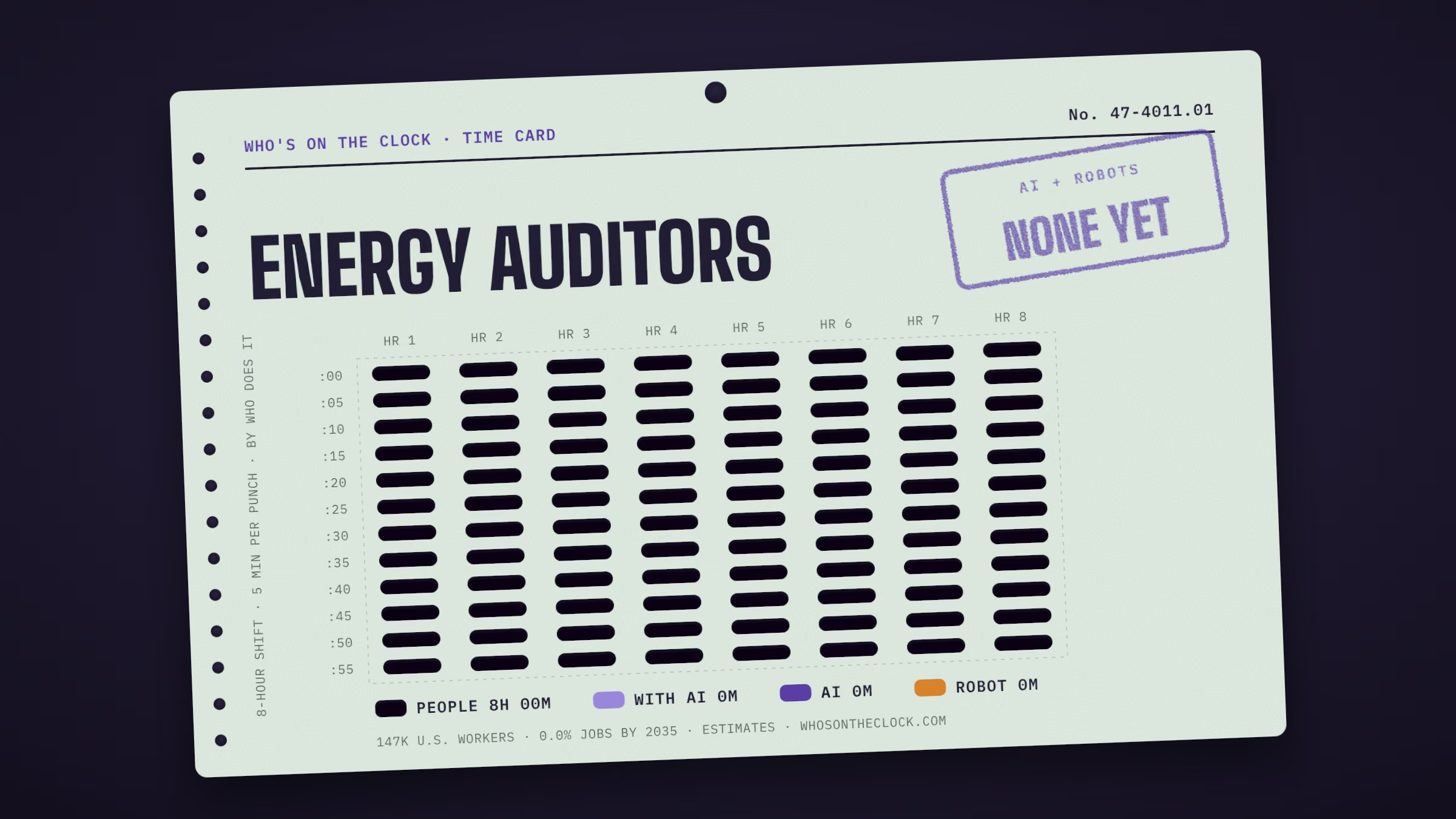
Conduct energy audits of buildings, building systems, or process systems. May also conduct investment grade audits of buildings or systems.
Time card
Untick tasks you don't do, or set your own times.
| Mine | Task, by time spent | Human | With AI | AI | Robot |
|---|---|---|---|---|---|
Inspect or evaluate building envelopes, mechanical systems, electrical systems, or process systems to determine the energy consumption of each system.1h 15m a shift · No AI or robot evidence foundWhy this label?This is physical work, and no robot has been shown doing it yet. How labels work | |||||
Prepare audit reports containing energy analysis results or recommendations for energy cost savings.1h 9m a shift · No AI or robot evidence foundWhy this label?No AI use or robot deployment showed up for this task in our data. That isn't proof it's safe; it may just be rare in the data. How labels work | |||||
Identify and prioritize energy-saving measures.34m a shift · No AI or robot evidence foundWhy this label?No AI use or robot deployment showed up for this task in our data. That isn't proof it's safe; it may just be rare in the data. How labels work | |||||
Calculate potential for energy savings.34m a shift · No AI or robot evidence foundWhy this label?No AI use or robot deployment showed up for this task in our data. That isn't proof it's safe; it may just be rare in the data. How labels work | |||||
Collect and analyze field data related to energy usage.27m a shift · No AI or robot evidence foundWhy this label?This is physical work, and no robot has been shown doing it yet. How labels work | |||||
Identify opportunities to improve the operation, maintenance, or energy efficiency of building or process systems.21m a shift · No AI or robot evidence foundWhy this label?No AI use or robot deployment showed up for this task in our data. That isn't proof it's safe; it may just be rare in the data. How labels work | |||||
Analyze technical feasibility of energy-saving measures, using knowledge of engineering, energy production, energy use, construction, maintenance, system operation, or process systems.21m a shift · No AI or robot evidence foundWhy this label?No AI use or robot deployment showed up for this task in our data. That isn't proof it's safe; it may just be rare in the data. How labels work | |||||
Recommend energy-efficient technologies or alternate energy sources.21m a shift · No AI or robot evidence foundWhy this label?No AI use or robot deployment showed up for this task in our data. That isn't proof it's safe; it may just be rare in the data. How labels work | |||||
Measure energy usage with devices such as data loggers, universal data recorders, light meters, sling psychrometers, psychrometric charts, flue gas analyzers, amp probes, watt meters, volt meters, thermometers, or utility meters.21m a shift · Robots only in factory cellsWhy this label?Robots have done this only in factory setups built around the machine, so it stays Human for energy auditors. How labels work | |||||
Educate customers on energy efficiency or answer questions on topics such as the costs of running household appliances or the selection of energy-efficient appliances.21m a shift · No AI or robot evidence foundWhy this label?No AI use or robot deployment showed up for this task in our data. That isn't proof it's safe; it may just be rare in the data. How labels work | |||||
Perform tests such as blower-door tests to locate air leaks.21m a shift · No AI or robot evidence foundWhy this label?This is physical work, and no robot has been shown doing it yet. How labels work | |||||
Analyze energy bills, including utility rates or tariffs, to gather historical energy usage data.21m a shift · No AI or robot evidence foundWhy this label?No AI use or robot deployment showed up for this task in our data. That isn't proof it's safe; it may just be rare in the data. How labels work | |||||
Identify any health or safety issues related to planned weatherization projects.14m a shift · No AI or robot evidence foundWhy this label?This is physical work, and no robot has been shown doing it yet. How labels work | |||||
Prepare job specification sheets for home energy improvements, such as attic insulation, window retrofits, or heating system upgrades.14m a shift · No AI or robot evidence foundWhy this label?No AI use or robot deployment showed up for this task in our data. That isn't proof it's safe; it may just be rare in the data. How labels work | |||||
Inspect newly installed energy-efficient equipment to ensure that it was installed properly and is performing according to specifications.14m a shift · No AI or robot evidence foundWhy this label?This is physical work, and no robot has been shown doing it yet. How labels work | |||||
Quantify energy consumption to establish baselines for energy use or need.14m a shift · No AI or robot evidence foundWhy this label?No AI use or robot deployment showed up for this task in our data. That isn't proof it's safe; it may just be rare in the data. How labels work | |||||
Determine patterns of building use to show annual or monthly needs for heating, cooling, lighting, or other energy needs.14m a shift · No AI or robot evidence foundWhy this label?No AI use or robot deployment showed up for this task in our data. That isn't proof it's safe; it may just be rare in the data. How labels work | |||||
Examine commercial sites to determine the feasibility of installing equipment that allows building management systems to reduce electricity consumption during peak demand periods.7m a shift · No AI or robot evidence foundWhy this label?This is physical work, and no robot has been shown doing it yet. How labels work | |||||
Compare existing energy consumption levels to normative data.7m a shift · No AI or robot evidence foundWhy this label?No AI use or robot deployment showed up for this task in our data. That isn't proof it's safe; it may just be rare in the data. How labels work | |||||
Oversee installation of equipment such as water heater wraps, pipe insulation, weatherstripping, door sweeps, or low-flow showerheads to improve energy efficiency.7m a shift · No AI or robot evidence foundWhy this label?This is physical work, and no robot has been shown doing it yet. How labels work | |||||
Verify income eligibility of participants in publicly financed weatherization programs.7m a shift · No AI or robot evidence foundWhy this label?No AI use or robot deployment showed up for this task in our data. That isn't proof it's safe; it may just be rare in the data. How labels work |