Will AI replace environmental science and protection technicians, including health?

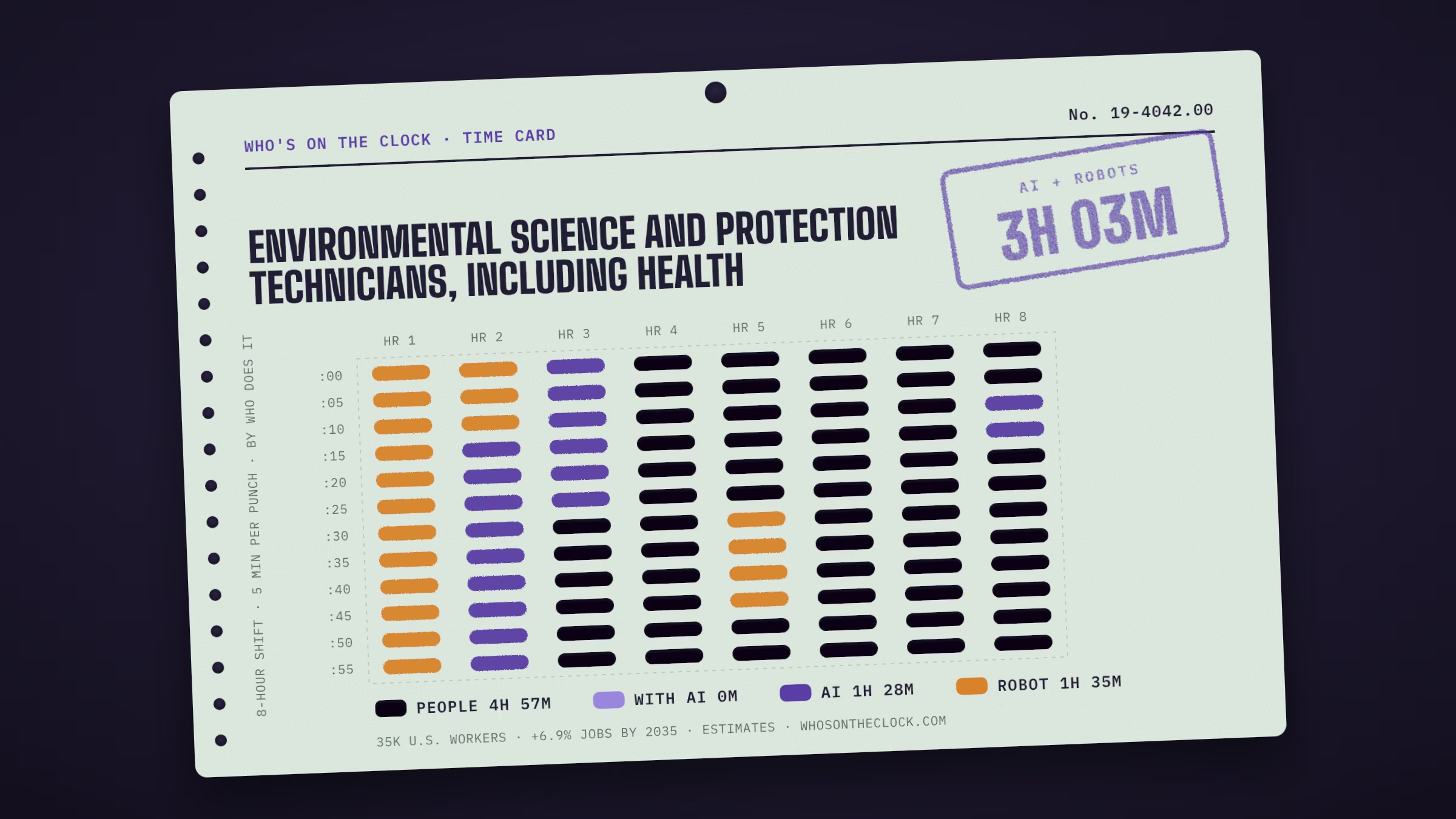
The biggest change here is physical: systems like OceanAlpha ESM30 autonomous water sampling and monitoring USV have done tasks such as “Collect samples of gases, soils, water, industrial wastewater” in real workplaces, about 1h 35m of a typical shift. Most of the rest, 4h 57m, has no AI or robot evidence. BLS expects about 6.9% more of these jobs by 2035.

Time card for environmental science and protection technicians, including health showing a typical 8-hour shift: 4h 57m done by people, 1h 28m by AI, 1h 35m by robots.
Each mark is 5 minutes of a typical shift for environmental science and protection technicians, including health, colored by who does that task today. Estimates from O*NET tasks and Anthropic Economic Index data. How it's made

Home / Science / Environmental Science and Protection Technicians, Including Health

Perform laboratory and field tests to monitor the environment and investigate sources of pollution, including those that affect health, under the direction of an environmental scientist, engineer, or other specialist. May collect samples of gases, soil, water, and other materials for testing.

Time card

Untick tasks you don't do, or set your own times.
MineTask, by time spentHumanWith AIAIRobot
Collect samples of gases, soils, water, industrial wastewater, or asbestos products to conduct tests on pollutant levels or identify sources of pollution.1h 16m a shift · Robots deployed · e.g. OceanAlpha ESM30 autonomous water sampling and monitoring USV
Why this label?Marked Robot because OceanAlpha ESM30 autonomous water sampling and monitoring USV (in real use) has done this task in a real workplace. It shows a robot can do it somewhere, not that most environmental science and protection technicians, including health work alongside one. How labels work
Record test data and prepare reports, summaries, or charts that interpret test results.1h 16m a shift · Observed in AI useTypical AI request: about 7h 48m alone, 43m with AI
Why this label?Marked AI because this task shows up regularly in real AI conversations (Anthropic Economic Index, 2025 usage), and in most of them AI does the task on its own rather than helping a person. Many workplaces may not use AI for it at all. How labels work
Investigate hazardous conditions or spills or outbreaks of disease or food poisoning, collecting samples for analysis.25m a shift · No AI or robot evidence found
Why this label?This is physical work, and no robot has been shown doing it yet. How labels work
Prepare samples or photomicrographs for testing and analysis.25m a shift · Robots only in factory cells
Why this label?Robots have done this only in factory setups built around the machine, so it stays Human for environmental science and protection technicians, including health. How labels work
Weigh, analyze, or measure collected sample particles, such as lead, coal dust, or rock, to determine concentration of pollutants.25m a shift · Robots only in factory cells
Why this label?Robots have done this only in factory setups built around the machine, so it stays Human for environmental science and protection technicians, including health. How labels work
Calibrate microscopes or test instruments.25m a shift · Robots only in factory cells
Why this label?Robots have done this only in factory setups built around the machine, so it stays Human for environmental science and protection technicians, including health. How labels work
Discuss test results and analyses with customers.19m a shift · No AI or robot evidence found
Why this label?No AI use or robot deployment showed up for this task in our data. That isn't proof it's safe; it may just be rare in the data. How labels work
Inspect workplaces to ensure the absence of health and safety hazards, such as high noise levels, radiation, or potential lighting hazards.19m a shift · Robots deployed · e.g. Spot with FLIR MUVE C360 gas sensor and Spot CAM+IR
Why this label?Marked Robot because Spot with FLIR MUVE C360 gas sensor and Spot CAM+IR (in real use) has done this task in a real workplace. It shows a robot can do it somewhere, not that most environmental science and protection technicians, including health work alongside one. How labels work
Provide information or technical or program assistance to government representatives, employers, or the general public on the issues of public health, environmental protection, or workplace safety.19m a shift · No AI or robot evidence found
Why this label?No AI use or robot deployment showed up for this task in our data. That isn't proof it's safe; it may just be rare in the data. How labels work
Maintain files, such as hazardous waste databases, chemical usage data, personnel exposure information, or diagrams showing equipment locations.19m a shift · No AI or robot evidence found
Why this label?No AI use or robot deployment showed up for this task in our data. That isn't proof it's safe; it may just be rare in the data. How labels work
Set up equipment or stations to monitor and collect pollutants from sites, such as smoke stacks, manufacturing plants, or mechanical equipment.19m a shift · No AI or robot evidence found
Why this label?This is physical work, and no robot has been shown doing it yet. How labels work
Calculate amount of pollutant in samples or compute air pollution or gas flow in industrial processes, using chemical and mathematical formulas.19m a shift · No AI or robot evidence found
Why this label?No AI use or robot deployment showed up for this task in our data. That isn't proof it's safe; it may just be rare in the data. How labels work
Develop or implement programs for monitoring of environmental pollution or radiation.13m a shift · Robots only in factory cells
Why this label?Robots have done this only in factory setups built around the machine, so it stays Human for environmental science and protection technicians, including health. How labels work
Monitor emission control devices to ensure they are operating properly and comply with state and federal regulations.13m a shift · No AI or robot evidence found
Why this label?This is physical work, and no robot has been shown doing it yet. How labels work
Make recommendations to control or eliminate unsafe conditions at workplaces or public facilities.13m a shift · No AI or robot evidence found
Why this label?No AI use or robot deployment showed up for this task in our data. That isn't proof it's safe; it may just be rare in the data. How labels work
Perform statistical analysis of environmental data.13m a shift · No AI or robot evidence found
Why this label?No AI use or robot deployment showed up for this task in our data. That isn't proof it's safe; it may just be rare in the data. How labels work
Examine and analyze material for presence and concentration of contaminants, such as asbestos, using variety of microscopes.13m a shift · Observed in AI use
Why this label?Marked AI because this task shows up regularly in real AI conversations (Anthropic Economic Index, 2025 usage), and in most of them AI does the task on its own rather than helping a person. Many workplaces may not use AI for it at all. How labels work
Develop testing procedures.6m a shift · No AI or robot evidence found
Why this label?No AI use or robot deployment showed up for this task in our data. That isn't proof it's safe; it may just be rare in the data. How labels work
Develop or implement site recycling or hazardous waste stream programs.6m a shift · No AI or robot evidence found
Why this label?No AI use or robot deployment showed up for this task in our data. That isn't proof it's safe; it may just be rare in the data. How labels work
Direct activities of workers in laboratory.6m a shift · No AI or robot evidence found
Why this label?No AI use or robot deployment showed up for this task in our data. That isn't proof it's safe; it may just be rare in the data. How labels work
Analyze potential environmental impacts of production process changes, and recommend steps to mitigate negative impacts.6m a shift · No AI or robot evidence found
Why this label?No AI use or robot deployment showed up for this task in our data. That isn't proof it's safe; it may just be rare in the data. How labels work
Initiate procedures to close down or fine establishments violating environmental or health regulations.6m a shift · No AI or robot evidence found
Why this label?No AI use or robot deployment showed up for this task in our data. That isn't proof it's safe; it may just be rare in the data. How labels work
Inspect sanitary conditions at public facilities.6m a shift · No AI or robot evidence found
Why this label?This is physical work, and no robot has been shown doing it yet. How labels work
Determine amounts and kinds of chemicals to use in destroying harmful organisms or removing impurities from purification systems.6m a shift · No AI or robot evidence found
Why this label?No AI use or robot deployment showed up for this task in our data. That isn't proof it's safe; it may just be rare in the data. How labels work
Distribute permits, closure plans, or cleanup plans.6m a shift · No AI or robot evidence found
Why this label?No AI use or robot deployment showed up for this task in our data. That isn't proof it's safe; it may just be rare in the data. How labels work

Clock history

  1. 3h 3m touchedFirst published: O*NET 30.1, Anthropic Economic Index (2025 usage and September 2026 robot study), BLS May 2025

When new data changes this clock, the date, the new numbers and the reason are logged here. Company news alone never moves the clock.

On the floor

No company news tracked for this job yet. New stories are added as they happen.

Ask the clock

Will AI replace environmental science and protection technicians, including health?

Some tasks are already being done by AI or machines; the rest still needs a person. About 3h 3m of a typical shift is made up of tasks that AI or robots have done on their own in real use somewhere. That doesn't mean those hours are automated in a typical workplace. The breakdown: 1h 28m that AI mostly does alone, 1h 35m that robots have done in real workplaces. The other 4h 57m (62%) stays with people. Separately, BLS expects about 6.9% more of these jobs by 2035 (all jobs: +3.5%).

What can AI already do for environmental science and protection technicians, including health?

AI shows up regularly in 2 of 25 tasks, about 1h 28m of a typical shift. The biggest ones:

  • Record test data and prepare reports, summaries, or charts that interpret test results. (1h 16m a shift, AI mostly does it alone)
  • Examine and analyze material for presence and concentration of contaminants, such as asbestos, using variety of microscopes. (13m a shift, AI mostly does it alone)
Where do robots fit in?

For some tasks, yes. Robots have done 2 of this job's tasks in workplaces like this one, about 1h 35m of a typical shift. 5 more tasks have only been done in factory setups built around the machine, so they stay with people here. For 4 physical tasks, no robot has shown it can do the work yet.

  • Collect samples of gases, soils, water, industrial wastewater, or asbestos products to conduct tests on pollutant levels or identify sources of pollution. (1h 16m a shift; e.g. OceanAlpha ESM30 autonomous water sampling and monitoring USV, in use)
  • Inspect workplaces to ensure the absence of health and safety hazards, such as high noise levels, radiation, or potential lighting hazards. (19m a shift; e.g. Spot with FLIR MUVE C360 gas sensor and Spot CAM+IR, in use)
What still needs a person?

4h 57m of a typical shift, or 62%, goes to tasks with no AI or robot evidence yet. No AI usage or robot deployment has shown up for these so far. The biggest:

  • Investigate hazardous conditions or spills or outbreaks of disease or food poisoning, collecting samples for analysis. (25m a shift)
  • Prepare samples or photomicrographs for testing and analysis. (25m a shift)
  • Weigh, analyze, or measure collected sample particles, such as lead, coal dust, or rock, to determine concentration of pollutants. (25m a shift)
  • Calibrate microscopes or test instruments. (25m a shift)
  • Discuss test results and analyses with customers. (19m a shift)
Why is that work hard to automate?

Much of it comes down to where and how the work happens. In-person, hands-on and high-stakes work is where AI and robots have made the least headway so far. In the official O*NET survey of people in this job:

  • 73% say dealing with the public is very or extremely important
  • 64% carry high or very high responsibility for other workers' safety
  • 50% talk face to face with others every day
How much time does AI save on these tasks?

For the 1 task in this job where AI shows up and timing data exists, a typical request takes about 7h 48m for a person alone and about 43m with AI. These are Claude's own estimates from real conversations in April and May 2026 (Anthropic Economic Index). They describe single requests, not whole workdays, and time saved on a task doesn't mean jobs are cut. The biggest gaps:

  • Record test data and prepare reports, summaries, or charts that interpret test results (about 7h 48m alone, 43m with AI)
Are employers still hiring environmental science and protection technicians, including health?

On Indeed, job postings in the Scientific Research & Development sector are at 84% of their February 2020 level (all U.S. postings: 104%), up 19.9% from a year earlier, as of Oct 9, 2026. BLS separately expects about 5,300 openings a year in this job through 2035. Across all U.S. postings, 7.3% now mention AI skills. Sector postings cover more than this one job and move for many reasons besides AI.

How much do environmental science and protection technicians, including health make?

The median pay is about $55,090 a year ($26.49 an hour), 8% above the median for all U.S. jobs ($50,980). Most people in this job earn between $38,170 and $94,160 a year; that range covers the middle 80%. Pay figures are from BLS, May 2025, and vary a lot by state and employer. Pick a state to compare:

Is this job growing or shrinking?

BLS projects growth of 6.9% from 2025 to 2035, compared with 3.5% growth for all jobs. That's about 39,000 jobs in 2035. It expects about 5,300 openings a year, mostly from people retiring or changing careers. These projections don't single out AI as a cause.

How many environmental science and protection technicians, including health are there in the U.S.?

About 35,000 people in the U.S., roughly 0.02% of all workers (BLS, May 2025). That makes it the 449th largest of the 796 jobs on this site. BLS expects about 39,000 in 2035.

What training do environmental science and protection technicians, including health need?

The most common requirement is a bachelor's degree: about 68% of people in the job said so in the official O*NET survey. O*NET rates the job at level 4 of 5 for preparation, which usually means: bachelor's degree. Requirements vary by state and employer, especially for licensed work.

What should I learn to stay ahead of AI?

These come from the job's official skill ratings and from the tasks that AI and robots touch least today. Building them keeps you strong in the parts of the work that still need a person:

  • Skills that matter more here than in most jobs: Science, Writing, Mathematics, Reading Comprehension
  • Get strong at the parts of the job that stay with people (listed above), which take 4h 57m of a typical shift
  • Tools employers list: Microsoft Outlook, Microsoft Office software, Microsoft Excel, Adobe Acrobat, Autodesk AutoCAD
  • Learn to use AI well on the tasks where it already shows up in this job (listed above)
What other jobs could environmental science and protection technicians, including health move into?

These use similar skills, with less of a typical shift touched by AI or robots. Matches come from 109 official ratings of skills, knowledge and work activities, and each needs the same or less preparation unless the official list relates the jobs directly:

  • Environmental Compliance Inspectors (25m touched, $81k median pay)
  • Environmental Scientists and Specialists, Including Health (2h 16m touched, $82k median pay)
  • Environmental Engineering Technologists and Technicians (1h 26m touched, $60k median pay)
  • Brownfield Redevelopment Specialists and Site Managers (29m touched, $142k median pay)
  • Environmental Engineers (17m touched, $107k median pay)
How solid are these numbers?

Each task carries its own evidence label. For this job: 2 observed in real AI use, 2 with robots in real deployments, 21 with no AI or robot evidence found. The minutes per task are estimates, not measured hours, and "no evidence" doesn't prove a task is safe.

Tools in demand

  • Adobe Acrobat
  • Autodesk AutoCAD
  • ESRI ArcGIS software
  • Microsoft Access

Plus everyday office tools: Microsoft Outlook, Microsoft Office software, Microsoft Excel, Microsoft PowerPoint.

Also called

Air Analyst, Air Pollution Auditor, Air Quality Technician (Air Quality Tech), Analytical Lab Tech (Analytical Laboratory Technician), Asbestos Abatement Technician (Asbestos Abatement Tech), Asbestos Microscopist, Biological Lab Tech (Biological Laboratory Technician), Biotechnician, Certified Indoor Environmentalist, Chemical Lab Tech (Chemical Laboratory Technician), Compliance Technician (Compliance Tech), Decontamination Technician (Decontamination Tech), Emergency Spill Response Technician (Emergency Spill Response Tech), Energy and Conservation Technician (Energy and Conservation Tech)