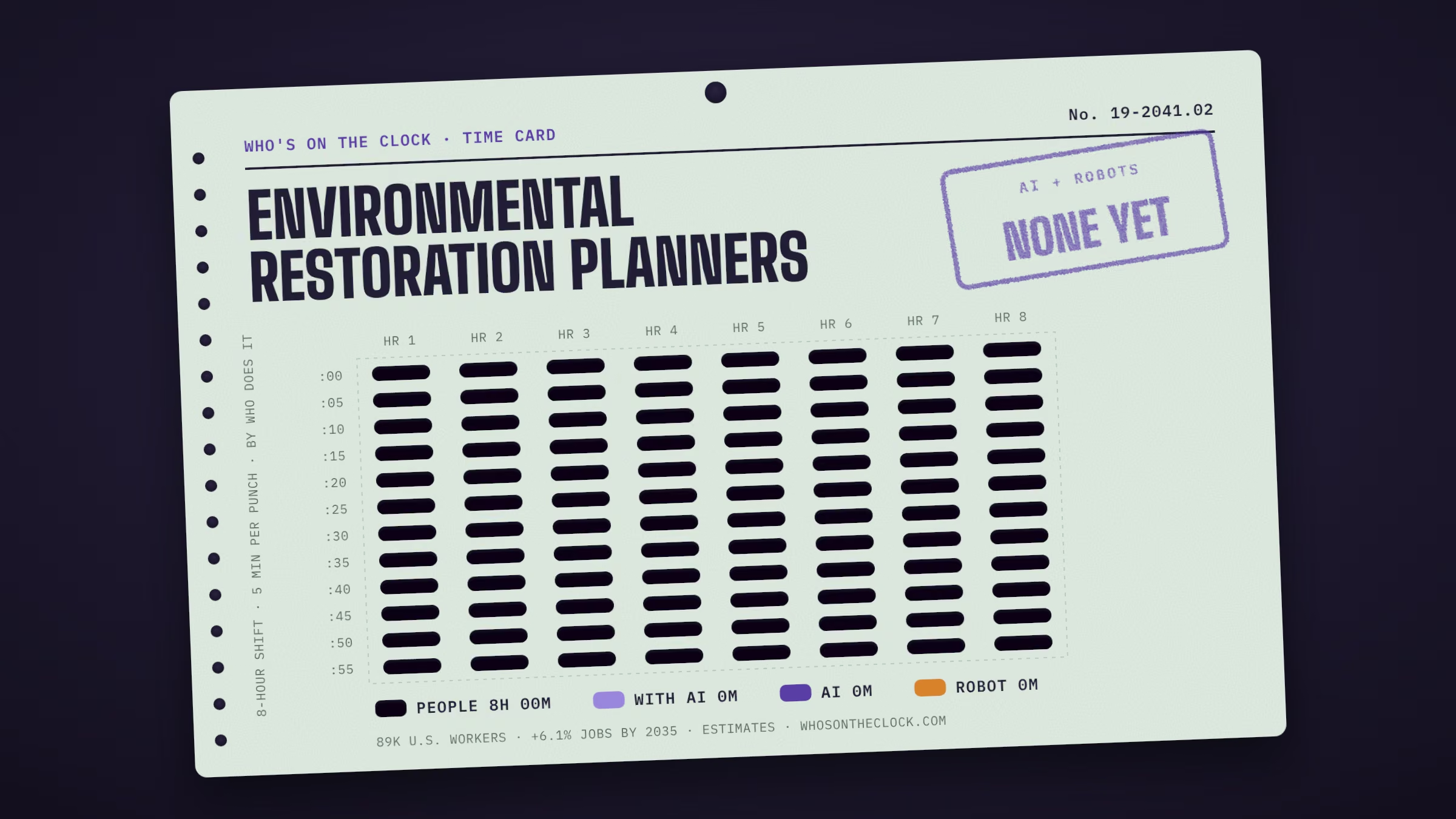
Collaborate with field and biology staff to oversee the implementation of restoration projects and to develop new products. Process and synthesize complex scientific data into practical strategies for restoration, monitoring or management.
Time card
Untick tasks you don't do, or set your own times.
| Mine | Task, by time spent | Human | With AI | AI | Robot |
|---|---|---|---|---|---|
Collect and analyze data to determine environmental conditions and restoration needs.41m a shift · No AI or robot evidence foundWhy this label?No AI use or robot deployment showed up for this task in our data. That isn't proof it's safe; it may just be rare in the data. How labels work | |||||
Create habitat management or restoration plans, such as native tree restoration and weed control.35m a shift · No AI or robot evidence foundWhy this label?No AI use or robot deployment showed up for this task in our data. That isn't proof it's safe; it may just be rare in the data. How labels work | |||||
Conduct site assessments to certify a habitat or to ascertain environmental damage or restoration needs.35m a shift · No AI or robot evidence foundWhy this label?This is physical work, and no robot has been shown doing it yet. How labels work | |||||
Plan environmental restoration projects, using biological databases, environmental strategies, and planning software.35m a shift · No AI or robot evidence foundWhy this label?No AI use or robot deployment showed up for this task in our data. That isn't proof it's safe; it may just be rare in the data. How labels work | |||||
Develop environmental restoration project schedules and budgets.29m a shift · No AI or robot evidence foundWhy this label?No AI use or robot deployment showed up for this task in our data. That isn't proof it's safe; it may just be rare in the data. How labels work | |||||
Provide technical direction on environmental planning to energy engineers, biologists, geologists, or other professionals working to develop restoration plans or strategies.29m a shift · No AI or robot evidence foundWhy this label?No AI use or robot deployment showed up for this task in our data. That isn't proof it's safe; it may just be rare in the data. How labels work | |||||
Supervise and provide technical guidance, training, or assistance to employees working in the field to restore habitats.29m a shift · No AI or robot evidence foundWhy this label?No AI use or robot deployment showed up for this task in our data. That isn't proof it's safe; it may just be rare in the data. How labels work | |||||
Communicate findings of environmental studies or proposals for environmental remediation to other restoration professionals.29m a shift · No AI or robot evidence foundWhy this label?No AI use or robot deployment showed up for this task in our data. That isn't proof it's safe; it may just be rare in the data. How labels work | |||||
Develop natural resource management plans, using knowledge of environmental planning or state and federal environmental regulatory requirements.23m a shift · No AI or robot evidence foundWhy this label?No AI use or robot deployment showed up for this task in our data. That isn't proof it's safe; it may just be rare in the data. How labels work | |||||
Apply for permits required for the implementation of environmental remediation projects.18m a shift · No AI or robot evidence foundWhy this label?No AI use or robot deployment showed up for this task in our data. That isn't proof it's safe; it may just be rare in the data. How labels work | |||||
Inspect active remediation sites to ensure compliance with environmental or safety policies, standards, or regulations.18m a shift · No AI or robot evidence foundWhy this label?This is physical work, and no robot has been shown doing it yet. How labels work | |||||
Identify environmental mitigation alternatives, ensuring compliance with applicable standards, laws, or regulations.18m a shift · No AI or robot evidence foundWhy this label?No AI use or robot deployment showed up for this task in our data. That isn't proof it's safe; it may just be rare in the data. How labels work | |||||
Plan or supervise environmental studies to achieve compliance with environmental regulations in construction, modification, operation, acquisition, or divestiture of facilities such as power plants.18m a shift · No AI or robot evidence foundWhy this label?No AI use or robot deployment showed up for this task in our data. That isn't proof it's safe; it may just be rare in the data. How labels work | |||||
Conduct environmental impact studies to examine the ecological effects of pollutants, disease, human activities, nature, and climate change.18m a shift · No AI or robot evidence foundWhy this label?No AI use or robot deployment showed up for this task in our data. That isn't proof it's safe; it may just be rare in the data. How labels work | |||||
Create environmental models or simulations, using geographic information system (GIS) data and knowledge of particular ecosystems or ecological regions.18m a shift · No AI or robot evidence foundWhy this label?No AI use or robot deployment showed up for this task in our data. That isn't proof it's safe; it may just be rare in the data. How labels work | |||||
Create diagrams to communicate environmental remediation planning, using geographic information systems (GIS), computer-aided design (CAD), or other mapping or diagramming software.18m a shift · No AI or robot evidence foundWhy this label?No AI use or robot deployment showed up for this task in our data. That isn't proof it's safe; it may just be rare in the data. How labels work | |||||
Write grants to obtain funding for restoration projects.12m a shift · No AI or robot evidence foundWhy this label?No AI use or robot deployment showed up for this task in our data. That isn't proof it's safe; it may just be rare in the data. How labels work | |||||
Review existing environmental remediation designs.12m a shift · No AI or robot evidence foundWhy this label?No AI use or robot deployment showed up for this task in our data. That isn't proof it's safe; it may just be rare in the data. How labels work | |||||
Develop and communicate recommendations for landowners to maintain or restore environmental conditions.12m a shift · No AI or robot evidence foundWhy this label?No AI use or robot deployment showed up for this task in our data. That isn't proof it's safe; it may just be rare in the data. How labels work | |||||
Conduct feasibility and cost-benefit studies for environmental remediation projects.12m a shift · No AI or robot evidence foundWhy this label?No AI use or robot deployment showed up for this task in our data. That isn't proof it's safe; it may just be rare in the data. How labels work | |||||
Develop environmental management or restoration plans for sites with power transmission lines, natural gas pipelines, fuel refineries, geothermal plants, wind farms, or solar farms.12m a shift · No AI or robot evidence foundWhy this label?No AI use or robot deployment showed up for this task in our data. That isn't proof it's safe; it may just be rare in the data. How labels work | |||||
Identify short- and long-term impacts of environmental remediation activities.6m a shift · No AI or robot evidence foundWhy this label?No AI use or robot deployment showed up for this task in our data. That isn't proof it's safe; it may just be rare in the data. How labels work | |||||
Notify regulatory or permitting agencies of deviations from implemented remediation plans.6m a shift · No AI or robot evidence foundWhy this label?No AI use or robot deployment showed up for this task in our data. That isn't proof it's safe; it may just be rare in the data. How labels work |