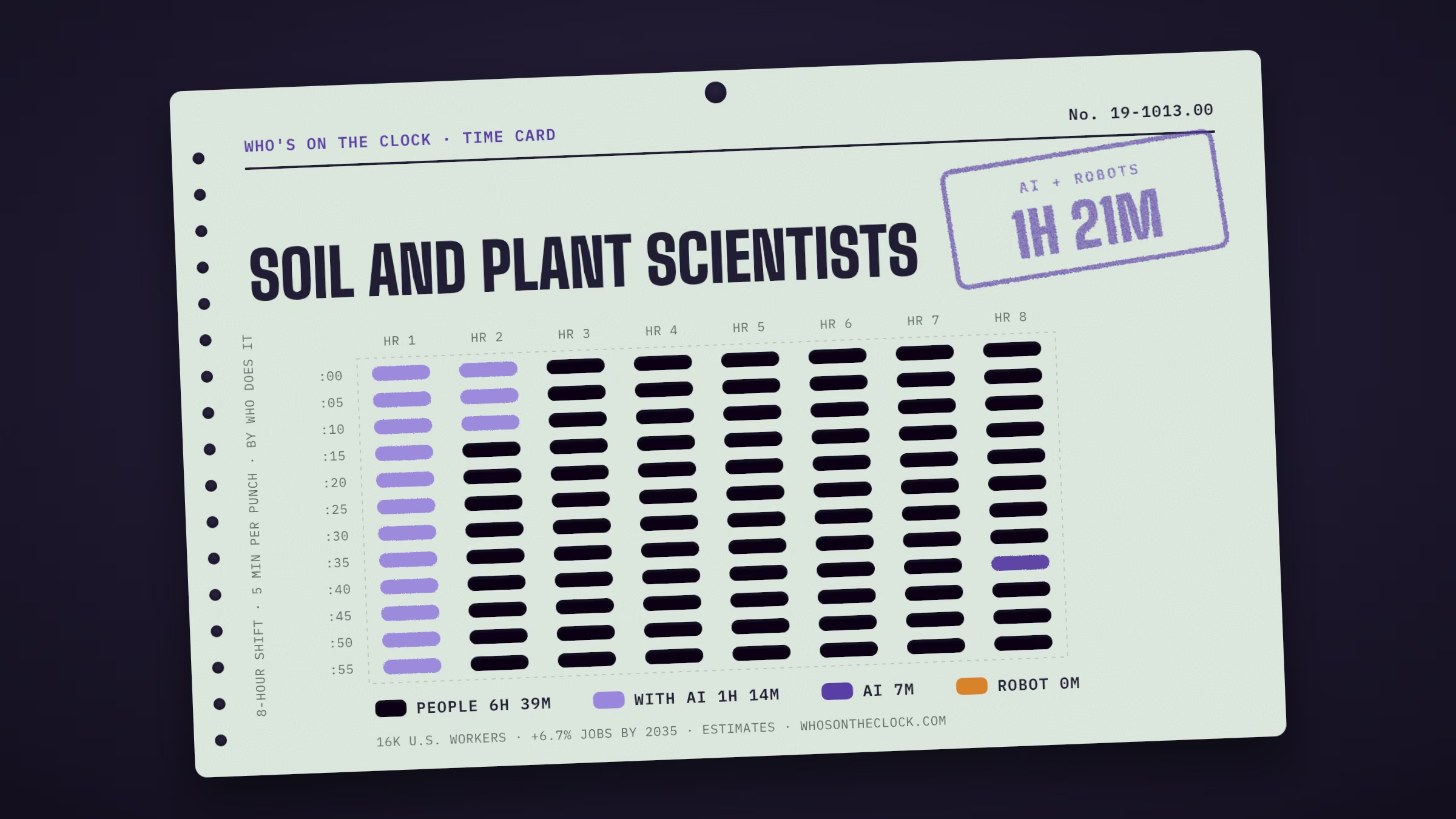
Conduct research in breeding, physiology, production, yield, and management of crops and agricultural plants or trees, shrubs, and nursery stock, their growth in soils, and control of pests; or study the chemical, physical, biological, and mineralogical composition of soils as they relate to plant or crop growth. May classify and map soils and investigate effects of alternative practices on soil and crop productivity.
Time card
Untick tasks you don't do, or set your own times.
| Mine | Task, by time spent | Human | With AI | AI | Robot |
|---|---|---|---|---|---|
Communicate research or project results to other professionals or the public or teach related courses, seminars, or workshops.1h 14m a shift · Observed in AI useWhy this label?Marked With AI because people regularly use AI to help with this task in real conversations (Anthropic Economic Index, 2025 usage), but AI doesn't usually finish it alone. How labels work | |||||
Provide information or recommendations to farmers or other landowners regarding ways in which they can best use land, promote plant growth, or avoid or correct problems such as erosion.41m a shift · No AI or robot evidence foundWhy this label?No AI use or robot deployment showed up for this task in our data. That isn't proof it's safe; it may just be rare in the data. How labels work | |||||
Conduct experiments to develop new or improved varieties of field crops, focusing on characteristics such as yield, quality, disease resistance, nutritional value, or adaptation to specific soils or climates.41m a shift · No AI or robot evidence foundWhy this label?This is physical work, and no robot has been shown doing it yet. How labels work | |||||
Conduct experiments to investigate the underlying mechanisms of plant growth and response to the environment.34m a shift · Robots only in factory cellsWhy this label?Robots have done this only in factory setups built around the machine, so it stays Human for soil and plant scientists. How labels work | |||||
Develop methods of conserving or managing soil that can be applied by farmers or forestry companies.20m a shift · No AI or robot evidence foundWhy this label?No AI use or robot deployment showed up for this task in our data. That isn't proof it's safe; it may just be rare in the data. How labels work | |||||
Investigate soil problems or poor water quality to determine sources and effects.20m a shift · No AI or robot evidence foundWhy this label?No AI use or robot deployment showed up for this task in our data. That isn't proof it's safe; it may just be rare in the data. How labels work | |||||
Investigate responses of soils to specific management practices to determine the use capabilities of soils and the effects of alternative practices on soil productivity.20m a shift · No AI or robot evidence foundWhy this label?No AI use or robot deployment showed up for this task in our data. That isn't proof it's safe; it may just be rare in the data. How labels work | |||||
Develop new or improved methods or products for controlling or eliminating weeds, crop diseases, or insect pests.20m a shift · No AI or robot evidence foundWhy this label?No AI use or robot deployment showed up for this task in our data. That isn't proof it's safe; it may just be rare in the data. How labels work | |||||
Study soil characteristics to classify soils on the basis of factors such as geographic location, landscape position, or soil properties.20m a shift · No AI or robot evidence foundWhy this label?This is physical work, and no robot has been shown doing it yet. How labels work | |||||
Conduct research to determine best methods of planting, spraying, cultivating, harvesting, storing, processing, or transporting horticultural products.20m a shift · No AI or robot evidence foundWhy this label?No AI use or robot deployment showed up for this task in our data. That isn't proof it's safe; it may just be rare in the data. How labels work | |||||
Survey undisturbed or disturbed lands for classification, inventory, mapping, environmental impact assessments, environmental protection planning, conservation planning, or reclamation planning.20m a shift · No AI or robot evidence foundWhy this label?This is physical work, and no robot has been shown doing it yet. How labels work | |||||
Identify degraded or contaminated soils and develop plans to improve their chemical, biological, or physical characteristics.14m a shift · No AI or robot evidence foundWhy this label?No AI use or robot deployment showed up for this task in our data. That isn't proof it's safe; it may just be rare in the data. How labels work | |||||
Develop improved measurement techniques, soil conservation methods, soil sampling devices, or related technology.14m a shift · No AI or robot evidence foundWhy this label?No AI use or robot deployment showed up for this task in our data. That isn't proof it's safe; it may just be rare in the data. How labels work | |||||
Develop environmentally safe methods or products for controlling or eliminating weeds, crop diseases, or pests.14m a shift · No AI or robot evidence foundWhy this label?No AI use or robot deployment showed up for this task in our data. That isn't proof it's safe; it may just be rare in the data. How labels work | |||||
Study ways to improve agricultural sustainability, such as the use of new methods of composting.14m a shift · No AI or robot evidence foundWhy this label?No AI use or robot deployment showed up for this task in our data. That isn't proof it's safe; it may just be rare in the data. How labels work | |||||
Perform chemical analyses of the microorganism content of soils to determine microbial reactions or chemical mineralogical relationships to plant growth.14m a shift · Robots only in factory cellsWhy this label?Robots have done this only in factory setups built around the machine, so it stays Human for soil and plant scientists. How labels work | |||||
Develop ways of altering soils to suit different types of plants.14m a shift · No AI or robot evidence foundWhy this label?No AI use or robot deployment showed up for this task in our data. That isn't proof it's safe; it may just be rare in the data. How labels work | |||||
Conduct experiments investigating how soil forms, changes, or interacts with land-based ecosystems or living organisms.14m a shift · Robots only in factory cellsWhy this label?Robots have done this only in factory setups built around the machine, so it stays Human for soil and plant scientists. How labels work | |||||
Provide advice regarding the development of regulatory standards for land reclamation or soil conservation.7m a shift · No AI or robot evidence foundWhy this label?No AI use or robot deployment showed up for this task in our data. That isn't proof it's safe; it may just be rare in the data. How labels work | |||||
Consult with engineers or other technical personnel working on construction projects about the effects of soil problems and possible solutions to these problems.7m a shift · No AI or robot evidence foundWhy this label?No AI use or robot deployment showed up for this task in our data. That isn't proof it's safe; it may just be rare in the data. How labels work | |||||
Plan or supervise waste management programs for composting or farming.7m a shift · No AI or robot evidence foundWhy this label?No AI use or robot deployment showed up for this task in our data. That isn't proof it's safe; it may just be rare in the data. How labels work | |||||
Research technical requirements or environmental impacts of urban green spaces, such as green roof installations.7m a shift · No AI or robot evidence foundWhy this label?No AI use or robot deployment showed up for this task in our data. That isn't proof it's safe; it may just be rare in the data. How labels work | |||||
Identify or classify species of insects or allied forms, such as mites or spiders.7m a shift · Observed in AI useTypical AI request: about 16m alone, 4m with AIWhy this label?Marked AI because this task shows up regularly in real AI conversations (Anthropic Economic Index, 2025 usage), and in most of them AI does the task on its own rather than helping a person. Many workplaces may not use AI for it at all. How labels work | |||||
Study insect distribution or habitat and recommend methods to prevent importation or spread of injurious species.7m a shift · No AI or robot evidence foundWhy this label?No AI use or robot deployment showed up for this task in our data. That isn't proof it's safe; it may just be rare in the data. How labels work | |||||
Plan or supervise land conservation or reclamation programs for industrial development projects.7m a shift · No AI or robot evidence foundWhy this label?No AI use or robot deployment showed up for this task in our data. That isn't proof it's safe; it may just be rare in the data. How labels work | |||||
Conduct research into the use of plant species as green fuels or in the production of green fuels.7m a shift · No AI or robot evidence foundWhy this label?No AI use or robot deployment showed up for this task in our data. That isn't proof it's safe; it may just be rare in the data. How labels work | |||||
Conduct experiments regarding causes of bee diseases or factors affecting yields of nectar or pollen.time not estimated · Robots only in factory cellsWhy this label?Robots have done this only in factory setups built around the machine, so it stays Human for soil and plant scientists. How labels work |