Will AI replace first-line supervisors of security workers?

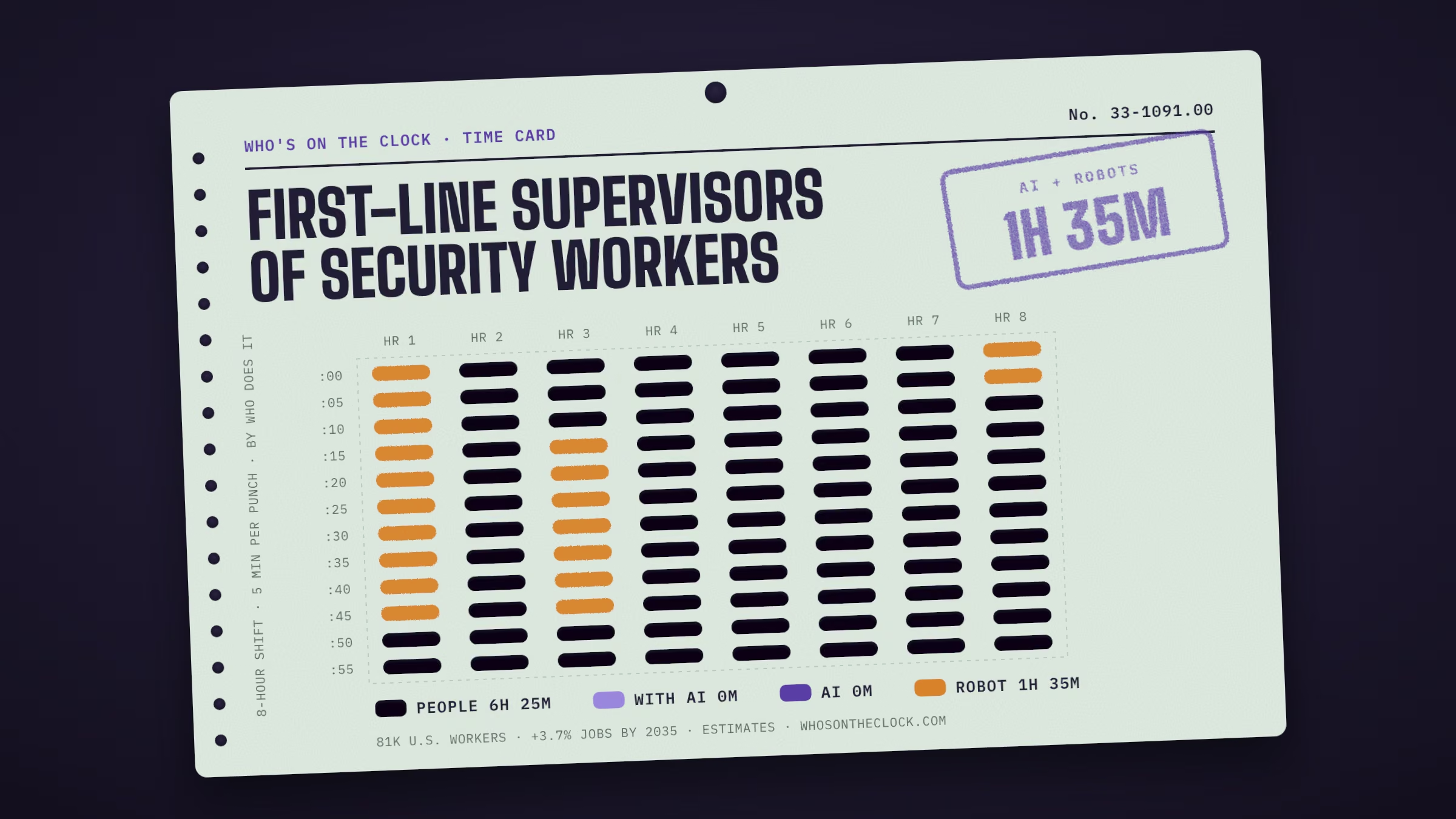
The biggest change here is physical: systems like Cobalt Robot have done tasks such as “Patrol the premises to prevent or detect intrusion, protect property” in real workplaces, about 1h 35m of a typical shift. Most of the rest, 6h 25m, has no AI or robot evidence. BLS expects about 3.7% more of these jobs by 2035.

Time card for first-line supervisors of security workers showing a typical 8-hour shift: 6h 25m done by people, 1h 35m by robots.
Each mark is 5 minutes of a typical shift for first-line supervisors of security workers, colored by who does that task today. Estimates from O*NET tasks and Anthropic Economic Index data. How it's made

Home / Protective services / First-Line Supervisors of Security Workers

Directly supervise and coordinate activities of security workers and security guards.

Time card

Untick tasks you don't do, or set your own times.
MineTask, by time spentHumanWith AIAIRobot
Patrol the premises to prevent or detect intrusion, protect property, or preserve order.47m a shift · Robots deployed · e.g. Cobalt Robot
Why this label?Marked Robot because Cobalt Robot (in real use) has done this task in a real workplace. It shows a robot can do it somewhere, not that most first-line supervisors of security workers work alongside one. How labels work
Monitor the behavior of security employees to ensure adherence to quality standards, deadlines, or procedures.47m a shift · No AI or robot evidence found
Why this label?No AI use or robot deployment showed up for this task in our data. That isn't proof it's safe; it may just be rare in the data. How labels work
Monitor closed-circuit television cameras.41m a shift · No AI or robot evidence found
Why this label?No AI use or robot deployment showed up for this task in our data. That isn't proof it's safe; it may just be rare in the data. How labels work
Investigate disturbances on the premises, such as security alarms, altercations, and suspicious activity.36m a shift · Robots deployed · e.g. Cobalt Robot (Cobalt AI)
Why this label?Marked Robot because Cobalt Robot (Cobalt AI) (in real use) has done this task in a real workplace. It shows a robot can do it somewhere, not that most first-line supervisors of security workers work alongside one. How labels work
Monitor and authorize entry of employees, visitors, or other persons.36m a shift · No AI or robot evidence found
Why this label?No AI use or robot deployment showed up for this task in our data. That isn't proof it's safe; it may just be rare in the data. How labels work
Write reports documenting observations made while on patrol.30m a shift · No AI or robot evidence found
Why this label?No AI use or robot deployment showed up for this task in our data. That isn't proof it's safe; it may just be rare in the data. How labels work
Advise employees in handling problems or resolving complaints from customers, tenants, detainees, or other persons.30m a shift · No AI or robot evidence found
Why this label?No AI use or robot deployment showed up for this task in our data. That isn't proof it's safe; it may just be rare in the data. How labels work
Assign security personnel to posts or patrols.24m a shift · No AI or robot evidence found
Why this label?No AI use or robot deployment showed up for this task in our data. That isn't proof it's safe; it may just be rare in the data. How labels work
Train security personnel on protective procedures, first aid, fire safety, and other duties.24m a shift · No AI or robot evidence found
Why this label?No AI use or robot deployment showed up for this task in our data. That isn't proof it's safe; it may just be rare in the data. How labels work
Explain company policies and procedures to staff using oral or written communication.24m a shift · No AI or robot evidence found
Why this label?No AI use or robot deployment showed up for this task in our data. That isn't proof it's safe; it may just be rare in the data. How labels work
Recruit, interview, and hire security personnel.18m a shift · No AI or robot evidence found
Why this label?No AI use or robot deployment showed up for this task in our data. That isn't proof it's safe; it may just be rare in the data. How labels work
Screen individuals and belongings to prevent passage of prohibited materials using walkthrough detectors, wands, or bag searches.18m a shift · No AI or robot evidence found
Why this label?This is physical work, and no robot has been shown doing it yet. How labels work
Inspect and adjust security equipment to ensure it is operational or to detect evidence of tampering.18m a shift · No AI or robot evidence found
Why this label?This is physical work, and no robot has been shown doing it yet. How labels work
Develop and document security procedures, policies, or standards.18m a shift · No AI or robot evidence found
Why this label?No AI use or robot deployment showed up for this task in our data. That isn't proof it's safe; it may just be rare in the data. How labels work
Secure entrances and exits by locking doors and gates.12m a shift · Robots deployed · e.g. Verkada Command access control with electronic/wireless door locks (Mountain View-Los Altos Union HSD)
Why this label?Marked Robot because Verkada Command access control with electronic/wireless door locks (Mountain View-Los Altos Union HSD) (in real use) has done this task in a real workplace. It shows a robot can do it somewhere, not that most first-line supervisors of security workers work alongside one. How labels work
Apprehend or evict trespassers, rule violators, or other security threats from the premises.12m a shift · No AI or robot evidence found
Why this label?This is physical work, and no robot has been shown doing it yet. How labels work
Schedule training or drills for emergencies, such as fires, bombs, and other threats.12m a shift · No AI or robot evidence found
Why this label?No AI use or robot deployment showed up for this task in our data. That isn't proof it's safe; it may just be rare in the data. How labels work
Log items distributed to persons, such as keys and key cards.12m a shift · No AI or robot evidence found
Why this label?No AI use or robot deployment showed up for this task in our data. That isn't proof it's safe; it may just be rare in the data. How labels work
Order materials or supplies, such as keys, uniforms, and badges.12m a shift · No AI or robot evidence found
Why this label?No AI use or robot deployment showed up for this task in our data. That isn't proof it's safe; it may just be rare in the data. How labels work
Call police or fire departments in cases of emergency, such as fire, bomb threats, and presence of unauthorized persons.6m a shift · No AI or robot evidence found
Why this label?No AI use or robot deployment showed up for this task in our data. That isn't proof it's safe; it may just be rare in the data. How labels work
Write and present department budgets to upper management or other stakeholders.6m a shift · No AI or robot evidence found
Why this label?No AI use or robot deployment showed up for this task in our data. That isn't proof it's safe; it may just be rare in the data. How labels work

Clock history

  1. 1h 35m touchedFirst published: O*NET 30.1, Anthropic Economic Index (2025 usage and September 2026 robot study), BLS May 2025

When new data changes this clock, the date, the new numbers and the reason are logged here. Company news alone never moves the clock.

On the floor

No company news tracked for this job yet. New stories are added as they happen.

Ask the clock

Will AI replace first-line supervisors of security workers?

Unlikely, though parts of the work are changing. About 1h 35m of an 8-hour shift goes to tasks touched by robots. The other 6h 25m (80%) stays with people. Separately, BLS expects about 3.7% more of these jobs by 2035 (all jobs: +3.5%).

What can AI already do for first-line supervisors of security workers?

None of this job's tasks show regular AI use yet. That can mean the work is hands-on or in person, or simply that it rarely comes up in AI usage data.

Where do robots fit in?

For some tasks, yes. Robots have done 3 of this job's tasks in workplaces like this one, about 1h 35m of a typical shift. For 3 physical tasks, no robot has shown it can do the work yet.

  • Patrol the premises to prevent or detect intrusion, protect property, or preserve order. (47m a shift; e.g. Cobalt Robot, in use)
  • Investigate disturbances on the premises, such as security alarms, altercations, and suspicious activity. (36m a shift; e.g. Cobalt Robot (Cobalt AI), in use)
  • Secure entrances and exits by locking doors and gates. (12m a shift; e.g. Verkada Command access control with electronic/wireless door locks (Mountain View-Los Altos Union HSD), in use)
What still needs a person?

6h 25m of a typical shift, or 80%, goes to tasks with no AI or robot evidence yet. No AI usage or robot deployment has shown up for these so far. The biggest:

  • Monitor the behavior of security employees to ensure adherence to quality standards, deadlines, or procedures. (47m a shift)
  • Monitor closed-circuit television cameras. (41m a shift)
  • Monitor and authorize entry of employees, visitors, or other persons. (36m a shift)
  • Write reports documenting observations made while on patrol. (30m a shift)
  • Advise employees in handling problems or resolving complaints from customers, tenants, detainees, or other persons. (30m a shift)
Why is that work hard to automate?

Much of it comes down to where and how the work happens. In-person, hands-on and high-stakes work is where AI and robots have made the least headway so far. In the official O*NET survey of people in this job:

  • 99% are in constant contact with other people
  • 98% carry high or very high responsibility for other workers' safety
  • 93% say dealing with the public is very or extremely important
Are employers still hiring first-line supervisors of security workers?

On Indeed, job postings in the Security & Public Safety sector are at 119% of their February 2020 level (all U.S. postings: 104%), up 4.4% from a year earlier, as of Oct 9, 2026. BLS separately expects about 6,800 openings a year in this job through 2035. Across all U.S. postings, 7.3% now mention AI skills. Sector postings cover more than this one job and move for many reasons besides AI.

How much do first-line supervisors of security workers make?

The median pay is about $55,940 a year ($26.90 an hour), 10% above the median for all U.S. jobs ($50,980). Most people in this job earn between $37,300 and $92,260 a year; that range covers the middle 80%. Pay figures are from BLS, May 2025, and vary a lot by state and employer. Pick a state to compare:

Is this job growing or shrinking?

BLS projects growth of 3.7% from 2025 to 2035, compared with 3.5% growth for all jobs. That's about 86,000 jobs in 2035. It expects about 6,800 openings a year, mostly from people retiring or changing careers. These projections don't single out AI as a cause.

How many first-line supervisors of security workers are there in the U.S.?

About 81,000 people in the U.S., roughly 0.05% of all workers (BLS, May 2025). That makes it the 305th largest of the 796 jobs on this site. BLS expects about 86,000 in 2035.

What training do first-line supervisors of security workers need?

The most common requirement is an associate's degree: about 30% of people in the job said so in the official O*NET survey. O*NET rates the job at level 2 of 5 for preparation, which usually means: high school diploma, some training. Requirements vary by state and employer, especially for licensed work.

What should I learn to stay ahead of AI?

These come from the job's official skill ratings and from the tasks that AI and robots touch least today. Building them keeps you strong in the parts of the work that still need a person:

  • Skills that matter more here than in most jobs: Management of Personnel Resources, Time Management, Judgment and Decision Making, Coordination
  • Get strong at the parts of the job that stay with people (listed above), which take 6h 25m of a typical shift
  • Tools employers list: Microsoft Office software, Microsoft Access, Microsoft Excel, Microsoft Outlook, Microsoft PowerPoint
What other jobs could first-line supervisors of security workers move into?

These use similar skills. Matches come from 109 official ratings of skills, knowledge and work activities, and each needs the same or less preparation unless the official list relates the jobs directly:

  • Security Managers (1h 39m touched, $107k median pay)
How solid are these numbers?

Each task carries its own evidence label. For this job: 3 with robots in real deployments, 18 with no AI or robot evidence found. The minutes per task are estimates, not measured hours, and "no evidence" doesn't prove a task is safe.

Tools in demand

  • Microsoft Access

Plus everyday office tools: Microsoft Office software, Microsoft Excel, Microsoft Outlook, Microsoft PowerPoint, Microsoft Word.

Also called

Armed Security Supervisor, Armed Site Supervisor, Campus Safety Chief, Guard Captain, Guard Chief, Guard Supervisor, Internal Security Manager, Loss Prevention Supervisor, Officer Sergeant, Protection Supervisor, Public Safety Manager, Public Safety Supervisor, Safety Supervisor, Security Chief