Will AI replace security managers?

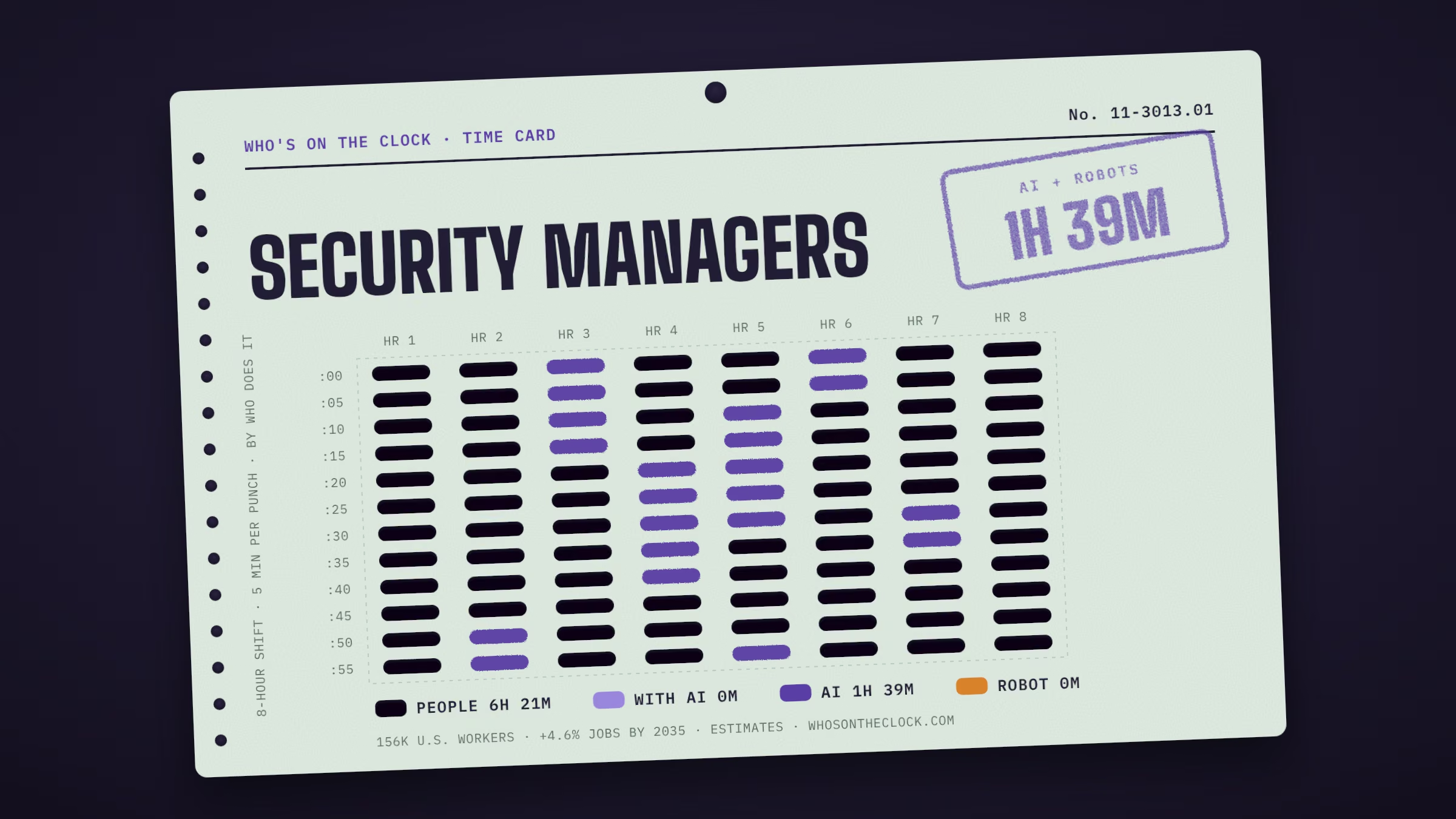
Not replace, but it is changing the job. About 1h 40m of an 8-hour shift goes to tasks touched by AI working on its own. The other 6h 21m (79%) stays with people. Separately, BLS expects about 4.6% more of these jobs by 2035 (all jobs: +3.5%).

Time card for security managers showing a typical 8-hour shift: 6h 21m done by people, 1h 40m by AI.
Each mark is 5 minutes of a typical shift for security managers, colored by who does that task today. Estimates from O*NET tasks and Anthropic Economic Index data. How it's made

Home / Management / Security Managers

Direct an organization's security functions, including physical security and safety of employees and facilities.

Time card

Untick tasks you don't do, or set your own times.
MineTask, by time spentHumanWith AIAIRobot
Plan, direct, or coordinate security activities to safeguard company employees, guests, or others on company property.55m a shift · No AI or robot evidence found
Supervise or provide leadership to subordinate security professionals, performing activities such as hiring, investigating applicants' backgrounds, training, assigning work, evaluating performance, or disciplining.55m a shift · No AI or robot evidence found
Identify, investigate, or resolve security breaches.28m a shift · Observed in AI use
Monitor security policies, programs or procedures to ensure compliance with internal security policies, or applicable government security requirements, policies, and directives.28m a shift · No AI or robot evidence found
Communicate security status, updates, and actual or potential problems, using established protocols.28m a shift · No AI or robot evidence found
Analyze and evaluate security operations to identify risks or opportunities for improvement through auditing, review, or assessment.22m a shift · Observed in AI use
Create or implement security standards, policies, and procedures.22m a shift · No AI or robot evidence found
Write or review security-related documents, such as incident reports, proposals, and tactical or strategic initiatives.22m a shift · Observed in AI use
Direct or participate in emergency management and contingency planning.17m a shift · No AI or robot evidence found
Assess risks to mitigate potential consequences of incidents and develop a plan to respond to incidents.17m a shift · Observed in AI useTypical AI request: about 9h 18m alone, 27m with AI
Develop, recommend, or manage security procedures for operations or processes, such as security call centers, access control, and reporting tools.17m a shift · No AI or robot evidence found
Conduct physical examinations of property to ensure compliance with security policies and regulations.17m a shift · No AI or robot evidence found
Train subordinate security professionals or other organization members in security rules and procedures.17m a shift · No AI or robot evidence found
Prepare reports or make presentations on internal investigations, losses, or violations of regulations, policies and procedures.17m a shift · No AI or robot evidence found
Respond to medical emergencies, bomb threats, fire alarms, or intrusion alarms, following emergency response procedures.11m a shift · No AI or robot evidence found
Plan security for special and high-risk events.11m a shift · No AI or robot evidence found
Conduct threat or vulnerability analyses to determine probable frequency, criticality, consequence, or severity of natural or man-made disasters or criminal activity on the organization's profitability or delivery of products or services.11m a shift · Observed in AI use
Coordinate security operations or activities with public law enforcement, fire and other agencies.11m a shift · No AI or robot evidence found
Develop or manage investigation programs, including collection and preservation of video and notes of surveillance processes or investigative interviews.11m a shift · No AI or robot evidence found
Attend meetings, professional seminars, or conferences to keep abreast of changes in executive legislative directives or new technologies impacting security operations.11m a shift · No AI or robot evidence found
Purchase security-related supplies, equipment, or technology.11m a shift · No AI or robot evidence found
Develop, conduct, support, or assist in governmental reviews, internal corporate evaluations, or assessments of the overall effectiveness of facility and personnel security processes.11m a shift · No AI or robot evidence found
Develop budgets for security operations.6m a shift · No AI or robot evidence found
Develop, implement, manage, or evaluate policies and methods to protect personnel against harassment, threats, or violence.6m a shift · No AI or robot evidence found
Monitor and ensure a sound, ethical environment.6m a shift · No AI or robot evidence found
Develop, arrange for, perform, or assess executive protection activities to reduce security risks.6m a shift · No AI or robot evidence found
Review financial reports to ensure efficiency and quality of security operations.6m a shift · No AI or robot evidence found
Support efforts to reduce substance abuse or other illegal activities in the workplace.6m a shift · No AI or robot evidence found

On the floor

No company news tracked for this job yet. New stories are added as they happen.

Ask the clock

Will AI replace security managers?

Not replace, but it is changing the job. About 1h 40m of an 8-hour shift goes to tasks touched by AI working on its own. The other 6h 21m (79%) stays with people. Separately, BLS expects about 4.6% more of these jobs by 2035 (all jobs: +3.5%).

What parts of the job can AI already do?

AI shows up regularly in 5 of 28 tasks, about 1h 40m of a typical shift. The biggest ones:

  • Identify, investigate, or resolve security breaches. (28m a shift, AI mostly does it alone)
  • Analyze and evaluate security operations to identify risks or opportunities for improvement through auditing, review, or assessment. (22m a shift, AI mostly does it alone)
  • Write or review security-related documents, such as incident reports, proposals, and tactical or strategic initiatives. (22m a shift, AI mostly does it alone)
  • Assess risks to mitigate potential consequences of incidents and develop a plan to respond to incidents. (17m a shift, AI mostly does it alone)
  • Conduct threat or vulnerability analyses to determine probable frequency, criticality, consequence, or severity of natural or man-made disasters or criminal activity on the organization's profitability or delivery of products or services. (11m a shift, AI mostly does it alone)
Can a robot do this job?

Not in workplaces like this one, based on a 2026 review of robot deployments. For 2 physical tasks, no robot has shown it can do the work yet.

What parts of the job are still done by people?

6h 21m of a typical shift, or 79%, goes to tasks with no AI or robot evidence yet. No AI usage or robot deployment has shown up for these so far. The biggest:

  • Plan, direct, or coordinate security activities to safeguard company employees, guests, or others on company property. (55m a shift)
  • Supervise or provide leadership to subordinate security professionals, performing activities such as hiring, investigating applicants' backgrounds, training, assigning work, evaluating performance, or disciplining. (55m a shift)
  • Monitor security policies, programs or procedures to ensure compliance with internal security policies, or applicable government security requirements, policies, and directives. (28m a shift)
  • Communicate security status, updates, and actual or potential problems, using established protocols. (28m a shift)
  • Create or implement security standards, policies, and procedures. (22m a shift)
Why does a person still do this work?

Part of the answer is the setting, not just the tasks. Work that is in person, hands on or high stakes is where AI and robots have made the least headway so far. In the official O*NET survey of people in this job:

  • 80% carry high or very high responsibility for other workers' safety
  • 65% say dealing with the public is very or extremely important
  • 58% handle conflict at least once a week
How much time does AI save on this job's tasks?

For the 1 task in this job where AI shows up and timing data exists, a typical request takes about 9h 18m for a person alone and about 27m with AI. These are Claude's own estimates from real conversations in April and May 2026 (Anthropic Economic Index). They describe single requests, not whole workdays, and time saved on a task doesn't mean jobs are cut. The biggest gaps:

  • Assess risks to mitigate potential consequences of incidents and develop a plan to respond to incidents (about 9h 18m alone, 27m with AI)
Are employers still hiring for this job?

On Indeed, job postings in the Management sector are at 104% of their February 2020 level (all U.S. postings: 104%), up 8.3% from a year earlier, as of Oct 9, 2026. BLS separately expects about 14,000 openings a year in this job through 2035. Across all U.S. postings, 7.3% now mention AI skills. Sector postings cover more than this one job and move for many reasons besides AI.

How much do security managers make?

The median pay is about $106,660 a year ($51.28 an hour), 109% above the median for all U.S. jobs ($50,980). Most people in this job earn between $64,480 and $176,120 a year; that range covers the middle 80%. Pay figures are from BLS, May 2025, and vary a lot by state and employer. Pick a state to compare:

Is this job growing or shrinking?

BLS projects growth of 4.6% from 2025 to 2035, compared with 3.5% growth for all jobs. That's about 174,000 jobs in 2035. It expects about 14,000 openings a year, mostly from people retiring or changing careers. These projections don't single out AI as a cause.

How many people do this job?

About 156,000 people in the U.S., roughly 0.10% of all workers (BLS, May 2025). That makes it the 207th largest of the 796 jobs on this site. BLS expects about 174,000 in 2035.

What do you need to become one?

The most common requirement is a bachelor's degree: about 70% of people in the job said so in the official O*NET survey. O*NET rates the job at level 4 of 5 for preparation, which usually means: bachelor's degree. Requirements vary by state and employer, especially for licensed work.

What should I learn to stay ahead?

These come from the job's official skill ratings and from the tasks that AI and robots touch least today. Building them keeps you strong in the parts of the work that still need a person:

  • Skills that matter more here than in most jobs: Management of Financial Resources, Management of Material Resources, Management of Personnel Resources, Coordination
  • Get strong at the parts of the job that stay with people (listed above), which take 6h 21m of a typical shift
  • Tools employers list: SAP software, Microsoft PowerPoint, Microsoft Outlook, Microsoft Office software, Microsoft Excel
  • Learn to use AI well on the tasks where it already shows up in this job (listed above)
What similar jobs could I move into?

These use similar skills, with less of a typical shift touched by AI or robots. Matches come from 109 official ratings of skills, knowledge and work activities, and each needs the same or less preparation unless the official list relates the jobs directly:

  • Emergency Management Directors (0m touched, $93k median pay)
  • Medical and Health Services Managers (31m touched, $124k median pay)
  • Loss Prevention Managers (23m touched, $142k median pay)
  • Construction Managers (1h 4m touched, $115k median pay)
  • Human Resources Managers (0m touched, $149k median pay)
How solid are these numbers?

Each task carries its own evidence label. For this job: 5 observed in real AI use, 23 with no AI or robot evidence found. The minutes per task are estimates, not measured hours, and "no evidence" doesn't prove a task is safe.

Tools in demand

  • SAP software
  • Microsoft PowerPoint
  • Microsoft Outlook
  • Microsoft Office software
  • Microsoft Excel
  • Amazon Web Services AWS software
  • Facebook
  • Microsoft Access

Also called

Chief Security Officer (CSO), Cloud Security Manager, Corporate Physical Security Supervisor, Corporate Security Director, Corporate Security Manager, IS Security Manager (Information Systems Security Manager), Internal Security Manager, Judicial Office Security Director, Museum Security Chief, Physical Security Manager, Physical Security Systems Manager, Regional Security Manager, Safety Manager, Safety System Support Manager