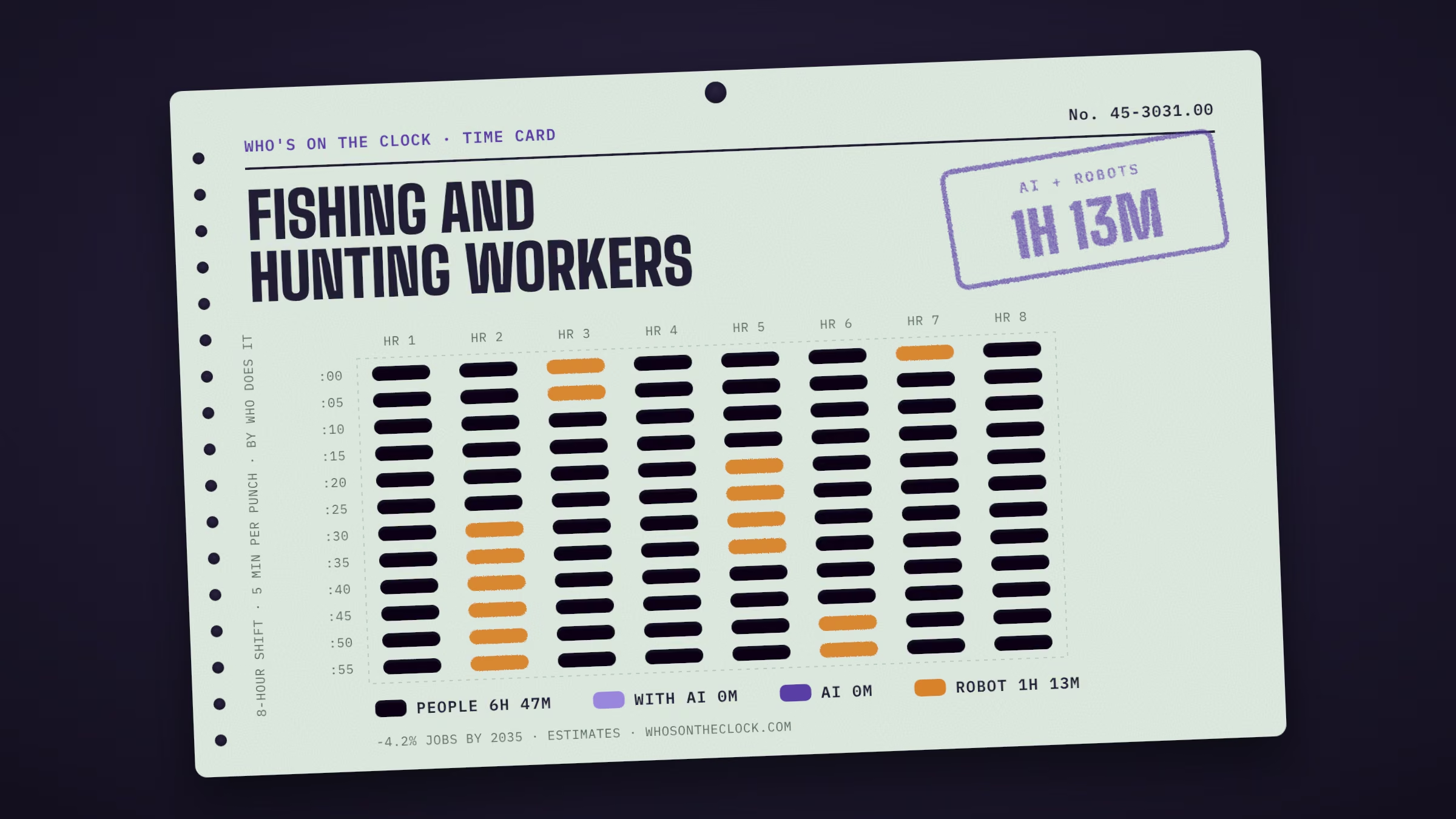
Hunt, trap, catch, or gather wild animals or aquatic animals and plants. May use nets, traps, or other equipment. May haul catch onto ship or other vessel.
Time card
Untick tasks you don't do, or set your own times.
| Mine | Task, by time spent | Human | With AI | AI | Robot |
|---|---|---|---|---|---|
Remove catches from fishing equipment and measure them to ensure compliance with legal size.44m a shift · No AI or robot evidence foundWhy this label?This is physical work, and no robot has been shown doing it yet. How labels work | |||||
Put fishing equipment into the water and anchor or tow equipment, according to the fishing method used.44m a shift · No AI or robot evidence foundWhy this label?This is physical work, and no robot has been shown doing it yet. How labels work | |||||
Steer vessels and operate navigational instruments.39m a shift · Robots deployed · e.g. Saildrone Voyager USVWhy this label?Marked Robot because Saildrone Voyager USV (in real use) has done this task in a real workplace. It shows a robot can do it somewhere, not that most fishing and hunting workers work alongside one. How labels work | |||||
Maintain engines, fishing gear, and other on-board equipment and perform minor repairs.39m a shift · No AI or robot evidence foundWhy this label?This is physical work, and no robot has been shown doing it yet. How labels work | |||||
Sort, pack, and store catch in holds with salt and ice.33m a shift · Robots only in factory cellsWhy this label?Robots have done this only in factory setups built around the machine, so it stays Human for fishing and hunting workers. How labels work | |||||
Patrol trap lines or nets to inspect settings, remove catch, and reset or relocate traps.28m a shift · No AI or robot evidence foundWhy this label?This is physical work, and no robot has been shown doing it yet. How labels work | |||||
Harvest marine life for human or animal consumption, using diving or dredging equipment, traps, barges, rods, reels, or tackle.22m a shift · No AI or robot evidence foundWhy this label?This is physical work, and no robot has been shown doing it yet. How labels work | |||||
Travel on foot, by vehicle, or by equipment such as boats, snowmobiles, helicopters, snowshoes, or skis to reach hunting areas.17m a shift · Robots deployed · e.g. Saildrone Explorer USVWhy this label?Marked Robot because Saildrone Explorer USV (in real use) has done this task in a real workplace. It shows a robot can do it somewhere, not that most fishing and hunting workers work alongside one. How labels work | |||||
Select, bait, and set traps, and lay poison along trails, according to species, size, habits, and environs of birds or animals and reasons for trapping them.17m a shift · No AI or robot evidence foundWhy this label?This is physical work, and no robot has been shown doing it yet. How labels work | |||||
Wash decks, conveyors, knives, and other equipment, using brushes, detergents, and water.17m a shift · Robots only in factory cellsWhy this label?Robots have done this only in factory setups built around the machine, so it stays Human for fishing and hunting workers. How labels work | |||||
Load and unload vessel equipment and supplies, by hand or using hoisting equipment.17m a shift · Robots only in factory cellsWhy this label?Robots have done this only in factory setups built around the machine, so it stays Human for fishing and hunting workers. How labels work | |||||
Locate fish, using fish-finding equipment.17m a shift · No AI or robot evidence foundWhy this label?No AI use or robot deployment showed up for this task in our data. That isn't proof it's safe; it may just be rare in the data. How labels work | |||||
Transport fish to processing plants or to buyers.17m a shift · Robots deployed · e.g. GENBU (MEGURI2040 Stage 2 autonomous coastal containership)Why this label?Marked Robot because GENBU (MEGURI2040 Stage 2 autonomous coastal containership) (in real use) has done this task in a real workplace. It shows a robot can do it somewhere, not that most fishing and hunting workers work alongside one. How labels work | |||||
Direct fishing or hunting operations, and supervise crew members.11m a shift · No AI or robot evidence foundWhy this label?No AI use or robot deployment showed up for this task in our data. That isn't proof it's safe; it may just be rare in the data. How labels work | |||||
Interpret weather and vessel conditions to determine appropriate responses.11m a shift · No AI or robot evidence foundWhy this label?No AI use or robot deployment showed up for this task in our data. That isn't proof it's safe; it may just be rare in the data. How labels work | |||||
Connect accessories such as floats, weights, flags, lights, or markers to nets, lines, or traps.11m a shift · No AI or robot evidence foundWhy this label?This is physical work, and no robot has been shown doing it yet. How labels work | |||||
Compute positions and plot courses on charts to navigate vessels, using instruments such as compasses, sextants, and charts.11m a shift · No AI or robot evidence foundWhy this label?No AI use or robot deployment showed up for this task in our data. That isn't proof it's safe; it may just be rare in the data. How labels work | |||||
Track animals by checking for signs such as droppings or destruction of vegetation.11m a shift · No AI or robot evidence foundWhy this label?This is physical work, and no robot has been shown doing it yet. How labels work | |||||
Skin quarry, using knives, and stretch pelts on frames to be cured.11m a shift · No AI or robot evidence foundWhy this label?This is physical work, and no robot has been shown doing it yet. How labels work | |||||
Attach nets, slings, hooks, blades, or lifting devices to cables, booms, hoists, or dredges.11m a shift · Robots only in factory cellsWhy this label?Robots have done this only in factory setups built around the machine, so it stays Human for fishing and hunting workers. How labels work | |||||
Teach or guide individuals or groups unfamiliar with specific hunting methods or types of prey.11m a shift · No AI or robot evidence foundWhy this label?No AI use or robot deployment showed up for this task in our data. That isn't proof it's safe; it may just be rare in the data. How labels work | |||||
Oversee the purchase of supplies, gear, and equipment.6m a shift · No AI or robot evidence foundWhy this label?No AI use or robot deployment showed up for this task in our data. That isn't proof it's safe; it may just be rare in the data. How labels work | |||||
Scrape fat, blubber, or flesh from skin sides of pelts with knives or hand scrapers.6m a shift · Robots only in factory cellsWhy this label?Robots have done this only in factory setups built around the machine, so it stays Human for fishing and hunting workers. How labels work | |||||
Kill or stun trapped quarry, using clubs, poisons, guns, or drowning methods.6m a shift · Robots only in factory cellsWhy this label?Robots have done this only in factory setups built around the machine, so it stays Human for fishing and hunting workers. How labels work | |||||
Maintain and repair trapping equipment.6m a shift · No AI or robot evidence foundWhy this label?This is physical work, and no robot has been shown doing it yet. How labels work | |||||
Obtain permission from landowners to hunt or trap on their land.6m a shift · No AI or robot evidence foundWhy this label?No AI use or robot deployment showed up for this task in our data. That isn't proof it's safe; it may just be rare in the data. How labels work | |||||
Release quarry from traps or nets and transfer to cages.6m a shift · No AI or robot evidence foundWhy this label?This is physical work, and no robot has been shown doing it yet. How labels work | |||||
Participate in animal damage control, wildlife management, disease control, and research activities.6m a shift · No AI or robot evidence foundWhy this label?This is physical work, and no robot has been shown doing it yet. How labels work | |||||
Obtain required approvals for using poisons or traps, and notify persons in areas where traps and poison are set.time not estimated · No AI or robot evidence foundWhy this label?No AI use or robot deployment showed up for this task in our data. That isn't proof it's safe; it may just be rare in the data. How labels work |