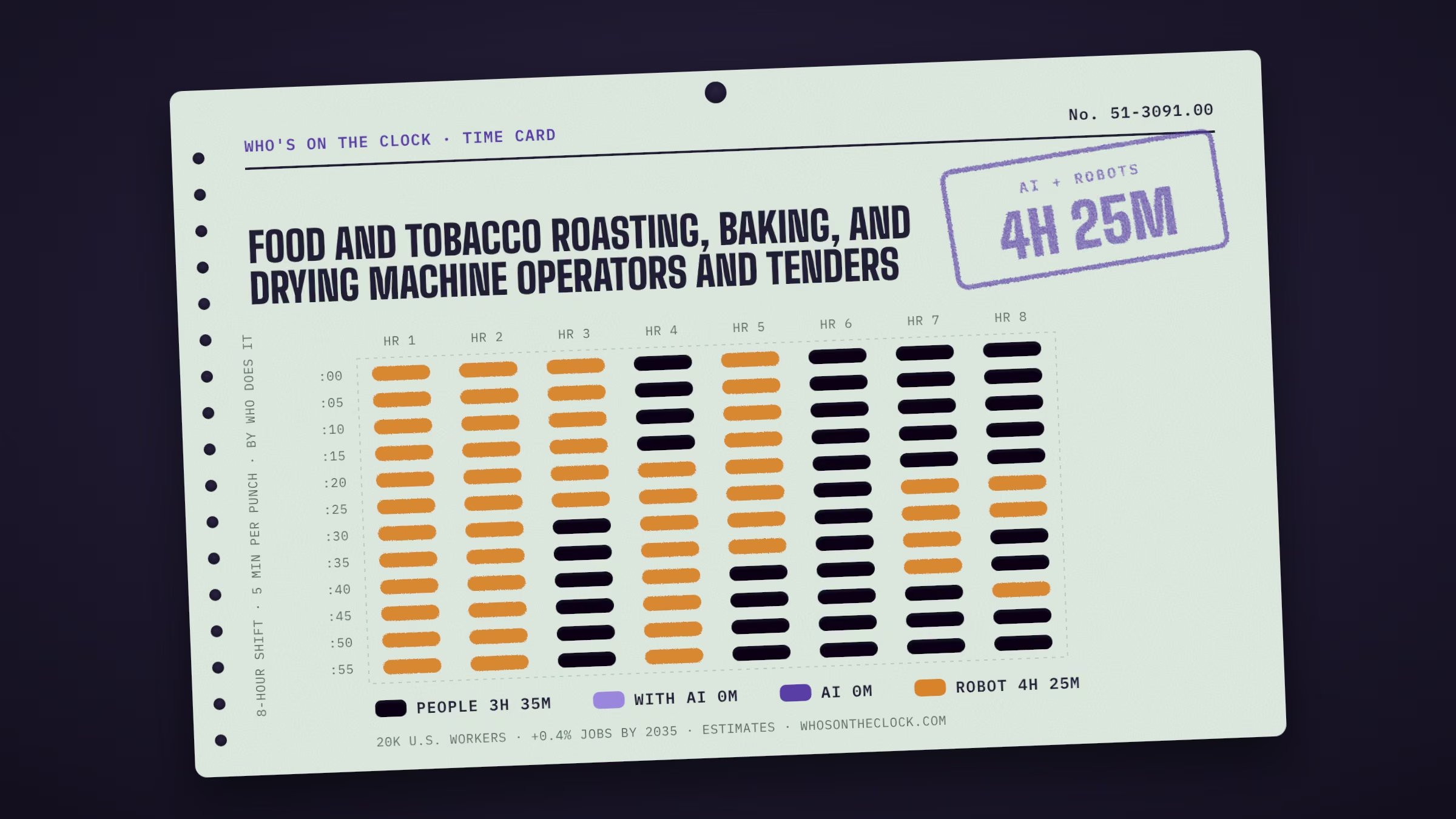
Operate or tend food or tobacco roasting, baking, or drying equipment, including hearth ovens, kiln driers, roasters, char kilns, and vacuum drying equipment.
Time card
Untick tasks you don't do, or set your own times.
| Mine | Task, by time spent | Human | With AI | AI | Robot |
|---|---|---|---|---|---|
Operate or tend equipment that roasts, bakes, dries, or cures food items such as cocoa and coffee beans, grains, nuts, and bakery products.1h 20m a shift · Robots deployed · e.g. PROBAT NEPTUNE roasters with ProCS M, REFLEX/COLOUR CONTROL and PILOT PLANT controlWhy this label?Marked Robot because PROBAT NEPTUNE roasters with ProCS M, REFLEX/COLOUR CONTROL and PILOT PLANT control (in real use) has done this task in a real workplace. It shows a robot can do it somewhere, not that most food and tobacco roasting, baking, and drying machine operators and tenders work alongside one. How labels work | |||||
Observe temperature, humidity, pressure gauges, and product samples and adjust controls, such as thermostats and valves, to maintain prescribed operating conditions for specific stages.1h 8m a shift · Robots deployed · e.g. Q-Bake / EyePro vision inspection with Real-Time Oven FeedbackWhy this label?Marked Robot because Q-Bake / EyePro vision inspection with Real-Time Oven Feedback (in real use) has done this task in a real workplace. It shows a robot can do it somewhere, not that most food and tobacco roasting, baking, and drying machine operators and tenders work alongside one. How labels work | |||||
Observe, feel, taste, or otherwise examine products during and after processing to ensure conformance to standards.49m a shift · Robots only in factory cellsWhy this label?Robots have done this only in factory setups built around the machine, so it stays Human for food and tobacco roasting, baking, and drying machine operators and tenders. How labels work | |||||
Fill or remove product from trays, carts, hoppers, or equipment, using scoops, peels, or shovels, or by hand.49m a shift · Robots deployed · e.g. Chef Robotics (Chef / Chef+ AI food assembly robot)Why this label?Marked Robot because Chef Robotics (Chef / Chef+ AI food assembly robot) (in real use) has done this task in a real workplace. It shows a robot can do it somewhere, not that most food and tobacco roasting, baking, and drying machine operators and tenders work alongside one. How labels work | |||||
Set temperature and time controls, light ovens, burners, driers, or roasters, and start equipment, such as conveyors, cylinders, blowers, driers, or pumps.31m a shift · Robots deployed · e.g. Honeywell 7800 Series burner control units (RM/EC7800 flame safeguard)Why this label?Marked Robot because Honeywell 7800 Series burner control units (RM/EC7800 flame safeguard) (in real use) has done this task in a real workplace. It shows a robot can do it somewhere, not that most food and tobacco roasting, baking, and drying machine operators and tenders work alongside one. How labels work | |||||
Observe flow of materials and listen for machine malfunctions, such as jamming or spillage, and notify supervisors if corrective actions fail.31m a shift · No AI or robot evidence foundWhy this label?No AI use or robot deployment showed up for this task in our data. That isn't proof it's safe; it may just be rare in the data. How labels work | |||||
Clean equipment with steam, hot water, and hoses.31m a shift · Robots only in factory cellsWhy this label?Robots have done this only in factory setups built around the machine, so it stays Human for food and tobacco roasting, baking, and drying machine operators and tenders. How labels work | |||||
Record production data, such as weight and amount of product processed, type of product, and time and temperature of processing.25m a shift · No AI or robot evidence foundWhy this label?No AI use or robot deployment showed up for this task in our data. That isn't proof it's safe; it may just be rare in the data. How labels work | |||||
Weigh or measure products, using scale hoppers or scale conveyors.18m a shift · Robots only in factory cellsWhy this label?Robots have done this only in factory setups built around the machine, so it stays Human for food and tobacco roasting, baking, and drying machine operators and tenders. How labels work | |||||
Push racks or carts to transfer products to storage, cooling stations, or the next stage of processing.18m a shift · Robots deployed · e.g. Seegrid Palion Tow Tractor S7 AMRWhy this label?Marked Robot because Seegrid Palion Tow Tractor S7 AMR (in real use) has done this task in a real workplace. It shows a robot can do it somewhere, not that most food and tobacco roasting, baking, and drying machine operators and tenders work alongside one. How labels work | |||||
Read work orders to determine quantities and types of products to be baked, dried, or roasted.12m a shift · No AI or robot evidence foundWhy this label?No AI use or robot deployment showed up for this task in our data. That isn't proof it's safe; it may just be rare in the data. How labels work | |||||
Take product samples during or after processing for laboratory analyses.12m a shift · Robots only in factory cellsWhy this label?Robots have done this only in factory setups built around the machine, so it stays Human for food and tobacco roasting, baking, and drying machine operators and tenders. How labels work | |||||
Test products for moisture content, using moisture meters.12m a shift · Robots only in factory cellsWhy this label?Robots have done this only in factory setups built around the machine, so it stays Human for food and tobacco roasting, baking, and drying machine operators and tenders. How labels work | |||||
Open valves, gates, or chutes or use shovels to load or remove products from ovens or other equipment.12m a shift · Robots deployed · e.g. PROBAT NEPTUNE drum roasters with ProCS M / PILOT PLANT control (Luckin Qingdao roastery)Why this label?Marked Robot because PROBAT NEPTUNE drum roasters with ProCS M / PILOT PLANT control (Luckin Qingdao roastery) (in real use) has done this task in a real workplace. It shows a robot can do it somewhere, not that most food and tobacco roasting, baking, and drying machine operators and tenders work alongside one. How labels work | |||||
Signal coworkers to synchronize flow of materials.6m a shift · No AI or robot evidence foundWhy this label?No AI use or robot deployment showed up for this task in our data. That isn't proof it's safe; it may just be rare in the data. How labels work | |||||
Clear or dislodge blockages in bins, screens, or other equipment, using poles, brushes, or mallets.6m a shift · Robots only in factory cellsWhy this label?Robots have done this only in factory setups built around the machine, so it stays Human for food and tobacco roasting, baking, and drying machine operators and tenders. How labels work | |||||
Start conveyors to move roasted grain to cooling pans and agitate grain with rakes as blowers force air through perforated bottoms of pans.6m a shift · Robots deployed · e.g. Bellwether Shop Roaster / Series 2Why this label?Marked Robot because Bellwether Shop Roaster / Series 2 (in real use) has done this task in a real workplace. It shows a robot can do it somewhere, not that most food and tobacco roasting, baking, and drying machine operators and tenders work alongside one. How labels work | |||||
Smooth out products in bins, pans, trays, or conveyors, using rakes or shovels.6m a shift · Robots only in factory cellsWhy this label?Robots have done this only in factory setups built around the machine, so it stays Human for food and tobacco roasting, baking, and drying machine operators and tenders. How labels work | |||||
Install equipment, such as spray units, cutting blades, or screens, using hand tools.6m a shift · Robots only in factory cellsWhy this label?Robots have done this only in factory setups built around the machine, so it stays Human for food and tobacco roasting, baking, and drying machine operators and tenders. How labels work |