Will AI replace textile knitting and weaving machine setters, operators, and tenders?
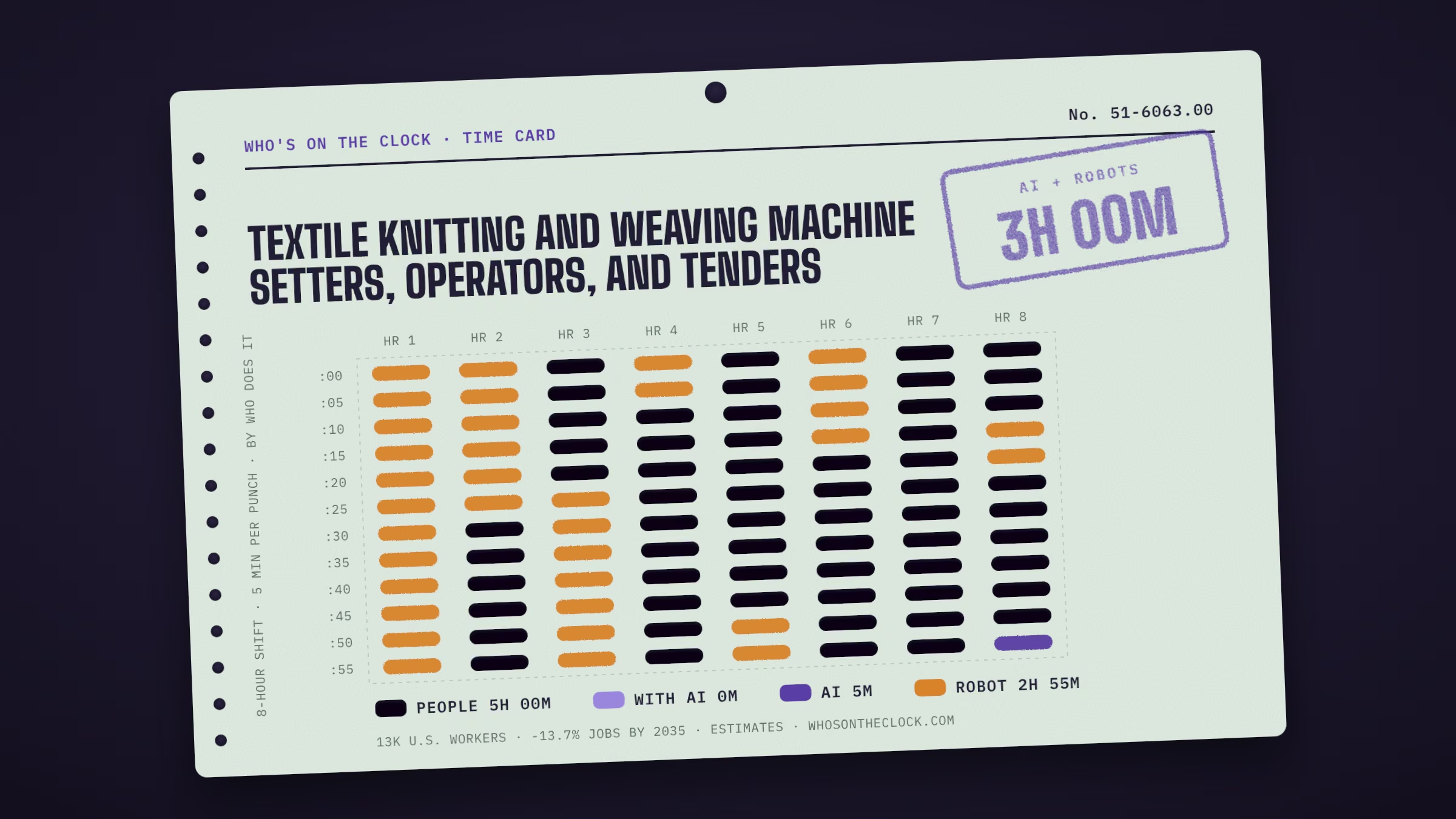
Some tasks are already handled by AI or machines; the rest still needs a person. About 3h 1m of an 8-hour shift goes to tasks that AI or robots largely take over. The breakdown: 5m that AI mostly does alone, 2h 55m that robots have done in real workplaces. The other 4h 59m (62%) stays with people. Separately, BLS expects about 13.7% fewer of these jobs by 2035 (all jobs: +3.5%).
⤢ Full sizeEach mark is 5 minutes of a typical shift for textile knitting and weaving machine setters, operators, and tenders, colored by who does that task today. Estimates from O*NET tasks and Anthropic Economic Index data. How it's made
Home / Production & factory / Textile Knitting and Weaving Machine Setters, Operators, and Tenders
Set up, operate, or tend machines that knit, loop, weave, or draw in textiles.
Thread yarn, thread, and fabric through guides, needles, and rollers of machines for weaving, knitting, or other processing.56m a shift · Robots only in factory cells
Examine looms to determine causes of loom stoppage, such as warp filling, harness breaks, or mechanical defects.34m a shift · Robots only in factory cells
Set up, or set up and operate textile machines that perform textile processing and manufacturing operations such as winding, twisting, knitting, weaving, bonding, or stretching.34m a shift · No AI or robot evidence found
Inspect products to ensure that specifications are met and to determine if machines need adjustment.28m a shift · Robots only in factory cells
Remove defects in cloth by cutting and pulling out filling.17m a shift · Robots only in factory cells
Inspect machinery to determine whether repairs are needed.17m a shift · Robots only in factory cells
Confer with co-workers to obtain information about orders, processes, or problems.17m a shift · No AI or robot evidence found
Install, level, and align machine components such as gears, chains, guides, dies, cutters, or needles to set up machinery for operation.17m a shift · Robots only in factory cells
Repair or replace worn or defective needles and other components, using hand tools.17m a shift · Robots only in factory cells
Adjust machine heating mechanisms, tensions, and speeds to produce specified products.17m a shift · Robots only in factory cells
Notify supervisors or repair staff of mechanical malfunctions.11m a shift · No AI or robot evidence found
Operate machines for test runs to verify adjustments and to obtain product samples.11m a shift · Robots only in factory cells
Record information about work completed and machine settings.11m a shift · No AI or robot evidence found
Study guides, loom patterns, samples, charts, or specification sheets, or confer with supervisors or engineering staff to determine setup requirements.11m a shift · No AI or robot evidence found
Program electronic equipment.6m a shift · Observed in AI use
On the floor
No company news tracked for this job yet. New stories are added as they happen.
Ask the clock
Will AI replace textile knitting and weaving machine setters, operators, and tenders?
Some tasks are already handled by AI or machines; the rest still needs a person. About 3h 1m of an 8-hour shift goes to tasks that AI or robots largely take over. The breakdown: 5m that AI mostly does alone, 2h 55m that robots have done in real workplaces. The other 4h 59m (62%) stays with people. Separately, BLS expects about 13.7% fewer of these jobs by 2035 (all jobs: +3.5%).
What can AI already do for textile knitting and weaving machine setters, operators, and tenders?
AI shows up regularly in 1 of 19 tasks, about 5m of a typical shift. The biggest ones:
Program electronic equipment. (6m a shift, AI mostly does it alone)
Where do robots fit in?
For some tasks, yes. Robots have done 4 of this job's tasks in workplaces like this one, about 2h 55m of a typical shift. 9 more tasks have only been done in factory setups built around the machine, so they stay with people here. For 1 physical task, no robot has shown it can do the work yet.
Start machines, monitor operations, and make adjustments as needed. (1h 30m a shift; e.g. Smartex CORE (formerly Smartex-V1) vision inspection for circular knitting, in use)
Observe woven cloth to detect weaving defects. (45m a shift; e.g. Uster Q-Bar 2 / Uster EVS Fabriq Vision, in use)
Clean, oil, and lubricate machines, using air hoses, cleaning solutions, rags, oil cans, or grease guns. (28m a shift; e.g. Luwa LTC / LoomTravClean and SpinTravClean travelling cleaners, in use)
Stop machines when specified amounts of product have been produced. (11m a shift; e.g. Zhejiang Wanli rapier loom touch-screen loom control (Full Piece Stop / Preset Length function), sold commercially)
What still needs a person?
4h 59m of a typical shift, or 62%, goes to tasks with no AI or robot evidence yet. No AI usage or robot deployment has shown up for these so far. The biggest:
Thread yarn, thread, and fabric through guides, needles, and rollers of machines for weaving, knitting, or other processing. (56m a shift)
Examine looms to determine causes of loom stoppage, such as warp filling, harness breaks, or mechanical defects. (34m a shift)
Set up, or set up and operate textile machines that perform textile processing and manufacturing operations such as winding, twisting, knitting, weaving, bonding, or stretching. (34m a shift)
Inspect products to ensure that specifications are met and to determine if machines need adjustment. (28m a shift)
Remove defects in cloth by cutting and pulling out filling. (17m a shift)
Why is that work hard to automate?
Much of it comes down to where and how the work happens. In-person, hands-on and high-stakes work is where AI and robots have made the least headway so far. In the official O*NET survey of people in this job:
97% use their hands on tools, objects or controls more than half the time
75% spend more than half the day on their feet
69% spend more than half the day walking or moving
Are employers still hiring textile knitting and weaving machine setters, operators, and tenders?
On Indeed, job postings in the Production & Manufacturing sector are at 124% of their February 2020 level (all U.S. postings: 104%), up 12.6% from a year earlier, as of Oct 9, 2026. BLS separately expects about 1,300 openings a year in this job through 2035. Across all U.S. postings, 7.3% now mention AI skills. Sector postings cover more than this one job and move for many reasons besides AI.
How much do textile knitting and weaving machine setters, operators, and tenders make?
The median pay is about $39,530 a year ($19.01 an hour), 22% below the median for all U.S. jobs ($50,980). Most people in this job earn between $29,960 and $49,130 a year; that range covers the middle 80%. Pay figures are from BLS, May 2025, and vary a lot by state and employer. Pick a state to compare:
Is this job growing or shrinking?
BLS projects a decline of 13.7% from 2025 to 2035, compared with 3.5% growth for all jobs. That's about 12,000 jobs in 2035. Even so, it expects about 1,300 openings a year, mostly from people retiring or changing careers. These projections don't single out AI as a cause.
How many textile knitting and weaving machine setters, operators, and tenders are there in the U.S.?
About 13,000 people in the U.S., roughly 0.01% of all workers (BLS, May 2025). That makes it the 623rd largest of the 796 jobs on this site. BLS expects about 12,000 in 2035.
What training do textile knitting and weaving machine setters, operators, and tenders need?
The most common requirement is a high school diploma: about 95% of people in the job said so in the official O*NET survey. O*NET rates the job at level 2 of 5 for preparation, which usually means: high school diploma, some training. Requirements vary by state and employer, especially for licensed work.
What should I learn to stay ahead of AI?
These come from the job's official skill ratings and from the tasks that AI and robots touch least today. Building them keeps you strong in the parts of the work that still need a person:
Skills that matter more here than in most jobs: Operations Monitoring, Operation and Control, Monitoring, Active Listening
Get strong at the parts of the job that stay with people (listed above), which take 4h 59m of a typical shift
Tools employers list: Microsoft Excel, Microsoft Office software, Microsoft Outlook, Microsoft PowerPoint, Microsoft Word
Learn to use AI well on the tasks where it already shows up in this job (listed above)
What other jobs could textile knitting and weaving machine setters, operators, and tenders move into?
These use similar skills, with less of a typical shift touched by AI or robots. Matches come from 109 official ratings of skills, knowledge and work activities, and each needs the same or less preparation unless the official list relates the jobs directly:
Electromechanical Equipment Assemblers (0m touched, $46k median pay)
Molders, Shapers, and Casters (6m touched, $46k median pay)
Textile Cutting Machine Setters, Operators, and Tenders (2h 11m touched, $39k median pay)
Sawing Machine Setters, Operators, and Tenders, Wood (0m touched, $43k median pay)
Textile Bleaching and Dyeing Machine Operators and Tenders (2h 5m touched, $38k median pay)
How solid are these numbers?
Each task carries its own evidence label. For this job: 1 observed in real AI use, 3 with robots in real deployments, 1 with robots sold or demonstrated, 14 with no AI or robot evidence found. The minutes per task are estimates, not measured hours, and "no evidence" doesn't prove a task is safe.