Will AI replace hand packers and packagers?

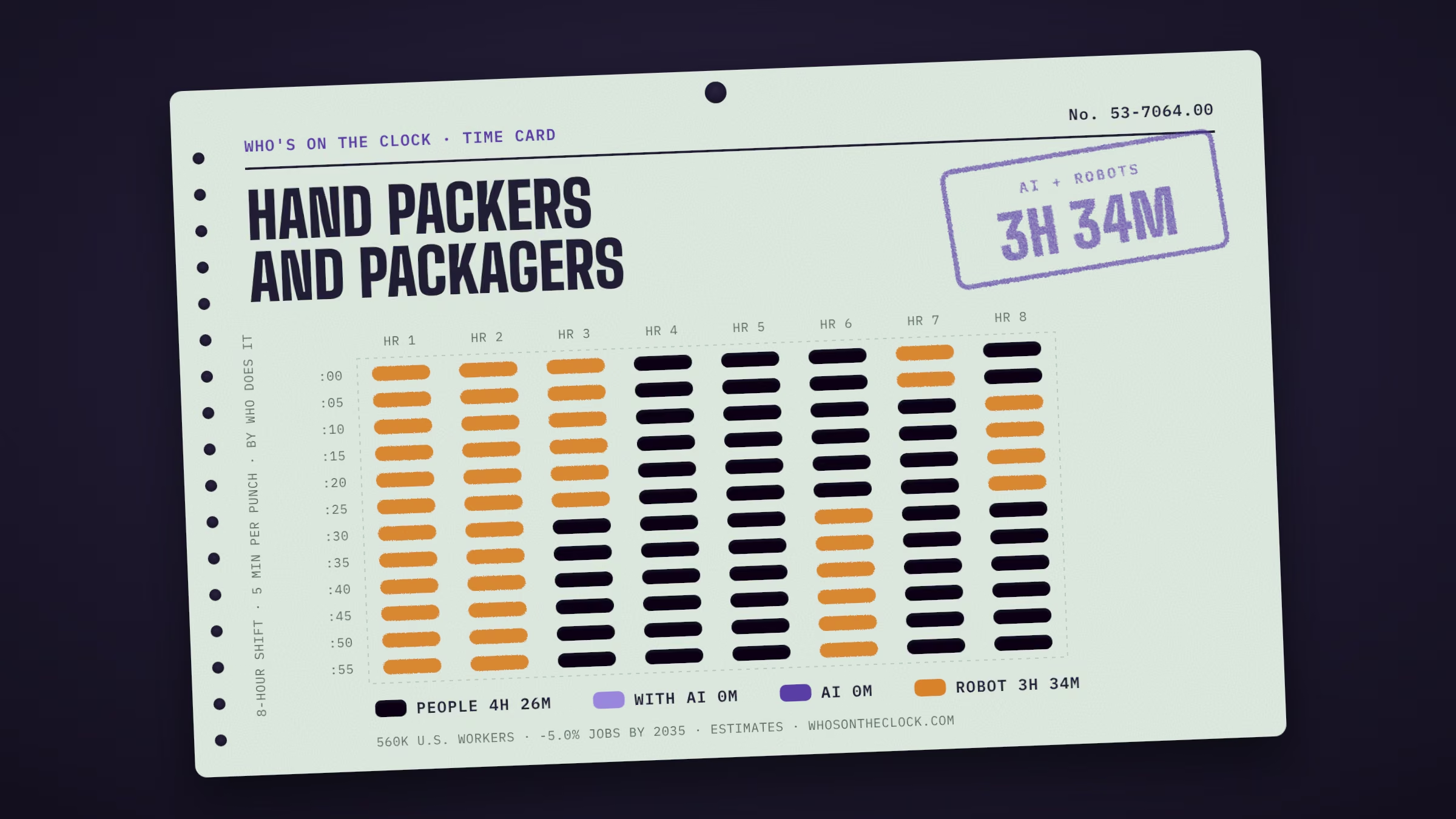
The biggest change here is physical: systems like Chef Robotics food assembly pod have done tasks such as “Place or pour products or materials into containers” in real workplaces, about 3h 34m of a typical shift. Most of the rest, 4h 26m, has no AI or robot evidence. BLS expects about 5% fewer of these jobs by 2035.

Time card for hand packers and packagers showing a typical 8-hour shift: 4h 26m done by people, 3h 34m by robots.
Each mark is 5 minutes of a typical shift for hand packers and packagers, colored by who does that task today. Estimates from O*NET tasks and Anthropic Economic Index data. How it's made

Home / Transportation & warehouse / Hand Packers and Packagers

Pack or package by hand a wide variety of products and materials.

Time card

Untick tasks you don't do, or set your own times.
MineTask, by time spentHumanWith AIAIRobot
Place or pour products or materials into containers, using hand tools and equipment, or fill containers from spouts or chutes.1h 27m a shift · Robots deployed · e.g. Chef Robotics food assembly pod
Why this label?Marked Robot because Chef Robotics food assembly pod (in real use) has done this task in a real workplace. It shows a robot can do it somewhere, not that most hand packers and packagers work alongside one. How labels work
Obtain, move, and sort products, materials, containers, and orders, using hand tools.1h 7m a shift · Robots deployed · e.g. Digit (Agility Robotics) at GXO Logistics
Why this label?Marked Robot because Digit (Agility Robotics) at GXO Logistics (in real use) has done this task in a real workplace. It shows a robot can do it somewhere, not that most hand packers and packagers work alongside one. How labels work
Seal containers or materials, using glues, fasteners, nails, and hand tools.53m a shift · Robots only in factory cells
Why this label?Robots have done this only in factory setups built around the machine, so it stays Human for hand packers and packagers. How labels work
Examine and inspect containers, materials, or products to ensure that product quality and packing specifications are met.47m a shift · Robots only in factory cells
Why this label?Robots have done this only in factory setups built around the machine, so it stays Human for hand packers and packagers. How labels work
Measure, weigh, and count products and materials.40m a shift · Robots only in factory cells
Why this label?Robots have done this only in factory setups built around the machine, so it stays Human for hand packers and packagers. How labels work
Assemble, line, and pad cartons, crates, and containers, using hand tools.40m a shift · Robots only in factory cells
Why this label?Robots have done this only in factory setups built around the machine, so it stays Human for hand packers and packagers. How labels work
Remove completed or defective products or materials, placing them on moving equipment, such as conveyors, or in specified areas, such as loading docks.40m a shift · Robots deployed · e.g. Stretch (Boston Dynamics)
Why this label?Marked Robot because Stretch (Boston Dynamics) (in real use) has done this task in a real workplace. It shows a robot can do it somewhere, not that most hand packers and packagers work alongside one. How labels work
Mark and label containers, container tags, or products, using marking tools.33m a shift · Robots only in factory cells
Why this label?Robots have done this only in factory setups built around the machine, so it stays Human for hand packers and packagers. How labels work
Clean containers, materials, supplies, or work areas, using cleaning solutions and hand tools.27m a shift · Robots only in factory cells
Why this label?Robots have done this only in factory setups built around the machine, so it stays Human for hand packers and packagers. How labels work
Load materials and products into package processing equipment.20m a shift · Robots deployed · e.g. Schubert tog.519 cobot
Why this label?Marked Robot because Schubert tog.519 cobot (in real use) has done this task in a real workplace. It shows a robot can do it somewhere, not that most hand packers and packagers work alongside one. How labels work
Record product, packaging, and order information on specified forms and records.13m a shift · No AI or robot evidence found
Why this label?No AI use or robot deployment showed up for this task in our data. That isn't proof it's safe; it may just be rare in the data. How labels work
Transport packages to customers' vehicles.13m a shift · Robots only in factory cells
Why this label?Robots have done this only in factory setups built around the machine, so it stays Human for hand packers and packagers. How labels work

Clock history

  1. 3h 34m touchedFirst published: O*NET 30.1, Anthropic Economic Index (2025 usage and September 2026 robot study), BLS May 2025

When new data changes this clock, the date, the new numbers and the reason are logged here. Company news alone never moves the clock.

On the floor

  1. Rolling outCascade Coffee
    Coffee co-packer Cascade Coffee runs six cobot palletizers

    Cascade Coffee installed six Robotiq cobot palletizers on its retail lines after palletizing turnover exceeded 60%. Some temporary end-of-line workers moved into higher-paying technical roles, and the first unit paid back in nine months.

    Packaging World

  2. Rolling outAmazon
    Amazon puts touch-sensing Vulcan robot to work stowing items

    Vulcan is in full operation stowing items in Spokane, Washington, and can handle about 75% of the roughly 1 million unique items there. A picking version is being tested in Hamburg, and Amazon plans more U.S. and German sites in 2026.

    CNBC via NBC New York

Ask the clock

Will AI replace hand packers and packagers?

Some tasks are already being done by AI or machines; the rest still needs a person. About 3h 34m of a typical shift is made up of tasks that AI or robots have done on their own in real use somewhere. That doesn't mean those hours are automated in a typical workplace. The other 4h 26m (55%) stays with people. Separately, BLS expects about 5% fewer of these jobs by 2035 (all jobs: +3.5%).

What can AI already do for hand packers and packagers?

None of this job's tasks show regular AI use yet. That can mean the work is hands-on or in person, or simply that it rarely comes up in AI usage data.

Where do robots fit in?

For some tasks, yes. Robots have done 4 of this job's tasks in workplaces like this one, about 3h 34m of a typical shift. 7 more tasks have only been done in factory setups built around the machine, so they stay with people here.

  • Place or pour products or materials into containers, using hand tools and equipment, or fill containers from spouts or chutes. (1h 27m a shift; e.g. Chef Robotics food assembly pod, in use)
  • Obtain, move, and sort products, materials, containers, and orders, using hand tools. (1h 7m a shift; e.g. Digit (Agility Robotics) at GXO Logistics, in use)
  • Remove completed or defective products or materials, placing them on moving equipment, such as conveyors, or in specified areas, such as loading docks. (40m a shift; e.g. Stretch (Boston Dynamics), in use)
  • Load materials and products into package processing equipment. (20m a shift; e.g. Schubert tog.519 cobot, in use)
What still needs a person?

4h 26m of a typical shift, or 55%, goes to tasks with no AI or robot evidence yet. No AI usage or robot deployment has shown up for these so far. The biggest:

  • Seal containers or materials, using glues, fasteners, nails, and hand tools. (53m a shift)
  • Examine and inspect containers, materials, or products to ensure that product quality and packing specifications are met. (47m a shift)
  • Measure, weigh, and count products and materials. (40m a shift)
  • Assemble, line, and pad cartons, crates, and containers, using hand tools. (40m a shift)
  • Mark and label containers, container tags, or products, using marking tools. (33m a shift)
Why is that work hard to automate?

Much of it comes down to where and how the work happens. In-person, hands-on and high-stakes work is where AI and robots have made the least headway so far. In the official O*NET survey of people in this job:

  • 73% spend more than half the day on their feet
  • 68% use their hands on tools, objects or controls more than half the time
  • 57% carry high or very high responsibility for other workers' safety
What are companies actually doing?

We track 2 sourced company moves that affect this job. Most recent:

  • Mar 17, 2026: Coffee co-packer Cascade Coffee runs six cobot palletizers (Rolling out)
  • May 7, 2025: Amazon puts touch-sensing Vulcan robot to work stowing items (Rolling out)
Are employers still hiring hand packers and packagers?

On Indeed, job postings in the Loading & Stocking sector are at 109% of their February 2020 level (all U.S. postings: 104%), up 12.4% from a year earlier, as of Oct 9, 2026. BLS separately expects about 62,000 openings a year in this job through 2035. Across all U.S. postings, 7.3% now mention AI skills. Sector postings cover more than this one job and move for many reasons besides AI.

How much do hand packers and packagers make?

The median pay is about $36,280 a year ($17.44 an hour), 29% below the median for all U.S. jobs ($50,980). Most people in this job earn between $27,890 and $47,100 a year; that range covers the middle 80%. Pay figures are from BLS, May 2025, and vary a lot by state and employer. Pick a state to compare:

Is this job growing or shrinking?

BLS projects a decline of 5% from 2025 to 2035, compared with 3.5% growth for all jobs. That's about 528,000 jobs in 2035. Even so, it expects about 62,000 openings a year, mostly from people retiring or changing careers. These projections don't single out AI as a cause.

How many hand packers and packagers are there in the U.S.?

About 560,000 people in the U.S., roughly 0.36% of all workers (BLS, May 2025). That makes it the 74th largest of the 796 jobs on this site. BLS expects about 528,000 in 2035.

What training do hand packers and packagers need?

The most common requirement is a high school diploma: about 54% of people in the job said so in the official O*NET survey. O*NET rates the job at level 2 of 5 for preparation, which usually means: high school diploma, some training. Requirements vary by state and employer, especially for licensed work.

What should I learn to stay ahead of AI?

These come from the job's official skill ratings and from the tasks that AI and robots touch least today. Building them keeps you strong in the parts of the work that still need a person:

  • Skills that matter more here than in most jobs: Monitoring
  • Get strong at the parts of the job that stay with people (listed above), which take 4h 26m of a typical shift
  • Tools employers list: Autodesk AutoCAD, Microsoft Excel, Microsoft Office software, Microsoft Word, SAP software
What other jobs could hand packers and packagers move into?

These use similar skills, with less of a typical shift touched by AI or robots. Matches come from 109 official ratings of skills, knowledge and work activities, and each needs the same or less preparation unless the official list relates the jobs directly:

  • Agricultural Products Graders and Sorters (0m touched, $36k median pay)
  • Cleaners of Vehicles and Equipment (1h 11m touched, $36k median pay)
  • Packaging and Filling Machine Operators and Tenders (37m touched, $43k median pay)
How solid are these numbers?

Each task carries its own evidence label. For this job: 4 with robots in real deployments, 8 with no AI or robot evidence found. The minutes per task are estimates, not measured hours, and "no evidence" doesn't prove a task is safe.

Tools in demand

  • Autodesk AutoCAD
  • SAP software

Plus everyday office tools: Microsoft Excel, Microsoft Office software, Microsoft Word.

Also called

Agricultural Produce Packer, Ampoule Sealer, Apple Packing Header, Bag Filler, Bag Loader, Bag Sealer, Bagger, Band Shover, Bandoleer Packer, Barrel Filler, Batt Packer, Bin Filler, Binder and Wrapper Packer, Book Packer