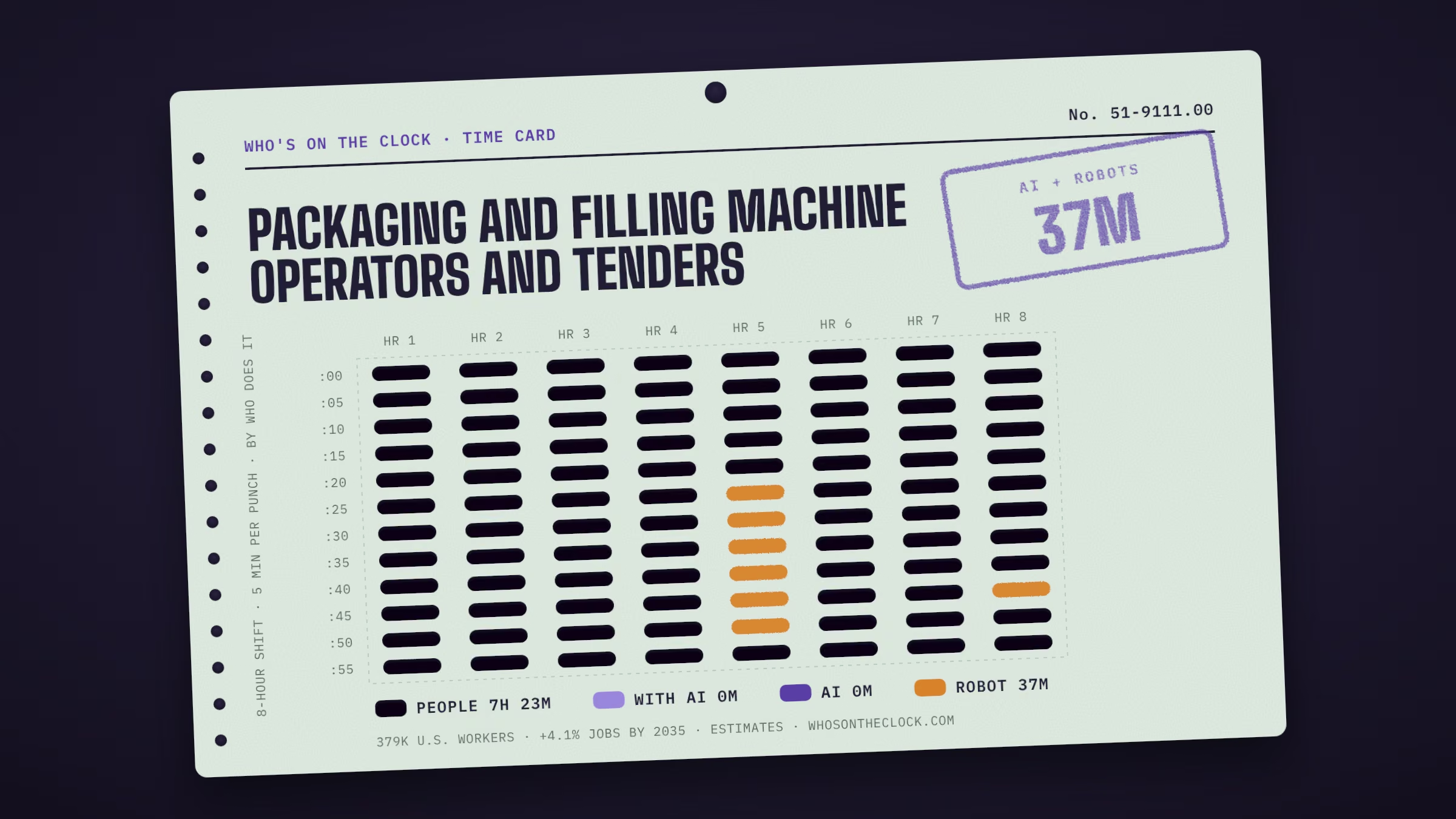
Operate or tend machines to prepare industrial or consumer products for storage or shipment. Includes cannery workers who pack food products.
Time card
Untick tasks you don't do, or set your own times.
| Mine | Task, by time spent | Human | With AI | AI | Robot |
|---|---|---|---|---|---|
Tend or operate machine that packages product.55m a shift · Robots only in factory cellsWhy this label?Robots have done this only in factory setups built around the machine, so it stays Human for packaging and filling machine operators and tenders. How labels work | |||||
Observe machine operations to ensure quality and conformity of filled or packaged products to standards.43m a shift · Robots only in factory cellsWhy this label?Robots have done this only in factory setups built around the machine, so it stays Human for packaging and filling machine operators and tenders. How labels work | |||||
Monitor the production line, watching for problems such as pile-ups, jams, or glue that isn't sticking properly.43m a shift · Robots only in factory cellsWhy this label?Robots have done this only in factory setups built around the machine, so it stays Human for packaging and filling machine operators and tenders. How labels work | |||||
Stop or reset machines when malfunctions occur, clear machine jams, and report malfunctions to a supervisor.31m a shift · No AI or robot evidence foundWhy this label?This is physical work, and no robot has been shown doing it yet. How labels work | |||||
Remove finished packaged items from machine and separate rejected items.31m a shift · Robots only in factory cellsWhy this label?Robots have done this only in factory setups built around the machine, so it stays Human for packaging and filling machine operators and tenders. How labels work | |||||
Clean, oil, and make minor adjustments or repairs to machinery and equipment, such as opening valves or setting guides.31m a shift · Robots only in factory cellsWhy this label?Robots have done this only in factory setups built around the machine, so it stays Human for packaging and filling machine operators and tenders. How labels work | |||||
Supply materials to spindles, conveyors, hoppers, or other feeding devices and unload packaged product.31m a shift · Robots only in factory cellsWhy this label?Robots have done this only in factory setups built around the machine, so it stays Human for packaging and filling machine operators and tenders. How labels work | |||||
Stack finished packaged items, or wrap protective material around each item, and pack the items in cartons or containers.31m a shift · Robots deployed · e.g. Formic robotics-as-a-service palletizer (Yaskawa Motoman HC20 cobot)Why this label?Marked Robot because Formic robotics-as-a-service palletizer (Yaskawa Motoman HC20 cobot) (in real use) has done this task in a real workplace. It shows a robot can do it somewhere, not that most packaging and filling machine operators and tenders work alongside one. How labels work | |||||
Sort, grade, weigh, and inspect products, verifying and adjusting product weight or measurement to meet specifications.25m a shift · Robots only in factory cellsWhy this label?Robots have done this only in factory setups built around the machine, so it stays Human for packaging and filling machine operators and tenders. How labels work | |||||
Inspect and remove defective products and packaging material.25m a shift · Robots only in factory cellsWhy this label?Robots have done this only in factory setups built around the machine, so it stays Human for packaging and filling machine operators and tenders. How labels work | |||||
Package the product in the form in which it will be sent out, for example, filling bags with flour from a chute or spout.25m a shift · Robots only in factory cellsWhy this label?Robots have done this only in factory setups built around the machine, so it stays Human for packaging and filling machine operators and tenders. How labels work | |||||
Stock and sort product for packaging or filling machine operation, and replenish packaging supplies, such as wrapping paper, plastic sheet, boxes, cartons, glue, ink, or labels.25m a shift · Robots only in factory cellsWhy this label?Robots have done this only in factory setups built around the machine, so it stays Human for packaging and filling machine operators and tenders. How labels work | |||||
Attach identification labels to finished packaged items, or cut stencils and stencil information on containers, such as lot numbers or shipping destinations.18m a shift · Robots only in factory cellsWhy this label?Robots have done this only in factory setups built around the machine, so it stays Human for packaging and filling machine operators and tenders. How labels work | |||||
Regulate machine flow, speed, or temperature.12m a shift · Robots only in factory cellsWhy this label?Robots have done this only in factory setups built around the machine, so it stays Human for packaging and filling machine operators and tenders. How labels work | |||||
Adjust machine components and machine tension and pressure according to size or processing angle of product.12m a shift · Robots only in factory cellsWhy this label?Robots have done this only in factory setups built around the machine, so it stays Human for packaging and filling machine operators and tenders. How labels work | |||||
Count and record finished and rejected packaged items.12m a shift · No AI or robot evidence foundWhy this label?No AI use or robot deployment showed up for this task in our data. That isn't proof it's safe; it may just be rare in the data. How labels work | |||||
Secure finished packaged items by hand tying, sewing, gluing, stapling, or attaching fastener.12m a shift · Robots only in factory cellsWhy this label?Robots have done this only in factory setups built around the machine, so it stays Human for packaging and filling machine operators and tenders. How labels work | |||||
Start machine by engaging controls.6m a shift · Robots deployed · e.g. Universal Robots UR10 cobot at Dynamic GroupWhy this label?Marked Robot because Universal Robots UR10 cobot at Dynamic Group (in real use) has done this task in a real workplace. It shows a robot can do it somewhere, not that most packaging and filling machine operators and tenders work alongside one. How labels work | |||||
Clean packaging containers, line and pad crates, or assemble cartons to prepare for product packing.6m a shift · Robots only in factory cellsWhy this label?Robots have done this only in factory setups built around the machine, so it stays Human for packaging and filling machine operators and tenders. How labels work | |||||
Clean and remove damaged or otherwise inferior materials to prepare raw products for processing.6m a shift · Robots only in factory cellsWhy this label?Robots have done this only in factory setups built around the machine, so it stays Human for packaging and filling machine operators and tenders. How labels work |