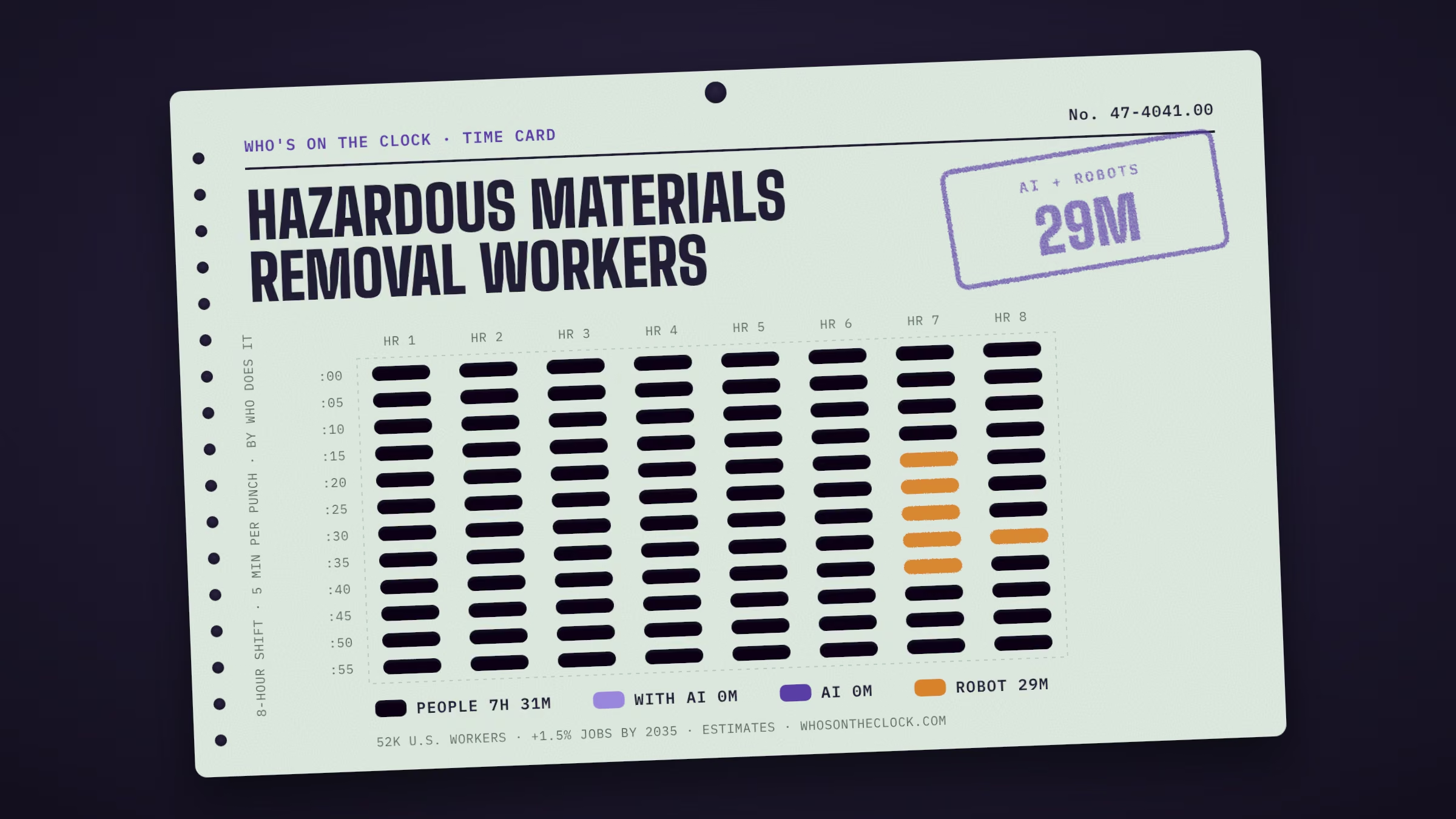
Identify, remove, pack, transport, or dispose of hazardous materials, including asbestos, lead-based paint, waste oil, fuel, transmission fluid, radioactive materials, or contaminated soil. Specialized training and certification in hazardous materials handling or a confined entry permit are generally required. May operate earth-moving equipment or trucks.
Time card
Untick tasks you don't do, or set your own times.
| Mine | Task, by time spent | Human | With AI | AI | Robot |
|---|---|---|---|---|---|
Remove asbestos or lead from surfaces, using hand or power tools such as scrapers, vacuums, or high-pressure sprayers.1h 40m a shift · Robots only in factory cellsWhy this label?Robots have done this only in factory setups built around the machine, so it stays Human for hazardous materials removal workers. How labels work | |||||
Build containment areas prior to beginning abatement or decontamination work.59m a shift · No AI or robot evidence foundWhy this label?This is physical work, and no robot has been shown doing it yet. How labels work | |||||
Prepare hazardous material for removal or storage.41m a shift · Robots only in factory cellsWhy this label?Robots have done this only in factory setups built around the machine, so it stays Human for hazardous materials removal workers. How labels work | |||||
Clean contaminated equipment or areas for reuse, using detergents or solvents, sandblasters, filter pumps, or steam cleaners.41m a shift · Robots only in factory cellsWhy this label?Robots have done this only in factory setups built around the machine, so it stays Human for hazardous materials removal workers. How labels work | |||||
Comply with prescribed safety procedures or federal laws regulating waste disposal methods.29m a shift · No AI or robot evidence foundWhy this label?This is physical work, and no robot has been shown doing it yet. How labels work | |||||
Load or unload materials into containers or onto trucks, using hoists or forklifts.29m a shift · Robots only in factory cellsWhy this label?Robots have done this only in factory setups built around the machine, so it stays Human for hazardous materials removal workers. How labels work | |||||
Clean mold-contaminated sites by removing damaged porous materials or thoroughly cleaning all contaminated nonporous materials.29m a shift · No AI or robot evidence foundWhy this label?This is physical work, and no robot has been shown doing it yet. How labels work | |||||
Remove or limit contamination following emergencies involving hazardous substances.23m a shift · No AI or robot evidence foundWhy this label?This is physical work, and no robot has been shown doing it yet. How labels work | |||||
Operate machines or equipment to remove, package, store, or transport loads of waste materials.23m a shift · Robots only in factory cellsWhy this label?Robots have done this only in factory setups built around the machine, so it stays Human for hazardous materials removal workers. How labels work | |||||
Drive trucks or other heavy equipment to convey contaminated waste to designated sea or ground locations.23m a shift · Robots deployed · e.g. Cat MineStar Command for haulingWhy this label?Marked Robot because Cat MineStar Command for hauling (in real use) has done this task in a real workplace. It shows a robot can do it somewhere, not that most hazardous materials removal workers work alongside one. How labels work | |||||
Identify asbestos, lead, or other hazardous materials to be removed, using monitoring devices.18m a shift · Robots only in factory cellsWhy this label?Robots have done this only in factory setups built around the machine, so it stays Human for hazardous materials removal workers. How labels work | |||||
Record numbers of containers stored at disposal sites, specifying amounts or types of equipment or waste disposed.12m a shift · No AI or robot evidence foundWhy this label?No AI use or robot deployment showed up for this task in our data. That isn't proof it's safe; it may just be rare in the data. How labels work | |||||
Sort specialized hazardous waste at landfills or disposal centers, following proper disposal procedures.12m a shift · No AI or robot evidence foundWhy this label?This is physical work, and no robot has been shown doing it yet. How labels work | |||||
Identify or separate waste products or materials for recycling or reuse.12m a shift · Robots only in factory cellsWhy this label?Robots have done this only in factory setups built around the machine, so it stays Human for hazardous materials removal workers. How labels work | |||||
Operate cranes to move or load baskets, casks, or canisters.6m a shift · Robots deployed · e.g. ABB stacking crane automation (Automated Stacking Cranes)Why this label?Marked Robot because ABB stacking crane automation (Automated Stacking Cranes) (in real use) has done this task in a real workplace. It shows a robot can do it somewhere, not that most hazardous materials removal workers work alongside one. How labels work | |||||
Process e-waste, such as computer components containing lead or mercury.6m a shift · Robots only in factory cellsWhy this label?Robots have done this only in factory setups built around the machine, so it stays Human for hazardous materials removal workers. How labels work | |||||
Organize or track the locations of hazardous items in landfills.6m a shift · Robots only in factory cellsWhy this label?Robots have done this only in factory setups built around the machine, so it stays Human for hazardous materials removal workers. How labels work | |||||
Mix or pour concrete into forms to encase waste material for disposal.6m a shift · Robots only in factory cellsWhy this label?Robots have done this only in factory setups built around the machine, so it stays Human for hazardous materials removal workers. How labels work | |||||
Apply bioremediation techniques to hazardous wastes to allow naturally occurring bacteria to break down toxic substances.6m a shift · Robots only in factory cellsWhy this label?Robots have done this only in factory setups built around the machine, so it stays Human for hazardous materials removal workers. How labels work | |||||
Upload baskets of irradiated elements onto machines that insert fuel elements into canisters and secure lids.time not estimated · Robots only in factory cellsWhy this label?Robots have done this only in factory setups built around the machine, so it stays Human for hazardous materials removal workers. How labels work | |||||
Package, store, or move irradiated fuel elements in the underwater storage basins of nuclear reactor plants, using machines or equipment.time not estimated · Robots only in factory cellsWhy this label?Robots have done this only in factory setups built around the machine, so it stays Human for hazardous materials removal workers. How labels work |