Will AI replace highway maintenance workers?

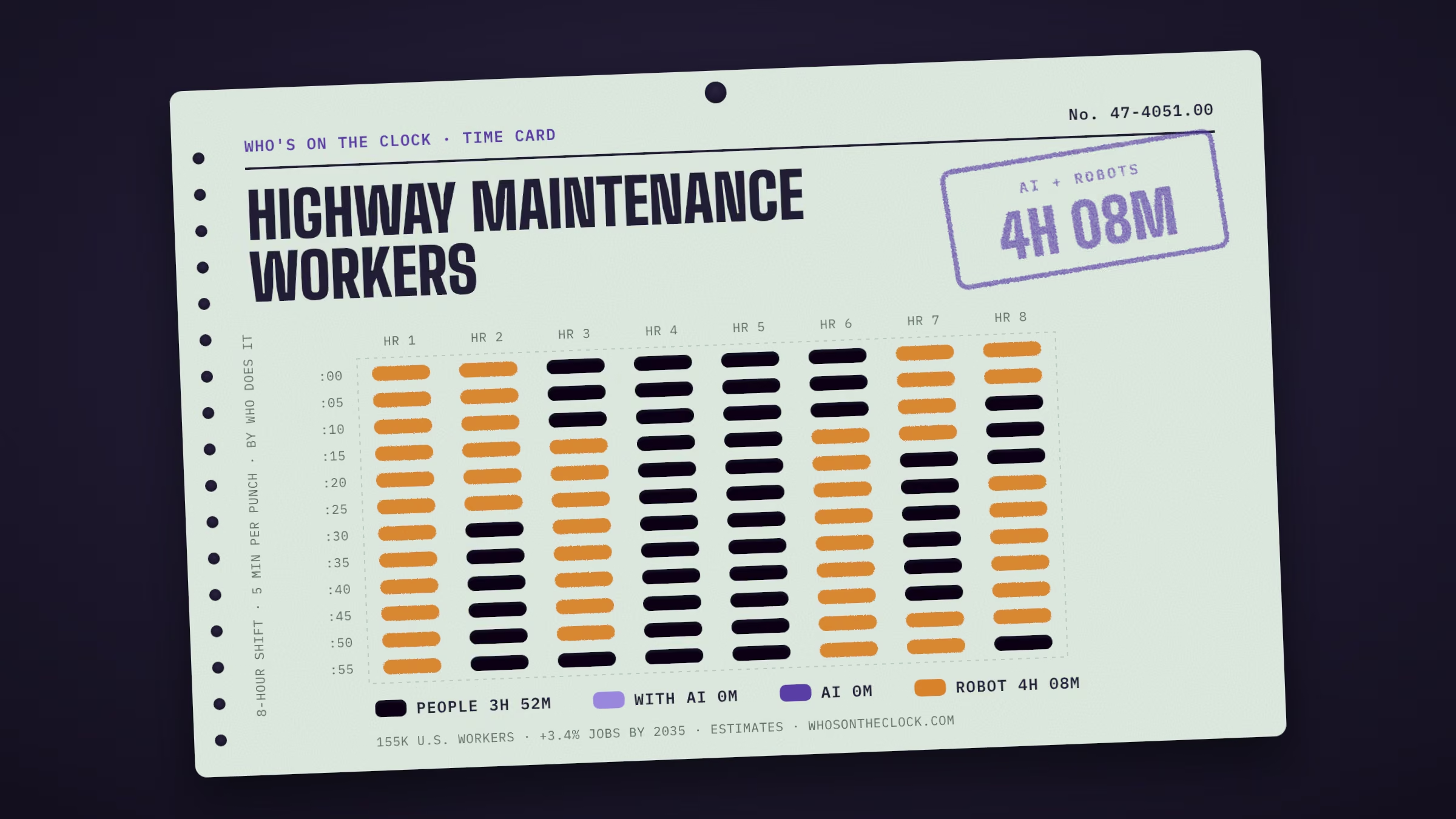
The biggest change here is physical: systems like Yeti Move autonomy on Øveraasen RS 600 runway sweeper/plow machines have done tasks such as “Drive heavy equipment and vehicles with adjustable attachments to sweep debris from paved surfaces” in real workplaces, about 4h 8m of a typical shift. Only 3h 52m of the shift has no AI or robot evidence. BLS expects about 3.4% more of these jobs by 2035.

Time card for highway maintenance workers showing a typical 8-hour shift: 3h 52m done by people, 4h 8m by robots.
Each mark is 5 minutes of a typical shift for highway maintenance workers, colored by who does that task today. Estimates from O*NET tasks and Anthropic Economic Index data. How it's made

Home / Construction / Highway Maintenance Workers

Maintain highways, municipal and rural roads, airport runways, and rights-of-way. Duties include patching broken or eroded pavement and repairing guard rails, highway markers, and snow fences. May also mow or clear brush from along road, or plow snow from roadway.

Time card

Untick tasks you don't do, or set your own times.
MineTask, by time spentHumanWith AIAIRobot
Drive heavy equipment and vehicles with adjustable attachments to sweep debris from paved surfaces, mow grass and weeds, remove snow and ice, and spread salt and sand.1h 30m a shift · Robots deployed · e.g. Yeti Move autonomy on Øveraasen RS 600 runway sweeper/plow machines
Why this label?Marked Robot because Yeti Move autonomy on Øveraasen RS 600 runway sweeper/plow machines (in real use) has done this task in a real workplace. It shows a robot can do it somewhere, not that most highway maintenance workers work alongside one. How labels work
Dump, spread, and tamp asphalt, using pneumatic tampers, to repair joints and patch broken pavement.45m a shift · No AI or robot evidence found
Why this label?This is physical work, and no robot has been shown doing it yet. How labels work
Drive trucks to transport crews and equipment to work sites.40m a shift · Robots deployed · e.g. Kratos Autonomous Truck-Mounted Attenuator (ATMA), leader-follower
Why this label?Marked Robot because Kratos Autonomous Truck-Mounted Attenuator (ATMA), leader-follower (in real use) has done this task in a real workplace. It shows a robot can do it somewhere, not that most highway maintenance workers work alongside one. How labels work
Set out signs and cones around work areas to divert traffic.34m a shift · Robots only in factory cells
Why this label?Robots have done this only in factory setups built around the machine, so it stays Human for highway maintenance workers. How labels work
Perform preventative maintenance on vehicles and heavy equipment.34m a shift · No AI or robot evidence found
Why this label?This is physical work, and no robot has been shown doing it yet. How labels work
Erect, install, or repair guardrails, road shoulders, berms, highway markers, warning signals, and highway lighting, using hand tools and power tools.34m a shift · Robots only in factory cells
Why this label?Robots have done this only in factory setups built around the machine, so it stays Human for highway maintenance workers. How labels work
Clean and clear debris from culverts, catch basins, drop inlets, ditches, and other drain structures.34m a shift · Robots only in factory cells
Why this label?Robots have done this only in factory setups built around the machine, so it stays Human for highway maintenance workers. How labels work
Perform roadside landscaping work, such as clearing weeds and brush, and planting and trimming trees.34m a shift · Robots deployed · e.g. RC Mowers Autonomous Mowing Robot (AMR)
Why this label?Marked Robot because RC Mowers Autonomous Mowing Robot (AMR) (in real use) has done this task in a real workplace. It shows a robot can do it somewhere, not that most highway maintenance workers work alongside one. How labels work
Flag motorists to warn them of obstacles or repair work ahead.28m a shift · Robots deployed · e.g. Portable/temporary traffic control signals (trailer- and pedestal-mounted, auto mode)
Why this label?Marked Robot because Portable/temporary traffic control signals (trailer- and pedestal-mounted, auto mode) (in real use) has done this task in a real workplace. It shows a robot can do it somewhere, not that most highway maintenance workers work alongside one. How labels work
Remove litter and debris from roadways, including debris from rock and mud slides.28m a shift · Robots only in factory cells
Why this label?Robots have done this only in factory setups built around the machine, so it stays Human for highway maintenance workers. How labels work
Haul and spread sand, gravel, and clay to fill washouts and repair road shoulders.23m a shift · Robots deployed · e.g. A4CSEL (Kajima automated construction system), automated dump trucks, bulldozers, vibratory rollers
Why this label?Marked Robot because A4CSEL (Kajima automated construction system), automated dump trucks, bulldozers, vibratory rollers (in real use) has done this task in a real workplace. It shows a robot can do it somewhere, not that most highway maintenance workers work alongside one. How labels work
Inspect, clean, and repair drainage systems, bridges, tunnels, and other structures.17m a shift · No AI or robot evidence found
Why this label?This is physical work, and no robot has been shown doing it yet. How labels work
Paint traffic control lines and place pavement traffic messages, by hand or using machines.11m a shift · Robots deployed · e.g. 10Lines autonomous road-marking robot
Why this label?Marked Robot because 10Lines autonomous road-marking robot (in real use) has done this task in a real workplace. It shows a robot can do it somewhere, not that most highway maintenance workers work alongside one. How labels work
Apply poisons along roadsides and in animal burrows to eliminate unwanted roadside vegetation and rodents.6m a shift · Robots deployed · e.g. GUSS / Mini GUSS autonomous sprayers
Why this label?Marked Robot because GUSS / Mini GUSS autonomous sprayers (in real use) has done this task in a real workplace. It shows a robot can do it somewhere, not that most highway maintenance workers work alongside one. How labels work
Measure and mark locations for installation of markers, using tape, string, or chalk.6m a shift · Robots deployed · e.g. TinyMobileRobots TinySurveyor Terra
Why this label?Marked Robot because TinyMobileRobots TinySurveyor Terra (in real use) has done this task in a real workplace. It shows a robot can do it somewhere, not that most highway maintenance workers work alongside one. How labels work
Apply oil to road surfaces, using sprayers.6m a shift · Robots deployed · e.g. Autonomous water trucks (Caterpillar chassis, Rio Tinto Autonomous Haulage System)
Why this label?Marked Robot because Autonomous water trucks (Caterpillar chassis, Rio Tinto Autonomous Haulage System) (in real use) has done this task in a real workplace. It shows a robot can do it somewhere, not that most highway maintenance workers work alongside one. How labels work
Inspect markers to verify accurate installation.6m a shift · Robots deployed · e.g. ANYmal (ANYbotics)
Why this label?Marked Robot because ANYmal (ANYbotics) (in real use) has done this task in a real workplace. It shows a robot can do it somewhere, not that most highway maintenance workers work alongside one. How labels work
Place and remove snow fences used to prevent the accumulation of drifting snow on highways.6m a shift · No AI or robot evidence found
Why this label?This is physical work, and no robot has been shown doing it yet. How labels work
Blend compounds to form adhesive mixtures used for marker installation.time not estimated · Robots only in factory cells
Why this label?Robots have done this only in factory setups built around the machine, so it stays Human for highway maintenance workers. How labels work

Clock history

  1. 4h 8m touchedFirst published: O*NET 30.1, Anthropic Economic Index (2025 usage and September 2026 robot study), BLS May 2025

When new data changes this clock, the date, the new numbers and the reason are logged here. Company news alone never moves the clock.

On the floor

  1. Colorado runs driverless crash trucks behind highway crews

    CDOT has three self-driving truck-mounted attenuators in use in Limon, Pueblo and southwest Colorado, mainly on striping projects. It plans to expand statewide and to mowing, pothole patching and sweeping.

    Roads & Bridges

Ask the clock

Will AI replace highway maintenance workers?

Some tasks are already being done by AI or machines; the rest still needs a person. About 4h 8m of a typical shift is made up of tasks that AI or robots have done on their own in real use somewhere. That doesn't mean those hours are automated in a typical workplace. The other 3h 52m (48%) stays with people. Separately, BLS expects about 3.4% more of these jobs by 2035 (all jobs: +3.5%).

What can AI already do for highway maintenance workers?

None of this job's tasks show regular AI use yet. That can mean the work is hands-on or in person, or simply that it rarely comes up in AI usage data.

Where do robots fit in?

For some tasks, yes. Robots have done 10 of this job's tasks in workplaces like this one, about 4h 8m of a typical shift. 5 more tasks have only been done in factory setups built around the machine, so they stay with people here. For 4 physical tasks, no robot has shown it can do the work yet.

  • Drive heavy equipment and vehicles with adjustable attachments to sweep debris from paved surfaces, mow grass and weeds, remove snow and ice, and spread salt and sand. (1h 30m a shift; e.g. Yeti Move autonomy on Øveraasen RS 600 runway sweeper/plow machines, in use)
  • Drive trucks to transport crews and equipment to work sites. (40m a shift; e.g. Kratos Autonomous Truck-Mounted Attenuator (ATMA), leader-follower, in use)
  • Perform roadside landscaping work, such as clearing weeds and brush, and planting and trimming trees. (34m a shift; e.g. RC Mowers Autonomous Mowing Robot (AMR), in use)
  • Flag motorists to warn them of obstacles or repair work ahead. (28m a shift; e.g. Portable/temporary traffic control signals (trailer- and pedestal-mounted, auto mode), in use)
What still needs a person?

3h 52m of a typical shift, or 48%, goes to tasks with no AI or robot evidence yet. No AI usage or robot deployment has shown up for these so far. The biggest:

  • Dump, spread, and tamp asphalt, using pneumatic tampers, to repair joints and patch broken pavement. (45m a shift)
  • Set out signs and cones around work areas to divert traffic. (34m a shift)
  • Perform preventative maintenance on vehicles and heavy equipment. (34m a shift)
  • Erect, install, or repair guardrails, road shoulders, berms, highway markers, warning signals, and highway lighting, using hand tools and power tools. (34m a shift)
  • Clean and clear debris from culverts, catch basins, drop inlets, ditches, and other drain structures. (34m a shift)
Why is that work hard to automate?

Much of it comes down to where and how the work happens. In-person, hands-on and high-stakes work is where AI and robots have made the least headway so far. In the official O*NET survey of people in this job:

  • 99% use their hands on tools, objects or controls more than half the time
  • 94% work outdoors in all weather every day
  • 90% work in very hot or cold conditions at least weekly
What are companies actually doing?

We track 1 sourced company move that affects this job. Most recent:

  • Oct 1, 2025: Colorado runs driverless crash trucks behind highway crews (Pilot)
Are employers still hiring highway maintenance workers?

On Indeed, job postings in the Construction sector are at 129% of their February 2020 level (all U.S. postings: 104%), up 6.4% from a year earlier, as of Oct 9, 2026. BLS separately expects about 12,000 openings a year in this job through 2035. Across all U.S. postings, 7.3% now mention AI skills. Sector postings cover more than this one job and move for many reasons besides AI.

How much do highway maintenance workers make?

The median pay is about $50,260 a year ($24.16 an hour), 1% below the median for all U.S. jobs ($50,980). Most people in this job earn between $36,230 and $71,970 a year; that range covers the middle 80%. Pay figures are from BLS, May 2025, and vary a lot by state and employer. Pick a state to compare:

Is this job growing or shrinking?

BLS projects growth of 3.4% from 2025 to 2035, compared with 3.5% growth for all jobs. That's about 167,000 jobs in 2035. It expects about 12,000 openings a year, mostly from people retiring or changing careers. These projections don't single out AI as a cause.

How many highway maintenance workers are there in the U.S.?

About 155,000 people in the U.S., roughly 0.10% of all workers (BLS, May 2025). That makes it the 208th largest of the 796 jobs on this site. BLS expects about 167,000 in 2035.

What training do highway maintenance workers need?

The most common requirement is a high school diploma: about 88% of people in the job said so in the official O*NET survey. O*NET rates the job at level 2 of 5 for preparation, which usually means: high school diploma, some training. Requirements vary by state and employer, especially for licensed work.

What should I learn to stay ahead of AI?

These come from the job's official skill ratings and from the tasks that AI and robots touch least today. Building them keeps you strong in the parts of the work that still need a person:

  • Skills that matter more here than in most jobs: Operation and Control, Operations Monitoring, Coordination, Complex Problem Solving
  • Get strong at the parts of the job that stay with people (listed above), which take 3h 52m of a typical shift
  • Tools employers list: Microsoft Excel, Microsoft Office software, Microsoft Outlook, Microsoft PowerPoint, Microsoft Word
What other jobs could highway maintenance workers move into?

These use similar skills, with less of a typical shift touched by AI or robots. Matches come from 109 official ratings of skills, knowledge and work activities, and each needs the same or less preparation unless the official list relates the jobs directly:

  • Rail-Track Laying and Maintenance Equipment Operators (2h 31m touched, $70k median pay)
  • Construction Laborers (1h 35m touched, $47k median pay)
  • Pile Driver Operators (0m touched, $73k median pay)
How solid are these numbers?

Each task carries its own evidence label. For this job: 10 with robots in real deployments, 9 with no AI or robot evidence found. The minutes per task are estimates, not measured hours, and "no evidence" doesn't prove a task is safe.

Tools in demand

Mostly everyday office tools: Microsoft Excel, Microsoft Office software, Microsoft Outlook, Microsoft PowerPoint, Microsoft Word. The job's skills matter more than any specific software.

Also called

Asphalt Raker, Caltrans Equipment Operator, Certified Flagger, Construction Flagger, Equipment Operator (EO), Flagger, Highway Maintainer, Highway Maintenance Crew Worker, Highway Maintenance Technician, Highway Maintenance Worker, Highway Technician (Highway Tech), Highway Worker, Hot Oiler, Lane Marker Installer