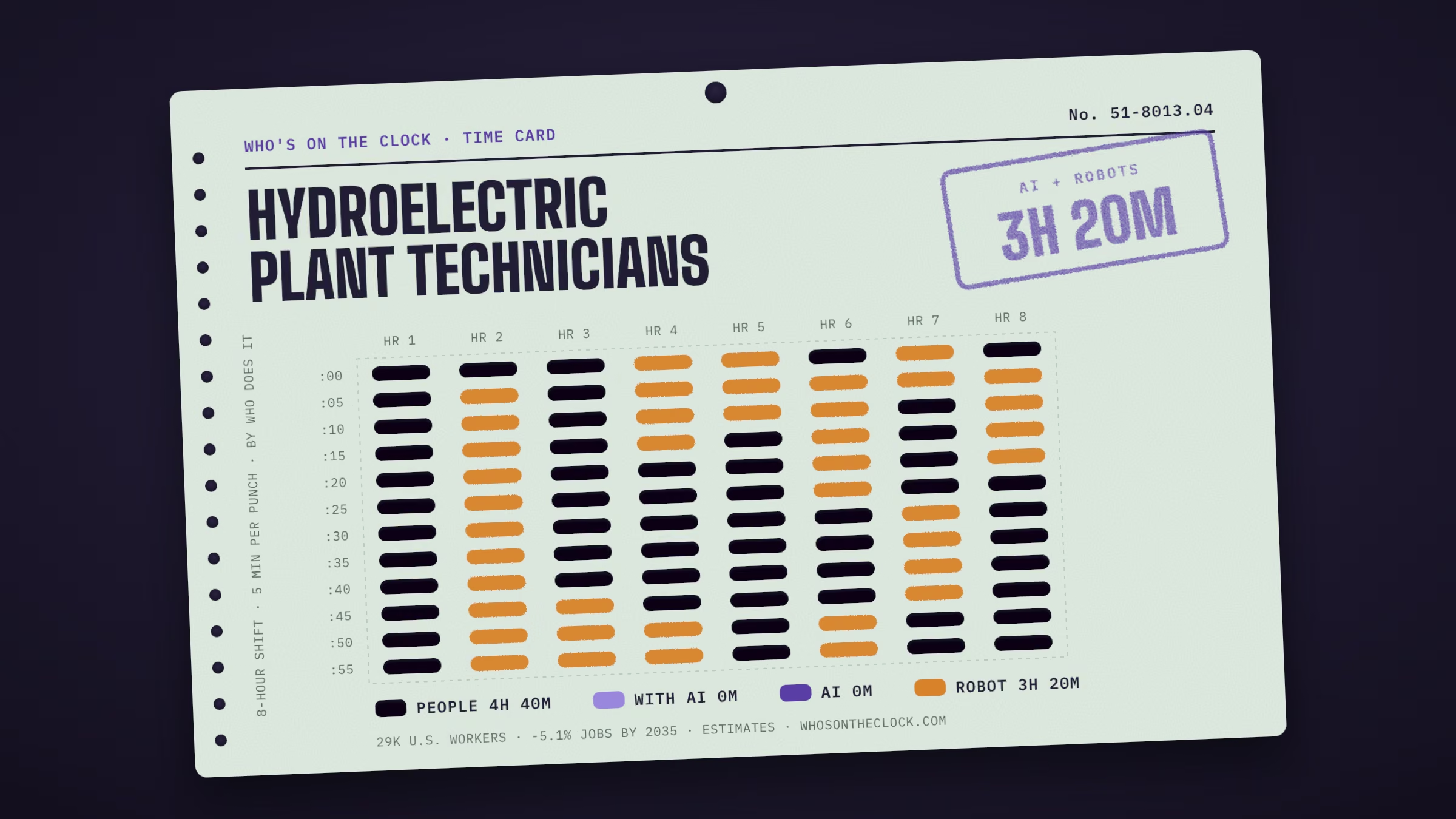
Monitor and control activities associated with hydropower generation. Operate plant equipment, such as turbines, pumps, valves, gates, fans, electric control boards, and battery banks. Monitor equipment operation and performance and make necessary adjustments to ensure optimal performance. Perform equipment maintenance and repair as necessary.
Time card
Untick tasks you don't do, or set your own times.
| Mine | Task, by time spent | Human | With AI | AI | Robot |
|---|---|---|---|---|---|
Maintain or repair hydroelectric plant electrical, mechanical, or electronic equipment, such as motors, transformers, voltage regulators, generators, relays, battery systems, air compressors, sump pumps, gates, or valves.1h 7m a shift · No AI or robot evidence foundWhy this label?This is physical work, and no robot has been shown doing it yet. How labels work | |||||
Monitor hydroelectric power plant equipment operation and performance, adjusting to performance specifications, as necessary.55m a shift · Robots deployed · e.g. Spot with Orbit fleet softwareWhy this label?Marked Robot because Spot with Orbit fleet software (in real use) has done this task in a real workplace. It shows a robot can do it somewhere, not that most hydroelectric plant technicians work alongside one. How labels work | |||||
Identify or address malfunctions of hydroelectric plant operational equipment, such as generators, transformers, or turbines.43m a shift · No AI or robot evidence foundWhy this label?This is physical work, and no robot has been shown doing it yet. How labels work | |||||
Inspect water-powered electric generators or auxiliary equipment in hydroelectric plants to verify proper operation or to determine maintenance or repair needs.36m a shift · Robots deployed · e.g. Spot with Orbit, gauge/thermal/acoustic inspection payloadsWhy this label?Marked Robot because Spot with Orbit, gauge/thermal/acoustic inspection payloads (in real use) has done this task in a real workplace. It shows a robot can do it somewhere, not that most hydroelectric plant technicians work alongside one. How labels work | |||||
Maintain logs, reports, work requests, or other records of work performed in hydroelectric plants.30m a shift · No AI or robot evidence foundWhy this label?No AI use or robot deployment showed up for this task in our data. That isn't proof it's safe; it may just be rare in the data. How labels work | |||||
Start, adjust, or stop generating units, operating valves, gates, or auxiliary equipment in hydroelectric power generating plants.24m a shift · Robots deployed · e.g. Reclamation hydropower fleet remote operationWhy this label?Marked Robot because Reclamation hydropower fleet remote operation (in real use) has done this task in a real workplace. It shows a robot can do it somewhere, not that most hydroelectric plant technicians work alongside one. How labels work | |||||
Install or calibrate electrical or mechanical equipment, such as motors, engines, switchboards, relays, switch gears, meters, pumps, hydraulics, or flood channels.24m a shift · Robots only in factory cellsWhy this label?Robots have done this only in factory setups built around the machine, so it stays Human for hydroelectric plant technicians. How labels work | |||||
Test and repair or replace electrical equipment, such as circuit breakers, station batteries, cable trays, conduits, or control devices.24m a shift · Robots only in factory cellsWhy this label?Robots have done this only in factory setups built around the machine, so it stays Human for hydroelectric plant technicians. How labels work | |||||
Take readings and record data, such as water levels, temperatures, or flow rates.24m a shift · Robots deployed · e.g. Boston Dynamics Spot 'Energy Dog' with Smart Inspection analyticsWhy this label?Marked Robot because Boston Dynamics Spot 'Energy Dog' with Smart Inspection analytics (in real use) has done this task in a real workplace. It shows a robot can do it somewhere, not that most hydroelectric plant technicians work alongside one. How labels work | |||||
Communicate status of hydroelectric operating equipment to dispatchers or supervisors.18m a shift · No AI or robot evidence foundWhy this label?No AI use or robot deployment showed up for this task in our data. That isn't proof it's safe; it may just be rare in the data. How labels work | |||||
Operate hydroelectric plant equipment, such as turbines, pumps, valves, gates, fans, electric control boards, or battery banks.18m a shift · Robots deployed · e.g. TVA Hydro Dispatch Control Center remote/automatic hydro unit control systemsWhy this label?Marked Robot because TVA Hydro Dispatch Control Center remote/automatic hydro unit control systems (in real use) has done this task in a real workplace. It shows a robot can do it somewhere, not that most hydroelectric plant technicians work alongside one. How labels work | |||||
Change oil, hydraulic fluid, or other lubricants to maintain condition of hydroelectric plant equipment.18m a shift · Robots only in factory cellsWhy this label?Robots have done this only in factory setups built around the machine, so it stays Human for hydroelectric plant technicians. How labels work | |||||
Perform tunnel or field inspections of hydroelectric plant facilities or resources.18m a shift · Robots deployed · e.g. Boston Dynamics Spot with Energy Robotics inspection softwareWhy this label?Marked Robot because Boston Dynamics Spot with Energy Robotics inspection software (in real use) has done this task in a real workplace. It shows a robot can do it somewhere, not that most hydroelectric plant technicians work alongside one. How labels work | |||||
Perform preventive or corrective containment or cleanup measures in hydroelectric plants to prevent environmental contamination.12m a shift · No AI or robot evidence foundWhy this label?This is physical work, and no robot has been shown doing it yet. How labels work | |||||
Operate high voltage switches or related devices in hydropower stations.12m a shift · Robots deployed · e.g. USACE hydro unit control systems (PLC/hard-wired automatic start-stop sequencing with automatic synchronizing)Why this label?Marked Robot because USACE hydro unit control systems (PLC/hard-wired automatic start-stop sequencing with automatic synchronizing) (in real use) has done this task in a real workplace. It shows a robot can do it somewhere, not that most hydroelectric plant technicians work alongside one. How labels work | |||||
Implement load or switching orders in hydroelectric plants, in accordance with specifications or instructions.12m a shift · Robots deployed · e.g. Hydropower plant AGC / monitoring system + Local Control Unit + turbine governorWhy this label?Marked Robot because Hydropower plant AGC / monitoring system + Local Control Unit + turbine governor (in real use) has done this task in a real workplace. It shows a robot can do it somewhere, not that most hydroelectric plant technicians work alongside one. How labels work | |||||
Connect metal parts or components in hydroelectric plants by welding, soldering, riveting, tapping, bolting, bonding, or screwing.12m a shift · Robots only in factory cellsWhy this label?Robots have done this only in factory setups built around the machine, so it stays Human for hydroelectric plant technicians. How labels work | |||||
Lift and move loads, using cranes, hoists, and rigging, to install or repair hydroelectric system equipment or infrastructure.12m a shift · Robots only in factory cellsWhy this label?Robots have done this only in factory setups built around the machine, so it stays Human for hydroelectric plant technicians. How labels work | |||||
Splice or terminate cables or electrical wiring in hydroelectric plants.6m a shift · Robots only in factory cellsWhy this label?Robots have done this only in factory setups built around the machine, so it stays Human for hydroelectric plant technicians. How labels work | |||||
Erect scaffolds, platforms, or hoisting frames to access hydroelectric plant machinery or infrastructure for repair or replacement.6m a shift · No AI or robot evidence foundWhy this label?This is physical work, and no robot has been shown doing it yet. How labels work | |||||
Cut, bend, or shape metal for applications in hydroelectric plants, using equipment such as hydraulic benders or pipe threaders.6m a shift · Robots only in factory cellsWhy this label?Robots have done this only in factory setups built around the machine, so it stays Human for hydroelectric plant technicians. How labels work |