Will AI replace geothermal technicians?

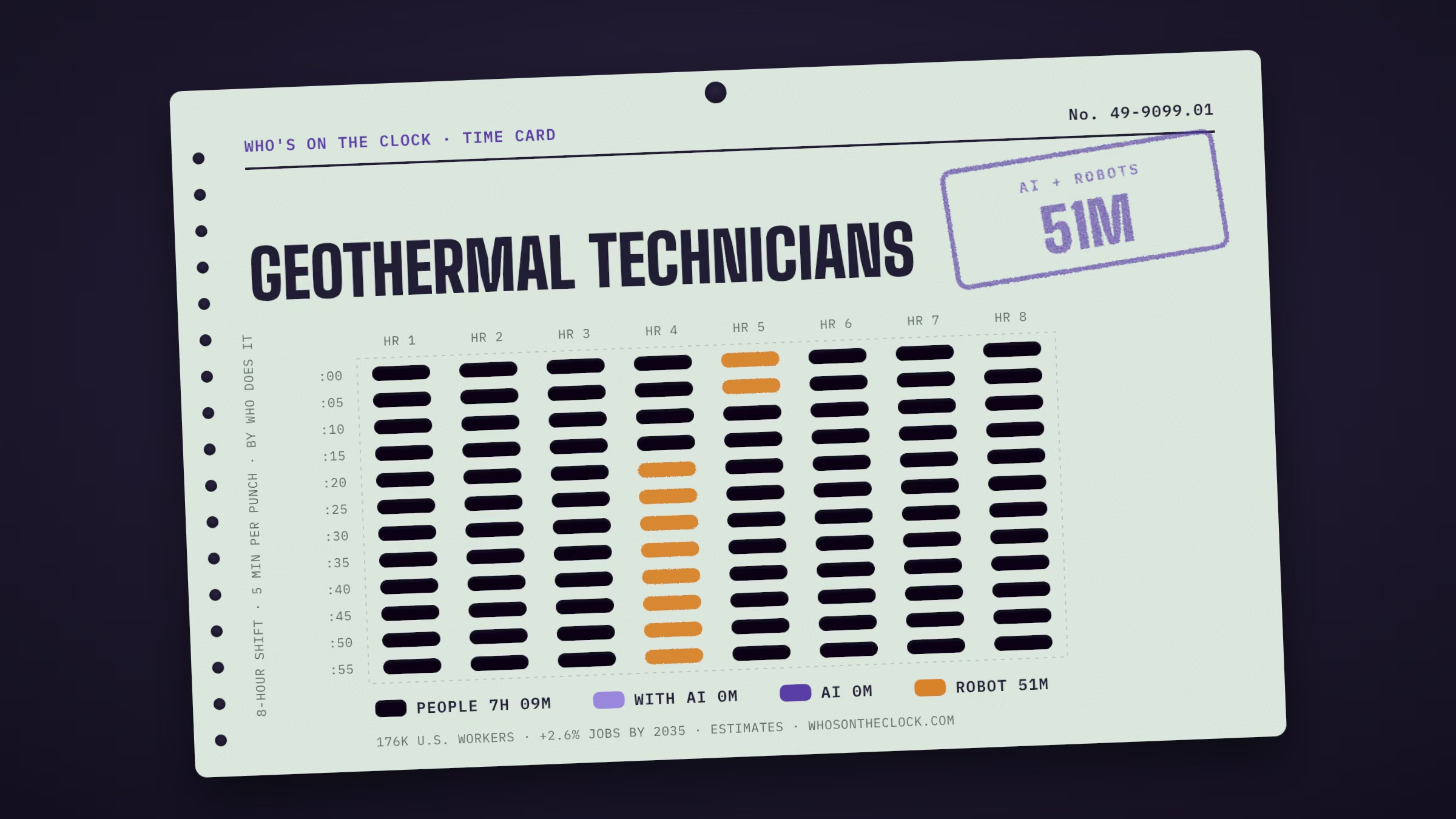
Unlikely, though parts of the work are changing. About 51m of an 8-hour shift goes to tasks touched by robots. The other 7h 9m (89%) stays with people. Separately, BLS expects about 2.6% more of these jobs by 2035 (all jobs: +3.5%).

Time card for geothermal technicians showing a typical 8-hour shift: 7h 9m done by people, 51m by robots.
Each mark is 5 minutes of a typical shift for geothermal technicians, colored by who does that task today. Estimates from O*NET tasks and Anthropic Economic Index data. How it's made

Home / Repair & maintenance / Geothermal Technicians

Perform technical activities at power plants or individual installations necessary for the generation of power from geothermal energy sources. Monitor and control operating activities at geothermal power generation facilities and perform maintenance and repairs as necessary. Install, test, and maintain residential and commercial geothermal heat pumps.

Time card

Untick tasks you don't do, or set your own times.
MineTask, by time spentHumanWith AIAIRobot
Monitor and adjust operations of geothermal power plant equipment or systems.1h 4m a shift · Robots only in factory cells
Install, maintain, or repair ground or water source-coupled heat pumps to heat and cool residential or commercial building air or water.1h 4m a shift · No AI or robot evidence found
Prepare and maintain logs, reports, or other documentation of work performed.38m a shift · No AI or robot evidence found
Identify and correct malfunctions of geothermal plant equipment, electrical systems, instrumentation, or controls.32m a shift · No AI or robot evidence found
Collect and record data associated with operating geothermal power plants or well fields.26m a shift · Robots deployed · e.g. Spot (with Orbit software), operated by J-POWER / Tohoku Enterprise
Operate equipment, such as excavators, backhoes, rock hammers, trench compactors, pavement saws, grout mixers or pumps, geothermal loop reels, and coil tubing units (CTU).26m a shift · Robots deployed · e.g. Built Robotics Exosystem excavators (used by Bechtel)
Perform pre- and post-installation pressure, flow, and related tests of vertical and horizontal geothermal loop piping.19m a shift · No AI or robot evidence found
Maintain electrical switchgear, process controls, transmitters, gauges, and control equipment in accordance with geothermal plant procedures.19m a shift · No AI or robot evidence found
Maintain, calibrate, or repair plant instrumentation, control, and electronic devices in geothermal plants.19m a shift · No AI or robot evidence found
Design and lay out geothermal heat systems according to property characteristics, heating and cooling requirements, piping and equipment requirements, applicable regulations, or other factors.19m a shift · No AI or robot evidence found
Install and maintain geothermal system instrumentation or controls.19m a shift · Robots only in factory cells
Weld piping, such as high density polyethylene (HDPE) piping, using techniques such as butt, socket, side-wall, and electro-fusion welding.19m a shift · Robots only in factory cells
Dig trenches for system piping to appropriate depths and lay piping in trenches.19m a shift · No AI or robot evidence found
Adjust power production systems to meet load and distribution demands.13m a shift · No AI or robot evidence found
Calculate heat loss and heat gain factors for residential properties to determine heating and cooling required by installed geothermal systems.13m a shift · No AI or robot evidence found
Prepare newly installed geothermal heat systems for operation by flushing, purging, or other actions.13m a shift · Robots only in factory cells
Backfill piping trenches to protect pipes from damage.13m a shift · Robots only in factory cells
Determine whether emergency or auxiliary systems will be needed to keep properties heated or cooled in extreme weather conditions.6m a shift · No AI or robot evidence found
Identify equipment options, such as compressors, and make appropriate selections.6m a shift · No AI or robot evidence found
Install and maintain geothermal plant electrical protection equipment.6m a shift · No AI or robot evidence found
Test water sources for factors, such as flow volume and contaminant presence.6m a shift · Robots only in factory cells
Integrate hot water heater systems with geothermal heat exchange systems.6m a shift · No AI or robot evidence found
Determine the type of geothermal loop system most suitable to a specific property and its heating and cooling needs.6m a shift · No AI or robot evidence found
Apply coatings or operate systems to mitigate corrosion of geothermal plant equipment or structures.6m a shift · Robots only in factory cells

On the floor

  1. AnnouncedFervo Energy
    Fervo, Nvidia and PNNL build AI twin for geothermal drilling

    Fervo, Nvidia and the Pacific Northwest National Laboratory are building EGS-Twin, which combines live field data, simulations and AI forecasting. The goal is to help geothermal operators drill more efficiently.

    Invezz

Ask the clock

Will AI replace geothermal technicians?

Unlikely, though parts of the work are changing. About 51m of an 8-hour shift goes to tasks touched by robots. The other 7h 9m (89%) stays with people. Separately, BLS expects about 2.6% more of these jobs by 2035 (all jobs: +3.5%).

What can AI already do for geothermal technicians?

None of this job's tasks show regular AI use yet. That can mean the work is hands-on or in person, or simply that it rarely comes up in AI usage data.

Where do robots fit in?

For some tasks, yes. Robots have done 2 of this job's tasks in workplaces like this one, about 51m of a typical shift. 7 more tasks have only been done in factory setups built around the machine, so they stay with people here. For 8 physical tasks, no robot has shown it can do the work yet.

  • Collect and record data associated with operating geothermal power plants or well fields. (26m a shift; e.g. Spot (with Orbit software), operated by J-POWER / Tohoku Enterprise, in use)
  • Operate equipment, such as excavators, backhoes, rock hammers, trench compactors, pavement saws, grout mixers or pumps, geothermal loop reels, and coil tubing units (CTU). (26m a shift; e.g. Built Robotics Exosystem excavators (used by Bechtel), in use)
What still needs a person?

7h 9m of a typical shift, or 89%, goes to tasks with no AI or robot evidence yet. No AI usage or robot deployment has shown up for these so far. The biggest:

  • Monitor and adjust operations of geothermal power plant equipment or systems. (1h 4m a shift)
  • Install, maintain, or repair ground or water source-coupled heat pumps to heat and cool residential or commercial building air or water. (1h 4m a shift)
  • Prepare and maintain logs, reports, or other documentation of work performed. (38m a shift)
  • Identify and correct malfunctions of geothermal plant equipment, electrical systems, instrumentation, or controls. (32m a shift)
  • Perform pre- and post-installation pressure, flow, and related tests of vertical and horizontal geothermal loop piping. (19m a shift)
Why is that work hard to automate?

Much of it comes down to where and how the work happens. In-person, hands-on and high-stakes work is where AI and robots have made the least headway so far. In the official O*NET survey of people in this job:

  • 91% carry high or very high responsibility for other workers' safety
  • 88% work in very hot or cold conditions at least weekly
  • 83% work outdoors in all weather every day
What are companies actually doing?

We track 1 sourced company move that affects this job. Most recent:

  • Jun 22, 2026: Fervo, Nvidia and PNNL build AI twin for geothermal drilling (Announced)
Are employers still hiring geothermal technicians?

On Indeed, job postings in the Installation & Maintenance sector are at 118% of their February 2020 level (all U.S. postings: 104%), up 4.1% from a year earlier, as of Oct 9, 2026. BLS separately expects about 18,000 openings a year in this job through 2035. Across all U.S. postings, 7.3% now mention AI skills. Sector postings cover more than this one job and move for many reasons besides AI.

How much do geothermal technicians make?

The median pay is about $49,230 a year ($23.67 an hour), 3% below the median for all U.S. jobs ($50,980). Most people in this job earn between $36,080 and $77,040 a year; that range covers the middle 80%. Pay figures are from BLS, May 2025, and vary a lot by state and employer. Pick a state to compare:

Is this job growing or shrinking?

BLS projects growth of 2.6% from 2025 to 2035, compared with 3.5% growth for all jobs. That's about 211,000 jobs in 2035. It expects about 18,000 openings a year, mostly from people retiring or changing careers. These projections don't single out AI as a cause.

How many geothermal technicians are there in the U.S.?

About 176,000 people in the U.S., roughly 0.11% of all workers (BLS, May 2025). That makes it the 188th largest of the 796 jobs on this site. BLS expects about 211,000 in 2035.

What training do geothermal technicians need?

The most common requirement is a high school diploma: about 66% of people in the job said so in the official O*NET survey. O*NET rates the job at level 2 of 5 for preparation, which usually means: high school diploma, some training. Requirements vary by state and employer, especially for licensed work.

What should I learn to stay ahead of AI?

These come from the job's official skill ratings and from the tasks that AI and robots touch least today. Building them keeps you strong in the parts of the work that still need a person:

  • Skills that matter more here than in most jobs: Installation, Troubleshooting, Operations Monitoring, Repairing
  • Get strong at the parts of the job that stay with people (listed above), which take 7h 9m of a typical shift
  • Tools employers list: Autodesk AutoCAD, Microsoft Excel, Microsoft Office software, Microsoft Outlook, Microsoft Word
What other jobs could geothermal technicians move into?

These use similar skills, with less of a typical shift touched by AI or robots. Matches come from 109 official ratings of skills, knowledge and work activities, and each needs the same or less preparation unless the official list relates the jobs directly:

  • Wind Turbine Service Technicians (12m touched, $64k median pay)
  • Millwrights (0m touched, $66k median pay)
How solid are these numbers?

Each task carries its own evidence label. For this job: 2 with robots in real deployments, 22 with no AI or robot evidence found. The minutes per task are estimates, not measured hours, and "no evidence" doesn't prove a task is safe.

Tools in demand

  • Autodesk AutoCAD
  • Microsoft Excel
  • Microsoft Office software
  • Microsoft Outlook
  • Microsoft Word
  • SAP software

Also called

Corrosion Technician, Design Technician, Distribution Field Technician, Field Distribution Technician, Geothermal Field Technician, Geothermal HVAC Technician (Geothermal Heating, Ventilating, and Air Conditioning Technician), Geothermal Installer, Geothermal Service Technician, Geothermal System Installer, Geothermal Technician, Ground Source Heat Pump Technician (GSHP Technician), I C and E Technician (Instrumentation, Control, and Electrical Technician), I and C Technician (Instrument and Controls Technician), I and E Technician (Instrumentation and Electrical Technician)