Will AI replace layout workers, metal and plastic?

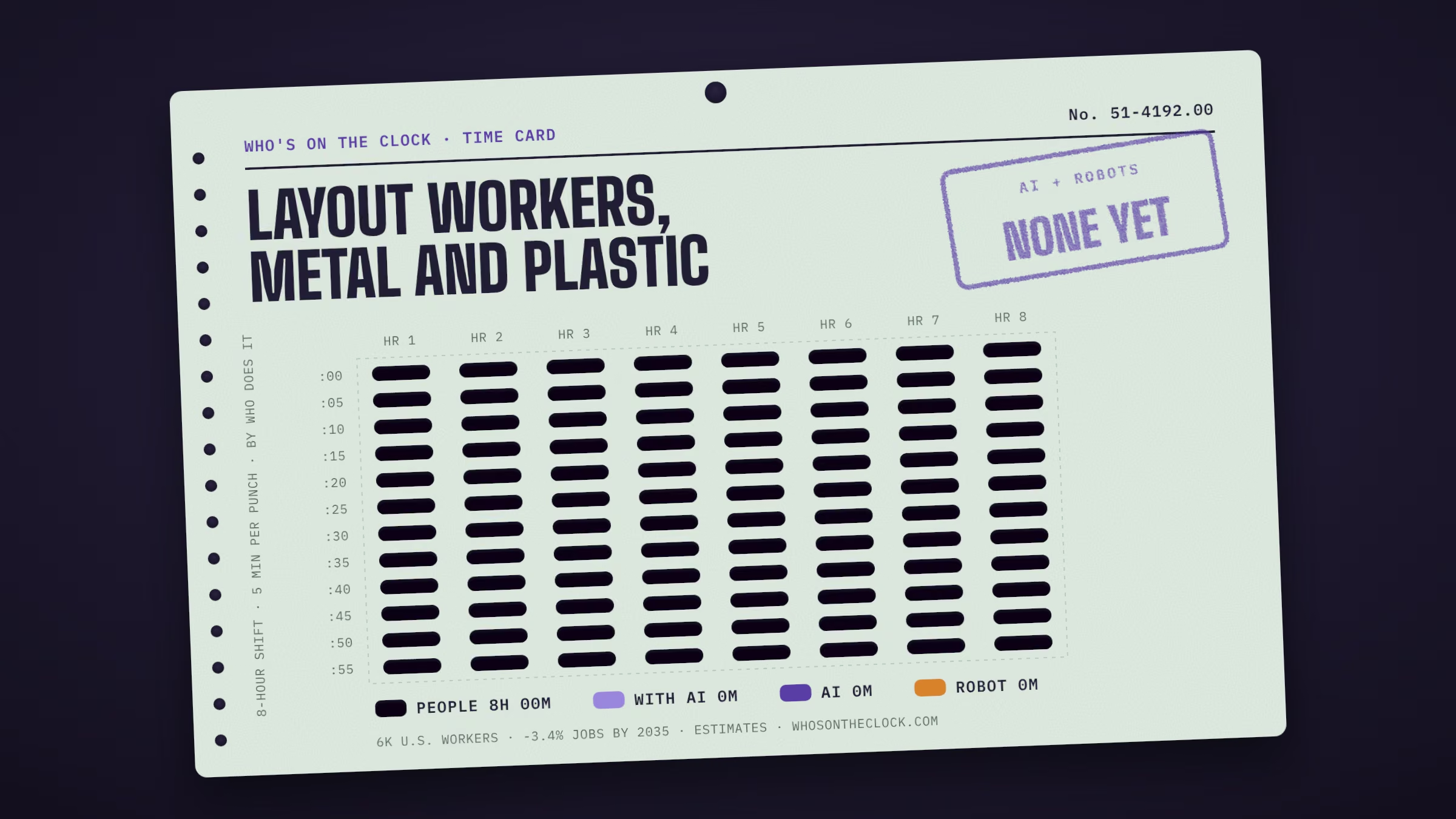
Most of the shift goes to “Mark curves, lines, holes, dimensions”, which remains people's work. So far the record shows no AI use or robot deployment for any of this job's tasks. That reflects today's evidence and could change. BLS expects about 3.4% fewer of these jobs by 2035.

Time card for layout workers, metal and plastic showing a typical 8-hour shift: 8h done by people.
Each mark is 5 minutes of a typical shift for layout workers, metal and plastic, colored by who does that task today. Estimates from O*NET tasks and Anthropic Economic Index data. How it's made

Home / Production & factory / Layout Workers, Metal and Plastic

Lay out reference points and dimensions on metal or plastic stock or workpieces, such as sheets, plates, tubes, structural shapes, castings, or machine parts, for further processing. Includes shipfitters.

Time card

Untick tasks you don't do, or set your own times.
MineTask, by time spentHumanWith AIAIRobot
Mark curves, lines, holes, dimensions, and welding symbols onto workpieces, using scribes, soapstones, punches, and hand drills.1h 22m a shift · Robots only in factory cells
Why this label?Robots have done this only in factory setups built around the machine, so it stays Human for layout workers, metal and plastic. How labels work
Fit and align fabricated parts to be welded or assembled.47m a shift · Robots only in factory cells
Why this label?Robots have done this only in factory setups built around the machine, so it stays Human for layout workers, metal and plastic. How labels work
Plan and develop layouts from blueprints and templates, applying knowledge of trigonometry, design, effects of heat, and properties of metals.47m a shift · No AI or robot evidence found
Why this label?No AI use or robot deployment showed up for this task in our data. That isn't proof it's safe; it may just be rare in the data. How labels work
Lay out and fabricate metal structural parts such as plates, bulkheads, and frames.47m a shift · Robots only in factory cells
Why this label?Robots have done this only in factory setups built around the machine, so it stays Human for layout workers, metal and plastic. How labels work
Plan locations and sequences of cutting, drilling, bending, rolling, punching, and welding operations, using compasses, protractors, dividers, and rules.41m a shift · No AI or robot evidence found
Why this label?No AI use or robot deployment showed up for this task in our data. That isn't proof it's safe; it may just be rare in the data. How labels work
Compute layout dimensions, and determine and mark reference points on metal stock or workpieces for further processing, such as welding and assembly.41m a shift · Robots only in factory cells
Why this label?Robots have done this only in factory setups built around the machine, so it stays Human for layout workers, metal and plastic. How labels work
Locate center lines and verify template positions, using measuring instruments such as gauge blocks, height gauges, and dial indicators.35m a shift · Robots only in factory cells
Why this label?Robots have done this only in factory setups built around the machine, so it stays Human for layout workers, metal and plastic. How labels work
Lift and position workpieces in relation to surface plates, manually or with hoists, and using parallel blocks and angle plates.35m a shift · Robots only in factory cells
Why this label?Robots have done this only in factory setups built around the machine, so it stays Human for layout workers, metal and plastic. How labels work
Design and prepare templates of wood, paper, or metal.23m a shift · Robots only in factory cells
Why this label?Robots have done this only in factory setups built around the machine, so it stays Human for layout workers, metal and plastic. How labels work
Inspect machined parts to verify conformance to specifications.23m a shift · Robots only in factory cells
Why this label?Robots have done this only in factory setups built around the machine, so it stays Human for layout workers, metal and plastic. How labels work
Install doors, hatches, brackets, and clips.18m a shift · Robots only in factory cells
Why this label?Robots have done this only in factory setups built around the machine, so it stays Human for layout workers, metal and plastic. How labels work
Brace parts in position within hulls or ships for riveting or welding.18m a shift · No AI or robot evidence found
Why this label?This is physical work, and no robot has been shown doing it yet. How labels work
Add dimensional details to blueprints or drawings made by other workers.12m a shift · No AI or robot evidence found
Why this label?No AI use or robot deployment showed up for this task in our data. That isn't proof it's safe; it may just be rare in the data. How labels work
Apply pigment to layout surfaces, using paint brushes.12m a shift · Robots only in factory cells
Why this label?Robots have done this only in factory setups built around the machine, so it stays Human for layout workers, metal and plastic. How labels work

Clock history

  1. 0m touchedFirst published: O*NET 30.1, Anthropic Economic Index (2025 usage and September 2026 robot study), BLS May 2025

When new data changes this clock, the date, the new numbers and the reason are logged here. Company news alone never moves the clock.

On the floor

No company news tracked for this job yet. New stories are added as they happen.

Ask the clock

Will AI replace layout workers, metal and plastic?

Not on current evidence. Less than 30 minutes of a typical shift goes to tasks that AI or robots are doing today. The other 8h (100%) stays with people. Separately, BLS expects about 3.4% fewer of these jobs by 2035 (all jobs: +3.5%).

What can AI already do for layout workers, metal and plastic?

None of this job's tasks show regular AI use yet. That can mean the work is hands-on or in person, or simply that it rarely comes up in AI usage data.

Where do robots fit in?

Not in workplaces like this one, based on a 2026 review of robot deployments. 10 more tasks have only been done in factory setups built around the machine, so they stay with people here. For 1 physical task, no robot has shown it can do the work yet.

What still needs a person?

8h of a typical shift, or 100%, goes to tasks with no AI or robot evidence yet. No AI usage or robot deployment has shown up for these so far. The biggest:

  • Mark curves, lines, holes, dimensions, and welding symbols onto workpieces, using scribes, soapstones, punches, and hand drills. (1h 22m a shift)
  • Fit and align fabricated parts to be welded or assembled. (47m a shift)
  • Plan and develop layouts from blueprints and templates, applying knowledge of trigonometry, design, effects of heat, and properties of metals. (47m a shift)
  • Lay out and fabricate metal structural parts such as plates, bulkheads, and frames. (47m a shift)
  • Plan locations and sequences of cutting, drilling, bending, rolling, punching, and welding operations, using compasses, protractors, dividers, and rules. (41m a shift)
Why is that work hard to automate?

Much of it comes down to where and how the work happens. In-person, hands-on and high-stakes work is where AI and robots have made the least headway so far. In the official O*NET survey of people in this job:

  • 82% spend more than half the day on their feet
  • 75% use their hands on tools, objects or controls more than half the time
  • 73% work in very hot or cold conditions at least weekly
Are employers still hiring layout workers, metal and plastic?

On Indeed, job postings in the Production & Manufacturing sector are at 124% of their February 2020 level (all U.S. postings: 104%), up 12.6% from a year earlier, as of Oct 9, 2026. BLS separately expects about 500 openings a year in this job through 2035. Across all U.S. postings, 7.3% now mention AI skills. Sector postings cover more than this one job and move for many reasons besides AI.

How much do layout workers, metal and plastic make?

The median pay is about $63,870 a year ($30.71 an hour), 25% above the median for all U.S. jobs ($50,980). Most people in this job earn between $39,980 and $93,860 a year; that range covers the middle 80%. Pay figures are from BLS, May 2025, and vary a lot by state and employer. Pick a state to compare:

Is this job growing or shrinking?

BLS projects a decline of 3.4% from 2025 to 2035, compared with 3.5% growth for all jobs. That's about 5,900 jobs in 2035. Even so, it expects about 500 openings a year, mostly from people retiring or changing careers. These projections don't single out AI as a cause.

How many layout workers, metal and plastic are there in the U.S.?

About 5,970 people in the U.S., roughly 0.00% of all workers (BLS, May 2025). That makes it the 717th largest of the 796 jobs on this site. BLS expects about 5,900 in 2035.

What training do layout workers, metal and plastic need?

The most common requirement is a high school diploma: about 60% of people in the job said so in the official O*NET survey. O*NET rates the job at level 2 of 5 for preparation, which usually means: high school diploma, some training. Requirements vary by state and employer, especially for licensed work.

What should I learn to stay ahead of AI?

These come from the job's official skill ratings and from the tasks that AI and robots touch least today. Building them keeps you strong in the parts of the work that still need a person:

  • Skills that matter more here than in most jobs: Mathematics, Quality Control Analysis, Operations Monitoring, Complex Problem Solving
  • Get strong at the parts of the job that stay with people (listed above), which take 8h of a typical shift
  • Tools employers list: Autodesk AutoCAD, Microsoft Excel, Microsoft Office software, Microsoft PowerPoint, Microsoft Word
What other jobs could layout workers, metal and plastic move into?

These use similar skills. Matches come from 109 official ratings of skills, knowledge and work activities, and each needs the same or less preparation unless the official list relates the jobs directly:

  • Structural Metal Fabricators and Fitters (0m touched, $51k median pay)
  • Cabinetmakers and Bench Carpenters (0m touched, $47k median pay)
  • Welding, Soldering, and Brazing Machine Setters, Operators, and Tenders (53m touched, $48k median pay)
  • Stone Cutters and Carvers, Manufacturing (0m touched, $46k median pay)
  • Lathe and Turning Machine Tool Setters, Operators, and Tenders, Metal and Plastic (2h 14m touched, $51k median pay)
How solid are these numbers?

Each task carries its own evidence label. For this job: 14 with no AI or robot evidence found. The minutes per task are estimates, not measured hours, and "no evidence" doesn't prove a task is safe.

Tools in demand

  • Autodesk AutoCAD

Plus everyday office tools: Microsoft Excel, Microsoft Office software, Microsoft PowerPoint, Microsoft Word.

Also called

Aircraft Lay Out Worker, Bellmaker, Development Mechanic, Dimensional Inspector, Duplicator, Hangersmith, Lay-Out Worker, Layout Fabricator, Layout Fitter, Layout Inspector, Layout Man, Layout Mechanic, Layout Technician (Layout Tech), Layout Worker