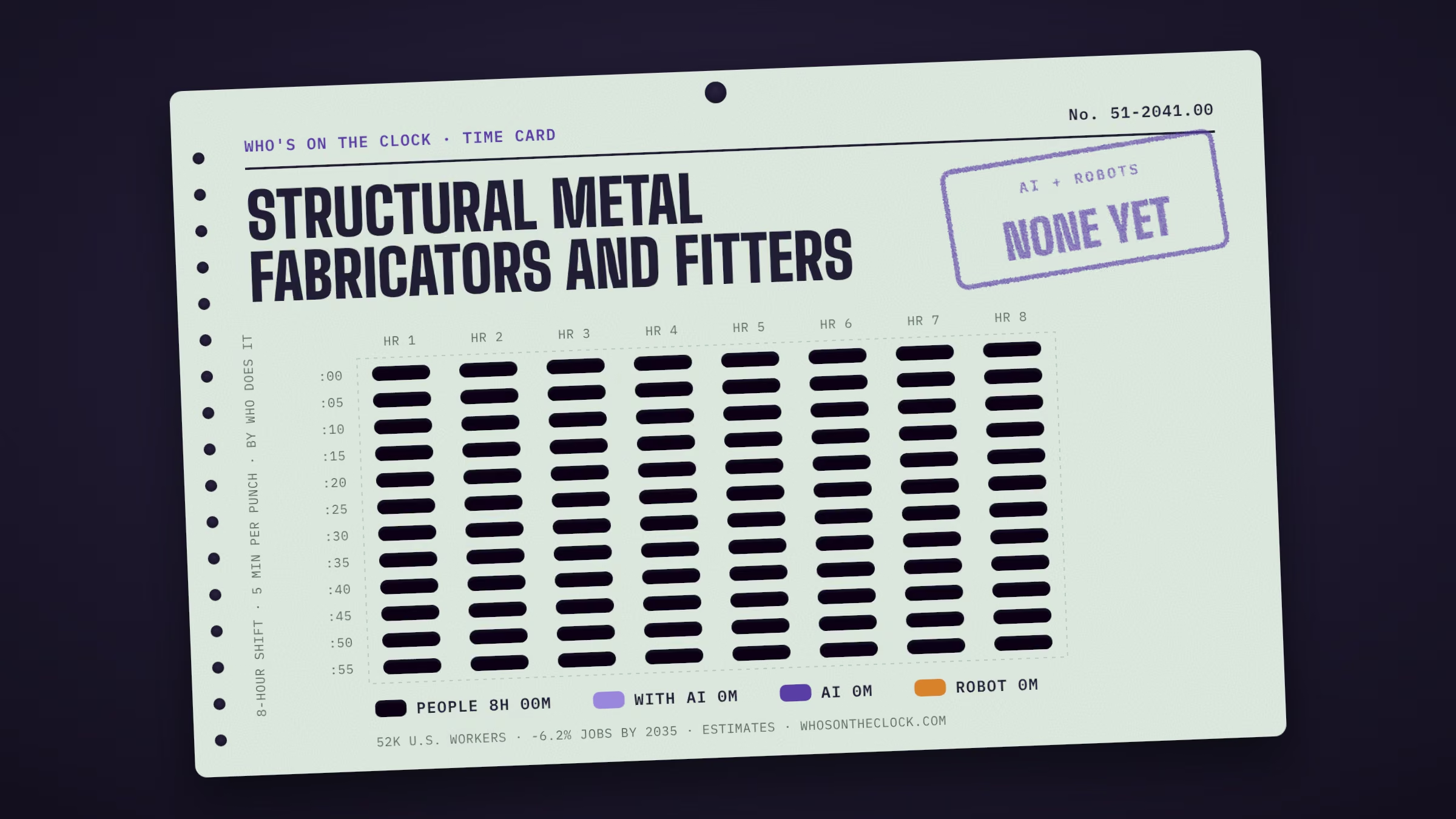
Fabricate, position, align, and fit parts of structural metal products.
Time card
Untick tasks you don't do, or set your own times.
| Mine | Task, by time spent | Human | With AI | AI | Robot |
|---|---|---|---|---|---|
Position, align, fit, and weld parts to form complete units or subunits, following blueprints and layout specifications, and using jigs, welding torches, and hand tools.1h 22m a shift · Robots only in factory cellsWhy this label?Robots have done this only in factory setups built around the machine, so it stays Human for structural metal fabricators and fitters. How labels work | |||||
Tack-weld fitted parts together.47m a shift · Robots only in factory cellsWhy this label?Robots have done this only in factory setups built around the machine, so it stays Human for structural metal fabricators and fitters. How labels work | |||||
Set up and operate fabricating machines, such as brakes, rolls, shears, flame cutters, grinders, and drill presses, to bend, cut, form, punch, drill, or otherwise form and assemble metal components.41m a shift · Robots only in factory cellsWhy this label?Robots have done this only in factory setups built around the machine, so it stays Human for structural metal fabricators and fitters. How labels work | |||||
Verify conformance of workpieces to specifications, using squares, rulers, and measuring tapes.29m a shift · Robots only in factory cellsWhy this label?Robots have done this only in factory setups built around the machine, so it stays Human for structural metal fabricators and fitters. How labels work | |||||
Study engineering drawings and blueprints to determine materials requirements and task sequences.29m a shift · No AI or robot evidence foundWhy this label?No AI use or robot deployment showed up for this task in our data. That isn't proof it's safe; it may just be rare in the data. How labels work | |||||
Lay out and examine metal stock or workpieces to be processed to ensure that specifications are met.29m a shift · Robots only in factory cellsWhy this label?Robots have done this only in factory setups built around the machine, so it stays Human for structural metal fabricators and fitters. How labels work | |||||
Move parts into position, manually or with hoists or cranes.29m a shift · Robots only in factory cellsWhy this label?Robots have done this only in factory setups built around the machine, so it stays Human for structural metal fabricators and fitters. How labels work | |||||
Position or tighten braces, jacks, clamps, ropes, or bolt straps, or bolt parts in position for welding or riveting.29m a shift · Robots only in factory cellsWhy this label?Robots have done this only in factory setups built around the machine, so it stays Human for structural metal fabricators and fitters. How labels work | |||||
Hammer, chip, and grind workpieces to cut, bend, and straighten metal.29m a shift · Robots only in factory cellsWhy this label?Robots have done this only in factory setups built around the machine, so it stays Human for structural metal fabricators and fitters. How labels work | |||||
Align and fit parts according to specifications, using jacks, turnbuckles, wedges, drift pins, pry bars, and hammers.23m a shift · Robots only in factory cellsWhy this label?Robots have done this only in factory setups built around the machine, so it stays Human for structural metal fabricators and fitters. How labels work | |||||
Set up face blocks, jigs, and fixtures.18m a shift · Robots only in factory cellsWhy this label?Robots have done this only in factory setups built around the machine, so it stays Human for structural metal fabricators and fitters. How labels work | |||||
Locate and mark workpiece bending and cutting lines, allowing for stock thickness, machine and welding shrinkage, and other component specifications.18m a shift · Robots only in factory cellsWhy this label?Robots have done this only in factory setups built around the machine, so it stays Human for structural metal fabricators and fitters. How labels work | |||||
Remove high spots and cut bevels, using hand files, portable grinders, and cutting torches.18m a shift · Robots only in factory cellsWhy this label?Robots have done this only in factory setups built around the machine, so it stays Human for structural metal fabricators and fitters. How labels work | |||||
Lift or move materials and finished products, using large cranes.12m a shift · Robots only in factory cellsWhy this label?Robots have done this only in factory setups built around the machine, so it stays Human for structural metal fabricators and fitters. How labels work | |||||
Smooth workpiece edges and fix taps, tubes, and valves.6m a shift · Robots only in factory cellsWhy this label?Robots have done this only in factory setups built around the machine, so it stays Human for structural metal fabricators and fitters. How labels work | |||||
Mark reference points onto floors or face blocks and transpose them to workpieces, using measuring devices, squares, chalk, and soapstone.6m a shift · Robots only in factory cellsWhy this label?Robots have done this only in factory setups built around the machine, so it stays Human for structural metal fabricators and fitters. How labels work | |||||
Design and construct templates and fixtures, using hand tools.6m a shift · Robots only in factory cellsWhy this label?Robots have done this only in factory setups built around the machine, so it stays Human for structural metal fabricators and fitters. How labels work | |||||
Direct welders to build up low spots or short pieces with weld.6m a shift · No AI or robot evidence foundWhy this label?No AI use or robot deployment showed up for this task in our data. That isn't proof it's safe; it may just be rare in the data. How labels work | |||||
Straighten warped or bent parts, using sledges, hand torches, straightening presses, or bulldozers.6m a shift · Robots only in factory cellsWhy this label?Robots have done this only in factory setups built around the machine, so it stays Human for structural metal fabricators and fitters. How labels work | |||||
Erect ladders and scaffolding to fit together large assemblies.6m a shift · Robots only in factory cellsWhy this label?Robots have done this only in factory setups built around the machine, so it stays Human for structural metal fabricators and fitters. How labels work | |||||
Preheat workpieces to make them malleable, using hand torches or furnaces.6m a shift · Robots only in factory cellsWhy this label?Robots have done this only in factory setups built around the machine, so it stays Human for structural metal fabricators and fitters. How labels work | |||||
Install boilers, containers, and other structures.6m a shift · Robots only in factory cellsWhy this label?Robots have done this only in factory setups built around the machine, so it stays Human for structural metal fabricators and fitters. How labels work | |||||
Heat-treat parts, using acetylene torches.time not estimated · Robots only in factory cellsWhy this label?Robots have done this only in factory setups built around the machine, so it stays Human for structural metal fabricators and fitters. How labels work |