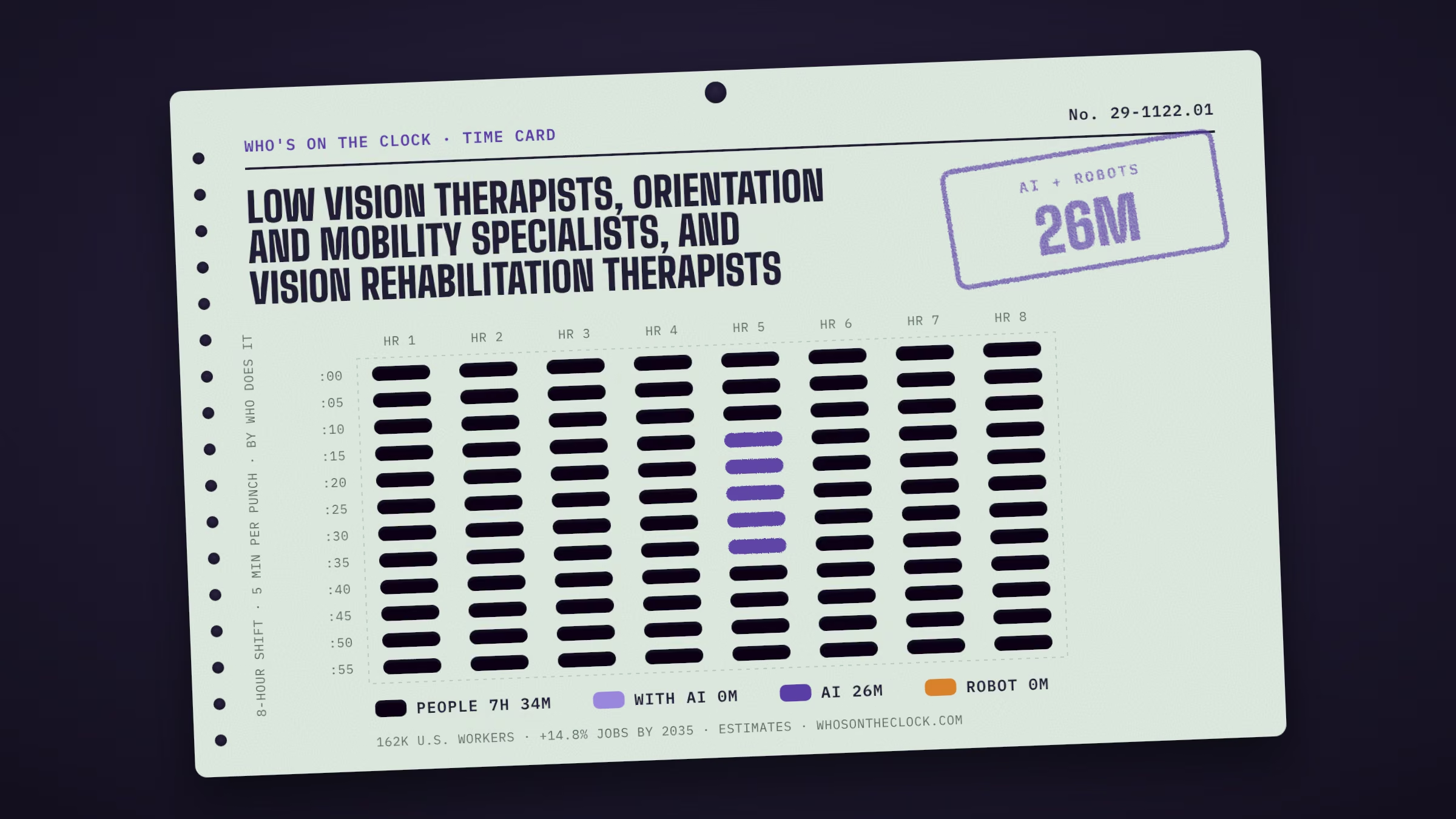
Provide therapy to patients with visual impairments to improve their functioning in daily life activities. May train patients in activities such as computer use, communication skills, or home management skills.
Time card
Untick tasks you don't do, or set your own times.
| Mine | Task, by time spent | Human | With AI | AI | Robot |
|---|---|---|---|---|---|
Write reports or complete forms to document assessments, training, progress, or follow-up outcomes.58m a shift · No AI or robot evidence foundWhy this label?No AI use or robot deployment showed up for this task in our data. That isn't proof it's safe; it may just be rare in the data. How labels work | |||||
Teach clients to travel independently, using a variety of actual or simulated travel situations or exercises.39m a shift · No AI or robot evidence foundWhy this label?This is physical work, and no robot has been shown doing it yet. How labels work | |||||
Teach independent living skills or techniques, such as adaptive eating, medication management, diabetes management, and personal management.39m a shift · No AI or robot evidence foundWhy this label?This is physical work, and no robot has been shown doing it yet. How labels work | |||||
Teach cane skills, including cane use with a guide, diagonal techniques, and two-point touches.32m a shift · No AI or robot evidence foundWhy this label?This is physical work, and no robot has been shown doing it yet. How labels work | |||||
Assess clients' functioning in areas such as vision, orientation and mobility skills, social and emotional issues, cognition, physical abilities, and personal goals.32m a shift · No AI or robot evidence foundWhy this label?This is physical work, and no robot has been shown doing it yet. How labels work | |||||
Train clients to use adaptive equipment, such as large print, reading stands, lamps, writing implements, software, and electronic devices.32m a shift · No AI or robot evidence foundWhy this label?This is physical work, and no robot has been shown doing it yet. How labels work | |||||
Develop rehabilitation or instructional plans collaboratively with clients, based on results of assessments, needs, and goals.26m a shift · No AI or robot evidence foundWhy this label?No AI use or robot deployment showed up for this task in our data. That isn't proof it's safe; it may just be rare in the data. How labels work | |||||
Provide consultation, support, or education to groups such as parents and teachers.26m a shift · Observed in AI useWhy this label?Marked AI because this task shows up regularly in real AI conversations (Anthropic Economic Index, 2025 usage), and in most of them AI does the task on its own rather than helping a person. Many workplaces may not use AI for it at all. How labels work | |||||
Train clients with visual impairments to use mobility devices or systems, such as human guides, dog guides, electronic travel aids (ETAs), and other adaptive mobility devices (AMDs).19m a shift · No AI or robot evidence foundWhy this label?This is physical work, and no robot has been shown doing it yet. How labels work | |||||
Train clients to use tactile, auditory, kinesthetic, olfactory, and proprioceptive information.19m a shift · No AI or robot evidence foundWhy this label?This is physical work, and no robot has been shown doing it yet. How labels work | |||||
Monitor clients' progress to determine whether changes in rehabilitation plans are needed.19m a shift · No AI or robot evidence foundWhy this label?No AI use or robot deployment showed up for this task in our data. That isn't proof it's safe; it may just be rare in the data. How labels work | |||||
Participate in professional development activities, such as reading literature, continuing education, attending conferences, and collaborating with colleagues.19m a shift · No AI or robot evidence foundWhy this label?No AI use or robot deployment showed up for this task in our data. That isn't proof it's safe; it may just be rare in the data. How labels work | |||||
Collaborate with specialists, such as rehabilitation counselors, speech pathologists, and occupational therapists, to provide client solutions.19m a shift · No AI or robot evidence foundWhy this label?No AI use or robot deployment showed up for this task in our data. That isn't proof it's safe; it may just be rare in the data. How labels work | |||||
Train clients to read or write Braille.19m a shift · No AI or robot evidence foundWhy this label?No AI use or robot deployment showed up for this task in our data. That isn't proof it's safe; it may just be rare in the data. How labels work | |||||
Teach self-advocacy skills to clients.13m a shift · No AI or robot evidence foundWhy this label?No AI use or robot deployment showed up for this task in our data. That isn't proof it's safe; it may just be rare in the data. How labels work | |||||
Identify visual impairments related to basic life skills in areas such as self care, literacy, communication, health management, home management, and meal preparation.13m a shift · No AI or robot evidence foundWhy this label?No AI use or robot deployment showed up for this task in our data. That isn't proof it's safe; it may just be rare in the data. How labels work | |||||
Design instructional programs to improve communication, using devices such as slates and styluses, braillers, keyboards, adaptive handwriting devices, talking book machines, digital books, and optical character readers (OCRs).13m a shift · No AI or robot evidence foundWhy this label?No AI use or robot deployment showed up for this task in our data. That isn't proof it's safe; it may just be rare in the data. How labels work | |||||
Obtain, distribute, or maintain low vision devices.13m a shift · No AI or robot evidence foundWhy this label?This is physical work, and no robot has been shown doing it yet. How labels work | |||||
Administer tests and interpret test results to develop rehabilitation plans for clients.13m a shift · No AI or robot evidence foundWhy this label?This is physical work, and no robot has been shown doing it yet. How labels work | |||||
Recommend appropriate mobility devices or systems, such as human guides, dog guides, long canes, electronic travel aids (ETAs), and other adaptive mobility devices (AMDs).6m a shift · No AI or robot evidence foundWhy this label?No AI use or robot deployment showed up for this task in our data. That isn't proof it's safe; it may just be rare in the data. How labels work | |||||
Refer clients to services, such as eye care, health care, rehabilitation, and counseling, to enhance visual and life functioning or when condition exceeds scope of practice.6m a shift · No AI or robot evidence foundWhy this label?No AI use or robot deployment showed up for this task in our data. That isn't proof it's safe; it may just be rare in the data. How labels work |