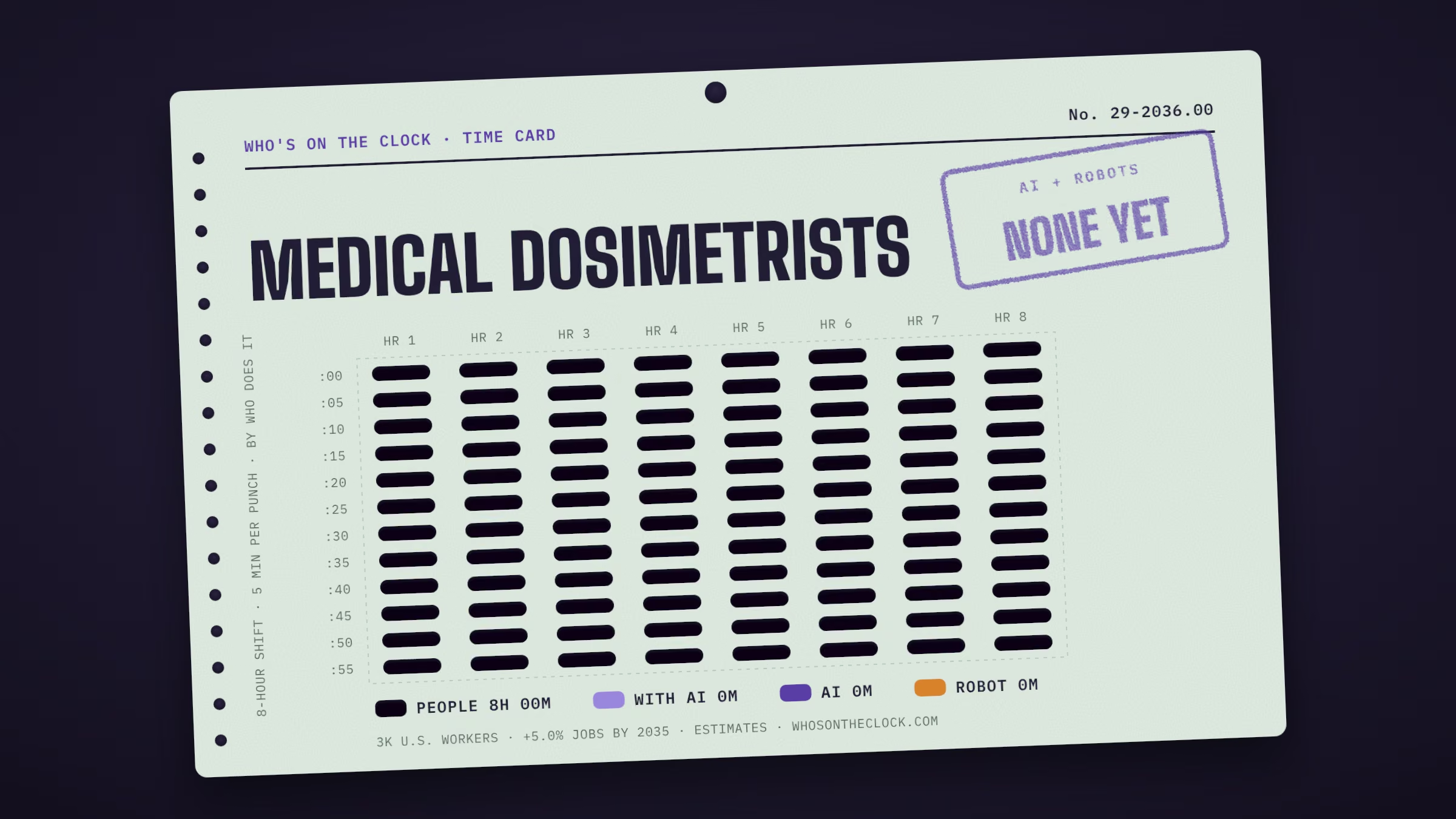
Generate radiation treatment plans, develop radiation dose calculations, communicate and supervise the treatment plan implementation, and consult with members of radiation oncology team.
Time card
Untick tasks you don't do, or set your own times.
| Mine | Task, by time spent | Human | With AI | AI | Robot |
|---|---|---|---|---|---|
Design the arrangement of radiation fields to reduce exposure to critical patient structures, such as organs, using computers, manuals, and guides.1h 46m a shift · No AI or robot evidence foundWhy this label?No AI use or robot deployment showed up for this task in our data. That isn't proof it's safe; it may just be rare in the data. How labels work | |||||
Identify and outline bodily structures, using imaging procedures, such as x-ray, magnetic resonance imaging, computed tomography, or positron emission tomography.56m a shift · No AI or robot evidence foundWhy this label?No AI use or robot deployment showed up for this task in our data. That isn't proof it's safe; it may just be rare in the data. How labels work | |||||
Develop radiation treatment plans in consultation with members of the radiation oncology team.44m a shift · No AI or robot evidence foundWhy this label?No AI use or robot deployment showed up for this task in our data. That isn't proof it's safe; it may just be rare in the data. How labels work | |||||
Plan the use of beam modifying devices, such as compensators, shields, and wedge filters, to ensure safe and effective delivery of radiation treatment.37m a shift · No AI or robot evidence foundWhy this label?No AI use or robot deployment showed up for this task in our data. That isn't proof it's safe; it may just be rare in the data. How labels work | |||||
Calculate the delivery of radiation treatment, such as the amount or extent of radiation per session, based on the prescribed course of radiation therapy.37m a shift · No AI or robot evidence foundWhy this label?No AI use or robot deployment showed up for this task in our data. That isn't proof it's safe; it may just be rare in the data. How labels work | |||||
Calculate, or verify calculations of, prescribed radiation doses.37m a shift · No AI or robot evidence foundWhy this label?No AI use or robot deployment showed up for this task in our data. That isn't proof it's safe; it may just be rare in the data. How labels work | |||||
Supervise or perform simulations for tumor localizations, using imaging methods such as magnetic resonance imaging, computed tomography, or positron emission tomography scans.25m a shift · No AI or robot evidence foundWhy this label?No AI use or robot deployment showed up for this task in our data. That isn't proof it's safe; it may just be rare in the data. How labels work | |||||
Create and transfer reference images and localization markers for treatment delivery, using image-guided radiation therapy.25m a shift · No AI or robot evidence foundWhy this label?No AI use or robot deployment showed up for this task in our data. That isn't proof it's safe; it may just be rare in the data. How labels work | |||||
Record patient information, such as radiation doses administered, in patient records.25m a shift · No AI or robot evidence foundWhy this label?No AI use or robot deployment showed up for this task in our data. That isn't proof it's safe; it may just be rare in the data. How labels work | |||||
Develop treatment plans, and calculate doses for brachytherapy procedures.19m a shift · No AI or robot evidence foundWhy this label?No AI use or robot deployment showed up for this task in our data. That isn't proof it's safe; it may just be rare in the data. How labels work | |||||
Advise oncology team members on use of beam modifying or immobilization devices in radiation treatment plans.12m a shift · No AI or robot evidence foundWhy this label?No AI use or robot deployment showed up for this task in our data. That isn't proof it's safe; it may just be rare in the data. How labels work | |||||
Perform quality assurance system checks, such as calibrations, on treatment planning computers.12m a shift · No AI or robot evidence foundWhy this label?No AI use or robot deployment showed up for this task in our data. That isn't proof it's safe; it may just be rare in the data. How labels work | |||||
Teach medical dosimetry, including its application, to students, radiation therapists, or residents.12m a shift · No AI or robot evidence foundWhy this label?No AI use or robot deployment showed up for this task in our data. That isn't proof it's safe; it may just be rare in the data. How labels work | |||||
Fabricate beam modifying devices, such as compensators, shields, and wedge filters.6m a shift · Robots only in factory cellsWhy this label?Robots have done this only in factory setups built around the machine, so it stays Human for medical dosimetrists. How labels work | |||||
Fabricate patient immobilization devices, such as molds or casts, for radiation delivery.6m a shift · Robots only in factory cellsWhy this label?Robots have done this only in factory setups built around the machine, so it stays Human for medical dosimetrists. How labels work | |||||
Develop requirements for the use of patient immobilization devices and positioning aides, such as molds or casts, as part of treatment plans to ensure accurate delivery of radiation and comfort of patient.6m a shift · No AI or robot evidence foundWhy this label?No AI use or robot deployment showed up for this task in our data. That isn't proof it's safe; it may just be rare in the data. How labels work | |||||
Conduct radiation oncology-related research, such as improving computer treatment planning systems or developing new treatment devices.6m a shift · No AI or robot evidence foundWhy this label?No AI use or robot deployment showed up for this task in our data. That isn't proof it's safe; it may just be rare in the data. How labels work | |||||
Educate patients regarding treatment plans, physiological reactions to treatment, or post-treatment care.6m a shift · No AI or robot evidence foundWhy this label?No AI use or robot deployment showed up for this task in our data. That isn't proof it's safe; it may just be rare in the data. How labels work | |||||
Measure the amount of radioactivity in patients or equipment, using radiation monitoring devices.time not estimated · Robots deployed · e.g. Spot (Boston Dynamics) with radiation detection payload (Gamma Reality)Why this label?Marked Robot because Spot (Boston Dynamics) with radiation detection payload (Gamma Reality) (in real use) has done this task in a real workplace. It shows a robot can do it somewhere, not that most medical dosimetrists work alongside one. How labels work |