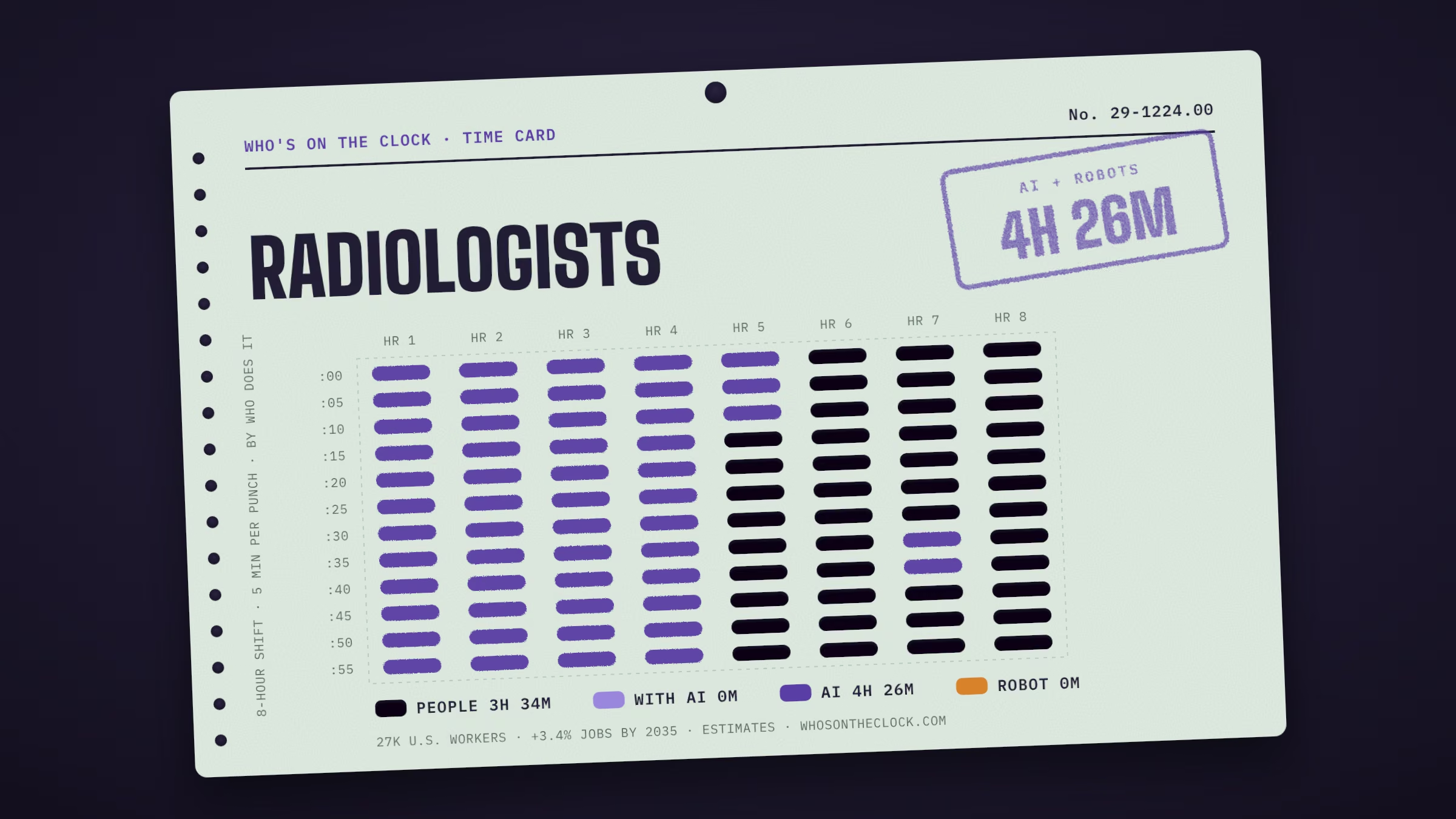
Diagnose and treat diseases and injuries using medical imaging techniques, such as x rays, magnetic resonance imaging (MRI), nuclear medicine, and ultrasounds. May perform minimally invasive medical procedures and tests.
Time card
Untick tasks you don't do, or set your own times.
| Mine | Task, by time spent | Human | With AI | AI | Robot |
|---|---|---|---|---|---|
Perform or interpret the outcomes of diagnostic imaging procedures including magnetic resonance imaging (MRI), computer tomography (CT), positron emission tomography (PET), nuclear cardiology treadmill studies, mammography, or ultrasound.2h 32m a shift · Observed in AI useTypical AI request: about 2h 20m alone, 32m with AIWhy this label?Marked AI because this task shows up regularly in real AI conversations (Anthropic Economic Index, 2025 usage), and in most of them AI does the task on its own rather than helping a person. Many workplaces may not use AI for it at all. How labels work | |||||
Prepare comprehensive interpretive reports of findings.1h 45m a shift · Observed in AI useTypical AI request: about 6h 14m alone, 43m with AIWhy this label?Marked AI because this task shows up regularly in real AI conversations (Anthropic Economic Index, 2025 usage), and in most of them AI does the task on its own rather than helping a person. Many workplaces may not use AI for it at all. How labels work | |||||
Communicate examination results or diagnostic information to referring physicians, patients, or families.29m a shift · No AI or robot evidence foundWhy this label?No AI use or robot deployment showed up for this task in our data. That isn't proof it's safe; it may just be rare in the data. How labels work | |||||
Obtain patients' histories from electronic records, patient interviews, dictated reports, or by communicating with referring clinicians.24m a shift · No AI or robot evidence foundWhy this label?No AI use or robot deployment showed up for this task in our data. That isn't proof it's safe; it may just be rare in the data. How labels work | |||||
Confer with medical professionals regarding image-based diagnoses.24m a shift · No AI or robot evidence foundWhy this label?No AI use or robot deployment showed up for this task in our data. That isn't proof it's safe; it may just be rare in the data. How labels work | |||||
Perform interventional procedures such as image-guided biopsy, percutaneous transluminal angioplasty, transhepatic biliary drainage, or nephrostomy catheter placement.24m a shift · No AI or robot evidence foundWhy this label?This is physical work, and no robot has been shown doing it yet. How labels work | |||||
Review or transmit images and information using picture archiving or communications systems.14m a shift · No AI or robot evidence foundWhy this label?No AI use or robot deployment showed up for this task in our data. That isn't proof it's safe; it may just be rare in the data. How labels work | |||||
Participate in continuing education activities to maintain and develop expertise.14m a shift · No AI or robot evidence foundWhy this label?No AI use or robot deployment showed up for this task in our data. That isn't proof it's safe; it may just be rare in the data. How labels work | |||||
Review procedure requests and patients' medical histories to determine applicability of procedures and radioisotopes to be used.14m a shift · No AI or robot evidence foundWhy this label?No AI use or robot deployment showed up for this task in our data. That isn't proof it's safe; it may just be rare in the data. How labels work | |||||
Document the performance, interpretation, or outcomes of all procedures performed.10m a shift · Observed in AI useWhy this label?Marked AI because this task shows up regularly in real AI conversations (Anthropic Economic Index, 2025 usage), and in most of them AI does the task on its own rather than helping a person. Many workplaces may not use AI for it at all. How labels work | |||||
Instruct radiologic staff in desired techniques, positions, or projections.10m a shift · No AI or robot evidence foundWhy this label?No AI use or robot deployment showed up for this task in our data. That isn't proof it's safe; it may just be rare in the data. How labels work | |||||
Participate in quality improvement activities including discussions of areas where risk of error is high.10m a shift · No AI or robot evidence foundWhy this label?No AI use or robot deployment showed up for this task in our data. That isn't proof it's safe; it may just be rare in the data. How labels work | |||||
Teach nuclear medicine, diagnostic radiology, or other specialties at graduate educational level.10m a shift · No AI or robot evidence foundWhy this label?No AI use or robot deployment showed up for this task in our data. That isn't proof it's safe; it may just be rare in the data. How labels work | |||||
Recognize or treat complications during and after procedures, including blood pressure problems, pain, oversedation, or bleeding.5m a shift · No AI or robot evidence foundWhy this label?This is physical work, and no robot has been shown doing it yet. How labels work | |||||
Develop or monitor procedures to ensure adequate quality control of images.5m a shift · No AI or robot evidence foundWhy this label?No AI use or robot deployment showed up for this task in our data. That isn't proof it's safe; it may just be rare in the data. How labels work | |||||
Provide counseling to radiologic patients to explain the processes, risks, benefits, or alternative treatments.5m a shift · No AI or robot evidence foundWhy this label?No AI use or robot deployment showed up for this task in our data. That isn't proof it's safe; it may just be rare in the data. How labels work | |||||
Establish or enforce standards for protection of patients or personnel.5m a shift · No AI or robot evidence foundWhy this label?No AI use or robot deployment showed up for this task in our data. That isn't proof it's safe; it may just be rare in the data. How labels work | |||||
Coordinate radiological services with other medical activities.5m a shift · No AI or robot evidence foundWhy this label?No AI use or robot deployment showed up for this task in our data. That isn't proof it's safe; it may just be rare in the data. How labels work | |||||
Develop treatment plans for radiology patients.5m a shift · No AI or robot evidence foundWhy this label?No AI use or robot deployment showed up for this task in our data. That isn't proof it's safe; it may just be rare in the data. How labels work | |||||
Check and approve the quality of diagnostic images before patients are discharged.5m a shift · No AI or robot evidence foundWhy this label?No AI use or robot deployment showed up for this task in our data. That isn't proof it's safe; it may just be rare in the data. How labels work | |||||
Direct nuclear medicine technologists or technicians regarding desired dosages, techniques, positions, and projections.5m a shift · No AI or robot evidence foundWhy this label?No AI use or robot deployment showed up for this task in our data. That isn't proof it's safe; it may just be rare in the data. How labels work | |||||
Prescribe radionuclides and dosages to be administered to individual patients.5m a shift · No AI or robot evidence foundWhy this label?No AI use or robot deployment showed up for this task in our data. That isn't proof it's safe; it may just be rare in the data. How labels work | |||||
Administer radioisotopes to clinical patients or research subjects.time not estimated · Robots deployed · e.g. MEDRAD Intego PET Infusion SystemWhy this label?Marked Robot because MEDRAD Intego PET Infusion System (in real use) has done this task in a real workplace. It shows a robot can do it somewhere, not that most radiologists work alongside one. How labels work | |||||
Advise other physicians of the clinical indications, limitations, assessments, or risks of diagnostic and therapeutic applications of radioactive materials.time not estimated · No AI or robot evidence foundWhy this label?No AI use or robot deployment showed up for this task in our data. That isn't proof it's safe; it may just be rare in the data. How labels work | |||||
Calculate, measure, or prepare radioisotope dosages.time not estimated · No AI or robot evidence foundWhy this label?No AI use or robot deployment showed up for this task in our data. That isn't proof it's safe; it may just be rare in the data. How labels work | |||||
Compare nuclear medicine procedures with other types of procedures, such as computed tomography, ultrasonography, nuclear magnetic resonance imaging, and angiography.time not estimated · No AI or robot evidence foundWhy this label?No AI use or robot deployment showed up for this task in our data. That isn't proof it's safe; it may just be rare in the data. How labels work | |||||
Establish and enforce radiation protection standards for patients and staff.time not estimated · No AI or robot evidence foundWhy this label?No AI use or robot deployment showed up for this task in our data. That isn't proof it's safe; it may just be rare in the data. How labels work | |||||
Formulate plans and procedures for nuclear medicine departments.time not estimated · No AI or robot evidence foundWhy this label?No AI use or robot deployment showed up for this task in our data. That isn't proof it's safe; it may just be rare in the data. How labels work | |||||
Monitor handling of radioactive materials to ensure that established procedures are followed.time not estimated · No AI or robot evidence foundWhy this label?No AI use or robot deployment showed up for this task in our data. That isn't proof it's safe; it may just be rare in the data. How labels work | |||||
Test dosage evaluation instruments and survey meters to ensure they are operating properly.time not estimated · Robots only in factory cellsWhy this label?Robots have done this only in factory setups built around the machine, so it stays Human for radiologists. How labels work |