Will AI replace mining and geological engineers, including mining safety engineers?

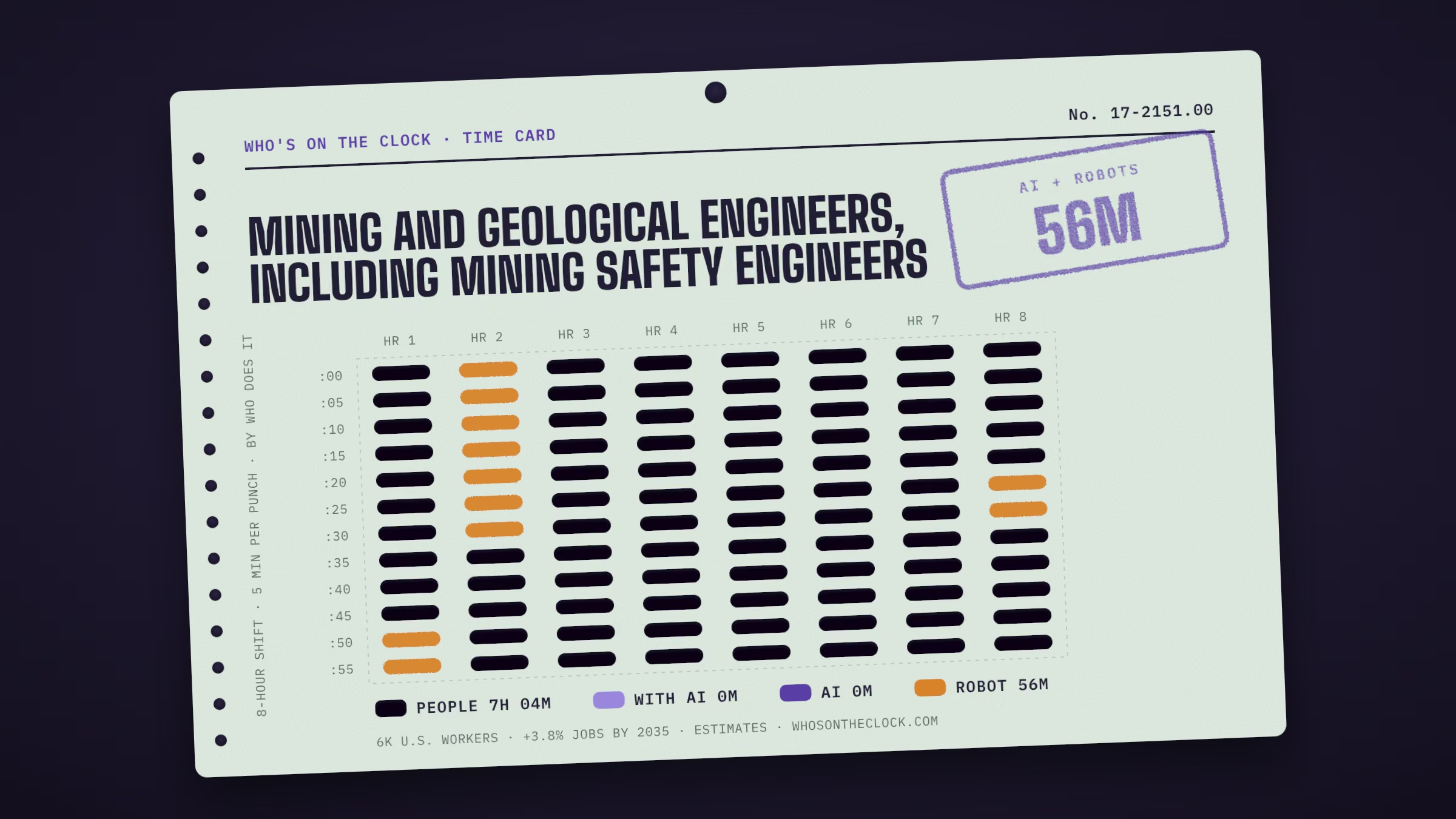
The biggest change here is physical: systems like ExynAero / Exyn autonomous UAV have done tasks such as “Inspect mining areas for unsafe structures, equipment” in real workplaces, about 56m of a typical shift. Most of the rest, 7h 4m, has no AI or robot evidence. BLS expects about 3.8% more of these jobs by 2035.

Time card for mining and geological engineers, including mining safety engineers showing a typical 8-hour shift: 7h 4m done by people, 56m by robots.
Each mark is 5 minutes of a typical shift for mining and geological engineers, including mining safety engineers, colored by who does that task today. Estimates from O*NET tasks and Anthropic Economic Index data. How it's made

Home / Engineering & architecture / Mining and Geological Engineers, Including Mining Safety Engineers

Conduct subsurface surveys to identify the characteristics of potential land or mining development sites. May specify the ground support systems, processes, and equipment for safe, economical, and environmentally sound extraction or underground construction activities. May inspect areas for unsafe geological conditions, equipment, and working conditions. May design, implement, and coordinate mine safety programs.

Time card

Untick tasks you don't do, or set your own times.
MineTask, by time spentHumanWith AIAIRobot
Prepare technical reports for use by mining, engineering, and management personnel.51m a shift · No AI or robot evidence found
Why this label?No AI use or robot deployment showed up for this task in our data. That isn't proof it's safe; it may just be rare in the data. How labels work
Inspect mining areas for unsafe structures, equipment, and working conditions.45m a shift · Robots deployed · e.g. ExynAero / Exyn autonomous UAV
Why this label?Marked Robot because ExynAero / Exyn autonomous UAV (in real use) has done this task in a real workplace. It shows a robot can do it somewhere, not that most mining and geological engineers, including mining safety engineers work alongside one. How labels work
Supervise, train, and evaluate technicians, technologists, survey personnel, engineers, scientists or other mine personnel.45m a shift · No AI or robot evidence found
Why this label?No AI use or robot deployment showed up for this task in our data. That isn't proof it's safe; it may just be rare in the data. How labels work
Prepare schedules, reports, and estimates of the costs involved in developing and operating mines.40m a shift · No AI or robot evidence found
Why this label?No AI use or robot deployment showed up for this task in our data. That isn't proof it's safe; it may just be rare in the data. How labels work
Examine maps, deposits, drilling locations, or mines to determine the location, size, accessibility, contents, value, and potential profitability of mineral, oil, and gas deposits.40m a shift · No AI or robot evidence found
Why this label?No AI use or robot deployment showed up for this task in our data. That isn't proof it's safe; it may just be rare in the data. How labels work
Design, implement, and monitor the development of mines, facilities, systems, or equipment.40m a shift · No AI or robot evidence found
Why this label?No AI use or robot deployment showed up for this task in our data. That isn't proof it's safe; it may just be rare in the data. How labels work
Select or develop mineral location, extraction, and production methods, based on factors such as safety, cost, and deposit characteristics.34m a shift · No AI or robot evidence found
Why this label?No AI use or robot deployment showed up for this task in our data. That isn't proof it's safe; it may just be rare in the data. How labels work
Select locations and plan underground or surface mining operations, specifying processes, labor usage, and equipment that will result in safe, economical, and environmentally sound extraction of minerals and ores.34m a shift · No AI or robot evidence found
Why this label?No AI use or robot deployment showed up for this task in our data. That isn't proof it's safe; it may just be rare in the data. How labels work
Monitor mine production rates to assess operational effectiveness.34m a shift · No AI or robot evidence found
Why this label?No AI use or robot deployment showed up for this task in our data. That isn't proof it's safe; it may just be rare in the data. How labels work
Implement and coordinate mine safety programs, including the design and maintenance of protective and rescue equipment and safety devices.28m a shift · No AI or robot evidence found
Why this label?No AI use or robot deployment showed up for this task in our data. That isn't proof it's safe; it may just be rare in the data. How labels work
Devise solutions to problems of land reclamation and water and air pollution, such as methods of storing excavated soil and returning exhausted mine sites to natural states.17m a shift · No AI or robot evidence found
Why this label?No AI use or robot deployment showed up for this task in our data. That isn't proof it's safe; it may just be rare in the data. How labels work
Lay out, direct, and supervise mine construction operations, such as the construction of shafts and tunnels.17m a shift · No AI or robot evidence found
Why this label?No AI use or robot deployment showed up for this task in our data. That isn't proof it's safe; it may just be rare in the data. How labels work
Design, develop, and implement computer applications for use in mining operations such as mine design, modeling, or mapping or for monitoring mine conditions.17m a shift · No AI or robot evidence found
Why this label?No AI use or robot deployment showed up for this task in our data. That isn't proof it's safe; it may just be rare in the data. How labels work
Test air to detect toxic gases and recommend measures to remove them, such as installation of ventilation shafts.11m a shift · Robots deployed · e.g. Spot with Teledyne FLIR MUVE C360 gas monitor
Why this label?Marked Robot because Spot with Teledyne FLIR MUVE C360 gas monitor (in real use) has done this task in a real workplace. It shows a robot can do it somewhere, not that most mining and geological engineers, including mining safety engineers work alongside one. How labels work
Select or devise materials-handling methods and equipment to transport ore, waste materials, and mineral products efficiently and economically.11m a shift · No AI or robot evidence found
Why this label?No AI use or robot deployment showed up for this task in our data. That isn't proof it's safe; it may just be rare in the data. How labels work
Evaluate data to develop new mining products, equipment, or processes.6m a shift · No AI or robot evidence found
Why this label?No AI use or robot deployment showed up for this task in our data. That isn't proof it's safe; it may just be rare in the data. How labels work
Design mining and mineral treatment equipment and machinery in collaboration with other engineering specialists.6m a shift · No AI or robot evidence found
Why this label?No AI use or robot deployment showed up for this task in our data. That isn't proof it's safe; it may just be rare in the data. How labels work
Conduct or direct mining experiments to test or prove research findings.6m a shift · No AI or robot evidence found
Why this label?No AI use or robot deployment showed up for this task in our data. That isn't proof it's safe; it may just be rare in the data. How labels work

Clock history

  1. 56m touchedFirst published: O*NET 30.1, Anthropic Economic Index (2025 usage and September 2026 robot study), BLS May 2025

When new data changes this clock, the date, the new numbers and the reason are logged here. Company news alone never moves the clock.

On the floor

No company news tracked for this job yet. New stories are added as they happen.

Ask the clock

Will AI replace mining and geological engineers, including mining safety engineers?

Unlikely, though parts of the work are changing. About 56m of an 8-hour shift goes to tasks touched by robots. The other 7h 4m (88%) stays with people. Separately, BLS expects about 3.8% more of these jobs by 2035 (all jobs: +3.5%).

What can AI already do for mining and geological engineers, including mining safety engineers?

None of this job's tasks show regular AI use yet. That can mean the work is hands-on or in person, or simply that it rarely comes up in AI usage data.

Where do robots fit in?

For some tasks, yes. Robots have done 2 of this job's tasks in workplaces like this one, about 56m of a typical shift.

  • Inspect mining areas for unsafe structures, equipment, and working conditions. (45m a shift; e.g. ExynAero / Exyn autonomous UAV, in use)
  • Test air to detect toxic gases and recommend measures to remove them, such as installation of ventilation shafts. (11m a shift; e.g. Spot with Teledyne FLIR MUVE C360 gas monitor, in use)
What still needs a person?

7h 4m of a typical shift, or 88%, goes to tasks with no AI or robot evidence yet. No AI usage or robot deployment has shown up for these so far. The biggest:

  • Prepare technical reports for use by mining, engineering, and management personnel. (51m a shift)
  • Supervise, train, and evaluate technicians, technologists, survey personnel, engineers, scientists or other mine personnel. (45m a shift)
  • Prepare schedules, reports, and estimates of the costs involved in developing and operating mines. (40m a shift)
  • Examine maps, deposits, drilling locations, or mines to determine the location, size, accessibility, contents, value, and potential profitability of mineral, oil, and gas deposits. (40m a shift)
  • Design, implement, and monitor the development of mines, facilities, systems, or equipment. (40m a shift)
Why is that work hard to automate?

Much of it comes down to where and how the work happens. In-person, hands-on and high-stakes work is where AI and robots have made the least headway so far. In the official O*NET survey of people in this job:

  • 79% talk face to face with others every day
Are employers still hiring mining and geological engineers, including mining safety engineers?

On Indeed, job postings in the Mechanical Engineering sector are at 168% of their February 2020 level (all U.S. postings: 104%), up 43.4% from a year earlier, as of Oct 9, 2026. BLS separately expects about 300 openings a year in this job through 2035. Across all U.S. postings, 7.3% now mention AI skills. Sector postings cover more than this one job and move for many reasons besides AI.

How much do mining and geological engineers, including mining safety engineers make?

The median pay is about $106,220 a year ($51.07 an hour), 108% above the median for all U.S. jobs ($50,980). Most people in this job earn between $67,490 and $169,990 a year; that range covers the middle 80%. Pay figures are from BLS, May 2025, and vary a lot by state and employer. Pick a state to compare:

Is this job growing or shrinking?

BLS projects growth of 3.8% from 2025 to 2035, compared with 3.5% growth for all jobs. That's about 6,400 jobs in 2035. It expects about 300 openings a year, mostly from people retiring or changing careers. These projections don't single out AI as a cause.

How many mining and geological engineers, including mining safety engineers are there in the U.S.?

About 6,080 people in the U.S., roughly 0.00% of all workers (BLS, May 2025). That makes it the 713th largest of the 796 jobs on this site. BLS expects about 6,400 in 2035.

What training do mining and geological engineers, including mining safety engineers need?

The most common requirement is a bachelor's degree: about 79% of people in the job said so in the official O*NET survey. O*NET rates the job at level 4 of 5 for preparation, which usually means: bachelor's degree. Requirements vary by state and employer, especially for licensed work.

What should I learn to stay ahead of AI?

These come from the job's official skill ratings and from the tasks that AI and robots touch least today. Building them keeps you strong in the parts of the work that still need a person:

  • Skills that matter more here than in most jobs: Management of Material Resources, Mathematics, Systems Evaluation, Systems Analysis
  • Get strong at the parts of the job that stay with people (listed above), which take 7h 4m of a typical shift
  • Tools employers list: Microsoft PowerPoint, Microsoft Office software, Microsoft Excel, Autodesk AutoCAD Civil 3D, Autodesk AutoCAD
What new tasks are mining and geological engineers, including mining safety engineers taking on?

Yes. Occupational experts recently added these to the official task list, a sign of how the work itself is shifting. New tasks aren't rated for AI or robots yet:

  • Use drone technology for aerial surveys and inspections of mining sites to enhance safety and efficiency.
What other jobs could mining and geological engineers, including mining safety engineers move into?

These use similar skills, with less of a typical shift touched by AI or robots. Matches come from 109 official ratings of skills, knowledge and work activities, and each needs the same or less preparation unless the official list relates the jobs directly:

  • Water/Wastewater Engineers (0m touched, $101k median pay)
  • Transportation Engineers (7m touched, $101k median pay)
  • Nuclear Engineers (0m touched, $134k median pay)
  • Fire-Prevention and Protection Engineers (0m touched, $115k median pay)
  • Chemical Engineers (0m touched, $125k median pay)
How solid are these numbers?

Each task carries its own evidence label. For this job: 2 with robots in real deployments, 16 with no AI or robot evidence found. The minutes per task are estimates, not measured hours, and "no evidence" doesn't prove a task is safe.

Tools in demand

  • Autodesk AutoCAD Civil 3D
  • Autodesk AutoCAD
  • Bentley MicroStation
  • Microsoft Access

Plus everyday office tools: Microsoft PowerPoint, Microsoft Office software, Microsoft Excel, Microsoft Outlook.

Also called

Coal Mine Inspector, Engineer, Exploration Engineer, Field Engineer, Geological Engineer, Geophysical Engineer, Geotechnical Engineer, Geotechnical Project Engineer, Metal Mine Inspector, Mine Analyst, Mine Development Engineer, Mine Engineer, Mine Environmental Engineer, Mine Expert