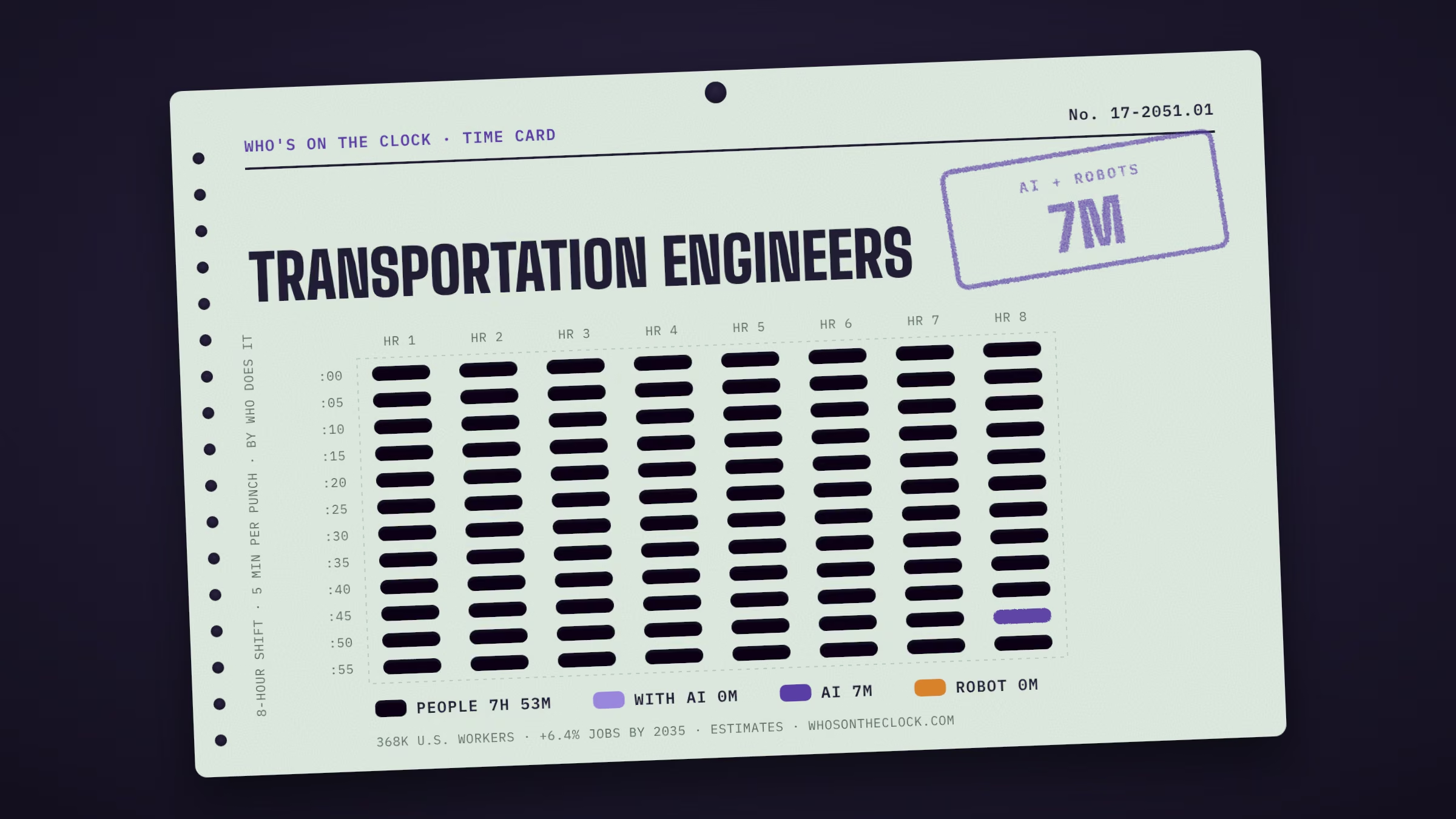
Develop plans for surface transportation projects, according to established engineering standards and state or federal construction policy. Prepare designs, specifications, or estimates for transportation facilities. Plan modifications of existing streets, highways, or freeways to improve traffic flow.
Time card
Untick tasks you don't do, or set your own times.
| Mine | Task, by time spent | Human | With AI | AI | Robot |
|---|---|---|---|---|---|
Design or prepare plans for new transportation systems or parts of systems, such as airports, commuter trains, highways, streets, bridges, drainage structures, or roadway lighting.1h 28m a shift · No AI or robot evidence foundWhy this label?No AI use or robot deployment showed up for this task in our data. That isn't proof it's safe; it may just be rare in the data. How labels work | |||||
Check construction plans, design calculations, or cost estimations to ensure completeness, accuracy, or conformity to engineering standards or practices.51m a shift · No AI or robot evidence foundWhy this label?No AI use or robot deployment showed up for this task in our data. That isn't proof it's safe; it may just be rare in the data. How labels work | |||||
Plan alteration or modification of existing transportation structures to improve safety or function.38m a shift · No AI or robot evidence foundWhy this label?No AI use or robot deployment showed up for this task in our data. That isn't proof it's safe; it may just be rare in the data. How labels work | |||||
Confer with contractors, utility companies, or government agencies to discuss plans, specifications, or work schedules.38m a shift · No AI or robot evidence foundWhy this label?No AI use or robot deployment showed up for this task in our data. That isn't proof it's safe; it may just be rare in the data. How labels work | |||||
Investigate traffic problems and recommend methods to improve traffic flow or safety.32m a shift · No AI or robot evidence foundWhy this label?No AI use or robot deployment showed up for this task in our data. That isn't proof it's safe; it may just be rare in the data. How labels work | |||||
Prepare administrative, technical, or statistical reports on traffic-operation matters, such as accidents, safety measures, or pedestrian volume or practices.25m a shift · No AI or robot evidence foundWhy this label?No AI use or robot deployment showed up for this task in our data. That isn't proof it's safe; it may just be rare in the data. How labels work | |||||
Prepare final project layout drawings that include details such as stress calculations.25m a shift · No AI or robot evidence foundWhy this label?No AI use or robot deployment showed up for this task in our data. That isn't proof it's safe; it may just be rare in the data. How labels work | |||||
Estimate transportation project costs.19m a shift · No AI or robot evidence foundWhy this label?No AI use or robot deployment showed up for this task in our data. That isn't proof it's safe; it may just be rare in the data. How labels work | |||||
Prepare project budgets, schedules, or specifications for labor or materials.19m a shift · No AI or robot evidence foundWhy this label?No AI use or robot deployment showed up for this task in our data. That isn't proof it's safe; it may just be rare in the data. How labels work | |||||
Review development plans to determine potential traffic impact.19m a shift · No AI or robot evidence foundWhy this label?No AI use or robot deployment showed up for this task in our data. That isn't proof it's safe; it may just be rare in the data. How labels work | |||||
Model transportation scenarios to evaluate the impacts of activities such as new development or to identify possible solutions to transportation problems.19m a shift · No AI or robot evidence foundWhy this label?No AI use or robot deployment showed up for this task in our data. That isn't proof it's safe; it may just be rare in the data. How labels work | |||||
Design or engineer drainage, erosion, or sedimentation control systems for transportation projects.13m a shift · No AI or robot evidence foundWhy this label?No AI use or robot deployment showed up for this task in our data. That isn't proof it's safe; it may just be rare in the data. How labels work | |||||
Evaluate traffic control devices or lighting systems to determine need for modification or expansion.13m a shift · No AI or robot evidence foundWhy this label?No AI use or robot deployment showed up for this task in our data. That isn't proof it's safe; it may just be rare in the data. How labels work | |||||
Inspect completed transportation projects to ensure safety or compliance with applicable standards or regulations.13m a shift · No AI or robot evidence foundWhy this label?This is physical work, and no robot has been shown doing it yet. How labels work | |||||
Participate in contract bidding, negotiation, or administration.13m a shift · No AI or robot evidence foundWhy this label?No AI use or robot deployment showed up for this task in our data. That isn't proof it's safe; it may just be rare in the data. How labels work | |||||
Present data, maps, or other information at construction-related public hearings or meetings.6m a shift · No AI or robot evidence foundWhy this label?No AI use or robot deployment showed up for this task in our data. That isn't proof it's safe; it may just be rare in the data. How labels work | |||||
Evaluate transportation systems or traffic control devices or lighting systems to determine need for modification or expansion.6m a shift · No AI or robot evidence foundWhy this label?No AI use or robot deployment showed up for this task in our data. That isn't proof it's safe; it may just be rare in the data. How labels work | |||||
Analyze environmental impact statements for transportation projects.6m a shift · No AI or robot evidence foundWhy this label?No AI use or robot deployment showed up for this task in our data. That isn't proof it's safe; it may just be rare in the data. How labels work | |||||
Supervise the maintenance or repair of transportation systems or system components.6m a shift · No AI or robot evidence foundWhy this label?No AI use or robot deployment showed up for this task in our data. That isn't proof it's safe; it may just be rare in the data. How labels work | |||||
Inspect completed transportation projects to ensure compliance with environmental regulations.6m a shift · No AI or robot evidence foundWhy this label?This is physical work, and no robot has been shown doing it yet. How labels work | |||||
Direct the surveying, staking, or laying-out of construction projects.6m a shift · No AI or robot evidence foundWhy this label?No AI use or robot deployment showed up for this task in our data. That isn't proof it's safe; it may just be rare in the data. How labels work | |||||
Design transportation systems or structures with sustainable materials or products, such as porous pavement or bioretention structures.6m a shift · No AI or robot evidence foundWhy this label?No AI use or robot deployment showed up for this task in our data. That isn't proof it's safe; it may just be rare in the data. How labels work | |||||
Investigate or test specific construction project materials to determine compliance to specifications or standards.6m a shift · Observed in AI useWhy this label?Marked AI because this task shows up regularly in real AI conversations (Anthropic Economic Index, 2025 usage), and in most of them AI does the task on its own rather than helping a person. Many workplaces may not use AI for it at all. How labels work | |||||
Develop or assist in the development of transportation-related computer software or computer processes.6m a shift · No AI or robot evidence foundWhy this label?No AI use or robot deployment showed up for this task in our data. That isn't proof it's safe; it may just be rare in the data. How labels work | |||||
Evaluate construction project materials for compliance with environmental standards.time not estimated · Observed in AI useWhy this label?Marked With AI because people regularly use AI to help with this task in real conversations (Anthropic Economic Index, 2025 usage), but AI doesn't usually finish it alone. How labels work | |||||
Develop plans to deconstruct damaged or obsolete roadways or other transportation structures in a manner that is environmentally sound or prepares the land for sustainable development.time not estimated · No AI or robot evidence foundWhy this label?No AI use or robot deployment showed up for this task in our data. That isn't proof it's safe; it may just be rare in the data. How labels work |