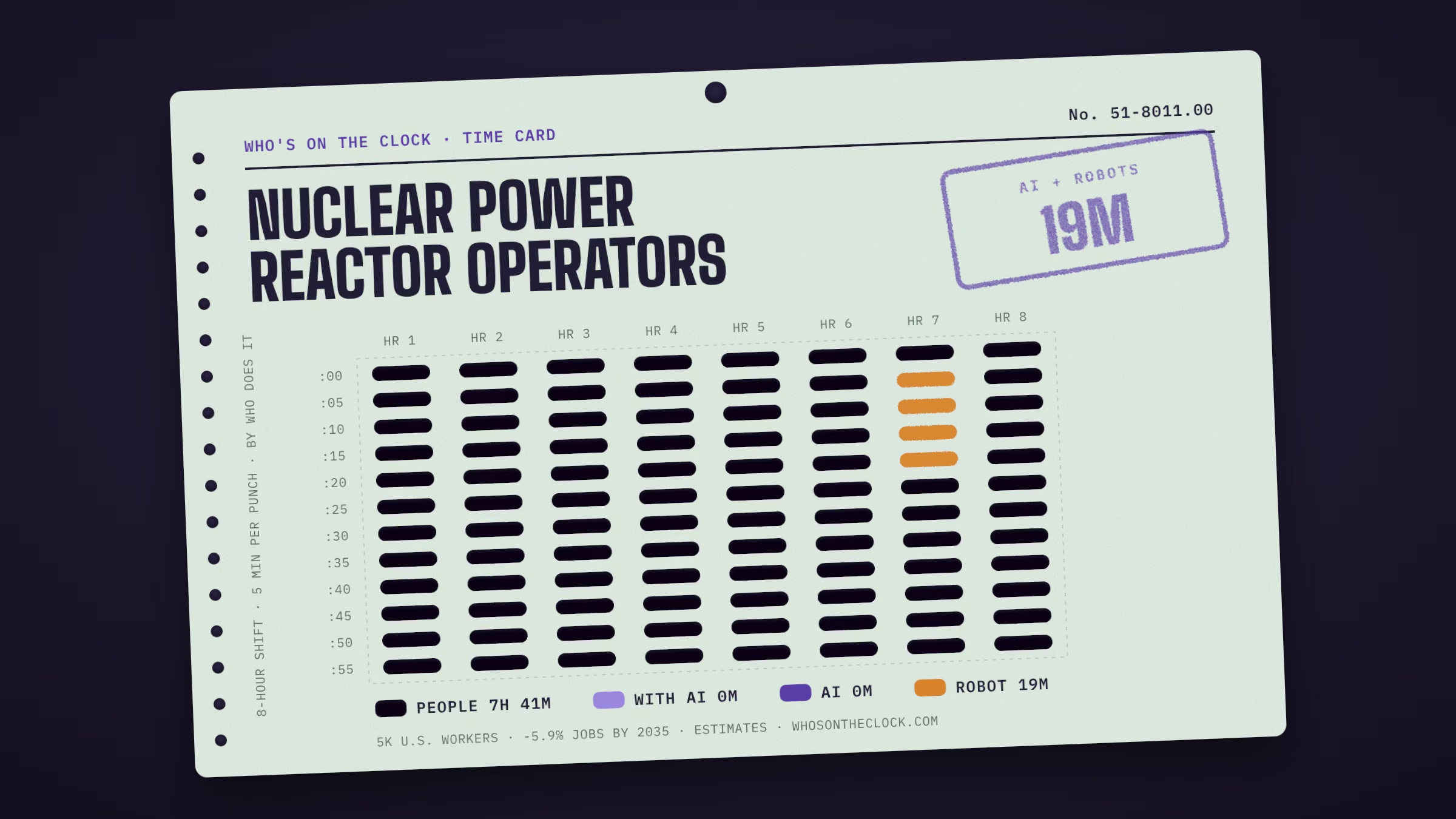
Operate or control nuclear reactors. Move control rods, start and stop equipment, monitor and adjust controls, and record data in logs. Implement emergency procedures when needed. May respond to abnormalities, determine cause, and recommend corrective action.
Time card
Untick tasks you don't do, or set your own times.
| Mine | Task, by time spent | Human | With AI | AI | Robot |
|---|---|---|---|---|---|
Monitor all systems for normal running conditions, performing activities such as checking gauges to assess output or the effects of generator loading on other equipment.1h 38m a shift · No AI or robot evidence foundWhy this label?No AI use or robot deployment showed up for this task in our data. That isn't proof it's safe; it may just be rare in the data. How labels work | |||||
Operate nuclear power reactors in accordance with policies and procedures to protect workers from radiation and to ensure environmental safety.1h 2m a shift · No AI or robot evidence foundWhy this label?This is physical work, and no robot has been shown doing it yet. How labels work | |||||
Record operating data, such as the results of surveillance tests.49m a shift · No AI or robot evidence foundWhy this label?No AI use or robot deployment showed up for this task in our data. That isn't proof it's safe; it may just be rare in the data. How labels work | |||||
Monitor or operate boilers, turbines, wells, or auxiliary power plant equipment.37m a shift · Robots only in factory cellsWhy this label?Robots have done this only in factory setups built around the machine, so it stays Human for nuclear power reactor operators. How labels work | |||||
Adjust controls to position rod and to regulate flux level, reactor period, coolant temperature, or rate of power flow, following standard procedures.25m a shift · Robots only in factory cellsWhy this label?Robots have done this only in factory setups built around the machine, so it stays Human for nuclear power reactor operators. How labels work | |||||
Develop or implement actions such as lockouts, tagouts, or clearances to allow equipment to be safely repaired.25m a shift · No AI or robot evidence foundWhy this label?No AI use or robot deployment showed up for this task in our data. That isn't proof it's safe; it may just be rare in the data. How labels work | |||||
Respond to system or unit abnormalities, diagnosing the cause, and recommending or taking corrective action.25m a shift · No AI or robot evidence foundWhy this label?No AI use or robot deployment showed up for this task in our data. That isn't proof it's safe; it may just be rare in the data. How labels work | |||||
Dispatch orders or instructions to personnel through radiotelephone or intercommunication systems to coordinate auxiliary equipment operation.25m a shift · No AI or robot evidence foundWhy this label?No AI use or robot deployment showed up for this task in our data. That isn't proof it's safe; it may just be rare in the data. How labels work | |||||
Implement operational procedures, such as those controlling start-up or shut-down activities.18m a shift · Robots only in factory cellsWhy this label?Robots have done this only in factory setups built around the machine, so it stays Human for nuclear power reactor operators. How labels work | |||||
Conduct inspections or operations outside of control rooms as necessary.18m a shift · Robots deployed · e.g. ANYmal X (ANYbotics)Why this label?Marked Robot because ANYmal X (ANYbotics) (in real use) has done this task in a real workplace. It shows a robot can do it somewhere, not that most nuclear power reactor operators work alongside one. How labels work | |||||
Authorize maintenance activities on units or changes in equipment or system operational status.18m a shift · No AI or robot evidence foundWhy this label?No AI use or robot deployment showed up for this task in our data. That isn't proof it's safe; it may just be rare in the data. How labels work | |||||
Supervise technicians' work activities to ensure that equipment is operated in accordance with policies and procedures that protect workers from radiation and ensure environmental safety.18m a shift · No AI or robot evidence foundWhy this label?No AI use or robot deployment showed up for this task in our data. That isn't proof it's safe; it may just be rare in the data. How labels work | |||||
Note malfunctions of equipment, instruments, or controls and report these conditions to supervisors.12m a shift · No AI or robot evidence foundWhy this label?No AI use or robot deployment showed up for this task in our data. That isn't proof it's safe; it may just be rare in the data. How labels work | |||||
Review and edit standard operating procedures.12m a shift · No AI or robot evidence foundWhy this label?No AI use or robot deployment showed up for this task in our data. That isn't proof it's safe; it may just be rare in the data. How labels work | |||||
Authorize actions to correct identified operational inefficiencies or hazards so that operating efficiency is maximized and potential environmental issues are minimized.12m a shift · No AI or robot evidence foundWhy this label?No AI use or robot deployment showed up for this task in our data. That isn't proof it's safe; it may just be rare in the data. How labels work | |||||
Participate in nuclear fuel element handling activities, such as preparation, transfer, loading, or unloading.6m a shift · Robots only in factory cellsWhy this label?Robots have done this only in factory setups built around the machine, so it stays Human for nuclear power reactor operators. How labels work | |||||
Direct reactor operators in emergency situations, in accordance with emergency operating procedures.6m a shift · No AI or robot evidence foundWhy this label?No AI use or robot deployment showed up for this task in our data. That isn't proof it's safe; it may just be rare in the data. How labels work | |||||
Direct the collection and testing of air, water, gas, or solid samples to determine radioactivity levels or to ensure appropriate radioactive containment.6m a shift · No AI or robot evidence foundWhy this label?No AI use or robot deployment showed up for this task in our data. That isn't proof it's safe; it may just be rare in the data. How labels work | |||||
Direct measurement of the intensity or types of radiation in work areas, equipment, or materials.6m a shift · No AI or robot evidence foundWhy this label?No AI use or robot deployment showed up for this task in our data. That isn't proof it's safe; it may just be rare in the data. How labels work |