Will AI replace nuclear monitoring technicians?

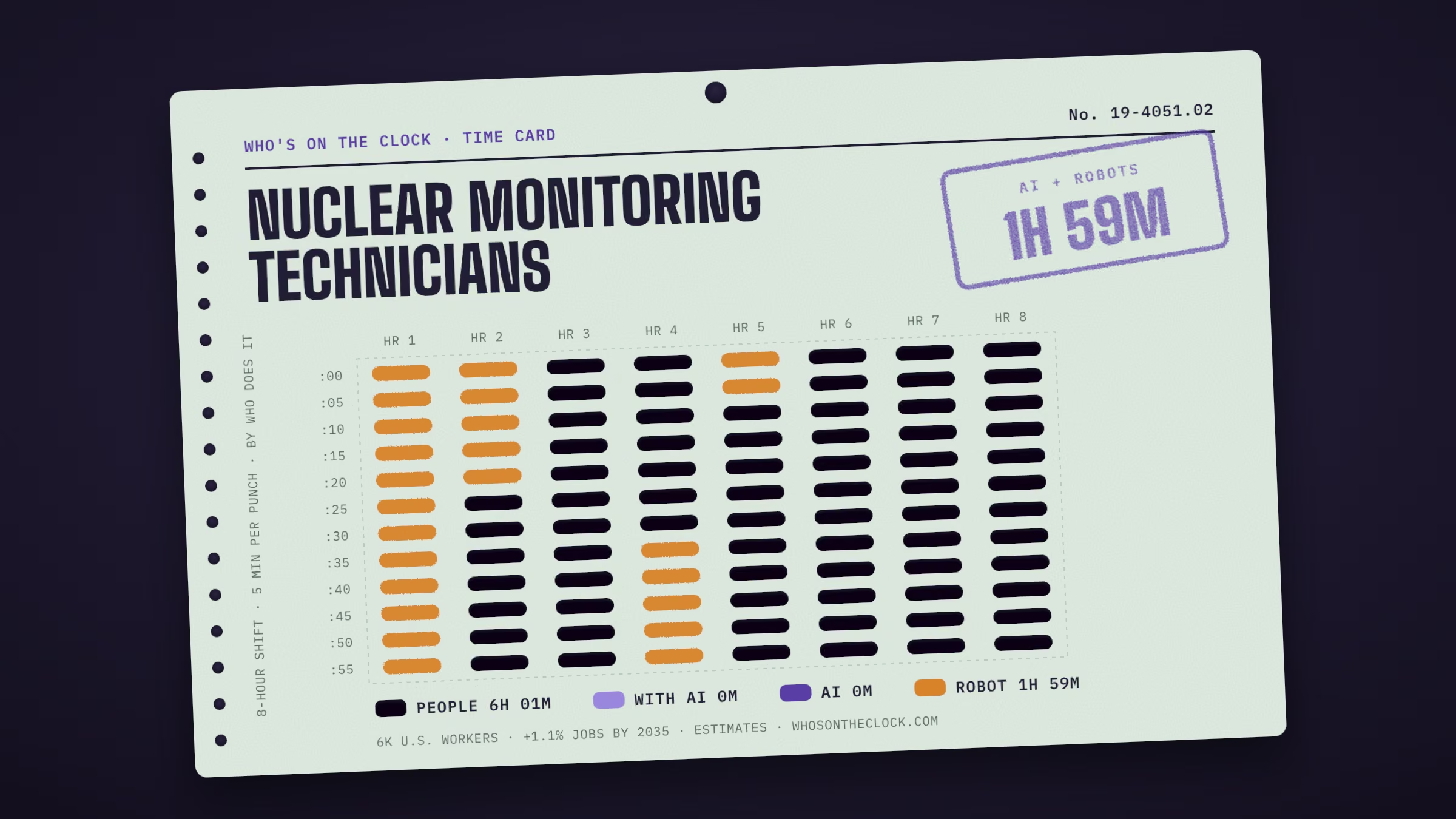
Not replace, but it is changing the job. About 1h 59m of an 8-hour shift goes to tasks touched by robots. The other 6h 1m (75%) stays with people. Separately, BLS expects about 1.1% more of these jobs by 2035 (all jobs: +3.5%).

Time card for nuclear monitoring technicians showing a typical 8-hour shift: 6h 1m done by people, 1h 59m by robots.
Each mark is 5 minutes of a typical shift for nuclear monitoring technicians, colored by who does that task today. Estimates from O*NET tasks and Anthropic Economic Index data. How it's made

Home / Science / Nuclear Monitoring Technicians

Collect and test samples to monitor results of nuclear experiments and contamination of humans, facilities, and environment.

Time card

Untick tasks you don't do, or set your own times.
MineTask, by time spentHumanWith AIAIRobot
Determine intensities and types of radiation in work areas, equipment, or materials, using radiation detectors or other instruments.1h 23m a shift · Robots deployed · e.g. Spot (with radiation detection payload)
Monitor personnel to determine the amounts and intensities of radiation exposure.59m a shift · Robots only in factory cells
Brief workers on radiation levels in work areas.36m a shift · No AI or robot evidence found
Collect samples of air, water, gases, or solids to determine radioactivity levels of contamination.36m a shift · Robots only in factory cells
Analyze samples, such as air or water samples, for contaminants or other elements.36m a shift · Robots deployed · e.g. Hidex 300 SL automatic TDCR liquid scintillation counter
Prepare reports describing contamination tests, material or equipment decontaminated, or methods used in decontamination processes.36m a shift · No AI or robot evidence found
Instruct personnel in radiation safety procedures and demonstrate use of protective clothing and equipment.30m a shift · No AI or robot evidence found
Enter data into computers to record characteristics of nuclear events or to locate coordinates of particles.30m a shift · No AI or robot evidence found
Calculate safe radiation exposure times for personnel using plant contamination readings and prescribed safe levels of radiation.24m a shift · No AI or robot evidence found
Set up equipment that automatically detects area radiation deviations and test detection equipment to ensure its accuracy.24m a shift · No AI or robot evidence found
Provide initial response to abnormal events or to alarms from radiation monitoring equipment.18m a shift · No AI or robot evidence found
Determine or recommend radioactive decontamination procedures, according to the size and nature of equipment and the degree of contamination.18m a shift · No AI or robot evidence found
Decontaminate objects by cleaning with soap or solvents or by abrading with wire brushes, buffing wheels, or sandblasting machines.18m a shift · Robots only in factory cells
Calibrate and maintain chemical instrumentation sensing elements and sampling system equipment, using calibration instruments and hand tools.18m a shift · Robots only in factory cells
Place radioactive waste, such as sweepings or broken sample bottles, into containers for shipping or disposal.12m a shift · Robots only in factory cells
Inform supervisors when individual exposures or area radiation levels approach maximum permissible limits.6m a shift · No AI or robot evidence found

On the floor

No company news tracked for this job yet. New stories are added as they happen.

Ask the clock

Will AI replace nuclear monitoring technicians?

Not replace, but it is changing the job. About 1h 59m of an 8-hour shift goes to tasks touched by robots. The other 6h 1m (75%) stays with people. Separately, BLS expects about 1.1% more of these jobs by 2035 (all jobs: +3.5%).

What parts of the job can AI already do?

None of this job's tasks show regular AI use yet. That can mean the work is hands-on or in person, or simply that it rarely comes up in AI usage data.

Where do robots fit in?

For some tasks, yes. Robots have done 2 of this job's tasks in workplaces like this one, about 1h 59m of a typical shift. 5 more tasks have only been done in factory setups built around the machine, so they stay with people here. For 2 physical tasks, no robot has shown it can do the work yet.

  • Determine intensities and types of radiation in work areas, equipment, or materials, using radiation detectors or other instruments. (1h 23m a shift; e.g. Spot (with radiation detection payload), in use)
  • Analyze samples, such as air or water samples, for contaminants or other elements. (36m a shift; e.g. Hidex 300 SL automatic TDCR liquid scintillation counter, in use)
What parts of the job are still done by people?

6h 1m of a typical shift, or 75%, goes to tasks with no AI or robot evidence yet. No AI usage or robot deployment has shown up for these so far. The biggest:

  • Monitor personnel to determine the amounts and intensities of radiation exposure. (59m a shift)
  • Brief workers on radiation levels in work areas. (36m a shift)
  • Collect samples of air, water, gases, or solids to determine radioactivity levels of contamination. (36m a shift)
  • Prepare reports describing contamination tests, material or equipment decontaminated, or methods used in decontamination processes. (36m a shift)
  • Instruct personnel in radiation safety procedures and demonstrate use of protective clothing and equipment. (30m a shift)
Why does a person still do this work?

Part of the answer is the setting, not just the tasks. Work that is in person, hands on or high stakes is where AI and robots have made the least headway so far. In the official O*NET survey of people in this job:

  • 98% talk face to face with others every day
  • 88% carry high or very high responsibility for other workers' safety
  • 72% work at arm's length or closer to other people
Are employers still hiring for this job?

On Indeed, job postings in the Scientific Research & Development sector are at 84% of their February 2020 level (all U.S. postings: 104%), up 19.9% from a year earlier, as of Oct 9, 2026. BLS separately expects about 900 openings a year in this job through 2035. Across all U.S. postings, 7.3% now mention AI skills. Sector postings cover more than this one job and move for many reasons besides AI.

How much do nuclear monitoring technicians make?

The median pay is about $110,240 a year ($53.00 an hour), 116% above the median for all U.S. jobs ($50,980). Most people in this job earn between $73,150 and $133,600 a year; that range covers the middle 80%. Pay figures are from BLS, May 2025, and vary a lot by state and employer. Pick a state to compare:

Is this job growing or shrinking?

BLS projects growth of 1.1% from 2025 to 2035, compared with 3.5% growth for all jobs. That's about 6,800 jobs in 2035. It expects about 900 openings a year, mostly from people retiring or changing careers. These projections don't single out AI as a cause.

How many people do this job?

About 6,470 people in the U.S., roughly 0.00% of all workers (BLS, May 2025). That makes it the 711th largest of the 796 jobs on this site. BLS expects about 6,800 in 2035.

What do you need to become one?

The most common requirement is an associate's degree: about 29% of people in the job said so in the official O*NET survey. O*NET rates the job at level 3 of 5 for preparation, which usually means: vocational school or associate's degree. Requirements vary by state and employer, especially for licensed work.

What should I learn to stay ahead?

These come from the job's official skill ratings and from the tasks that AI and robots touch least today. Building them keeps you strong in the parts of the work that still need a person:

  • Skills that matter more here than in most jobs: Operations Monitoring, Monitoring, Science, Quality Control Analysis
  • Get strong at the parts of the job that stay with people (listed above), which take 6h 1m of a typical shift
  • Tools employers list: Microsoft Excel, Microsoft Azure software, Microsoft Office software, Microsoft Outlook, Microsoft PowerPoint
Are there new tasks in this job?

Yes. Occupational experts recently added these to the official task list, a sign of how the work itself is shifting. New tasks aren't rated for AI or robots yet:

  • Document results from radiation and contamination surveys.
  • Inspect, test, and maintain respiratory protection equipment.
  • Write radiological work permits.
What similar jobs could I move into?

These use similar skills. Matches come from 109 official ratings of skills, knowledge and work activities, and each needs the same or less preparation unless the official list relates the jobs directly:

  • Nuclear Power Reactor Operators (19m touched, $123k median pay)
  • Nuclear Technicians (1h 31m touched, $110k median pay)
How solid are these numbers?

Each task carries its own evidence label. For this job: 2 with robots in real deployments, 14 with no AI or robot evidence found. The minutes per task are estimates, not measured hours, and "no evidence" doesn't prove a task is safe.

Tools in demand

  • Microsoft Excel
  • Microsoft Azure software
  • Microsoft Office software
  • Microsoft Outlook
  • Microsoft PowerPoint
  • Microsoft Windows
  • Microsoft Windows Server
  • Microsoft Word

Also called

Cathodic Protection Technician, Chemical Radiation Technician, Decontaminator, Health Physics Technician (HP Tech), Instrumentation Control Specialist, Laboratory Control Specialist, Metallographic Technician, Nuclear Chemistry Technician, Nuclear Control Technician, Nuclear Technician, Nuclear Worker Technician, Radiation Control Specialist, Radiation Control Technician (Radcon Technician), Radiation Monitor