Will AI replace passenger attendants?

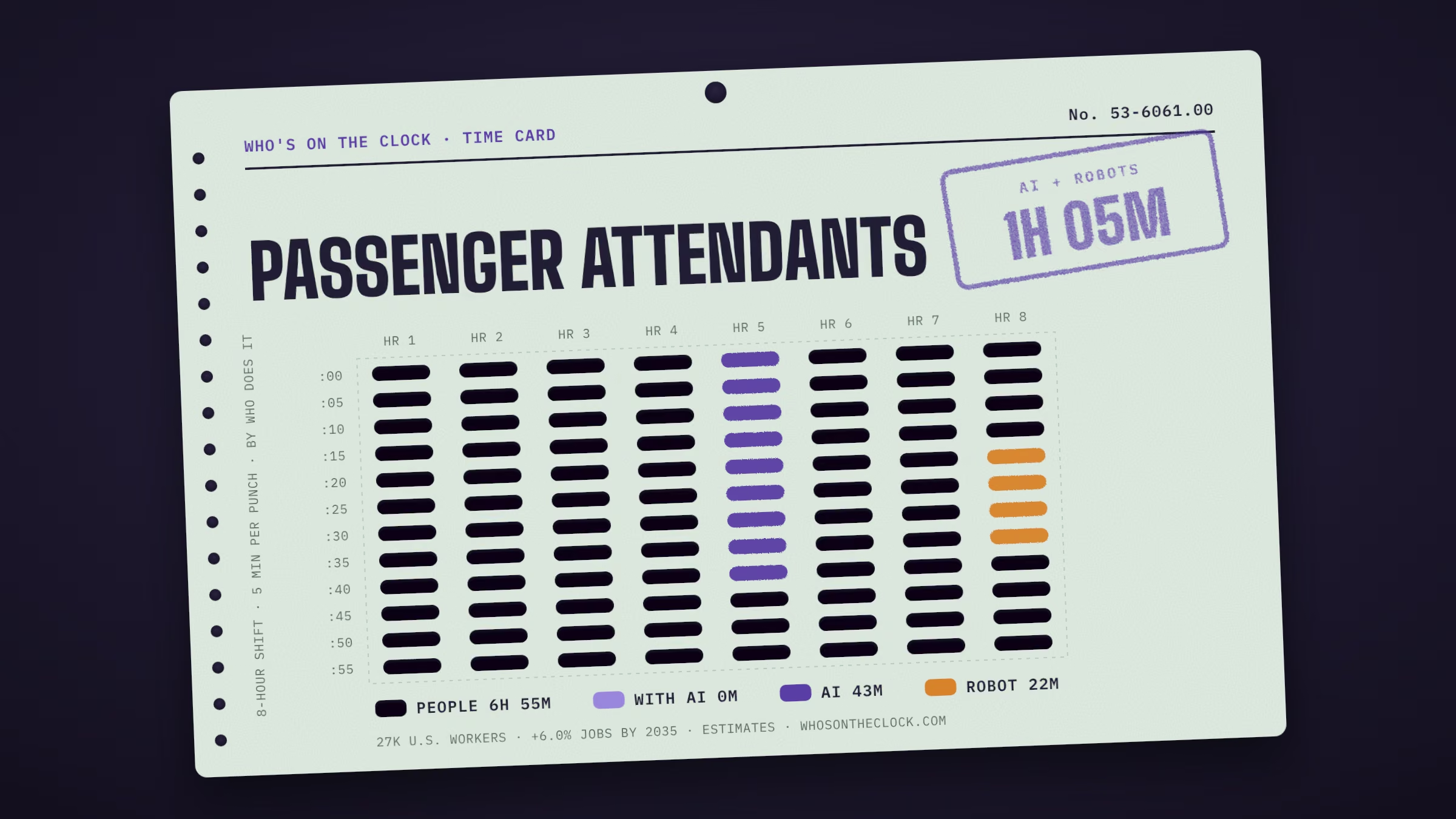
AI already handles some of this work on its own in real use, for tasks like “Provide customers with information on routes, gates, prices”. That's 43m of a typical shift; 6h 55m still has no AI or robot evidence. BLS expects about 6% more of these jobs by 2035.

Time card for passenger attendants showing a typical 8-hour shift: 6h 55m done by people, 43m by AI, 22m by robots.
Each mark is 5 minutes of a typical shift for passenger attendants, colored by who does that task today. Estimates from O*NET tasks and Anthropic Economic Index data. How it's made

Home / Transportation & warehouse / Passenger Attendants

Provide services to ensure the safety of passengers aboard ships, buses, trains, or within the station or terminal. Perform duties such as explaining the use of safety equipment, serving meals or beverages, or answering questions related to travel.

Time card

Untick tasks you don't do, or set your own times.
MineTask, by time spentHumanWith AIAIRobot
Secure passengers for transportation by buckling seatbelts or fastening wheelchairs with tie-down straps.1h 26m a shift · No AI or robot evidence found
Why this label?This is physical work, and no robot has been shown doing it yet. How labels work
Provide boarding assistance to elderly, sick, or injured people.1h 26m a shift · No AI or robot evidence found
Why this label?This is physical work, and no robot has been shown doing it yet. How labels work
Respond to passengers' questions, requests, or complaints.1h 12m a shift · No AI or robot evidence found
Why this label?No AI use or robot deployment showed up for this task in our data. That isn't proof it's safe; it may just be rare in the data. How labels work
Provide customers with information on routes, gates, prices, timetables, terminals, or concourses.43m a shift · Observed in AI useTypical AI request: about 32m alone, 9m with AI
Why this label?Marked AI because this task shows up regularly in real AI conversations (Anthropic Economic Index, 2025 usage), and in most of them AI does the task on its own rather than helping a person. Many workplaces may not use AI for it at all. How labels work
Greet passengers boarding transportation equipment and announce routes and stops.43m a shift · No AI or robot evidence found
Why this label?No AI use or robot deployment showed up for this task in our data. That isn't proof it's safe; it may just be rare in the data. How labels work
Determine or facilitate seating arrangements.29m a shift · No AI or robot evidence found
Why this label?No AI use or robot deployment showed up for this task in our data. That isn't proof it's safe; it may just be rare in the data. How labels work
Perform equipment safety checks prior to departure.29m a shift · Robots only in factory cells
Why this label?Robots have done this only in factory setups built around the machine, so it stays Human for passenger attendants. How labels work
Count and verify tickets and seat reservations and record numbers of passengers boarding and disembarking.29m a shift · No AI or robot evidence found
Why this label?No AI use or robot deployment showed up for this task in our data. That isn't proof it's safe; it may just be rare in the data. How labels work
Explain and demonstrate safety procedures and safety equipment use.22m a shift · No AI or robot evidence found
Why this label?No AI use or robot deployment showed up for this task in our data. That isn't proof it's safe; it may just be rare in the data. How labels work
Open and close doors for passengers.22m a shift · Robots deployed · e.g. Zoox robotaxi
Why this label?Marked Robot because Zoox robotaxi (in real use) has done this task in a real workplace. It shows a robot can do it somewhere, not that most passenger attendants work alongside one. How labels work
Signal transportation operators to stop or to proceed.14m a shift · No AI or robot evidence found
Why this label?No AI use or robot deployment showed up for this task in our data. That isn't proof it's safe; it may just be rare in the data. How labels work
Adjust window shades or seat cushions at the request of passengers.7m a shift · Robots only in factory cells
Why this label?Robots have done this only in factory setups built around the machine, so it stays Human for passenger attendants. How labels work

Clock history

  1. 1h 5m touchedFirst published: O*NET 30.1, Anthropic Economic Index (2025 usage and September 2026 robot study), BLS May 2025

When new data changes this clock, the date, the new numbers and the reason are logged here. Company news alone never moves the clock.

On the floor

No company news tracked for this job yet. New stories are added as they happen.

Ask the clock

Will AI replace passenger attendants?

Unlikely, though parts of the work are changing. About 1h 5m of an 8-hour shift goes to tasks touched by AI working on its own. The breakdown: 43m that AI mostly does alone, 22m that robots have done in real workplaces. The other 6h 55m (86%) stays with people. Separately, BLS expects about 6% more of these jobs by 2035 (all jobs: +3.5%).

What can AI already do for passenger attendants?

AI shows up regularly in 1 of 12 tasks, about 43m of a typical shift. The biggest ones:

  • Provide customers with information on routes, gates, prices, timetables, terminals, or concourses. (43m a shift, AI mostly does it alone)
Where do robots fit in?

For some tasks, yes. Robots have done 1 of this job's tasks in workplaces like this one, about 22m of a typical shift. 2 more tasks have only been done in factory setups built around the machine, so they stay with people here. For 2 physical tasks, no robot has shown it can do the work yet.

  • Open and close doors for passengers. (22m a shift; e.g. Zoox robotaxi, in use)
What still needs a person?

6h 55m of a typical shift, or 86%, goes to tasks with no AI or robot evidence yet. No AI usage or robot deployment has shown up for these so far. The biggest:

  • Secure passengers for transportation by buckling seatbelts or fastening wheelchairs with tie-down straps. (1h 26m a shift)
  • Provide boarding assistance to elderly, sick, or injured people. (1h 26m a shift)
  • Respond to passengers' questions, requests, or complaints. (1h 12m a shift)
  • Greet passengers boarding transportation equipment and announce routes and stops. (43m a shift)
  • Determine or facilitate seating arrangements. (29m a shift)
Why is that work hard to automate?

Much of it comes down to where and how the work happens. In-person, hands-on and high-stakes work is where AI and robots have made the least headway so far. In the official O*NET survey of people in this job:

  • 100% work at arm's length or closer to other people
  • 73% work in very hot or cold conditions at least weekly
  • 68% say dealing with the public is very or extremely important
How much time does AI save on these tasks?

For the 1 task in this job where AI shows up and timing data exists, a typical request takes about 32m for a person alone and about 9m with AI. These are Claude's own estimates from real conversations in April and May 2026 (Anthropic Economic Index). They describe single requests, not whole workdays, and time saved on a task doesn't mean jobs are cut. The biggest gaps:

  • Provide customers with information on routes, gates, prices, timetables, terminals, or concourses (about 32m alone, 9m with AI)
How much do passenger attendants make?

The median pay is about $37,720 a year ($18.14 an hour), 26% below the median for all U.S. jobs ($50,980). Most people in this job earn between $27,970 and $46,590 a year; that range covers the middle 80%. Pay figures are from BLS, May 2025, and vary a lot by state and employer. Pick a state to compare:

Is this job growing or shrinking?

BLS projects growth of 6% from 2025 to 2035, compared with 3.5% growth for all jobs. That's about 29,000 jobs in 2035. It expects about 4,300 openings a year, mostly from people retiring or changing careers. These projections don't single out AI as a cause.

How many passenger attendants are there in the U.S.?

About 27,000 people in the U.S., roughly 0.02% of all workers (BLS, May 2025). That makes it the 495th largest of the 796 jobs on this site. BLS expects about 29,000 in 2035.

What training do passenger attendants need?

The most common requirement is a high school diploma: about 82% of people in the job said so in the official O*NET survey. O*NET rates the job at level 2 of 5 for preparation, which usually means: high school diploma, some training. Requirements vary by state and employer, especially for licensed work.

What should I learn to stay ahead of AI?

These come from the job's official skill ratings and from the tasks that AI and robots touch least today. Building them keeps you strong in the parts of the work that still need a person:

  • Skills that matter more here than in most jobs: Service Orientation, Social Perceptiveness, Persuasion, Speaking
  • Get strong at the parts of the job that stay with people (listed above), which take 6h 55m of a typical shift
  • Tools employers list: Microsoft Office software, Microsoft Windows, Microsoft Word
  • Learn to use AI well on the tasks where it already shows up in this job (listed above)
What other jobs could passenger attendants move into?

These use similar skills. Matches come from 109 official ratings of skills, knowledge and work activities, and each needs the same or less preparation unless the official list relates the jobs directly:

  • Parking Attendants (2h 26m touched, $35k median pay)
  • Stockers and Order Fillers (1h 17m touched, $37k median pay)
  • Refuse and Recyclable Material Collectors (5h 14m touched, $50k median pay)
How solid are these numbers?

Each task carries its own evidence label. For this job: 1 observed in real AI use, 1 with robots in real deployments, 10 with no AI or robot evidence found. The minutes per task are estimates, not measured hours, and "no evidence" doesn't prove a task is safe.

Tools in demand

Mostly everyday office tools: Microsoft Office software, Microsoft Windows, Microsoft Word. The job's skills matter more than any specific software.

Also called

Airline Lounge Receptionist, Airport Attendant, Attendant, Bath Aide, Bath Steward, Bath Stewardess, Bus Aide, Bus Assistant, Bus Attendant, Bus Monitor, Bus Steward, Car Porter, Chair Car Attendant, Chair Lift Operator