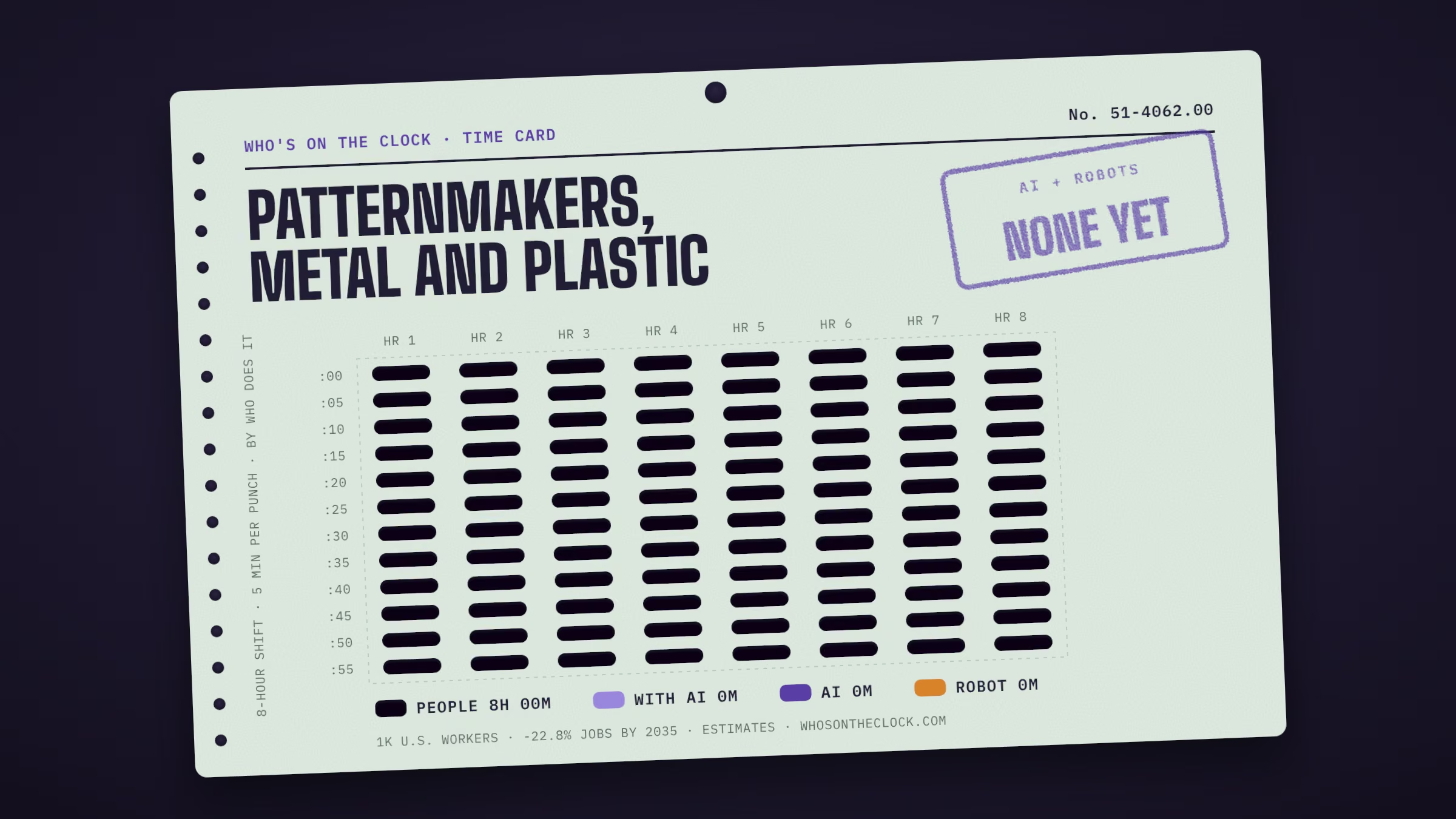
Lay out, machine, fit, and assemble castings and parts to metal or plastic foundry patterns, core boxes, or match plates.
Time card
Untick tasks you don't do, or set your own times.
| Mine | Task, by time spent | Human | With AI | AI | Robot |
|---|---|---|---|---|---|
Set up and operate machine tools, such as milling machines, lathes, drill presses, and grinders, to machine castings or patterns.1h 41m a shift · Robots only in factory cellsWhy this label?Robots have done this only in factory setups built around the machine, so it stays Human for patternmakers, metal and plastic. How labels work | |||||
Read and interpret blueprints or drawings of parts to be cast or patterns to be made, compute dimensions, and plan operational sequences.47m a shift · No AI or robot evidence foundWhy this label?No AI use or robot deployment showed up for this task in our data. That isn't proof it's safe; it may just be rare in the data. How labels work | |||||
Verify conformance of patterns or template dimensions to specifications, using measuring instruments such as calipers, scales, and micrometers.41m a shift · Robots only in factory cellsWhy this label?Robots have done this only in factory setups built around the machine, so it stays Human for patternmakers, metal and plastic. How labels work | |||||
Repair and rework templates and patterns.41m a shift · Robots only in factory cellsWhy this label?Robots have done this only in factory setups built around the machine, so it stays Human for patternmakers, metal and plastic. How labels work | |||||
Assemble pattern sections, using hand tools, bolts, screws, rivets, glue, or welding equipment.41m a shift · Robots only in factory cellsWhy this label?Robots have done this only in factory setups built around the machine, so it stays Human for patternmakers, metal and plastic. How labels work | |||||
Create computer models of patterns or parts, using modeling software.36m a shift · No AI or robot evidence foundWhy this label?No AI use or robot deployment showed up for this task in our data. That isn't proof it's safe; it may just be rare in the data. How labels work | |||||
Design and create templates, patterns, or coreboxes according to work orders, sample parts, or mockups.36m a shift · Robots only in factory cellsWhy this label?Robots have done this only in factory setups built around the machine, so it stays Human for patternmakers, metal and plastic. How labels work | |||||
Clean and finish patterns or templates, using emery cloths, files, scrapers, and power grinders.30m a shift · Robots only in factory cellsWhy this label?Robots have done this only in factory setups built around the machine, so it stays Human for patternmakers, metal and plastic. How labels work | |||||
Program computerized numerical control machine tools.30m a shift · No AI or robot evidence foundWhy this label?No AI use or robot deployment showed up for this task in our data. That isn't proof it's safe; it may just be rare in the data. How labels work | |||||
Construct platforms, fixtures, and jigs for holding and placing patterns.24m a shift · Robots only in factory cellsWhy this label?Robots have done this only in factory setups built around the machine, so it stays Human for patternmakers, metal and plastic. How labels work | |||||
Lay out and draw or scribe patterns onto material, using compasses, protractors, rulers, scribes, or other instruments.24m a shift · Robots only in factory cellsWhy this label?Robots have done this only in factory setups built around the machine, so it stays Human for patternmakers, metal and plastic. How labels work | |||||
Paint or lacquer patterns.12m a shift · Robots only in factory cellsWhy this label?Robots have done this only in factory setups built around the machine, so it stays Human for patternmakers, metal and plastic. How labels work | |||||
Mark identification numbers or symbols onto patterns or templates.6m a shift · Robots only in factory cellsWhy this label?Robots have done this only in factory setups built around the machine, so it stays Human for patternmakers, metal and plastic. How labels work | |||||
Select pattern materials such as wood, resin, and fiberglass.6m a shift · No AI or robot evidence foundWhy this label?No AI use or robot deployment showed up for this task in our data. That isn't proof it's safe; it may just be rare in the data. How labels work | |||||
Apply plastic-impregnated fabrics or coats of sealing wax or lacquer to patterns used to produce plastic.6m a shift · Robots only in factory cellsWhy this label?Robots have done this only in factory setups built around the machine, so it stays Human for patternmakers, metal and plastic. How labels work |