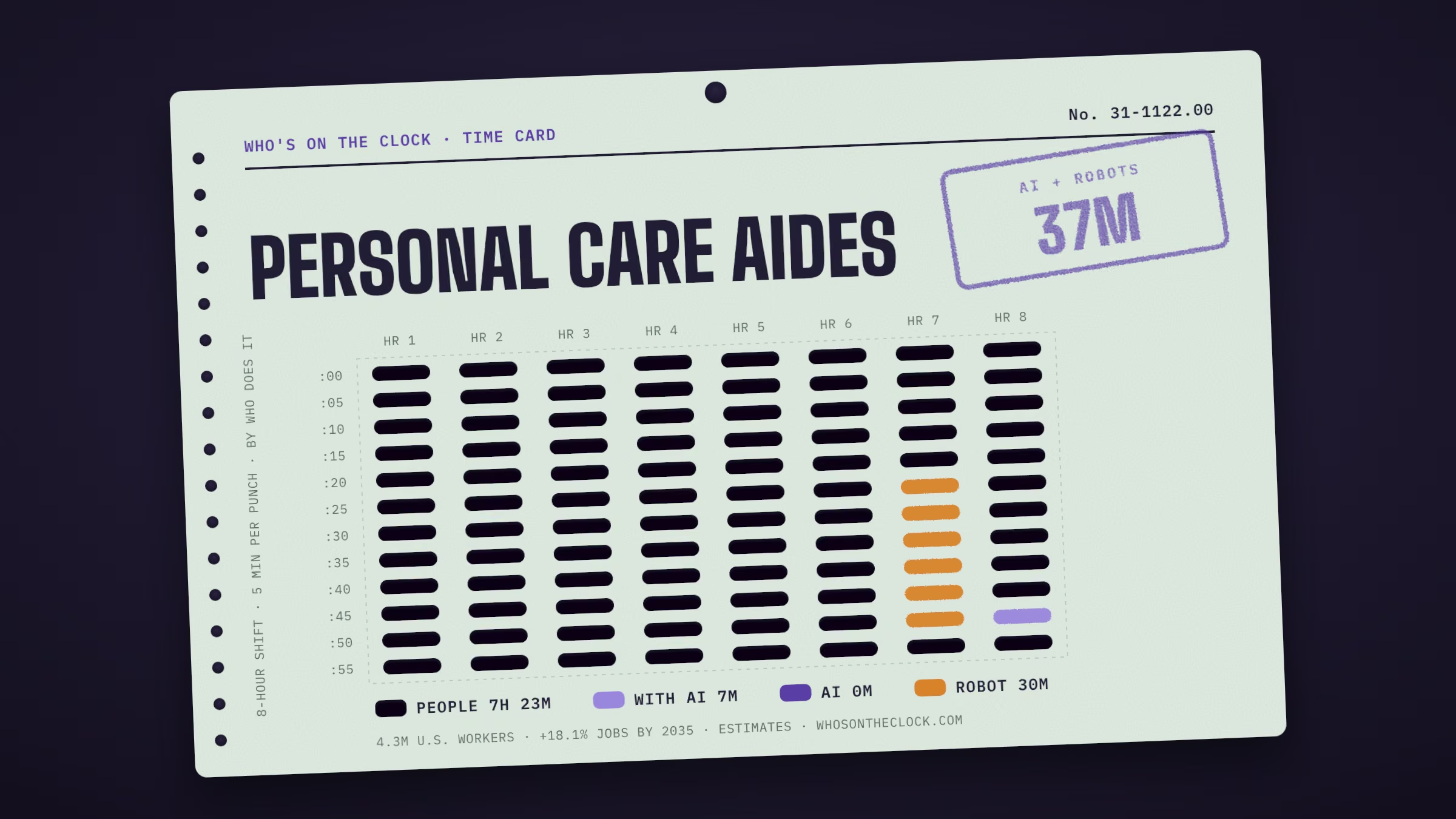
Provide personalized assistance to individuals with disabilities or illness who require help with personal care and activities of daily living support (e.g., feeding, bathing, dressing, grooming, toileting, and ambulation). May also provide help with tasks such as preparing meals, doing light housekeeping, and doing laundry. Work is performed in various settings depending on the needs of the care recipient and may include locations such as their home, place of work, out in the community, or at a daytime nonresidential facility.
Time card
Untick tasks you don't do, or set your own times.
| Mine | Task, by time spent | Human | With AI | AI | Robot |
|---|---|---|---|---|---|
Administer bedside or personal care, such as ambulation or personal hygiene assistance.1h 58m a shift · No AI or robot evidence foundWhy this label?This is physical work, and no robot has been shown doing it yet. How labels work | |||||
Care for individuals or families during periods of incapacitation, family disruption, or convalescence, providing companionship, personal care, or help in adjusting to new lifestyles.1h 51m a shift · No AI or robot evidence foundWhy this label?This is physical work, and no robot has been shown doing it yet. How labels work | |||||
Perform housekeeping duties, such as cooking, cleaning, washing clothes or dishes, or running errands.1h 14m a shift · Robots only in factory cellsWhy this label?Robots have done this only in factory setups built around the machine, so it stays Human for personal care aides. How labels work | |||||
Plan, shop for, or prepare nutritious meals or assist families in planning, shopping for, or preparing nutritious meals.52m a shift · Robots only in factory cellsWhy this label?Robots have done this only in factory setups built around the machine, so it stays Human for personal care aides. How labels work | |||||
Prepare and maintain records of client progress and services performed, reporting changes in client condition to manager or supervisor.30m a shift · No AI or robot evidence foundWhy this label?No AI use or robot deployment showed up for this task in our data. That isn't proof it's safe; it may just be rare in the data. How labels work | |||||
Perform healthcare-related tasks, such as monitoring vital signs and medication, under the direction of registered nurses or physiotherapists.30m a shift · Robots deployed · e.g. MoxiWhy this label?Marked Robot because Moxi (in real use) has done this task in a real workplace. It shows a robot can do it somewhere, not that most personal care aides work alongside one. How labels work | |||||
Transport clients to locations outside the home, such as to physicians' offices or on outings, using a motor vehicle.30m a shift · No AI or robot evidence foundWhy this label?This is physical work, and no robot has been shown doing it yet. How labels work | |||||
Instruct or advise clients on issues, such as household cleanliness, utilities, hygiene, nutrition, or infant care.15m a shift · No AI or robot evidence foundWhy this label?No AI use or robot deployment showed up for this task in our data. That isn't proof it's safe; it may just be rare in the data. How labels work | |||||
Participate in case reviews, consulting with the team caring for the client, to evaluate the client's needs and plan for continuing services.7m a shift · No AI or robot evidence foundWhy this label?No AI use or robot deployment showed up for this task in our data. That isn't proof it's safe; it may just be rare in the data. How labels work | |||||
Provide clients with communication assistance, typing their correspondence or obtaining information for them.7m a shift · Observed in AI useWhy this label?Marked With AI because people regularly use AI to help with this task in real conversations (Anthropic Economic Index, 2025 usage), but AI doesn't usually finish it alone. How labels work | |||||
Train family members to provide bedside care.7m a shift · No AI or robot evidence foundWhy this label?No AI use or robot deployment showed up for this task in our data. That isn't proof it's safe; it may just be rare in the data. How labels work |