Will AI replace home health aides?

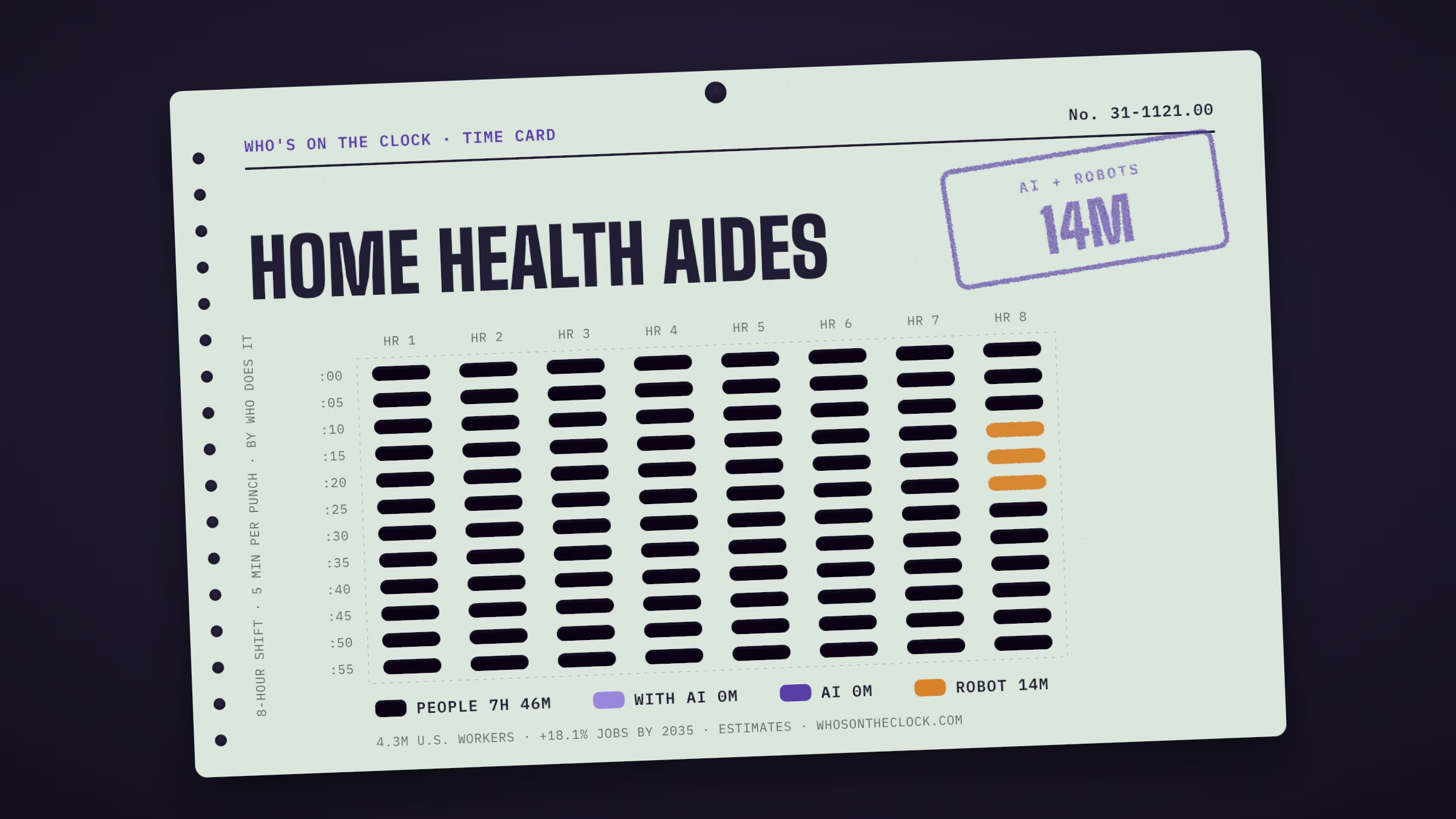
Not on current evidence. Less than 30 minutes of a typical shift goes to tasks that AI or robots are doing today. The other 7h 46m (97%) stays with people. Separately, BLS expects about 18.1% more of these jobs by 2035 (all jobs: +3.5%).

Time card for home health aides showing a typical 8-hour shift: 7h 46m done by people, 14m by robots.
Each mark is 5 minutes of a typical shift for home health aides, colored by who does that task today. Estimates from O*NET tasks and Anthropic Economic Index data. How it's made

Home / Healthcare support / Home Health Aides

Monitor the health status of an individual with disabilities or illness, and address their health-related needs, such as changing bandages, dressing wounds, or administering medication. Work is performed under the direction of offsite or intermittent onsite licensed nursing staff. Provide assistance with routine healthcare tasks or activities of daily living, such as feeding, bathing, toileting, or ambulation. May also help with tasks such as preparing meals, doing light housekeeping, and doing laundry depending on the patient's abilities.

Time card

Untick tasks you don't do, or set your own times.
MineTask, by time spentHumanWith AIAIRobot
Provide patients with help moving in and out of beds, baths, wheelchairs, or automobiles and with dressing and grooming.1h 13m a shift · No AI or robot evidence found
Bathe patients.58m a shift · Robots only in factory cells
Care for patients by changing bed linens, washing and ironing laundry, cleaning, or assisting with their personal care.58m a shift · No AI or robot evidence found
Entertain, converse with, or read aloud to patients to keep them mentally healthy and alert.58m a shift · No AI or robot evidence found
Plan, purchase, prepare, or serve meals to patients or other family members, according to prescribed diets.58m a shift · Robots only in factory cells
Maintain records of patient care, condition, progress, or problems to report and discuss observations with supervisor or case manager.36m a shift · No AI or robot evidence found
Provide patients and families with emotional support and instruction in areas such as caring for infants, preparing healthy meals, living independently, or adapting to disability or illness.29m a shift · No AI or robot evidence found
Perform a variety of duties as requested by client, such as obtaining household supplies or running errands.22m a shift · Robots only in factory cells
Direct patients in simple prescribed exercises or in the use of braces or artificial limbs.22m a shift · Robots only in factory cells
Check patients' pulse, temperature, and respiration.15m a shift · No AI or robot evidence found
Administer prescribed oral medications, under the written direction of physician or as directed by home care nurse or aide, and ensure patients take their medicine.15m a shift · Robots deployed · e.g. Evondos E300 in-home medicine dispensing robot / telecare system
Accompany clients to doctors' offices or on other trips outside the home, providing transportation, assistance, and companionship.15m a shift · No AI or robot evidence found
Massage patients or apply preparations or treatments, such as liniment, alcohol rubs, or heat-lamp stimulation.7m a shift · No AI or robot evidence found
Care for children with disabilities or who have sick parents or parents with disabilities.7m a shift · No AI or robot evidence found
Change dressings.7m a shift · No AI or robot evidence found

On the floor

No company news tracked for this job yet. New stories are added as they happen.

Ask the clock

Will AI replace home health aides?

Not on current evidence. Less than 30 minutes of a typical shift goes to tasks that AI or robots are doing today. The other 7h 46m (97%) stays with people. Separately, BLS expects about 18.1% more of these jobs by 2035 (all jobs: +3.5%).

What parts of the job can AI already do?

None of this job's tasks show regular AI use yet. That can mean the work is hands-on or in person, or simply that it rarely comes up in AI usage data.

Can a robot do this job?

For some tasks, yes. Robots have done 1 of this job's tasks in workplaces like this one, about 14m of a typical shift. 4 more tasks have only been done in factory setups built around the machine, so they stay with people here. For 7 physical tasks, no robot has shown it can do the work yet.

  • Administer prescribed oral medications, under the written direction of physician or as directed by home care nurse or aide, and ensure patients take their medicine. (15m a shift; e.g. Evondos E300 in-home medicine dispensing robot / telecare system, in use)
What parts of the job are still done by people?

7h 46m of a typical shift, or 97%, goes to tasks with no AI or robot evidence yet. No AI usage or robot deployment has shown up for these so far. The biggest:

  • Provide patients with help moving in and out of beds, baths, wheelchairs, or automobiles and with dressing and grooming. (1h 13m a shift)
  • Bathe patients. (58m a shift)
  • Care for patients by changing bed linens, washing and ironing laundry, cleaning, or assisting with their personal care. (58m a shift)
  • Entertain, converse with, or read aloud to patients to keep them mentally healthy and alert. (58m a shift)
  • Plan, purchase, prepare, or serve meals to patients or other family members, according to prescribed diets. (58m a shift)
Are employers still hiring for this job?

On Indeed, job postings in the Personal Care & Home Health sector are at 151% of their February 2020 level (all U.S. postings: 104%), up 2.1% from a year earlier, as of Oct 9, 2026. BLS separately expects about 761,000 openings a year in this job through 2035. Across all U.S. postings, 7.3% now mention AI skills. Sector postings cover more than this one job and move for many reasons besides AI.

How much do home health aides make?

The median pay is about $35,800 a year ($17.21 an hour), 30% below the median for all U.S. jobs ($50,980). Most people in this job earn between $27,040 and $45,040 a year; that range covers the middle 80%. Pay figures are from BLS, May 2025, and vary a lot by state and employer.

Is this job growing or shrinking?

BLS projects growth of 18.1% from 2025 to 2035, compared with 3.5% growth for all jobs. That's about 5.5 million jobs in 2035. It expects about 761,000 openings a year, mostly from people retiring or changing careers. These projections don't single out AI as a cause.

How many people do this job?

About 4.3 million people in the U.S., roughly 2.8% of all workers (BLS, May 2025). That makes it the 1st largest of the 796 jobs on this site. BLS expects about 5.5 million in 2035.

What do you need to become one?

The most common requirement is a high school diploma: about 63% of people in the job said so in the official O*NET survey. O*NET rates the job at level 2 of 5 for preparation, which usually means: high school diploma, some training. Requirements vary by state and employer, especially for licensed work.

What should I learn to stay ahead?

These come from the job's official skill ratings and from the tasks that AI and robots touch least today. Building them keeps you strong in the parts of the work that still need a person:

  • Skills that matter more here than in most jobs: Service Orientation, Persuasion, Social Perceptiveness, Instructing
  • Get strong at the parts of the job that stay with people (listed above), which take 7h 46m of a typical shift
  • Tools employers list: Linux, Microsoft Access, Microsoft Excel, Microsoft Office software, Microsoft Outlook
Are there new tasks in this job?

Yes. Occupational experts recently added these to the official task list, a sign of how the work itself is shifting. New tasks aren't rated for AI or robots yet:

  • Assist patients with toileting and incontinent care.
  • Feed patients.
What similar jobs could I move into?

These use similar skills. Matches come from 109 official ratings of skills, knowledge and work activities, and each needs the same or less preparation unless the official list relates the jobs directly:

  • Nursing Assistants (26m touched, $42k median pay)
  • Psychiatric Aides (0m touched, $45k median pay)
  • Personal Care Aides (37m touched, $36k median pay)
How solid are these numbers?

Each task carries its own evidence label. For this job: 1 with robots in real deployments, 14 with no AI or robot evidence found. The minutes per task are estimates, not measured hours, and "no evidence" doesn't prove a task is safe.

Tools in demand

  • Linux
  • Microsoft Access
  • Microsoft Excel
  • Microsoft Office software
  • Microsoft Outlook
  • Microsoft PowerPoint
  • Microsoft SharePoint
  • Microsoft Windows

Also called

Care Worker, Caregiver, Certified Home Health Aide (CHHA), Certified Medical Aide (CMA), Certified Nurses Aide (CNA), Companion, Day Support Professional, Digital Health Caregiver, Direct Care Counselor, Direct Care Professional, Direct Care Worker, Direct Support Professional (DSP), Habilitation Training Specialist, Health Care Assistant