Will AI replace pharmacy technicians?

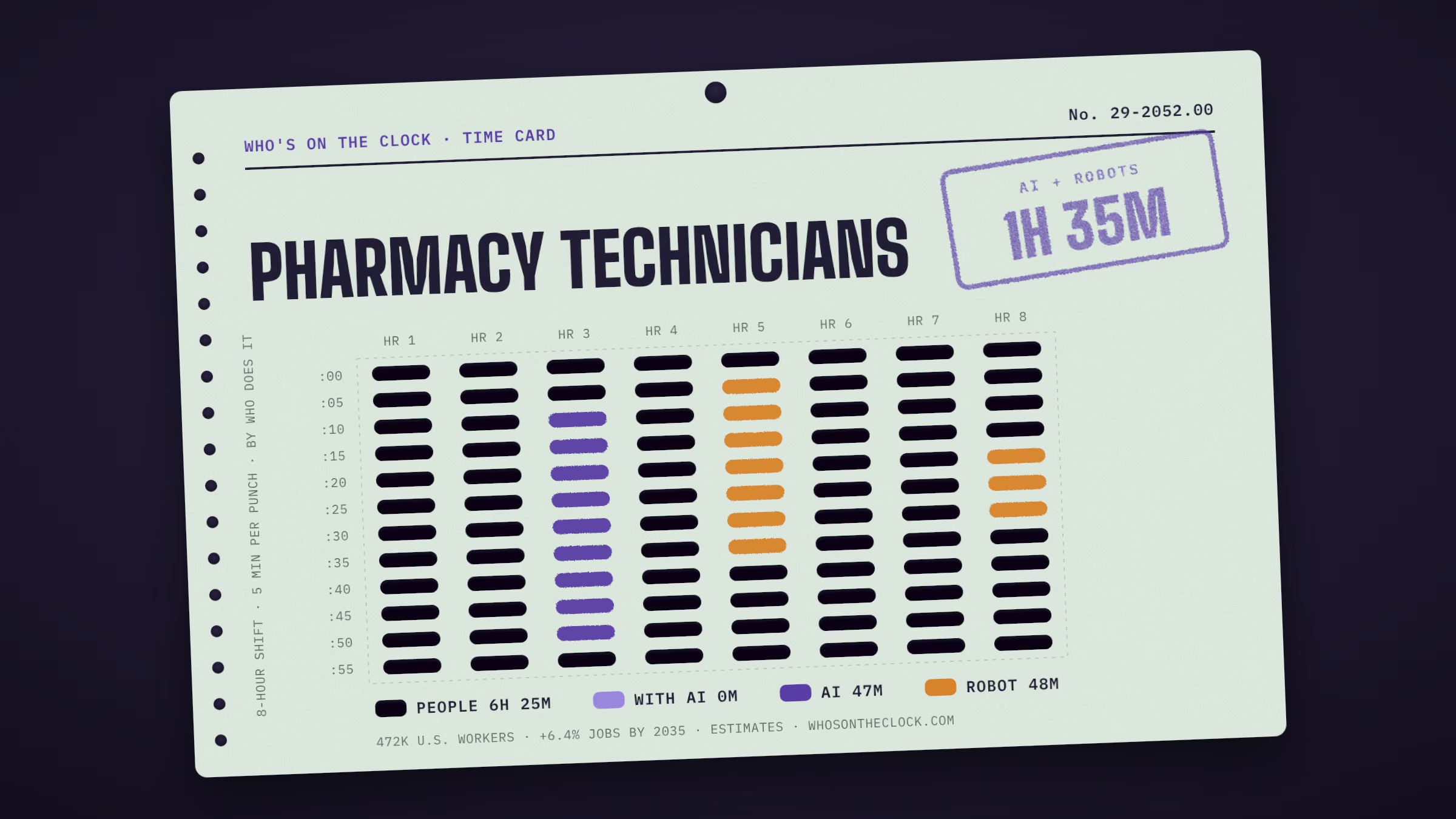
AI already handles some of this work on its own in real use, for tasks like “Answer telephones, responding to questions or requests”. That's 48m of a typical shift; 6h 25m still has no AI or robot evidence. BLS expects about 6.4% more of these jobs by 2035.

Time card for pharmacy technicians showing a typical 8-hour shift: 6h 25m done by people, 48m by AI, 47m by robots.
Each mark is 5 minutes of a typical shift for pharmacy technicians, colored by who does that task today. Estimates from O*NET tasks and Anthropic Economic Index data. How it's made

Home / Healthcare practitioners / Pharmacy Technicians

Prepare medications under the direction of a pharmacist. May measure, mix, count out, label, and record amounts and dosages of medications according to prescription orders.

Time card

Untick tasks you don't do, or set your own times.
MineTask, by time spentHumanWith AIAIRobot
Prepack bulk medicines, fill bottles with prescribed medications, and type and affix labels.1h 8m a shift · Robots only in factory cells
Why this label?Robots have done this only in factory setups built around the machine, so it stays Human for pharmacy technicians. How labels work
Enter prescription information into computer databases.1h 1m a shift · No AI or robot evidence found
Why this label?No AI use or robot deployment showed up for this task in our data. That isn't proof it's safe; it may just be rare in the data. How labels work
Answer telephones, responding to questions or requests.47m a shift · Observed in AI use
Why this label?Marked AI because this task shows up regularly in real AI conversations (Anthropic Economic Index, 2025 usage), and in most of them AI does the task on its own rather than helping a person. Many workplaces may not use AI for it at all. How labels work
Receive written prescription or refill requests and verify that information is complete and accurate.34m a shift · No AI or robot evidence found
Why this label?No AI use or robot deployment showed up for this task in our data. That isn't proof it's safe; it may just be rare in the data. How labels work
Assist customers by answering simple questions, locating items, or referring them to the pharmacist for medication information.34m a shift · No AI or robot evidence found
Why this label?No AI use or robot deployment showed up for this task in our data. That isn't proof it's safe; it may just be rare in the data. How labels work
Operate cash registers to accept payment from customers.34m a shift · Robots deployed · e.g. Asteres ScriptCenter MX
Why this label?Marked Robot because Asteres ScriptCenter MX (in real use) has done this task in a real workplace. It shows a robot can do it somewhere, not that most pharmacy technicians work alongside one. How labels work
Prepare and process medical insurance claim forms and records.27m a shift · No AI or robot evidence found
Why this label?No AI use or robot deployment showed up for this task in our data. That isn't proof it's safe; it may just be rare in the data. How labels work
Establish or maintain patient profiles, including lists of medications taken by individual patients.20m a shift · No AI or robot evidence found
Why this label?No AI use or robot deployment showed up for this task in our data. That isn't proof it's safe; it may just be rare in the data. How labels work
Receive and store incoming supplies, verify quantities against invoices, check for outdated medications in current inventory, and inform supervisors of stock needs and shortages.20m a shift · Robots only in factory cells
Why this label?Robots have done this only in factory setups built around the machine, so it stays Human for pharmacy technicians. How labels work
Order, label, and count stock of medications, chemicals, or supplies and enter inventory data into computer.20m a shift · Robots only in factory cells
Why this label?Robots have done this only in factory setups built around the machine, so it stays Human for pharmacy technicians. How labels work
Maintain proper storage and security conditions for drugs.14m a shift · Robots only in factory cells
Why this label?Robots have done this only in factory setups built around the machine, so it stays Human for pharmacy technicians. How labels work
Price and file prescriptions that have been filled.14m a shift · Robots only in factory cells
Why this label?Robots have done this only in factory setups built around the machine, so it stays Human for pharmacy technicians. How labels work
Clean and help maintain equipment or work areas and sterilize glassware, according to prescribed methods.14m a shift · Robots only in factory cells
Why this label?Robots have done this only in factory setups built around the machine, so it stays Human for pharmacy technicians. How labels work
Restock intravenous (IV) supplies and add measured drugs or nutrients to IV solutions under sterile conditions to prepare IV packs for various uses, such as chemotherapy medication.14m a shift · Robots only in factory cells
Why this label?Robots have done this only in factory setups built around the machine, so it stays Human for pharmacy technicians. How labels work
Supply and monitor robotic machines that dispense medicine into containers and label the containers.14m a shift · Robots only in factory cells
Why this label?Robots have done this only in factory setups built around the machine, so it stays Human for pharmacy technicians. How labels work
Deliver medications or pharmaceutical supplies to patients, nursing stations, or surgery.14m a shift · Robots deployed · e.g. Moxi
Why this label?Marked Robot because Moxi (in real use) has done this task in a real workplace. It shows a robot can do it somewhere, not that most pharmacy technicians work alongside one. How labels work
Mix pharmaceutical preparations, according to written prescriptions.7m a shift · Robots only in factory cells
Why this label?Robots have done this only in factory setups built around the machine, so it stays Human for pharmacy technicians. How labels work
Compute charges for medication or equipment dispensed to hospital patients and enter data in computer.7m a shift · No AI or robot evidence found
Why this label?No AI use or robot deployment showed up for this task in our data. That isn't proof it's safe; it may just be rare in the data. How labels work
Transfer medication from vials to the appropriate number of sterile, disposable syringes, using aseptic techniques.7m a shift · Robots only in factory cells
Why this label?Robots have done this only in factory setups built around the machine, so it stays Human for pharmacy technicians. How labels work
Maintain and merchandise home healthcare products or services.7m a shift · Robots only in factory cells
Why this label?Robots have done this only in factory setups built around the machine, so it stays Human for pharmacy technicians. How labels work
Price stock and mark items for sale.7m a shift · Robots only in factory cells
Why this label?Robots have done this only in factory setups built around the machine, so it stays Human for pharmacy technicians. How labels work

Clock history

  1. 1h 35m touchedFirst published: O*NET 30.1, Anthropic Economic Index (2025 usage and September 2026 robot study), BLS May 2025

When new data changes this clock, the date, the new numbers and the reason are logged here. Company news alone never moves the clock.

On the floor

  1. Rolling outDiligent Robotics
    Diligent unveils Moxi 2.0 hospital delivery robot, now in 25+ hospitals

    Diligent said its Moxi robots work in more than 25 U.S. hospitals, delivering medications and lab samples for nurses and pharmacy staff, with over 1.25 million deliveries so far. It aims to double its hospital footprint each year.

    Business Wire

  2. Rolling outWalgreens
    Walgreens opens 12th robotic prescription fulfillment center

    Walgreens opened a micro-fulfillment center in Brooklyn Park, Minnesota, projected to process 13 million prescriptions a year. Its 12 centers support more than 5,000 stores and fill more than 3.5 million prescriptions per week.

    PYMNTS

  3. PlanWalgreens
    Walgreens plans robot-filled prescriptions for over 5,000 stores by end of 2025

    Walgreens told CNBC it plans to expand robotic prescription filling to more than 5,000 retail locations by the end of 2025. Its 11 micro-fulfillment centers have filled at least 16 million prescriptions, with technicians loading the machines and pharmacists checking each order.

    Straight Arrow News

Ask the clock

Will AI replace pharmacy technicians?

Unlikely, though parts of the work are changing. About 1h 35m of an 8-hour shift goes to tasks touched by AI working on its own. The breakdown: 48m that AI mostly does alone, 47m that robots have done in real workplaces. The other 6h 25m (80%) stays with people. Separately, BLS expects about 6.4% more of these jobs by 2035 (all jobs: +3.5%).

What can AI already do for pharmacy technicians?

AI shows up regularly in 1 of 21 tasks, about 48m of a typical shift. The biggest ones:

  • Answer telephones, responding to questions or requests. (47m a shift, AI mostly does it alone)
Where do robots fit in?

For some tasks, yes. Robots have done 2 of this job's tasks in workplaces like this one, about 47m of a typical shift. 12 more tasks have only been done in factory setups built around the machine, so they stay with people here.

  • Operate cash registers to accept payment from customers. (34m a shift; e.g. Asteres ScriptCenter MX, in use)
  • Deliver medications or pharmaceutical supplies to patients, nursing stations, or surgery. (14m a shift; e.g. Moxi, in use)
What still needs a person?

6h 25m of a typical shift, or 80%, goes to tasks with no AI or robot evidence yet. No AI usage or robot deployment has shown up for these so far. The biggest:

  • Prepack bulk medicines, fill bottles with prescribed medications, and type and affix labels. (1h 8m a shift)
  • Enter prescription information into computer databases. (1h 1m a shift)
  • Receive written prescription or refill requests and verify that information is complete and accurate. (34m a shift)
  • Assist customers by answering simple questions, locating items, or referring them to the pharmacist for medication information. (34m a shift)
  • Prepare and process medical insurance claim forms and records. (27m a shift)
Why is that work hard to automate?

Much of it comes down to where and how the work happens. In-person, hands-on and high-stakes work is where AI and robots have made the least headway so far. In the official O*NET survey of people in this job:

  • 88% work at arm's length or closer to other people
  • 85% spend more than half the day on their feet
  • 78% say a mistake would be very or extremely serious
What are companies actually doing?

We track 3 sourced company moves that affect this job. Most recent:

  • Oct 28, 2025: Diligent unveils Moxi 2.0 hospital delivery robot, now in 25+ hospitals (Rolling out)
  • May 20, 2025: Walgreens opens 12th robotic prescription fulfillment center (Rolling out)
  • May 12, 2025: Walgreens plans robot-filled prescriptions for over 5,000 stores by end of 2025 (Plan)
Are employers still hiring pharmacy technicians?

On Indeed, job postings in the Pharmacy sector are at 127% of their February 2020 level (all U.S. postings: 104%), up 4.2% from a year earlier, as of Oct 9, 2026. BLS separately expects about 45,000 openings a year in this job through 2035. Across all U.S. postings, 7.3% now mention AI skills. Sector postings cover more than this one job and move for many reasons besides AI.

How much do pharmacy technicians make?

The median pay is about $45,750 a year ($22.00 an hour), 10% below the median for all U.S. jobs ($50,980). Most people in this job earn between $36,020 and $61,040 a year; that range covers the middle 80%. Pay figures are from BLS, May 2025, and vary a lot by state and employer. Pick a state to compare:

Is this job growing or shrinking?

BLS projects growth of 6.4% from 2025 to 2035, compared with 3.5% growth for all jobs. That's about 501,000 jobs in 2035. It expects about 45,000 openings a year, mostly from people retiring or changing careers. These projections don't single out AI as a cause.

How many pharmacy technicians are there in the U.S.?

About 472,000 people in the U.S., roughly 0.30% of all workers (BLS, May 2025). That makes it the 87th largest of the 796 jobs on this site. BLS expects about 501,000 in 2035.

What training do pharmacy technicians need?

The most common requirement is a post-secondary certificate: about 42% of people in the job said so in the official O*NET survey. O*NET rates the job at level 3 of 5 for preparation, which usually means: vocational school or associate's degree. Requirements vary by state and employer, especially for licensed work.

What should I learn to stay ahead of AI?

These come from the job's official skill ratings and from the tasks that AI and robots touch least today. Building them keeps you strong in the parts of the work that still need a person:

  • Skills that matter more here than in most jobs: Active Listening, Mathematics, Reading Comprehension, Speaking
  • Get strong at the parts of the job that stay with people (listed above), which take 6h 25m of a typical shift
  • Tools employers list: Microsoft PowerPoint, Microsoft Outlook, Microsoft Office software, Microsoft Excel, Apple Safari
  • Learn to use AI well on the tasks where it already shows up in this job (listed above)
What other jobs could pharmacy technicians move into?

These use similar skills, with less of a typical shift touched by AI or robots. Matches come from 109 official ratings of skills, knowledge and work activities, and each needs the same or less preparation unless the official list relates the jobs directly:

  • Veterinary Technologists and Technicians (7m touched, $47k median pay)
  • Medical Assistants (19m touched, $46k median pay)
How solid are these numbers?

Each task carries its own evidence label. For this job: 1 observed in real AI use, 2 with robots in real deployments, 18 with no AI or robot evidence found. The minutes per task are estimates, not measured hours, and "no evidence" doesn't prove a task is safe.

Tools in demand

  • MEDITECH software

Plus everyday office tools: Microsoft PowerPoint, Microsoft Outlook, Microsoft Office software, Microsoft Excel, Apple Safari, Microsoft Edge, Microsoft Word.

Also called

Accredited Pharmacy Technician, Certified Pharmacy Technician (CPhT), Chemotherapy Pharmacy Technician (Chemo Pharmacy Technician), Compounding Pharmacy Tech (Compounding Pharmacy Technician), Compounding Technician, Drug Coordinator, Hospital Pharmacy Tech (Hospital Pharmacy Technician), Inpatient Pharmacy Tech (Inpatient Pharmacy Technician), OR Pharmacy Tech (Operating Room Pharmacy Tech), Pharmacist Assistant, Pharmacist Technician, Pharmacy Clerk, Pharmacy Laboratory Technician, Pharmacy Technician (Pharm Tech)