Will AI replace phlebotomists?

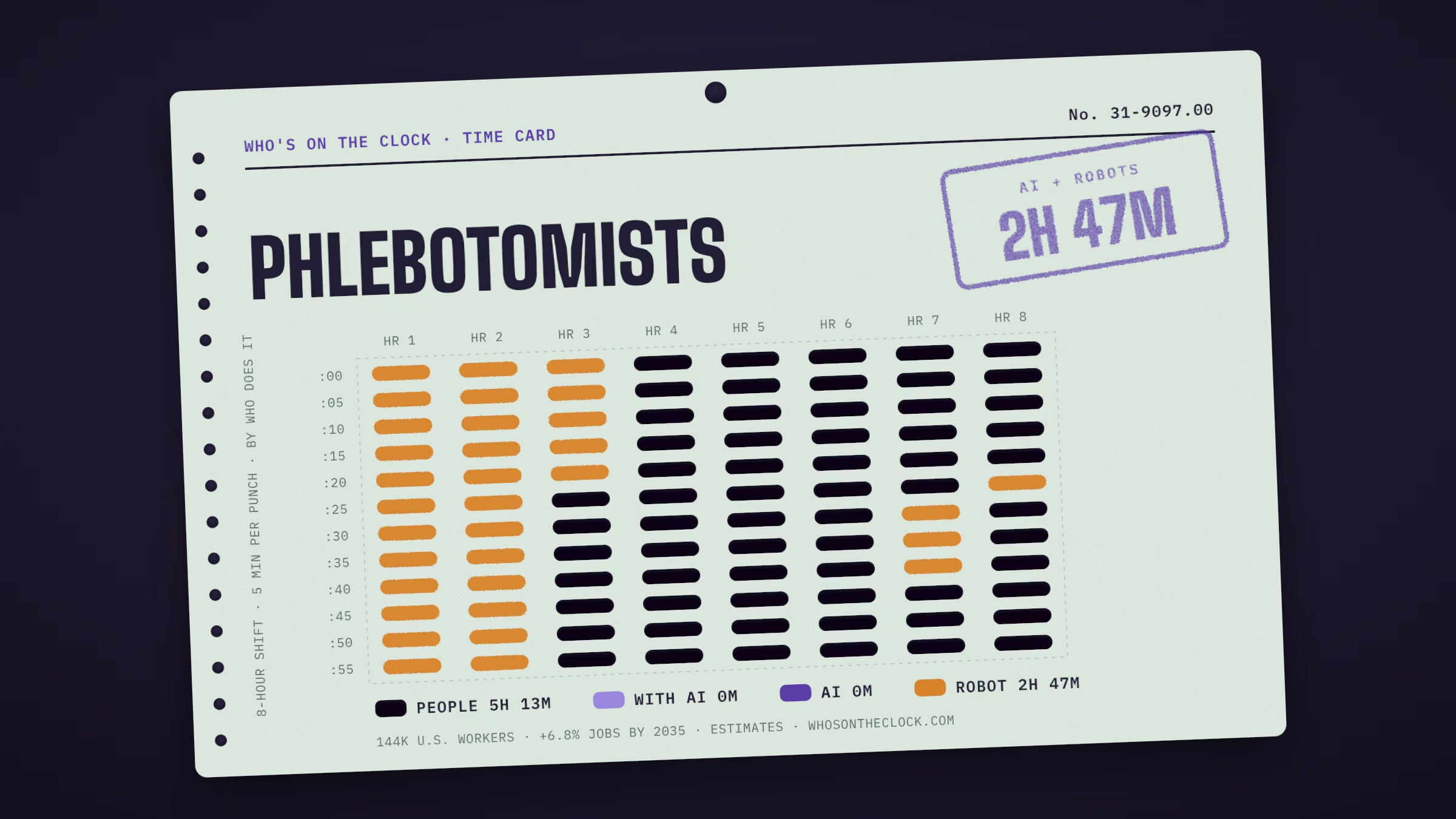
The biggest change here is physical: systems like Aletta Autonomous Robotic Phlebotomy Device have done tasks such as “Draw blood from veins by vacuum tube, syringe” in real workplaces, about 2h 47m of a typical shift. Most of the rest, 5h 13m, has no AI or robot evidence. BLS expects about 6.8% more of these jobs by 2035.

Time card for phlebotomists showing a typical 8-hour shift: 5h 13m done by people, 2h 47m by robots.
Each mark is 5 minutes of a typical shift for phlebotomists, colored by who does that task today. Estimates from O*NET tasks and Anthropic Economic Index data. How it's made

Home / Healthcare support / Phlebotomists

Draw blood for tests, transfusions, donations, or research. May explain the procedure to patients and assist in the recovery of patients with adverse reactions.

Time card

Untick tasks you don't do, or set your own times.
MineTask, by time spentHumanWith AIAIRobot
Draw blood from veins by vacuum tube, syringe, or butterfly venipuncture methods.2h 27m a shift · Robots deployed · e.g. Aletta Autonomous Robotic Phlebotomy Device (ARPD)
Why this label?Marked Robot because Aletta Autonomous Robotic Phlebotomy Device (ARPD) (in real use) has done this task in a real workplace. It shows a robot can do it somewhere, not that most phlebotomists work alongside one. How labels work
Match laboratory requisition forms to specimen tubes.40m a shift · Robots only in factory cells
Why this label?Robots have done this only in factory setups built around the machine, so it stays Human for phlebotomists. How labels work
Process blood or other fluid samples for further analysis by other medical professionals.33m a shift · Robots only in factory cells
Why this label?Robots have done this only in factory setups built around the machine, so it stays Human for phlebotomists. How labels work
Enter patient, specimen, insurance, or billing information into computer.33m a shift · No AI or robot evidence found
Why this label?No AI use or robot deployment showed up for this task in our data. That isn't proof it's safe; it may just be rare in the data. How labels work
Explain fluid or tissue collection procedures to patients.27m a shift · No AI or robot evidence found
Why this label?No AI use or robot deployment showed up for this task in our data. That isn't proof it's safe; it may just be rare in the data. How labels work
Organize or clean blood-drawing trays, ensuring that all instruments are sterile and all needles, syringes, or related items are of first-time use.20m a shift · Robots only in factory cells
Why this label?Robots have done this only in factory setups built around the machine, so it stays Human for phlebotomists. How labels work
Conduct standards tests, such as blood alcohol, blood culture, oral glucose tolerance, glucose screening, blood smears, or peak and trough drug levels tests.20m a shift · No AI or robot evidence found
Why this label?This is physical work, and no robot has been shown doing it yet. How labels work
Draw blood from capillaries by dermal puncture, such as heel or finger stick methods.20m a shift · No AI or robot evidence found
Why this label?This is physical work, and no robot has been shown doing it yet. How labels work
Dispose of contaminated sharps, in accordance with applicable laws, standards, and policies.13m a shift · Robots only in factory cells
Why this label?Robots have done this only in factory setups built around the machine, so it stays Human for phlebotomists. How labels work
Collect specimens at specific time intervals for tests, such as those assessing therapeutic drug levels.13m a shift · Robots only in factory cells
Why this label?Robots have done this only in factory setups built around the machine, so it stays Human for phlebotomists. How labels work
Document route of specimens from collection to laboratory analysis and diagnosis.13m a shift · No AI or robot evidence found
Why this label?No AI use or robot deployment showed up for this task in our data. That isn't proof it's safe; it may just be rare in the data. How labels work
Transport specimens or fluid samples from collection sites to laboratories.13m a shift · Robots deployed · e.g. Moxi (Diligent Robotics)
Why this label?Marked Robot because Moxi (Diligent Robotics) (in real use) has done this task in a real workplace. It shows a robot can do it somewhere, not that most phlebotomists work alongside one. How labels work
Collect fluid or tissue samples, using appropriate collection procedures.13m a shift · Robots only in factory cells
Why this label?Robots have done this only in factory setups built around the machine, so it stays Human for phlebotomists. How labels work
Monitor blood or plasma donors during and after procedures to ensure health, safety, and comfort.13m a shift · No AI or robot evidence found
Why this label?This is physical work, and no robot has been shown doing it yet. How labels work
Dispose of blood or other biohazard fluids or tissue, in accordance with applicable laws, standards, or policies.7m a shift · Robots only in factory cells
Why this label?Robots have done this only in factory setups built around the machine, so it stays Human for phlebotomists. How labels work
Provide sample analysis results to physicians to assist diagnosis.7m a shift · No AI or robot evidence found
Why this label?No AI use or robot deployment showed up for this task in our data. That isn't proof it's safe; it may just be rare in the data. How labels work
Conduct hemoglobin tests to ensure donor iron levels are normal.7m a shift · Robots deployed · e.g. OrSense NBM-200 non-invasive hemoglobin monitor
Why this label?Marked Robot because OrSense NBM-200 non-invasive hemoglobin monitor (in real use) has done this task in a real workplace. It shows a robot can do it somewhere, not that most phlebotomists work alongside one. How labels work
Train other medical personnel in phlebotomy or laboratory techniques.7m a shift · No AI or robot evidence found
Why this label?This is physical work, and no robot has been shown doing it yet. How labels work
Administer subcutaneous or intramuscular injects, in accordance with licensing restrictions.7m a shift · Robots only in factory cells
Why this label?Robots have done this only in factory setups built around the machine, so it stays Human for phlebotomists. How labels work
Draw blood from arteries, using arterial collection techniques.7m a shift · No AI or robot evidence found
Why this label?This is physical work, and no robot has been shown doing it yet. How labels work
Determine donor suitability, according to interview results, vital signs, and medical history.7m a shift · No AI or robot evidence found
Why this label?No AI use or robot deployment showed up for this task in our data. That isn't proof it's safe; it may just be rare in the data. How labels work
Calibrate or maintain machines, such as those used for plasma collection.7m a shift · No AI or robot evidence found
Why this label?This is physical work, and no robot has been shown doing it yet. How labels work
Serve refreshments to donors to ensure absorption of sugar into their systems.7m a shift · Robots only in factory cells
Why this label?Robots have done this only in factory setups built around the machine, so it stays Human for phlebotomists. How labels work

Clock history

  1. 2h 47m touchedFirst published: O*NET 30.1, Anthropic Economic Index (2025 usage and September 2026 robot study), BLS May 2025

When new data changes this clock, the date, the new numbers and the reason are logged here. Company news alone never moves the clock.

On the floor

  1. AnnouncedVitestro
    FDA authorizes Vitestro's Aletta robot to draw blood on its own

    The FDA authorized Aletta on August 19, 2026 for adults in outpatient settings, with one trained phlebotomist overseeing up to three devices. In a 1,633-patient study the needle went in on the first try 94.5% of the time.

    Cybernews

Ask the clock

Will AI replace phlebotomists?

Some tasks are already being done by AI or machines; the rest still needs a person. About 2h 47m of a typical shift is made up of tasks that AI or robots have done on their own in real use somewhere. That doesn't mean those hours are automated in a typical workplace. The other 5h 13m (65%) stays with people. Separately, BLS expects about 6.8% more of these jobs by 2035 (all jobs: +3.5%).

What can AI already do for phlebotomists?

None of this job's tasks show regular AI use yet. That can mean the work is hands-on or in person, or simply that it rarely comes up in AI usage data.

Where do robots fit in?

For some tasks, yes. Robots have done 3 of this job's tasks in workplaces like this one, about 2h 47m of a typical shift. 9 more tasks have only been done in factory setups built around the machine, so they stay with people here. For 6 physical tasks, no robot has shown it can do the work yet.

  • Draw blood from veins by vacuum tube, syringe, or butterfly venipuncture methods. (2h 27m a shift; e.g. Aletta Autonomous Robotic Phlebotomy Device (ARPD), in use)
  • Transport specimens or fluid samples from collection sites to laboratories. (13m a shift; e.g. Moxi (Diligent Robotics), in use)
  • Conduct hemoglobin tests to ensure donor iron levels are normal. (7m a shift; e.g. OrSense NBM-200 non-invasive hemoglobin monitor, in use)
What still needs a person?

5h 13m of a typical shift, or 65%, goes to tasks with no AI or robot evidence yet. No AI usage or robot deployment has shown up for these so far. The biggest:

  • Match laboratory requisition forms to specimen tubes. (40m a shift)
  • Process blood or other fluid samples for further analysis by other medical professionals. (33m a shift)
  • Enter patient, specimen, insurance, or billing information into computer. (33m a shift)
  • Explain fluid or tissue collection procedures to patients. (27m a shift)
  • Organize or clean blood-drawing trays, ensuring that all instruments are sterile and all needles, syringes, or related items are of first-time use. (20m a shift)
Why is that work hard to automate?

Much of it comes down to where and how the work happens. In-person, hands-on and high-stakes work is where AI and robots have made the least headway so far. In the official O*NET survey of people in this job:

  • 90% say a mistake would be very or extremely serious
  • 82% carry high or very high responsibility for other workers' safety
  • 82% spend more than half the day on their feet
What are companies actually doing?

We track 1 sourced company move that affects this job. Most recent:

  • Aug 21, 2026: FDA authorizes Vitestro's Aletta robot to draw blood on its own (Announced)
Are employers still hiring phlebotomists?

On Indeed, job postings in the Medical Technician sector are at 125% of their February 2020 level (all U.S. postings: 104%), down 2.6% from a year earlier, as of Oct 9, 2026. BLS separately expects about 18,000 openings a year in this job through 2035. Across all U.S. postings, 7.3% now mention AI skills. Sector postings cover more than this one job and move for many reasons besides AI.

How much do phlebotomists make?

The median pay is about $45,230 a year ($21.75 an hour), 11% below the median for all U.S. jobs ($50,980). Most people in this job earn between $35,780 and $58,780 a year; that range covers the middle 80%. Pay figures are from BLS, May 2025, and vary a lot by state and employer. Pick a state to compare:

Is this job growing or shrinking?

BLS projects growth of 6.8% from 2025 to 2035, compared with 3.5% growth for all jobs. That's about 154,000 jobs in 2035. It expects about 18,000 openings a year, mostly from people retiring or changing careers. These projections don't single out AI as a cause.

How many phlebotomists are there in the U.S.?

About 144,000 people in the U.S., roughly 0.09% of all workers (BLS, May 2025). That makes it the 222nd largest of the 796 jobs on this site. BLS expects about 154,000 in 2035.

What training do phlebotomists need?

The most common requirement is a post-secondary certificate: about 45% of people in the job said so in the official O*NET survey. O*NET rates the job at level 3 of 5 for preparation, which usually means: vocational school or associate's degree. Requirements vary by state and employer, especially for licensed work.

What should I learn to stay ahead of AI?

These come from the job's official skill ratings and from the tasks that AI and robots touch least today. Building them keeps you strong in the parts of the work that still need a person:

  • Skills that matter more here than in most jobs: Service Orientation, Social Perceptiveness, Instructing, Coordination
  • Get strong at the parts of the job that stay with people (listed above), which take 5h 13m of a typical shift
  • Tools employers list: Microsoft Office software, JavaScript, MEDITECH software, Microsoft Excel, Microsoft Outlook
What new tasks are phlebotomists taking on?

Yes. Occupational experts recently added these to the official task list, a sign of how the work itself is shifting. New tasks aren't rated for AI or robots yet:

  • Confirm the identities of patients by verifying their personal information.
What other jobs could phlebotomists move into?

These use similar skills. Matches come from 109 official ratings of skills, knowledge and work activities, and each needs the same or less preparation unless the official list relates the jobs directly:

  • Medical Assistants (19m touched, $46k median pay)
How solid are these numbers?

Each task carries its own evidence label. For this job: 3 with robots in real deployments, 20 with no AI or robot evidence found. The minutes per task are estimates, not measured hours, and "no evidence" doesn't prove a task is safe.

Tools in demand

  • JavaScript
  • MEDITECH software

Plus everyday office tools: Microsoft Office software, Microsoft Excel, Microsoft Outlook, Microsoft Word.

Also called

Certified Phlebotomist, Certified Phlebotomy Technician, Clinical Phlebotomist, Collections Technician, Lab Liaison Technician, Laboratory Phlebotomist, Long Term Care Phlebotomist, Mobile Examiner, Mobile Phlebotomist, Outpatient Phlebotomist, Patient Service Technician (PST), Phlebotomist, Phlebotomy Services Representative, Phlebotomy Services Technician