Will AI replace photographers?

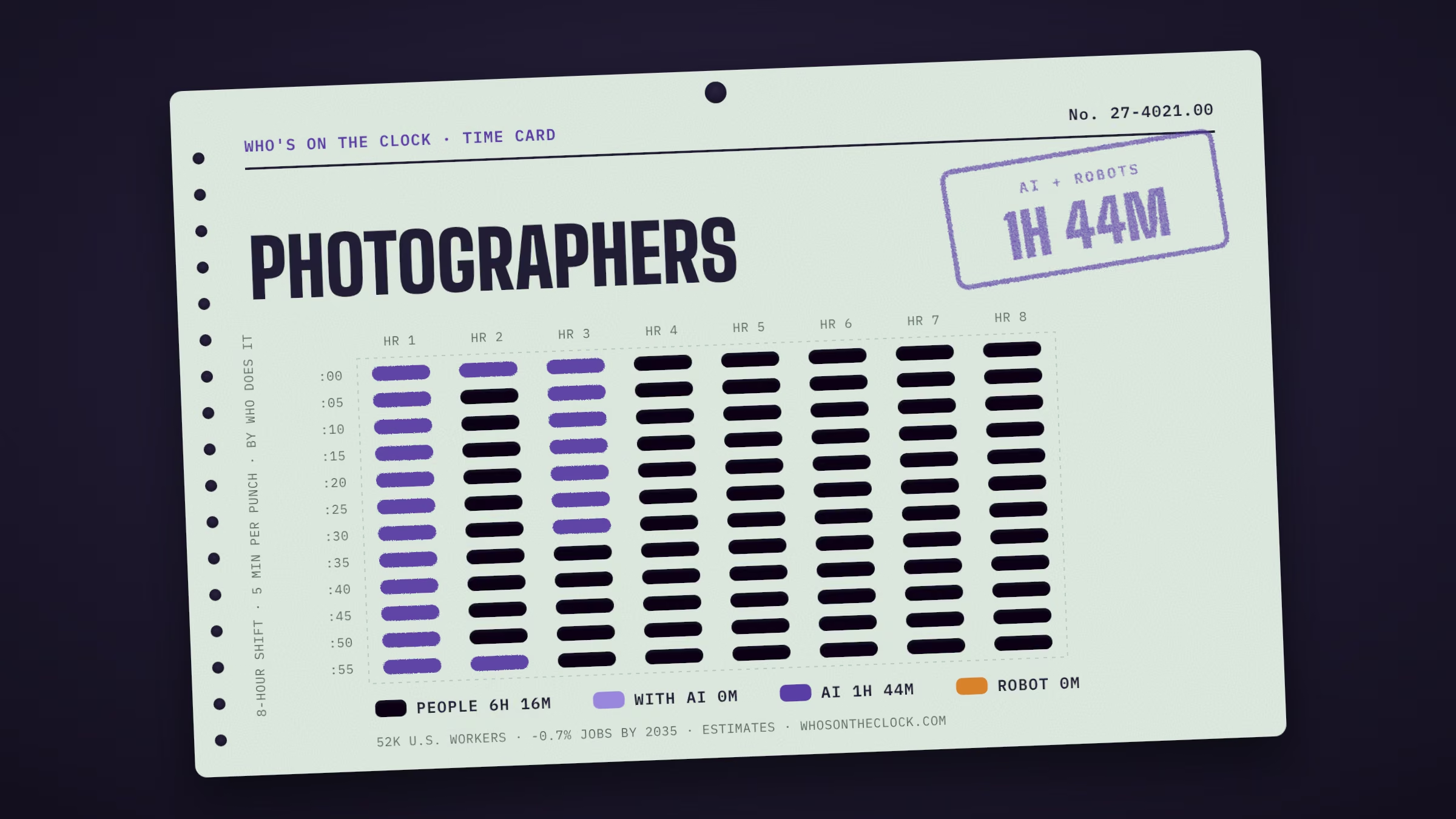
Unlikely, though parts of the work are changing. About 1h 44m of an 8-hour shift goes to tasks touched by AI working on its own. The other 6h 16m (78%) stays with people. Separately, BLS expects about 0.7% fewer of these jobs by 2035 (all jobs: +3.5%).

Time card for photographers showing a typical 8-hour shift: 6h 16m done by people, 1h 44m by AI.
Each mark is 5 minutes of a typical shift for photographers, colored by who does that task today. Estimates from O*NET tasks and Anthropic Economic Index data. How it's made

Home / Arts, media & sports / Photographers

Photograph people, landscapes, merchandise, or other subjects. May use lighting equipment to enhance a subject's appearance. May use editing software to produce finished images and prints. Includes commercial and industrial photographers, scientific photographers, and photojournalists.

Time card

Untick tasks you don't do, or set your own times.
MineTask, by time spentHumanWith AIAIRobot
Manipulate and enhance scanned or digital images to create desired effects, using computers and specialized software.1h 5m a shift · Observed in AI useTypical AI request: about 3h 4m alone, 11m with AI
Perform general office duties, such as scheduling appointments, keeping books, and ordering supplies.52m a shift · No AI or robot evidence found
Determine desired images and picture composition, selecting and adjusting subjects, equipment, and lighting to achieve desired effects.39m a shift · Observed in AI useTypical AI request: about 3h 49m alone, 58m with AI
Use traditional or digital cameras, along with a variety of equipment, such as tripods, filters, and flash attachments.39m a shift · No AI or robot evidence found
Take pictures of individuals, families, and small groups, either in studio or on location.39m a shift · Robots only in factory cells
Determine project goals, locations, and equipment needs by studying assignments and consulting with clients or advertising staff.32m a shift · No AI or robot evidence found
Enhance, retouch, and resize photographs and negatives, using airbrushing and other techniques.26m a shift · No AI or robot evidence found
Review sets of photographs to select the best work.26m a shift · No AI or robot evidence found
Adjust apertures, shutter speeds, and camera focus according to a combination of factors, such as lighting, field depth, subject motion, film type, and film speed.19m a shift · Robots only in factory cells
Transfer photographs to computers for editing, archiving, and electronic transmission.19m a shift · No AI or robot evidence found
Set up, mount, or install photographic equipment and cameras.19m a shift · No AI or robot evidence found
Select and assemble equipment and required background properties, according to subjects, materials, and conditions.19m a shift · No AI or robot evidence found
Create artificial light, using flashes and reflectors.13m a shift · No AI or robot evidence found
Estimate or measure light levels, distances, and numbers of exposures needed, using measuring devices and formulas.13m a shift · No AI or robot evidence found
Perform maintenance tasks necessary to keep equipment working properly.13m a shift · Robots only in factory cells
Test equipment prior to use to ensure that it is in good working order.6m a shift · Robots only in factory cells
Direct activities of workers setting up photographic equipment.6m a shift · No AI or robot evidence found
Mount, frame, laminate, or lacquer finished photographs.6m a shift · Robots only in factory cells
Write photograph captions.6m a shift · No AI or robot evidence found
Set up photographic exhibitions for the purpose of displaying and selling work.6m a shift · Robots only in factory cells
Employ a variety of specialized photographic materials and techniques, including infrared and ultraviolet films, macro photography, photogrammetry and sensitometry.6m a shift · Robots only in factory cells
License the use of photographs through stock photo agencies.6m a shift · No AI or robot evidence found
Engage in research to develop new photographic procedures and materials.time not estimated · No AI or robot evidence found
Send film to photofinishing laboratories for processing.time not estimated · Robots only in factory cells
Develop visual aids and charts for use in lectures or to present evidence in court.time not estimated · No AI or robot evidence found
Load and unload film.time not estimated · Robots only in factory cells
Produce computer-readable, digital images from film, using flatbed scanners and photofinishing laboratories.time not estimated · Robots only in factory cells
Develop and print exposed film, using chemicals, touch-up tools, and developing and printing equipment.time not estimated · Robots only in factory cells

On the floor

No company news tracked for this job yet. New stories are added as they happen.

Ask the clock

Will AI replace photographers?

Unlikely, though parts of the work are changing. About 1h 44m of an 8-hour shift goes to tasks touched by AI working on its own. The other 6h 16m (78%) stays with people. Separately, BLS expects about 0.7% fewer of these jobs by 2035 (all jobs: +3.5%).

What can AI already do for photographers?

AI shows up regularly in 2 of 28 tasks, about 1h 44m of a typical shift. The biggest ones:

  • Manipulate and enhance scanned or digital images to create desired effects, using computers and specialized software. (1h 5m a shift, AI mostly does it alone)
  • Determine desired images and picture composition, selecting and adjusting subjects, equipment, and lighting to achieve desired effects. (39m a shift, AI mostly does it alone)
Where do robots fit in?

Not in workplaces like this one, based on a 2026 review of robot deployments. 11 more tasks have only been done in factory setups built around the machine, so they stay with people here. For 6 physical tasks, no robot has shown it can do the work yet.

What still needs a person?

6h 16m of a typical shift, or 78%, goes to tasks with no AI or robot evidence yet. No AI usage or robot deployment has shown up for these so far. The biggest:

  • Perform general office duties, such as scheduling appointments, keeping books, and ordering supplies. (52m a shift)
  • Use traditional or digital cameras, along with a variety of equipment, such as tripods, filters, and flash attachments. (39m a shift)
  • Take pictures of individuals, families, and small groups, either in studio or on location. (39m a shift)
  • Determine project goals, locations, and equipment needs by studying assignments and consulting with clients or advertising staff. (32m a shift)
  • Enhance, retouch, and resize photographs and negatives, using airbrushing and other techniques. (26m a shift)
Why is that work hard to automate?

Much of it comes down to where and how the work happens. In-person, hands-on and high-stakes work is where AI and robots have made the least headway so far. In the official O*NET survey of people in this job:

  • 91% say dealing with the public is very or extremely important
  • 77% use their hands on tools, objects or controls more than half the time
  • 76% work at arm's length or closer to other people
How much time does AI save on these tasks?

For the 2 tasks in this job where AI shows up and timing data exists, a typical request takes about 3h 27m for a person alone and about 35m with AI. These are Claude's own estimates from real conversations in April and May 2026 (Anthropic Economic Index). They describe single requests, not whole workdays, and time saved on a task doesn't mean jobs are cut. The biggest gaps:

  • Manipulate and enhance scanned or digital images to create desired effects, using computers and specialized software (about 3h 4m alone, 11m with AI)
  • Determine desired images and picture composition, selecting and adjusting subjects, equipment, and lighting to achieve desired effects (about 3h 49m alone, 58m with AI)
Are employers still hiring photographers?

On Indeed, job postings in the Media & Communications sector are at 69% of their February 2020 level (all U.S. postings: 104%), up 6.8% from a year earlier, as of Oct 9, 2026. BLS separately expects about 11,000 openings a year in this job through 2035. Across all U.S. postings, 7.3% now mention AI skills. Sector postings cover more than this one job and move for many reasons besides AI.

How much do photographers make?

The median pay is about $44,660 a year ($21.47 an hour), 12% below the median for all U.S. jobs ($50,980). Most people in this job earn between $30,820 and $91,810 a year; that range covers the middle 80%. Pay figures are from BLS, May 2025, and vary a lot by state and employer. Pick a state to compare:

Is this job growing or shrinking?

BLS projects a decline of 0.7% from 2025 to 2035, compared with 3.5% growth for all jobs. That's about 144,000 jobs in 2035. Even so, it expects about 11,000 openings a year, mostly from people retiring or changing careers. These projections don't single out AI as a cause.

How many photographers are there in the U.S.?

About 52,000 people in the U.S., roughly 0.03% of all workers (BLS, May 2025). That makes it the 386th largest of the 796 jobs on this site. BLS expects about 144,000 in 2035.

What training do photographers need?

The most common requirement is some college: about 27% of people in the job said so in the official O*NET survey. O*NET rates the job at level 3 of 5 for preparation, which usually means: vocational school or associate's degree. Requirements vary by state and employer, especially for licensed work.

What should I learn to stay ahead of AI?

These come from the job's official skill ratings and from the tasks that AI and robots touch least today. Building them keeps you strong in the parts of the work that still need a person:

  • Skills that matter more here than in most jobs: Service Orientation, Speaking, Active Listening, Active Learning
  • Get strong at the parts of the job that stay with people (listed above), which take 6h 16m of a typical shift
  • Tools employers list: Adobe Photoshop, Adobe Acrobat, Adobe After Effects, Adobe Creative Cloud software, Adobe Illustrator
  • Learn to use AI well on the tasks where it already shows up in this job (listed above)
What new tasks are photographers taking on?

Yes. Occupational experts recently added these to the official task list, a sign of how the work itself is shifting. New tasks aren't rated for AI or robots yet:

  • Operate drones to capture aerial photographs and videos, following all regulatory guidelines.
What other jobs could photographers move into?

These use similar skills. Matches come from 109 official ratings of skills, knowledge and work activities, and each needs the same or less preparation unless the official list relates the jobs directly:

  • Graphic Designers (2h 19m touched, $63k median pay)
  • Art Directors (1h 29m touched, $115k median pay)
How solid are these numbers?

Each task carries its own evidence label. For this job: 2 observed in real AI use, 26 with no AI or robot evidence found. The minutes per task are estimates, not measured hours, and "no evidence" doesn't prove a task is safe.

Tools in demand

  • Adobe Photoshop
  • Adobe Acrobat
  • Adobe After Effects
  • Adobe Creative Cloud software
  • Adobe Illustrator
  • Adobe InDesign
  • Apple macOS
  • Facebook

Also called

Advertising Photographer, Aerial Photographer, Automotive Photographer, Biological Photographer, Biomedical Photographer, Commercial Photographer, Crime Scene Photographer, Digital Photographer, Event Photographer, Fashion Photographer, Finish Photographer, Food Photographer, Forensic Photographer, Freelance Photographer