Will AI replace private detectives and investigators?

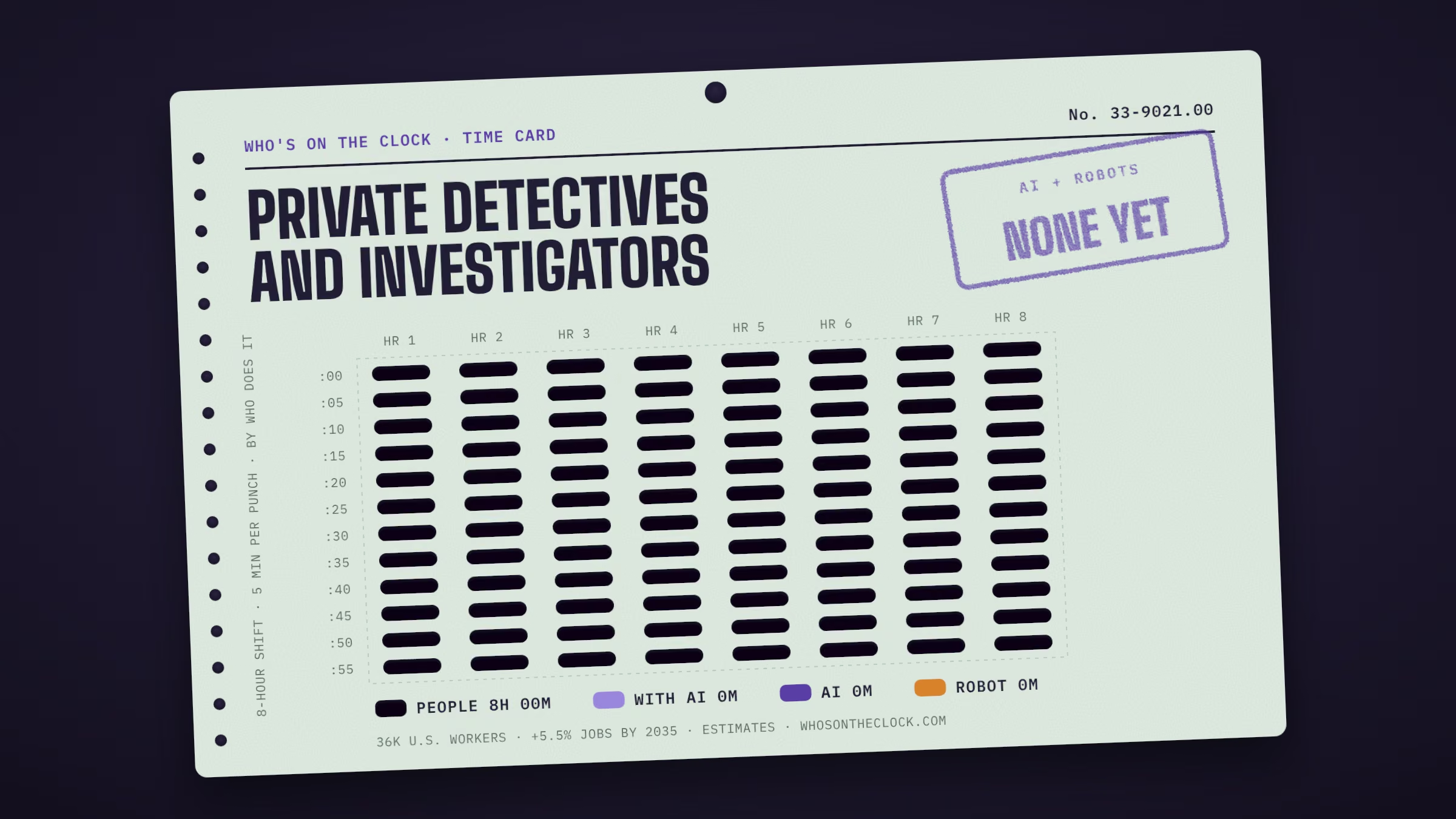
No AI use or robot deployment shows up yet for any of this job's tasks; the biggest part of the day, “Search computer databases, credit reports, public records”, is still entirely people's work. That's today's evidence, not a guarantee. BLS expects about 5.5% more of these jobs by 2035.

Time card for private detectives and investigators showing a typical 8-hour shift: 8h done by people.
Each mark is 5 minutes of a typical shift for private detectives and investigators, colored by who does that task today. Estimates from O*NET tasks and Anthropic Economic Index data. How it's made

Home / Protective services / Private Detectives and Investigators

Gather, analyze, compile, and report information regarding individuals or organizations to clients, or detect occurrences of unlawful acts or infractions of rules in private establishment.

Time card

Untick tasks you don't do, or set your own times.
MineTask, by time spentHumanWith AIAIRobot
Search computer databases, credit reports, public records, tax or legal filings, or other resources to locate persons or to compile information for investigations.1h 22m a shift · No AI or robot evidence found
Why this label?No AI use or robot deployment showed up for this task in our data. That isn't proof it's safe; it may just be rare in the data. How labels work
Write reports or case summaries to document investigations.1h 16m a shift · No AI or robot evidence found
Why this label?No AI use or robot deployment showed up for this task in our data. That isn't proof it's safe; it may just be rare in the data. How labels work
Observe and document activities of individuals to detect unlawful acts or to obtain evidence for cases, using binoculars and still or video cameras.1h 10m a shift · No AI or robot evidence found
Why this label?This is physical work, and no robot has been shown doing it yet. How labels work
Conduct personal background investigations, such as pre-employment checks, to obtain information about an individual's character, financial status, or personal history.47m a shift · No AI or robot evidence found
Why this label?No AI use or robot deployment showed up for this task in our data. That isn't proof it's safe; it may just be rare in the data. How labels work
Obtain and analyze information on suspects, crimes, or disturbances to solve cases, to identify criminal activity, or to gather information for court cases.47m a shift · No AI or robot evidence found
Why this label?No AI use or robot deployment showed up for this task in our data. That isn't proof it's safe; it may just be rare in the data. How labels work
Question persons to obtain evidence for cases of divorce, child custody, or missing persons or information about individuals' character or financial status.35m a shift · No AI or robot evidence found
Why this label?No AI use or robot deployment showed up for this task in our data. That isn't proof it's safe; it may just be rare in the data. How labels work
Confer with establishment officials, security departments, police, or postal officials to identify problems, provide information, or receive instructions.29m a shift · No AI or robot evidence found
Why this label?No AI use or robot deployment showed up for this task in our data. That isn't proof it's safe; it may just be rare in the data. How labels work
Conduct private investigations on a paid basis.23m a shift · No AI or robot evidence found
Why this label?This is physical work, and no robot has been shown doing it yet. How labels work
Expose fraudulent insurance claims or stolen funds.23m a shift · No AI or robot evidence found
Why this label?No AI use or robot deployment showed up for this task in our data. That isn't proof it's safe; it may just be rare in the data. How labels work
Investigate companies' financial standings, or locate funds stolen by embezzlers, using accounting skills.12m a shift · No AI or robot evidence found
Why this label?No AI use or robot deployment showed up for this task in our data. That isn't proof it's safe; it may just be rare in the data. How labels work
Perform undercover operations, such as evaluating the performance or honesty of employees by posing as customers or employees.12m a shift · No AI or robot evidence found
Why this label?No AI use or robot deployment showed up for this task in our data. That isn't proof it's safe; it may just be rare in the data. How labels work
Count cash and review transactions, sales checks, or register tapes to verify amounts or to identify shortages.12m a shift · Robots only in factory cells
Why this label?Robots have done this only in factory setups built around the machine, so it stays Human for private detectives and investigators. How labels work
Testify at hearings or court trials to present evidence.6m a shift · No AI or robot evidence found
Why this label?No AI use or robot deployment showed up for this task in our data. That isn't proof it's safe; it may just be rare in the data. How labels work
Alert appropriate personnel to suspects' locations.6m a shift · No AI or robot evidence found
Why this label?No AI use or robot deployment showed up for this task in our data. That isn't proof it's safe; it may just be rare in the data. How labels work

Clock history

  1. 0m touchedFirst published: O*NET 30.1, Anthropic Economic Index (2025 usage and September 2026 robot study), BLS May 2025

When new data changes this clock, the date, the new numbers and the reason are logged here. Company news alone never moves the clock.

On the floor

No company news tracked for this job yet. New stories are added as they happen.

Ask the clock

Will AI replace private detectives and investigators?

Not on current evidence. Less than 30 minutes of a typical shift goes to tasks that AI or robots are doing today. The other 8h (100%) stays with people. Separately, BLS expects about 5.5% more of these jobs by 2035 (all jobs: +3.5%).

What can AI already do for private detectives and investigators?

None of this job's tasks show regular AI use yet. That can mean the work is hands-on or in person, or simply that it rarely comes up in AI usage data.

Where do robots fit in?

Not in workplaces like this one, based on a 2026 review of robot deployments. 1 more task has only been done in factory setups built around the machine, so it stays with people here. For 2 physical tasks, no robot has shown it can do the work yet.

What still needs a person?

8h of a typical shift, or 100%, goes to tasks with no AI or robot evidence yet. No AI usage or robot deployment has shown up for these so far. The biggest:

  • Search computer databases, credit reports, public records, tax or legal filings, or other resources to locate persons or to compile information for investigations. (1h 22m a shift)
  • Write reports or case summaries to document investigations. (1h 16m a shift)
  • Observe and document activities of individuals to detect unlawful acts or to obtain evidence for cases, using binoculars and still or video cameras. (1h 10m a shift)
  • Conduct personal background investigations, such as pre-employment checks, to obtain information about an individual's character, financial status, or personal history. (47m a shift)
  • Obtain and analyze information on suspects, crimes, or disturbances to solve cases, to identify criminal activity, or to gather information for court cases. (47m a shift)
Why is that work hard to automate?

Much of it comes down to where and how the work happens. In-person, hands-on and high-stakes work is where AI and robots have made the least headway so far. In the official O*NET survey of people in this job:

  • 76% say dealing with the public is very or extremely important
  • 56% are in constant contact with other people
Are employers still hiring private detectives and investigators?

On Indeed, job postings in the Security & Public Safety sector are at 119% of their February 2020 level (all U.S. postings: 104%), up 4.4% from a year earlier, as of Oct 9, 2026. BLS separately expects about 3,200 openings a year in this job through 2035. Across all U.S. postings, 7.3% now mention AI skills. Sector postings cover more than this one job and move for many reasons besides AI.

How much do private detectives and investigators make?

The median pay is about $51,220 a year ($24.62 an hour), about the same as the median for all U.S. jobs ($50,980). Most people in this job earn between $36,740 and $97,630 a year; that range covers the middle 80%. Pay figures are from BLS, May 2025, and vary a lot by state and employer. Pick a state to compare:

Is this job growing or shrinking?

BLS projects growth of 5.5% from 2025 to 2035, compared with 3.5% growth for all jobs. That's about 42,000 jobs in 2035. It expects about 3,200 openings a year, mostly from people retiring or changing careers. These projections don't single out AI as a cause.

How many private detectives and investigators are there in the U.S.?

About 36,000 people in the U.S., roughly 0.02% of all workers (BLS, May 2025). That makes it the 444th largest of the 796 jobs on this site. BLS expects about 42,000 in 2035.

What training do private detectives and investigators need?

The most common requirement is a bachelor's degree: about 38% of people in the job said so in the official O*NET survey. O*NET rates the job at level 3 of 5 for preparation, which usually means: vocational school or associate's degree. Requirements vary by state and employer, especially for licensed work.

What should I learn to stay ahead of AI?

These come from the job's official skill ratings and from the tasks that AI and robots touch least today. Building them keeps you strong in the parts of the work that still need a person:

  • Skills that matter more here than in most jobs: Active Listening, Complex Problem Solving, Speaking, Critical Thinking
  • Get strong at the parts of the job that stay with people (listed above), which take 8h of a typical shift
  • Tools employers list: Microsoft Word, Microsoft Office software, Microsoft Excel, Facebook, Microsoft Access
What new tasks are private detectives and investigators taking on?

Yes. Occupational experts recently added these to the official task list, a sign of how the work itself is shifting. New tasks aren't rated for AI or robots yet:

  • Serve documents to parties named in legal proceedings.
  • Use advanced technology, such as drones, GPS trackers, and surveillance cameras, to facilitate investigations.
What other jobs could private detectives and investigators move into?

These use similar skills. Matches come from 109 official ratings of skills, knowledge and work activities, and each needs the same or less preparation unless the official list relates the jobs directly:

  • Detectives and Criminal Investigators (1h 3m touched, $94k median pay)
  • Fraud Examiners, Investigators and Analysts (1h 9m touched, $81k median pay)
  • Intelligence Analysts (49m touched, $94k median pay)
  • Police and Sheriff's Patrol Officers (1h 47m touched, $76k median pay)
  • Retail Loss Prevention Specialists (1h 29m touched, $43k median pay)
How solid are these numbers?

Each task carries its own evidence label. For this job: 14 with no AI or robot evidence found. The minutes per task are estimates, not measured hours, and "no evidence" doesn't prove a task is safe.

Tools in demand

  • Facebook
  • Microsoft Access

Plus everyday office tools: Microsoft Word, Microsoft Office software, Microsoft Excel, Microsoft Outlook, Microsoft PowerPoint, Microsoft Windows.

Also called

AML Investigator (Anti Money Laundering Investigator), Alarm Investigator, Asset Protection Detective, BSA Investigator (Bank Secrecy Act Investigator), Background Investigator, Bonding Agent, Case Investigator, Cash Shortage Investigator, Certified Legal Investigator, Contract Investigator, Detective, Detective Investigator, District Agent, Employee Relations Investigator